
When pop growth crawls in Stellaris 4.5, the fastest fix is to move pops off your capital into your colonies, keep each planet somewhere near half of its Planet Capacity, where growth peaks, and add a staffed Medical Center and Clone Vats on every planet.
Growth is usually slow for one of three reasons: your colonies are still tiny, Growth Required Scaling takes a bigger cut as your empire grows, or the planet is close to full. Hover over a pop group’s growth on the planet view and you will see which one it is, since the tooltip lists its Base Growth, any Bonus Growth and the Country Growth Scale.
To resettle pops by hand, set the Resettlement policy to Allowed and use the Resettle button on the planet’s Economy tab. It costs 100 Energy and 10 Unity for every 100 pops you move, while automatic migration is free but slow.
Behind all of this sits a growth curve. The formula, as tested by players, peaks when a species fills about half of the Planet Capacity, and with default settings it stops at a ceiling of 5 pops a month before your bonuses are added.
Everything here is for the PC version, patch 4.5.4 ‘Cygnus’, with the DLC named next to the bigger sources that need one. Most values below were read from the 4.5.3 game files and Paradox’s patch notes, as the 4.5.4 hotfix of 11 November 2026 only brought fixes, and only the growth curve and the empire-size scaling stay hidden in the engine, so those parts rest on player tests.
Contents
- How growth works in 4.5
- Where to see your growth
- Pop growth sources ranked
- Pop assembly
- Why your pop growth is slow
- How to resettle pops
- Growth plan for each stage
- Advice from older versions
- Willpower (4.6)
- More about pops
- Conclusion
How growth works in 4.5
A planet can gain or lose pops in three ways each month, which the planet view lists as Estimated Growth, Assembly and Decline Next Month. Organic species that can reproduce grow, while robots are assembled out of jobs like Roboticists, and assembly has no base value at all. Infertile organic species, such as Vat-Grown species or Clone Soldiers, only get flat growth from buildings.
Normal growth starts with Base Growth. Each species on a planet gets its own Base Growth from its pop count there and from the planet’s capacity. Tested by players, it works out to about pops x (capacity – pops) / (400 x capacity) a month. It never drops below 0.1 a month, it treats a tiny group as at least 10 pops, and it never rises above the Logistic Growth Ceiling, a galaxy setting that is 5 by default.
The tooltip writes Base Growth as 1 plus or minus a part “from Pops”. A line like “1 (+1.39 from Pops)” means a Base Growth of 2.39 pops a month, with the 1 already counted inside that number.
The curve has a clear shape. Growth peaks when the pops fill about half of the Planet Capacity, and a planet needs about 8,000 capacity to reach the default ceiling of 5 at all. On such a planet, growth will be just under 2 a month at 10% full, 5 at half full and just under 2 again at 90% full, while a bigger planet with 12,000 capacity holds the ceiling of 5 all the way from about 2,500 to about 9,500 pops.
Small colonies live at the bottom of that curve. A colony with 4,000 to 8,000 capacity grows about 0.25 a month at 100 pops, about 0.7 at 300 and about 2 at 1,000. Since the peak moves with each planet’s capacity, there is no single best pop count.
| Rule | Value |
|---|---|
| Three channels | Organics grow, robots are assembled (base 0), pops decline |
| All species grow together | All at the same time, calculated per species since 4.1 |
| Base Growth curve | About pops x (capacity – pops) / (400 x capacity) a month |
| Floor | Never below 0.1 a month, tiny groups count as 10 pops |
| Ceiling (caps Base Growth) | Logistic Growth Ceiling, default 5 (1 to 10, step 0.5) |
| Planet Capacity (Colony Capacity) | Spare housing + empty district space + pops, max 50,000 |
| Empty district space | 400 each, 600 on Gaia, Hive, Ringworld, Ecumenopolis |
| Habitat, Machine World, Tomb | 300 per empty district |
| Peak | Pops at half of capacity, reaching 5 needs about 8,000 |
| Pop Growth Speed | All bonuses and penalties add up, then multiply Base Growth |
| Flat bonus growth (Clone Vats) | Own multiplier, shared, not boosted by Pop Growth Speed |
| Growth Required Scaling | Default 0.25 (0 to 1), shown as Country Growth Scale |
| Country Growth Scale | Multiplies all growth and assembly, own empire only |
| Fractions | 1.4 means one pop plus a 40% chance of a second |
| Overcrowding | Growth stops when pops need 15% more housing, decline at 25% |
| Habitability | Below 100% cuts Pop Growth Speed, down to -50% at 0% |
| Multi-species | Each on its own curve, Xeno-Compatibility pools them |
| New colony | 100 pops, about 0.25 a month, capital upgrade at 1,000 |
Planet Capacity
Planet Capacity is the Databank’s name for the room a planet has for pops, and the planet screen labels the same number Colony Capacity. It adds up your spare housing, some space for each empty district and the pops already living there, where an empty district counts for 400 on most planets, 600 on a Gaia World, Hive World, Ring Segment or Ecumenopolis, and 300 on a Habitat, Machine World or Tomb World. No planet can go past 50,000.
More housing and cleared blockers raise it. Building a district swaps its free space for the district’s housing, and the space an empty district adds changes with the planet’s habitability.
Queued districts are a small trap. A district seems to stop counting as empty space as soon as you queue it, while its housing only arrives once it is finished. On a planet that is still growing, I would queue districts one or two at a time.
Galaxy settings
The Logistic Growth Ceiling (default 5, from 1 to 10 in steps of 0.5) caps Base Growth before Pop Growth Speed, the percentage bonus on growth, is applied. A planet with one species should top out at 5 pops a month, +30% Pop Growth Speed will lift that to 6.5, and flat Monthly Organic Pop Growth, a fixed number of pops a month from buildings like Clone Vats, is added after that.
4.0 changed this setting’s default, and 4.0.4 reset it for everyone. If your growth looks far too low on an old saved galaxy setup, check this slider first.
Growth Required Scaling (default 0.25, from 0 to 1 in steps of 0.05) shrinks growth as the total pop count of your empire rises, and the growth tooltip shows it as Country Growth Scale. It seems to multiply the final number, which means it hits Base Growth, flat Monthly Organic Pop Growth from Clone Vats or Spawning Drones, and robot assembly alike. A Country Growth Scale of -20% will turn 6.5 pops a month into 5.2.
The cut is small early on and grows with your empire, and the only number worth trusting is the percentage in your own tooltip. Setting it to 0 at galaxy setup turns it off. Patch 4.5 also fixed a bug that cut the setting to one digit, which had made the default of 0.25 work like 0.2.
How bonuses stack
All Pop Growth Speed bonuses and penalties appear to be added together first, and the total then multiplies Base Growth. Three +10% bonuses make +30%, which is a little less than the +33.1% you would get if they multiplied each other.
Flat Monthly Organic Pop Growth from Clone Vats, Spawning Drones or the Genomic Research Facility uses its own Monthly Organic Pop Growth Multiplier instead, and Pop Growth Speed does nothing for it. The planet shares that flat growth among the species living there that can use it.
Fractions work as chances. If a species should get 1.4 pops this month, it will get one pop for sure and has a 40% chance of a second.
An Ecumenopolis gives +15% Mechanical Pop Assembly Speed and +15% Monthly Organic Pop Growth Multiplier, and nothing for Pop Growth Speed.
Planets with several species
Every fertile species on a planet grows at the same time each month, and since 4.1 the game works this out per species. Each follows its own curve, which means a planet with three small species groups will usually sit low on all three curves at once.
The Xeno-Compatibility ascension perk (MegaCorp, Xenophile empires only) changes that. It gives +20% Pop Growth Speed on every colony with at least 2 species and pools all of them into one population for the curve, then shares the growth out by size. That helps most on planets with several small species groups, but it will not lift a planet past the ceiling.
Prioritized Species is a different tool. You set it in the planet view to steer which species grows there, it costs part of the current growth progress, and it does not add any growth. You cannot set it while the Population Controls policy is Prohibited.
Where to see your growth
Open a planet and hover over a pop group’s growth. The tooltip lists Base Growth with a part “from Pops”, “from Low Pops” or “from High Pops”, then Bonus Growth for flat sources, Country Growth Scale and one line per species.
Beware that the pop group tooltip covers only that one pop group. This is where the classic “+0.66 growth” confusion starts, because the species line and the planet total are higher. Read the species line or the Monthly Pop Summary instead.
The Monthly Pop Summary arrived in 4.1, and 4.5.3 added unusual pop sources to it. Mind that the planet summary counts flat organic growth from Clone Vats and similar buildings as growth, while its assembly figure covers robots only.
For job-based bonuses, hold Alt over the job. Since 4.5.3, that tooltip gives the job’s value per 100 workforce, the easiest way to see what your Medical Workers or Roboticists really add.
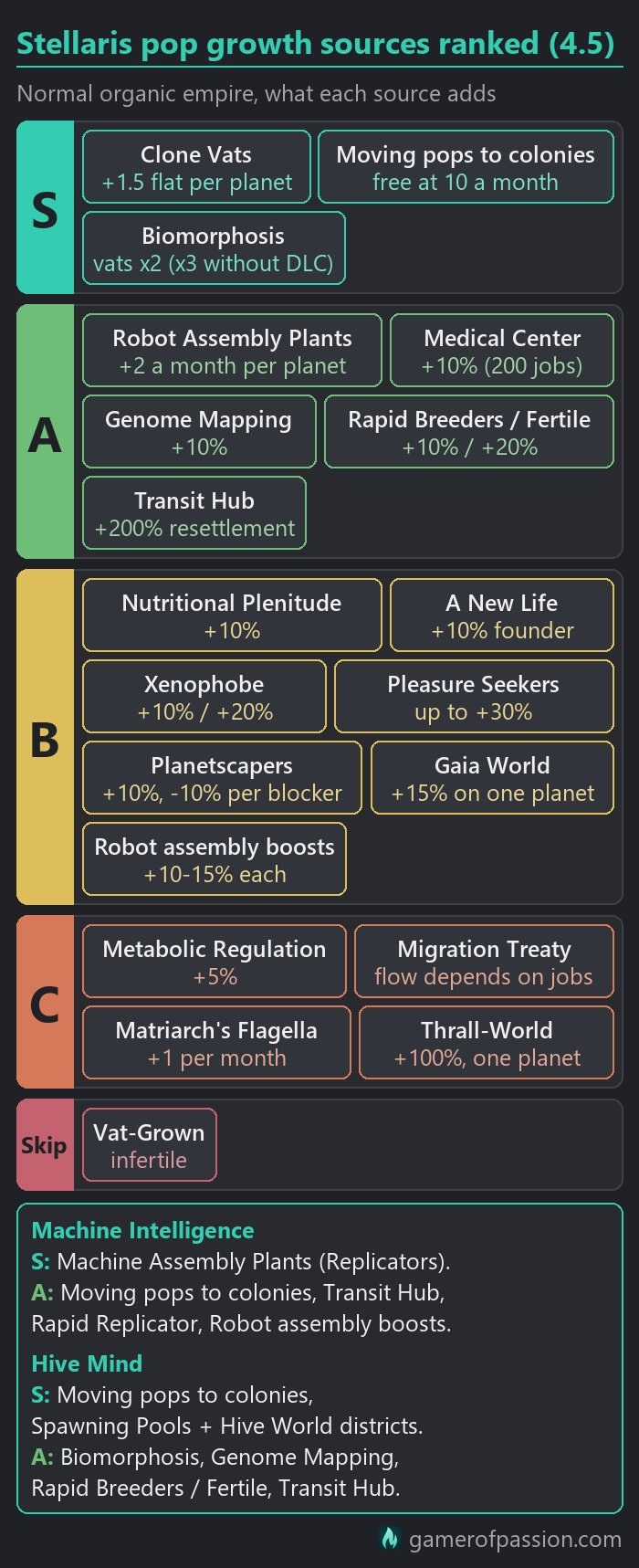
Pop growth sources ranked
This ranking is for a regular empire with organic pops. Machine Intelligences and Hive Minds get their own short lists further down.
| Source | Tier | Effect | Who can get it |
|---|---|---|---|
| Clone Vats | S | +1.5 a month per vat, boosted to 3 (4.5 without BioGenesis) | Tech Cloning, 1 per planet, 4 with Cloning Traditions |
| Moving pops to colonies (resettle or auto-migrate) | S | 100 Energy + 10 Unity per 100 pops, or free at 10 a month | Resettlement set to Allowed, or free auto-migration |
| Biomorphosis (Cloning or Genetic Traditions) | S | Vats 3 (4.5 without BioGenesis), Facility +10% or +1 and +1 | Biomorphosis perk, Cloning path and Facility (BioGenesis) |
| Robot Assembly Plants / Complex | A | +2 assembly per 100 Roboticists, +4 with the Complex | Regular empires, 1 per planet, 2 alloys per 100 jobs |
| Medical Center (Medical Workers) | A | +10% Pop Growth Speed and +10% multiplier, 200 jobs | Start tech Medical Care, regular non-machine empires |
| Genome Mapping | A | +10% Pop Growth Speed | Society tier 1 research |
| Rapid Breeders / Fertile | A | +10% / +20% Pop Growth Speed on the species | Species design, Fertile with Biomorphosis (BioGenesis) |
| Transit Hub | A | +200% Automatic Resettlement Chance, 30 pops a month | Planets in its system |
| Nutritional Plenitude (edict) | B | +10% Pop Growth Speed, +25% organic pop upkeep | Gene Crops technology, 10 Unity plus 10 upkeep |
| Expansion: A New Life | B | +10% Pop Growth Speed, founder species only | Expansion tradition |
| Xenophobe / Fanatic Xenophobe | B | +10% / +20% Pop Growth (or Assembly) Speed | Ethic choice, founder species |
| Pleasure Seekers (Hedonists) | B | +5% to +30% Pop Growth (or Assembly) Speed | Decadent Lifestyle, free housing and free amenities |
| Planetscapers / Cultivation Drones | B | +10% founder, -10% per natural blocker on a planet | Civic choice (Cosmic Storms) |
| Gaia World | B | +15% Pop Growth Speed, +50% migration destination | Own or terraform a Gaia World |
| Robot assembly boosts | B | +10% to +15% each (Mass-Produced +15%) | Robot users |
| Domestication: Metabolic Regulation | C | +5% Pop Growth Speed | Domestication tradition (The Grand Archive) |
| Migration Treaty | C | Net flow depends on the partner’s open jobs | Free unemployed pops and Civilians, 0.25 Influence upkeep |
| Matriarch’s Flagella | C | +1 Monthly Organic Pop Growth on its planet, in total | Tiyanki Matriarch trophy |
| Thrall-World | C | +100% Pop Growth Speed on that planet | Fully Enslaved pops, no free pop growth, most buildings off |
| Vat-Grown | Skip | Makes the species infertile, +25% to flat growth | Biomorphosis trait (BioGenesis) |
| Xeno-Compatibility | Not ranked | +20% at 2+ species, pools their growth | Xenophile only (MegaCorp) |
S tier holds the three levers that move your numbers the most. Clone Vats add flat pops every month, which matters most on new colonies where percentages do very little. Moving pops into new colonies lifts them off the slow bottom of the curve, and Biomorphosis doubles what every Clone Vats makes. With BioGenesis, the Cloning path does that and also lets you build more vats, while without the DLC, Stem Cell Stimulation even triples their output.
A tier is the groundwork. Robot Assembly Plants add +2 assembly a month per planet however close it is to its Planet Capacity, a staffed Medical Center and Genome Mapping give +10% each, and Rapid Breeders (+10%) or the Biomorphosis trait Fertile (+20%) speed up a whole species. Our trait tier list has the other growth traits. Transit Hubs triple the free migration out of planets in their system.
B tier is made of smaller or narrower bonuses. Nutritional Plenitude gives +10% but raises organic pop upkeep, while A New Life from the Expansion tree, Xenophobe (+10%, or +20% for Fanatic Xenophobe), Inward Perfection and the Lost Colony origin only help your founder species, where the game lists them as Pop Growth (or Assembly) Speed.
Pleasure Seekers can reach +30% through Hedonists on the Decadent Lifestyle, but only while the planet has free housing and amenities and your empire has no Consumer Goods deficit, as our civics tier list notes. Planetscapers, Cultivation Drones and the other planet-shaping civics (Cosmic Storms) give your founder species +10%, but every natural blocker left on a planet costs 10% growth and 10% job output there and adds 15% pop upkeep. A Gaia World gives +15%, and the robot assembly boosts add 10% to 15% each.
C tier is situational. Metabolic Regulation from Domestication only adds a little bit (+5%), and a Migration Treaty can drain your own pops just as easily as it brings new ones. The Matriarch’s Flagella gives +1 a month on one planet, and a Thrall-World gets +100% Pop Growth Speed, but it needs a Fully Enslaved pop group on a nearly undeveloped planet, stops free pops from growing there and disables most of the planet’s buildings.
Vat-Grown is a skip for regular empires, for reasons covered in the questions at the end.
Most of the tier letters are my reading of the values in the game files. Xeno-Compatibility gets no letter, as it only matters for multi-species Xenophile empires.
Encourage Colony Growth
Encourage Colony Growth is the planet decision most people search for as “Encourage Planetary Growth”. Its entry is still in the 4.5 game files (1,000 Food for +25% Pop Growth Speed on one planet for 10 years), but it is switched off there, so it does not show up among your planet decisions and you cannot take it.
Its opposite, Discourage Colony Growth (-75% Pop Growth Speed), is still in the game. The planet boosts you can still build are a staffed Medical Center and Clone Vats, both covered below.
Clone Vats
Clone Vats come with the Cloning technology (society tier 2, after Genome Mapping) and add 1.5 Monthly Organic Pop Growth to their planet for 2 energy upkeep. They are one of the few sources that help a fresh colony as much as your capital. The species on the planet that can use the vats share their output, and since 4.5.2 pops that cannot use them no longer dilute it.
What Biomorphosis does for your vats depends on BioGenesis. With the DLC, every vat makes 3 once you adopt Cloning Traditions, the tree of the Cloning path, and you can build one more vat for every capital upgrade tier once those traditions are finished, which makes 4 per planet at most. Without BioGenesis, Biomorphosis and Gene Tailoring open Genetic Traditions instead, which raise every vat to 3, and Stem Cell Stimulation from that tree takes it to 4.5, but you stay at one vat per planet. In both cases the upkeep rises along with the bonus.
With BioGenesis, Biomorphosis also unlocks the Genomic Research Facility, one per planet. It gives +10% Pop Growth Speed there from the first Purity choice, or +1 Monthly Organic Pop Growth from the first Cloning choice and +1 more from Genomic Growth. Its 200 Genomic Researchers are simply Medical Workers with another name in 4.5. Our Biomorphosis guide goes through each path, and our DLC tier list shows what else BioGenesis brings.
Medical Workers
Every 100 Medical Workers give +5% Pop Growth Speed and +5% Monthly Organic Pop Growth Multiplier on their planet. The Medical Center needs Medical Care, a technology you start the game with, and holds 200 Medical Workers for 2 energy upkeep, which makes a fully staffed one worth +10% and +10%.
Gene Clinics and Cyto-Revitalization Centers keep the same 200 jobs. Upgrading will raise the upkeep but not the growth. Since the bonus sits on the workers, empty Medical Worker jobs will probably give you nothing.
Machine Intelligence
Machine Intelligences assemble their machine pops. The authority gives a flat +1 Monthly Mechanical Pop Assembly on every planet, and every 100 Replicators add +1 more. Machine Assembly Plants hold 100 Replicators, the Complex holds 200, and machine capitals add another 100 to 400.
For a machine empire, Machine Assembly Plants are S tier, while moving pops, Transit Hubs, Rapid Replicator (+20% Mechanical Pop Assembly Speed) and the robot assembly boosts are A. Clone Vats and Migration Treaties do nothing for you, but Gestalts can resettle without the Resettlement policy.
Hive Minds
Hive Minds grow like organic empires, with +25% Pop Growth Speed from the authority, plus flat growth from Spawning Drones: +2 Monthly Organic Pop Growth per 100, shared by the hive species. Spawning Pools hold 100 of them (one per planet, not for Wilderness empires), each spawning district on a Hive World adds 50 more with the Hive Worlds perk, and the Genomic Research Facility gives hives 200 with BioGenesis.
For a hive, moving pops and the Spawning Pools are S tier, and Biomorphosis, Genome Mapping, Rapid Breeders or Fertile and Transit Hubs are A. Robot Assembly Plants and Medical Centers are not open to you, and a Synaptic Lathe world blocks both growth and assembly.
Pop assembly
Robots are assembled and never grown, which means every new robot needs a producer behind it, in most empires Roboticist jobs.
| Producer | Output | Limit |
|---|---|---|
| Robot Assembly Plants (robots) | +2 Monthly Mechanical Pop Assembly per 100 Roboticists | 1 per planet, 200 Roboticists as a Complex |
| Machine Intelligence | +1 per planet (authority), +1 per 100 Replicators | 1 Machine Assembly Plant per planet |
| Clone Vats | +1.5 a month, boosted to 3 (4.5 without BioGenesis), shared | 1 per planet, 4 with Cloning Traditions finished |
| Genomic Research Facility | +1 (Cloning) and +1 (Genomic Growth), or +10% (Purity) | 1 per planet (BioGenesis) |
| Ancient Clone Vats (Clone Army) | 2 to 20 Monthly Organic Pop Growth per vat | 20 per vat, more when Clone Soldiers are missing |
| Spawning Pools (Hive) | +2 Monthly Organic Pop Growth per 100 Spawning Drones | Pools 1 per planet, Hive World districts +50 jobs each |
| Chamber of Elevation (Necrophage) | +0.5 per 100 Necrophytes, for non-necrophage species | 1 per planet, necrophages do not grow on that planet |
| Augmentor Drone (cyborgs) | +3 Monthly Organic Pop Growth per 100, +10% / +10% | Machine Age cyborgs only |
Robot Assembly Plants hold 100 Roboticists, and every 100 Roboticists give +2 Monthly Mechanical Pop Assembly for 2 alloys upkeep, while the plant itself costs 5 energy upkeep. You can build one per planet, and the Robot Assembly Complex upgrade doubles that to 200 jobs and +4 a month.
Make sure your robot species has Population Controls set to No in its species rights, or it will not be assembled at all. That is the first thing to check if your plants are staffed and still no robots appear.
Assembly ignores the growth curve and Planet Capacity, and if you use robots, you are going to want a plant on every colony, new ones included. It still stops at the same overcrowding line as growth, and Country Growth Scale shrinks it like every other channel. An Energy Shortage will also lower pop assembly, as our energy credits guide explains.
Robot assembly has its own boosts. Mass-Produced gives +15%, Micro-Replicators and Self-Assembling Components +10% each, and the Versatility finisher another +10%. Additionally, Liquid Metal Joints adds +1 assembly per 100 Roboticists.
The Clone Army origin works differently. Its Clone Soldiers are infertile and grow only through Ancient Clone Vats, which give up to 20 Monthly Organic Pop Growth per vat. The further your clones fall below what the vats can sustain, the more each vat adds, down to 2 at the low end, and too few vats will force your clones into decline. Our origins tier list covers the rest of the origin.
Necrophage species grow at half speed (-50% Pop Growth Speed and multiplier), even though one in-game tooltip still says -75%. They do not grow at all on a planet with a Chamber of Elevation, whose Necrophytes boost the other species there a little bit instead.
Why your pop growth is slow
Slow growth nearly always has one of a handful of causes, and the growth tooltip will usually tell you which one it is.
| Cause | What you see | Fix |
|---|---|---|
| Tiny colony | “Base Growth: 1 (-0.75 from Low Pops)” | Move pops in: Resettle, or unemploy capital pops |
| Big empire (Growth Required Scaling) | “Country Growth Scale: -X%” in the tooltip | Growing pops in subjects, or set it to 0 at galaxy setup |
| Planet too full for its capacity | “(-X from High Pops)”, Planet Capacity near the pop count | More housing, clear blockers, move pops to emptier planets |
| Reading one pop group | Growth tooltip is per pop group | Read the species line or the Monthly Pop Summary |
| Old galaxy settings | Logistic Growth Ceiling and Growth Required Scaling | Press default (5 and 0.25) |
| Low habitability, down to -50% at 0% | “Planet Habitability” modifier | Resettle onto good worlds, terraform, habitability traits |
| Overcrowding, 15% short of housing | “Overcrowding is preventing further Pop growth” | More housing |
| Food or mineral shortage (-20% to -75% by stage) | Deficit situation in the top bar | Clear the deficit |
| Population Controls (0 growth) | “Active Population Controls are preventing Pop Growth” | Set the species right to No, remove the planet decision |
| Discourage Colony Growth (-75%) | “Growth Discouraged” | Remove the planet decision |
| No species can grow (only robots or infertile) | “No Pop Growth” (no species growing on the colony) | Assembly or flat growth buildings |
| Planet state or trait penalty | Modifier list: Occupation -50%, Planet Devastation -100% | Traits: Lithoid -25%, Necrophage -50%, Slow Breeders -10% |
| Stability, amenities, happiness, crime, open jobs | They do not change Pop Growth Speed | Not a cause: housing and habitability do |
Tiny colonies
A colony is finished when its colonists reach 100 pops, and from then on it grows about 0.25 a month by itself. At that rate it would need over 20 years to reach 200, which is why new colonies fill through automatic migration and resettlement, ever since 4.0 removed the minimum growth that small colonies used to get.
The tooltip will show something like “Base Growth: 1 (-0.75 from Low Pops)”, which works out to 0.25. That -0.75 is simply the low end of the curve, and there is no separate penalty for new colonies.
The fix is to move pops in, and about 1,000 is a good target. It lifts the colony’s own growth to about 2 a month and unlocks its first capital upgrade, which needs 1,000 sapient pops, as our habitats guide also points out. A few hundred pops only get it to about 0.7, while a planet with a lot of capacity can still use more than 1,000.
Growth Required Scaling
A big negative Country Growth Scale means the size of your empire is the problem. Mid-game, the main way around it is to grow pops in subjects, which seem to grow under their own, smaller penalty because the scaling only counts your own empire’s pops.
Full planets
A planet close to its Planet Capacity will show a negative part “from High Pops” in its Base Growth. More housing, cleared blockers and districts queued one or two at a time will help, and so will moving pops to emptier planets.
Overcrowding is a separate wall, and it is measured in housing. Once the pops need 15% more housing than the planet has (and at least 5 pops are short), growth and robot assembly stop, and at 25% more the planet starts losing pops. Planet Capacity and the Logistic Growth Ceiling play no part in it.
Other causes
Low habitability is another common one. Any habitability below 100% lowers Pop Growth Speed, down to -50% at 0%, and the same penalty raises amenity use and pop upkeep up to double and cuts workforce by up to half. Our terraforming guide shows how to raise it.
Population Controls can stop growth outright, and three things share that name. The species right set to Yes stops a species from reproducing (robots need it set to No to be assembled), the policy is either Allowed or Prohibited, and the Population Controls planet decision stops all growth on its planet.
Things that do not matter
Stability, amenities, happiness, crime and open jobs do not change growth. Low Stability gives pops a +25% chance to leave a planet and makes it -50% as a destination, High Stability does the reverse, and unemployment only adds +5% to the chance that pops migrate. The one exception is the Hedonist bonus from Pleasure Seekers, which needs free housing and free amenities to work.
How to resettle pops
Resettling is the fastest way to fill a new colony, and it takes three steps:
- Set the Resettlement policy to Allowed. Gestalts and empires with the Cosmogenesis perk do not need it.
- Open the planet you want to move pops from, go to its Economy tab and click Resettle. Shift-click moves a whole pop group, and Ctrl-click moves 500 pops.
- Pick the target planet and confirm. It costs 100 Energy and 10 Unity for every 100 pops you move, and the Resettle window shows you the price before you confirm.
Unemployed slaves and pops that are being purged cost only 50 Energy and no Unity. Moving the last pop off a colony costs 50 Influence and abandons that colony.
Species traits change the price. Migratory pops cost 35% less to resettle and Sedentary pops 35% more, while Rooted pops cost +200% and never move to another planet by themselves. Appropriation from the Adaptability tree cuts the cost by 50%, and the Corvée System civic, OTA Updates and Subsumed Will remove the Unity part.
Resettlement: Prohibited stops you from moving free pops by hand but gives +100% Automatic Resettlement Chance, the modifier that decides how many pops leave a planet by automatic migration.
Automatic migration
Automatic migration is free. Each colony can send about 10 pops a month to your other colonies, and that limit counts per source planet. The pops that move are unemployed pops and Civilians, the stratum newly grown free pops join first (Maintenance Drones in a Gestalt), while slaves and non-sapient robots only migrate from a system with a Transit Hub or from a planet with a Slave Processing Facility.
The source colony has to be older than 60 months, which your capital is exempt from, and hold more than 100 sapient pops, while the target needs open jobs, free housing and at least 20% habitability.
Automatic Resettlement Chance raises that rate:
- Resettlement Prohibited gives +100%, for about 20 pops a month.
- A Transit Hub gives +200% to the planets in its system, for about 30.
- The Greater Than Ourselves edict from the Galactic Community gives +200% for 20 Unity.
- Hyperlane Breach Points and Hyperspace Slipstreams give +25% each, and so does Appropriation.
- Overcrowding adds +50%, and the Population Controls planet decision +100%.
Where the pops go depends on Automatic Resettlement Destination Chance. Gaia, Hive and Machine Worlds, Ring Segments and Ecumenopolises get +50%, High Stability +50% (Low Stability -50%), Free Housing +25% and a Newly Founded Colony +25%, which makes a ring world a natural home for a lot of pops.
The free way to push pops out of your capital is to remove a job building there. Its workers become unemployed and start moving to colonies with open jobs.
| Rule | Value |
|---|---|
| Resettlement policy | Allowed, Gestalts and the Cosmogenesis perk do not need it |
| Resettle cost | 100 Energy and 10 Unity per 100 pops |
| Shift-click / Ctrl-click | Whole group / 500 pops |
| Unemployed slaves, purged pops | 50 Energy, no Unity |
| Last pop off a colony | 50 Influence, the colony is abandoned |
| Migratory / Sedentary / Rooted / Appropriation | -35% / +35% / +200% / -50% resettle cost |
| Corvée System, OTA Updates, Subsumed Will | Drop the Unity cost |
| Who auto-migrates | Unemployed pops and Civilians, Maintenance Drones |
| Slaves, non-sapient robots | Only with a Transit Hub or a Slave Processing Facility |
| Source colony | Older than 60 months, more than 100 sapient pops |
| Target colony | Open jobs, free housing, at least 20% habitability |
| Rate | About 10 pops a month per source colony |
| Resettlement Prohibited | +100% Automatic Resettlement Chance (20 a month) |
| Transit Hub | +200% for planets in its system |
| Greater Than Ourselves edict | +200%, 20 Unity |
| Breach Points, Slipstreams, Appropriation / overcrowding | +25% each / +50% |
| Migration Treaty | Free unemployed pops, Civilians, both ways, 0.25 Influence |
| Stop pops leaving | Migration Controls on the species, or Rooted pops |
Migration Treaties
A Migration Treaty costs 0.25 Influence upkeep per treaty, which our influence guide also lists, and it is free under the Free Migration federation law. Free unemployed pops and Civilians then move both ways, toward open jobs and free housing. Since 4.5, slaves, robot servants, Maintenance Drones and bio-trophies never leave your empire this way.
A partner full of empty jobs can drain your Civilians. Sign treaties with crowded empires and keep your own colonies hiring.
Stopping pops from leaving
The Migration Controls species right stops a species’ pops from migrating by themselves, and it should also keep them from leaving through a Migration Treaty. Rooted pops never move on their own either. Beyond that, keep jobs open on your own colonies and skip treaties with job-rich empires.
Growth plan for each stage
A regular empire starts with about 5,000 pops, and your capital is going to hold nearly all of them, which is why the early game is mostly about getting them out.
Early game
For the first 20 years or so, your growth plan should look like this:
- Staff the Medical Center on your capital.
- Research Genome Mapping early.
- Settle the guaranteed habitable worlds first and move about 1,000 pops into each, either by resettling them or by taking capital pops out of their jobs so they migrate.
- Queue districts one or two at a time on growing planets.
- Build Robot Assembly Plants on each colony if you use robots.
- Pick A New Life and enact Nutritional Plenitude.
Nutritional Plenitude is an edict in 4.5 that needs Gene Crops. It costs 10 Unity plus 10 Unity upkeep and raises the food, mineral and alloy upkeep of organic pops by 25%, and hives have their own version.
Leave the low-habitability worlds for later, since settling every world early gives you less growth overall. Our beginner guide goes through the first colonies step by step.
Mid game
- Build Clone Vats on every planet.
- Take Biomorphosis, then the Cloning path and Genomic Research Facilities with BioGenesis, or Genetic Traditions and Stem Cell Stimulation without it.
- Upgrade your plants to the Robot Assembly Complex.
- Build Transit Hubs in the systems your pops leave from.
- Finish Cloning Traditions for up to 4 Clone Vats per planet.
- Take Xeno-Compatibility if you run a multi-species Xenophile empire.
Late game
Late in the game, Growth Required Scaling is going to eat into everything your planets grow, and taking pops is probably the better deal by then. Conquest and abduction, with the raiding stance from the Nihilistic Acquisition ascension perk, bring in whole pop groups at once, and since those pops are not grown, the scaling does not shrink them.
Subjects should grow under their own scaling, and you can integrate them later for 50 influence plus 10 per planet plus 1 per 100 pops, as our vassals guide explains. Once their pops are yours, they count toward your own total.
Sign Migration Treaties only with crowded empires. If pops are short everywhere, automation buildings will let you run the same jobs with fewer of them.
Before the game
If you start a new galaxy, you can lower Growth Required Scaling or raise the Logistic Growth Ceiling for faster growth. Beware that the in-game tooltips warn about both. Raising the ceiling may have late-game performance and balance implications, and lowering the scaling may have significant performance and balance implications, with a lower ceiling “highly recommended” alongside it. If your PC already struggles late in a game, leaving both at their defaults is the safer choice.
Advice from older versions
Pops were rebuilt from the ground up in 4.0, and nearly every patch since has moved a number or two. None of these older claims fit 4.5:
- Pops used to be single units with a growth progress bar. Since 4.0, they live in pop groups with exact counts.
- Migration push and pull and the old Migration policy are gone, as all migration has been automatic since 4.0.
- Small colonies lost their minimum growth in 4.0.
- Nutritional Plenitude moved from the old Food policy to an edict.
- Gestation Worlds were removed in 4.3.
- The Ecumenopolis lost its Pop Growth Speed bonus in 4.2.
- A regular Clone Vats starts at 1.5 a month, and the cap of 25, later 20, belongs to the Clone Army’s Ancient Clone Vats.
- The +300% or +386% growth from Genomic Researchers is long gone, as they now work like Medical Workers.
- Xeno-Compatibility’s 10x growth was a 4.0.11 bug that 4.0.15 fixed, and the perk works with just 2 species on a colony.
- Growth Required Scaling tables from before 4.5 used a setting the game had cut to 0.2, and the scaling should hit Clone Vats and every other kind of growth as well.
- Since 4.5, the Matriarch’s Flagella gives +1 to the whole planet, shared by every species there.
- Necrophage growth has been -50% since 4.0.21, whatever the old -75% tooltip says.
- Migratory and Sedentary change resettlement costs by 35%, more than the 25% you may see listed.
- Hedonists can no longer outscale Growth Required Scaling, as 4.5 caps their bonus at +30%.
- Amenities have no effect on growth in 4.5, apart from the Hedonist bonus.
- Overcrowding stops growth at 15% short of housing, and Planet Capacity has nothing to do with it.
- Transit Hubs have given +200% Automatic Resettlement Chance since 4.0.10, double the old +100%.
- Cultivation Drones give less than a plain +10% on planets with natural blockers, as every blocker left there takes 10% back.
Willpower (4.6)
The free 4.6 update comes out together with the Willpower DLC on 23 November 2026, going by the dev diaries. Those diaries show an Immigration Bureau that you build in systems bordering foreign empires and that “will accumulate a diverse population on all your planets”, and a Meditation planetary decision that doubles the amenity or housing usage of meditating pops, which means overcrowding will come sooner there.
A Warmongers civic will change where new pops land, and pop ideologies may touch ethic-based growth bonuses such as Xenophobe. None of this is in the game yet, and I will update this guide once 4.6 is out.
More about pops
What is the pop growth cap?
There is no single cap. Base Growth should stop at the Logistic Growth Ceiling (5 by default) before your bonuses are added, and overcrowding stops growth once the pops need 15% more housing than the planet has. Planet Capacity itself tops out at 50,000, and Growth Required Scaling keeps shrinking everything as your empire grows.
How do you get a lot of pops fast?
Take them from someone else. Conquest and abduction through Nihilistic Acquisition bring whole pop groups at once, and a Clone Army can get up to 20 Clone Soldiers a month from each Ancient Clone Vat while it is short of clones. For normal growth, moving pops into your colonies and building Clone Vats everywhere is still the fastest setup.
How long does a new colony take to fill?
By itself, a colony of 100 pops would need over 20 years to reach 200. Automatic migration and resettlement do most of the filling, and a Transit Hub in the system your pops leave from will speed that up a lot.
Does unemployment help growth?
Not directly. Unemployment does not change growth at all and only adds +5% to the chance that pops migrate. It does decide who moves, though, and taking pops out of their jobs on your capital is the free way to send them to new colonies.
Is Vat-Grown worth it?
Usually not. Vat-Grown makes a species infertile, which stops its normal growth, and it only grows from flat sources such as Clone Vats and the Genomic Research Facility, which it boosts by 25%. That pays off only where normal growth is close to zero anyway, like brand-new colonies, crowded planets or an empire built around Clone Vats. For most empires, I would skip it.
Conclusion
Pop growth in 4.5 rewards spreading your pops out more than anything else. A colony at 100 pops barely grows, one at 1,000 grows well by itself, and a staffed Medical Center and Clone Vats will speed up every planet you own.
If you just want more pops without a special build, moving pops out early and putting Clone Vats on every planet will get you most of the way. Later on, conquest and subjects become the better source, since Growth Required Scaling keeps shrinking whatever your own planets grow.