
Traditions are one of the main ways to spend unity in Stellaris, and since every empire is capped at seven tradition trees that it can never swap out, the order you pick them in will shape the whole campaign.
For patch 4.5, Supremacy and Statecraft sit at the top of the tier list. Most empires will open with Discovery or Statecraft, add Prosperity next and have Supremacy by their third tree at the latest. Expansion is the odd one out, since it is a tree you either take first or not at all. The limit of seven trees includes your ascension tree, and every tree you finish will open one Ascension Perk slot. A tree you leave half done gives you its picks, but no perk.
Two trees were renamed in patch 4.3: Mercantile is now called Commerce, and Unyielding is now Fortification. Plenty of older guides and forum posts still use the old names. Every number on this page was taken from the 4.5.2 game files, and where a tooltip, a patch note or an older guide says something different, this page goes with the files.
Stellaris tradition tier list (4.5)
The chart sorts all 20 regular trees from S to D, the three gestalt replacement trees included. Ascension trees are ranked separately further down, since you can only ever take one of them.
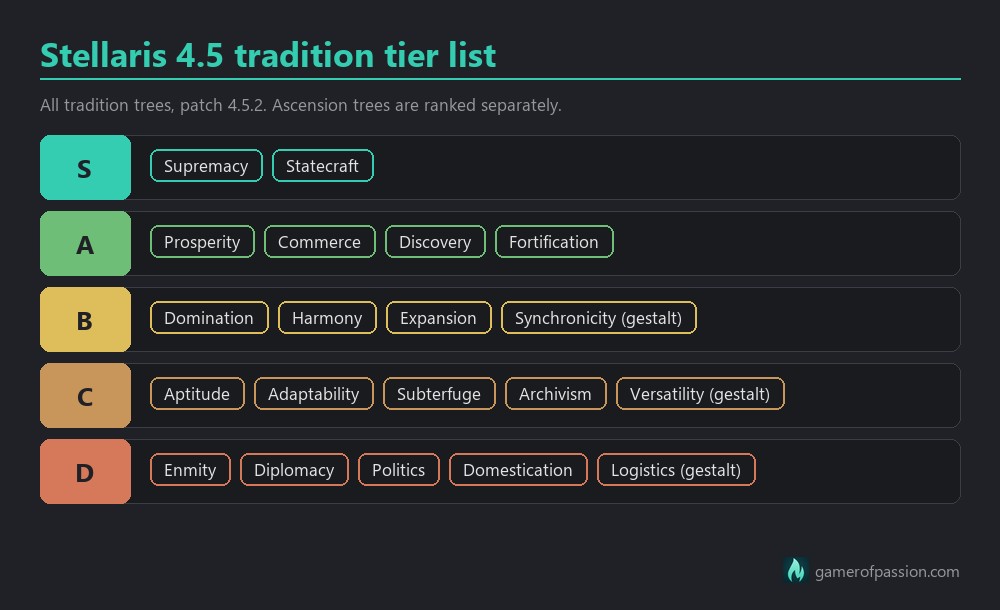
The table has the same tiers, along with the numbers behind each verdict and who is allowed to take the tree.
| Tree | Tier | Best for | Why (4.5.2 numbers) | Who can take it |
|---|---|---|---|---|
| Supremacy | S | Every empire that fights (crisis included) | +10% ship fire rate (Overwhelming Force), +20 flat and +20% naval capacity, +10% fleet command limit (War Games) | All, no DLC |
| Statecraft | S | Regular empires, leader and council builds | +25% council agenda speed, 150 XP per skill level to ruler and councilors on every agenda launch (Amongst Peers), -5% empire size when finished | All, Galactic Paragons |
| Prosperity | A | Any economy, Wilderness first pick | +5% resources from jobs, -5% job upkeep, buildings and districts 10% cheaper and 25% faster | All, no DLC |
| Commerce | A | Megacorps, trade-heavy and unity-rush builds | Trade policies turn half your trade into consumer goods or unity; finisher +10% trade | Regular empires only, no DLC |
| Discovery | A | Most common first pick | +35% survey speed (+25% Map the Stars edict), +1 research alternative, +10% research speed when finished | All, no DLC |
| Fortification | A | Defensive starts, chokepoints, Eternal Vigilance | -50% station upgrade cost (Fortress Doctrine), +50% defense platform cap, finishing it skips the Star Fortress tech for Eternal Vigilance | Not nomads, Apocalypse or Overlord |
| Domination | B | Slavers, authoritarian and elite-job builds | Imperious Architecture doubles per capital tier (50/100/200/400 housing and politician jobs), -5% empire size from pops when finished | All, no DLC |
| Harmony | B | Tall empires, planetary ascension | +25% colony ascension effects when finished, -5% empire size from pops (Kinship), -10% pop upkeep | Non-gestalt, no DLC |
| Expansion | B | Void Dwellers, nomads, wide starts (first or never) | -15% empire size from systems and colonies (Courier Network), -10% starbase influence, +1 max districts when finished | All, no DLC |
| Aptitude | C | Leader-heavy builds after the core trees | +2% specialist job efficiency per governor skill level (Specialist Training), +1 effective leader skill | All, Galactic Paragons |
| Adaptability | C | Designation-focused planets, nomads who want to settle | +5% to most colony designations when finished, +1 max districts (Adaptive Ecology), +10% habitability | Non-machine, no DLC |
| Subterfuge | C | Late military pick | +10 tracking, +5 evasion; finishing it unlocks Proxy Wars with Shadows of the Shroud | All, Nemesis |
| Archivism | C | Treasure hunters, big galaxies, dig-site builds | Dig sites in unowned systems, science ships 35% faster, up to +45% per specimen category (Flawless Display) | All, Grand Archive |
| Enmity | D | Empires boxed in by rivals | +3% pop growth per bordering rival, +15% damage against rivals, up to 6 rivals with Antagonistic stance | Not genocidal / Assimilator / Inward Perfection, no DLC |
| Diplomacy | D | Federation builders only | Agreement influence upkeep halved, one-off diplomatic costs -25%, 25% progress toward Federation Code | All except Inward Perfection, Devouring Swarm, Endbringers |
| Politics | D | Galactic Community players | Constitutional Immunity resolution, 18 months of unity each time your resolution passes | Not homicidal, Federations, Galactic Community must exist |
| Domestication | D | Space fauna builds (then much higher) | Outside fauna builds just +20% farmer output and +5% pop growth; needs Artificial Breeding tech | Grand Archive; most Machine Intelligences can never get the tech |
A tree lands in S when almost every empire wants it and it keeps paying off until the end-game crisis, A trees are strong in most builds, B trees in the right empire, C trees fill your last slots and D trees only fit one specific plan. The numbers come from the game files, while the tiers weigh them against what experienced players have settled on since the 4.3 economy rework.
The tiers also move with your empire type. Expansion is a B for a regular empire, but it is the first tree for Void Dwellers and nomads. Domestication is a D for almost everyone, and it will shoot up the list if you are building around space fauna.
Which tradition to pick first
Your first tree matters more than any other, because its picks are the cheapest you will ever buy (300 unity for the first and 342 for the second at base values) and its bonuses will run for the entire game. For most empires, five trees are realistic openers in 4.5: Discovery, Statecraft, Prosperity, Commerce and Expansion. Fortification is a sixth option for defensive starts, and slavers and Beastmasters have their own openers, which are covered further down.
The opening is also a little bit more flexible than it used to be. In 4.5.2 there is no surcharge for having several trees open, so you can adopt Statecraft for two picks, open Prosperity for its build speed and come back to finish Statecraft later without paying anything extra.
Discovery or Statecraft
Discovery is the most common first pick, and its early numbers explain why. To Boldly Go gives +35% survey speed, and the Map the Stars edict that the adoption unlocks adds another +25% along with +10% anomaly discovery chance. Science Division will give you one more research option to choose from, +1 scientist capacity and +1 starting skill for new scientists. You are going to find chokepoints, anomalies and good colony targets before your neighbours do.
Beware that Discovery does not cut researcher upkeep, even though some tier lists still claim it. Its only upkeep cut is the -15% scientist upkeep from Polytechnic Education, and that is the upkeep of your scientist leaders. The finisher will add +10% research speed to all three fields.
Statecraft needs Galactic Paragons. Constitutional Focus gives +25% council agenda speed, and Amongst Peers gives your ruler and every councilor 150 experience per skill level each time you launch an agenda. Neither pick has a prerequisite, so you can take both straight after adopting the tree. Its experience and skill bonuses will only reach your council, though, and the only permanent skill bonus in the tree is Shared Benefits with +1 effective councilor skill.
If you want to grab territory and anomalies as fast as possible, Discovery is the safer first tree. If you own Galactic Paragons and plan to run council agendas all game long, I would open with Statecraft and take Discovery a bit later.
Prosperity and Commerce as openers
Prosperity is never a wrong first tree. Standard Construction Templates makes buildings and districts 10% cheaper and 25% faster to build, Administrative Operations cuts their upkeep by 10%, Interstellar Franchising cuts job upkeep by 5% and The Pursuit of Profit adds +5% resources from jobs. None of these bonuses will lose value if you wait, so most empires simply take Prosperity as their second tree.
Commerce is the opener for empires with a lot of early trade, and only regular empires can take it. Its key pick is Adaptive Economic Policies, which unlocks two Trade Policies: Marketplace of Ideas converts half of your collected trade into unity at 0.25 unity per trade, and Consumer Benefits converts half into consumer goods at 0.5 per trade. The default Wealth Creation policy converts the same half into energy at 1:1. Commerce has no general megacorp bonus, so opening with it is a choice for trade-heavy builds of any kind. The one exception is the Worker Cooperative civic: for those megacorps, Adaptive Economic Policies turns into Adaptive Shareholder Schemes (+5% happiness and +5% job efficiency for Employee Ownership) and neither of the two Trade Policies is available.
Expansion as an opener
Expansion has the most misquoted numbers of all the early trees. Reach for the Stars cuts starbase influence costs by 10%, and outside of Wilderness and nomad empires the adoption speeds up colony development by 25%, with another 25% from Colonization Fever. Courier Network cuts Empire Size from systems and from colonies by 15% each. Older guides still say 25% there, but that value is gone.
The claim that Expansion boosts pop growth is only partly true. Its only growth bonus is A New Life with +10% growth for your founder species (assembly speed if that species is mechanical or a machine), and other species in your empire will get nothing from it.
Most of Expansion’s bonuses help you claim systems and grow new colonies, so it pays off most while you are still expanding. Opened as a fourth or fifth tree, its picks are going to arrive after your borders have settled.
Fortification for defensive starts
Fortification as a first tree is the defensive choice, for example when you start next to a much stronger neighbour or a genocidal empire. Its adoption gives +2 station capacity and +50% station upgrade speed, Defensive Zeal gives stations and defense platforms +33% damage and hull, and Fortress Doctrine, which needs Defensive Zeal first, halves station upgrade costs and adds another +2 station capacity. Finishing the tree also lets you take Eternal Vigilance without researching Star Fortress. Mind that it does little for your economy, so it only makes sense as an opener if your borders are in real danger.
Default order for a regular empire
For a regular empire, a standard human start like the United Nations of Earth included, this order will work in most games:
- Statecraft or Discovery
- Prosperity
- Supremacy
- Your ascension tree
- Commerce or Harmony
- Whichever of Statecraft and Discovery you skipped at the start
- A free slot for something situational, such as Fortification, Domination or Aptitude
The ascension tree usually ends up fourth, because a path perk normally needs two other Ascension Perks first, and almost every perk slot comes from a finished tree. Once your third tree is done, you can take the path perk, and the tree it unlocks opens as soon as you have the matching tech (Psionic Theory, for example) or reach the right step of the BioGenesis or Machine Age situation. The path perk also needs a free tree slot, so make sure you do not fill all seven slots with regular trees before you get there.
Best traditions by empire type
The default order fits a regular empire. Other empire types either get different trees or have one tree that will do far more for them than for anyone else.
| Empire | First tree | Next trees |
|---|---|---|
| Regular empire (default) | Discovery or Statecraft | Prosperity, Supremacy, ascension tree, Commerce or Harmony |
| Megacorporation | Statecraft or Commerce | Commerce, Prosperity, Supremacy |
| Machine Intelligence | Statecraft or Discovery | Prosperity, Supremacy, Synchronicity, Modularity / Nanotech / Virtuality (Synthetics without The Machine Age) |
| Hive Mind | Discovery or Statecraft | Prosperity, Supremacy, Synchronicity, Domination (hive picks) |
| Void Dwellers | Expansion | Prosperity, Discovery, Supremacy |
| Nomads | Expansion | Prosperity, Archivism; Adaptability only if you want to settle |
| Wilderness | Prosperity | Discovery, Supremacy |
| Slaver / authoritarian | Domination or Discovery | Prosperity, Supremacy |
| Space fauna (Beastmasters) | Domestication | Supremacy, Prosperity |
Gestalt twin trees
Machine Intelligences lose three of the regular trees and Hive Minds lose two, and both get replacement trees instead. Synchronicity replaces Harmony and Logistics replaces Commerce for both of them, while Versatility replaces Adaptability for machines only. Hive Minds keep the normal Adaptability tree.
| Tree | Tier | Replaces | Why (4.5.2 numbers) | Who can take it |
|---|---|---|---|---|
| Synchronicity | B | Hive Minds and Machines (Harmony twin) | Same core numbers as Harmony, no Holy Covenant, no Inner Stability agenda | Gestalt only |
| Versatility | C | Machine Intelligence (Adaptability twin) | -10% amenity usage, +10% pop assembly when finished; no habitability or extra district | Machines only |
| Logistics | D | Hive Minds and Machines (Commerce twin) | +10% trade when finished, no trade policies, no Trade League | Gestalt only |
You will find the same core numbers in Synchronicity as in Harmony, but no Holy Covenant federation and no Inner Stability agenda. Logistics keeps the +10% trade finisher, but it cannot use Trade Policies, does not unlock the Trade League and has no usable agenda. Versatility drops the habitability, extra district and designation boost of Adaptability for assembly and amenity bonuses. Most of the shared trees only rename their picks for gestalts.
Machine Intelligence
A Machine Intelligence will usually open with Statecraft or Discovery and then take Prosperity, Supremacy and Synchronicity. Statecraft has no empire-type limit, so machines can use it like any regular empire, only with machine names such as Strategic Focus instead of Constitutional Focus. Expansion’s A New Life becomes Hotjoin Protocols and boosts pop assembly. Domination will do a lot less for machines, because their Imperious Architecture is replaced by Modular Depots, which gives -15% Empire Size from districts and no extra jobs. For the ascension slot, machines take Synthetic Age.
Hive Mind
A Hive Mind will usually open with Discovery or Statecraft and then add Prosperity, Supremacy, Synchronicity and Domination. Domination will work well for hives, since their Imperious Architecture (Synaptic Extensions) adds 150 housing and 150 Coordinator jobs on a Hive Core, and 300 of each on a Hive Nexus. The gestalt adoption gives -15% amenities usage, and Workplace Motivators turns into Drone Network for them, with +5% menial drone output plus the Drone Overdrive edict. Since hives keep the regular Adaptability tree, they also keep its +10% habitability and extra district.
Megacorporation
A megacorporation will open with Statecraft or Commerce and then take Commerce if it was not first, followed by Prosperity and Supremacy. Megacorps usually have the trade to make Marketplace of Ideas and Consumer Benefits pay off. A megacorp can found a Trade League without the Commerce finisher, though, so the federation unlock on the finisher adds nothing for you, and what is left is the +10% trade and the perk slot.
Void Dwellers and nomads
Void Dwellers should open with Expansion, followed by Prosperity, Discovery and Supremacy. Expansion’s adoption cuts the alloy upkeep of habitats and habitat districts by 20%, Colonization Fever gives new habitats a free Habitation district, and the finisher adds +1 max districts on habitats. Prosperity’s Public Works Division also turns into Modular Superstructures for them, with another +1 habitat max districts. Where to put those habitats in the first place is covered in the habitats guide.
Nomads also open with Expansion, but their version will look quite different. The adoption gives +25% megastructure build speed and -20% waystation upkeep, and finishing the tree unlocks the nomad version of Eternal Vigilance, which otherwise needs the Advanced Wayline Logistics tech. That perk gives +25% arkship fire rate, +25% ship hull points, tougher waystations, 25% lower alloy costs for waystation upgrades and +1 commander capacity. Since nomads cannot take Fortification, Expansion is their only tradition route to it.
Prosperity and Archivism are the usual follow-ups. Only take Adaptability if you plan to settle down, because with the Nomads DLC, finishing Adaptability (or Versatility for machines) is what lets a nomadic empire settle on a planet. Sacred Path and Heirs of the Khan nomads cannot settle through the tradition at all.
Wilderness
Wilderness empires should start with Prosperity, whose Standardized Ecosystems keeps the -10% cost and +25% build speed, and then add Discovery and Supremacy. Several trees will change for them: the Expansion adoption gives +25% terraforming speed and -20% station upkeep, the Adaptability adoption gives -10% construction time, and the Domination finisher cuts Empire Size from districts instead of pops.
Slavers and authoritarian empires
Slaver and authoritarian empires can open with Domination instead of Discovery. Its adoption and Workplace Motivators each give +5% worker output and +5% slave job efficiency, Workplace Motivators also unlocks the Extended Shifts edict (+10% worker and slave job efficiency, -15% happiness for those pops), and the Civil Exclusion agenda (Galactic Paragons) gives +15% resources from jobs for 10 years after launch, with +10 crime.
Space fauna empires
Beastmasters are the one case where Domestication goes first. They get the Gravity Snares and Artificial Breeding techs for free, so they will be able to adopt the tree without meeting space fauna first. Everyone else will have to find fauna and research both techs before the tree unlocks.
Every tradition tree explained
Here is every tree in tier order, with the picks that matter, who can take it and when it is worth a slot. The gestalt twins are covered inside the tree they replace.
Supremacy (S tier)
Supremacy is the military tree, and every empire will have to fight at some point, if only against the end-game crisis. Adopting it gives a flat +20 naval capacity and +20% army damage. Fleet Logistics Corps adds +20% naval capacity and -10% ship upkeep, Master Shipwrights +25% ship build speed, and War Games, which needs both of those, +10% fleet command limit, +1 commander capacity and +1 starting commander skill.
The pick that matters most in battle is Overwhelming Force with +10% ship fire rate, and The Great Game adds +20% damage against starbases and waystations. The finisher unlocks the War Doctrine policies, for example Rapid Deployment with +25% sublight speed and +10% weapon range, and the Supremacist diplomatic stance with another +20% naval capacity. What you fill all that naval capacity with is a different question, and the fleet composition guide goes through it.
Supremacy needs no DLC. Take it in every game where you expect to fight, and have it by your third tree at the latest.
Statecraft (S tier)
Statecraft needs Galactic Paragons but has no other limit, so regular empires, Hive Minds and Machine Intelligences can all take it. Adopting it gives +50 Edict Fund, and its two key picks are covered in the first-pick section. The Amongst Peers tooltip only mentions councilors, but your ruler will get the experience too. Inspiring Agendas unlocks the Rightful Claims and Oppose the Fallen agendas, and Immutable Directives makes the effects of launched agendas last 25% longer.
Finishing the tree cuts your Empire Size by 5%. Its own agenda, Departmental Efficiency, gives +20% councilor experience and, once launched, +2 effective councilor skill for 10 years. If you own the DLC, take Statecraft in any empire, ideally as your first or second tree.
Prosperity (A tier)
Prosperity is open to every empire type and needs no DLC. Adopting it gives +20% output from mining stations, finishing it +25% from all orbital stations, and Public Works Division adds 100 housing to every City district. The Favored Society agenda (Galactic Paragons) gives your capital +20% resources from jobs for 10 years after launch.
Prosperity has no flashy single pick, but every bonus in it will work in any economy, and that makes it the usual second tree.
Commerce (A tier) and Logistics
Commerce is open to regular empires only and needs no DLC. The adoption cuts trader upkeep by 20%, and Trickle Up Economics is now +15% trade from living standards, with no trade per civilian and no consumer goods upkeep any more. Besides the two Trade Policies, Marketplace of Better Ideas adds +10% trade from jobs and Insider Trading cuts the market fee by 10%. The finisher gives +10% trade and, with the Federations DLC, Trade League access. Trade League members and Worker Cooperatives get their own policies in place of the two Trade Policies.
Logistics, the gestalt version, sits in D tier. Its adoption gives +5% Logistic Drone output, Nested Coordination +2 trade per 100 Logistic Drones and Distributed Delivery Systems +50% Logistic Drone jobs from districts, specializations and non-capital buildings.
Take Commerce if your empire runs on trade. Gestalts can leave Logistics for their very last slot.
Discovery (A tier)
Discovery is open to every empire and needs no DLC. Its adoption gives +20% anomaly research speed. Databank Uplinks unlocks the Research Subsidies edict: +10% researcher job efficiency for 30 unity to enact plus 30 unity upkeep, both scaled by empire size, and +1 trade upkeep per 100 researchers.
Entertainment Labs adds +200 amenities per 100 researchers and 20% more researcher jobs from research district specializations. There is a known 4.5.2 bug there: on ring worlds, the extra jobs do not apply to Physics Research specializations (for any empire) or to gestalt Society Research specializations. The +10% research finisher is the only regular finisher with a flat research bonus.
Take Discovery first or second, since its survey bonuses lose most of their value once the map is charted.
Fortification (A tier)
Fortification needs Apocalypse or Overlord, and nomads cannot take it. Resistance is Frugal makes your regular defense armies produce 0.5 unity each (Wilderness ones excepted) and gives defense armies +25% health. Never Surrender cuts war exhaustion gain by 25% and makes enemy claims on your systems 25% more expensive.
The finisher gives +50% defense platform cap and -20% station upkeep, plus the Eternal Vigilance shortcut and, with Federations, the Martial Alliance federation type. As of 4.5.2, Eternal Vigilance no longer builds free defense platforms. It gives +5 defense platform cap, +25% starbase damage and hull, +20% home-territory fire rate and +1 commander capacity.
Take it if you sit on a few chokepoints or fear a stronger neighbour.
Domination (B tier)
Domination is open to everyone with no DLC. Besides the worker and slave bonuses from the slaver section, Colonial Viceroys gives +0.5 monthly influence and Privy Council +20% councilor experience, and finishing the tree will cut Empire Size from pops by 5%.
Imperious Architecture adds housing and Politician jobs to your capital building, and the amount doubles with each capital tier: 50 on a Reassembled Ship Shelter, 100 on a Planetary Administration, 200 on a Planetary Capital, 400 on a System Capital-Complex and 800 on the Galactic Emperor’s Imperial Palace. Worker Cooperatives get Bureaucrat jobs instead. Patch 4.5.2 lists a fix for this pick not working, so it is probably worth another look if you skipped it before.
Gestalts get -15% amenities usage on adoption instead, plus their own versions of Imperious Architecture. Take Domination as a slaver, an authoritarian empire or any empire with a lot of elite jobs.
Harmony (B tier) and Synchronicity
Harmony is open to non-gestalt empires with no DLC. Its adoption gives -10% pop upkeep, and finishing it +25% Colony Ascension Effects. Kinship cuts Empire Size from pops by 5%, Mind and Body gives +10 leader lifespan and -1 maximum negative leader traits, and Utopian Dream gives a flat +3 stability (its old, unused description says 5%) and -10% Colony Ascension Cost.
Only Harmony has the Inner Stability agenda (+5 stability while it charges and for 10 years after launch, Galactic Paragons DLC), and with Federations its finisher unlocks the Holy Covenant federation type for empires that are not spiritualist.
Synchronicity, the gestalt twin, also sits in B tier. Synchronized Agents cuts Empire Size from pops by 5% and leader upkeep by 20%, and instead of Inner Stability it gets four node-experience agendas that work even without Galactic Paragons.
Take Harmony if you play tall and lean on planetary ascension, and skip it if you are going wide.
Expansion (B tier)
Expansion is open to everyone with no DLC. Besides the picks from the first-pick section, its adoption cuts habitat alloy upkeep by 20%, Colonization Fever gives new colonies one free City district and Galactic Ambition cuts station upkeep by 20%. The finisher gives +1 max districts on non-artificial planets, or on habitats for Void Dwellers and on artificial colonies for nomads.
Take it as your first tree with Void Dwellers, nomads or a wide empire that will settle a lot of colonies early. If you are not going to open with it, you can probably leave it out.
Aptitude (C tier)
Aptitude needs Galactic Paragons and is open to every empire type. The adoption gives one more option whenever a leader picks a trait. Specialist Training gives +2% specialist job efficiency per skill level of the planet’s governor (complex drones for Hive Minds and machines), so a level-5 governor will give +10% on that planet. There is no flat +10% bonus any more, and a planet without a governor will get nothing from it.
Champions of the Empire gives +1 effective skill to all leaders, Psychological Profiling -1 maximum negative leader traits and +1 commander, official and scientist capacity, and Healthcare Program +10% leader lifespan and -25% leader upkeep. The finisher gives every new leader +1 starting trait and instantly gives your current regular leaders one random trait, skipping Renowned and Legendary leaders.
Take it for a leader-heavy build once Statecraft, Prosperity and Supremacy are done.
Adaptability (C tier) and Versatility
Adaptability is open to every empire except Machine Intelligences and needs no DLC. The adoption gives -10% pop housing usage, Environmental Diversification +10% habitability, and Adaptive Ecology +1 max districts on every non-artificial planet. Void Dwellers and nomads get Adaptive Architecture instead, with +1 max districts on artificial colonies.
Finishing it adds +5% to most colony designations, so a +15% designation becomes +20% for its jobs. Capitals work differently: the Empire Capital gets +2.5% job efficiency for all jobs, a Factory or Trade Capital the usual +5% for its jobs, and a Forge Capital +5% for every job on the planet. Thrall-Worlds will lose their +10% worker bonus when you finish the tree, which looks like a bug.
Versatility, the machine twin, also sits in C tier. Spatial Optimization gives -10% amenities usage, Material Analysis -5% job upkeep and the finisher +10% pop assembly speed. Like Adaptability, finishing it lets a nomadic empire settle.
Take Adaptability for designation-heavy planets, or as a nomad who wants to settle.
Subterfuge (C tier)
Subterfuge needs Nemesis. The adoption cuts operation infiltration cost by 25% and gives +1 codebreaking. Information Security gives +5 evasion and +1 encryption, Operational Security gives +10 tracking, +1 codebreaking and +2 operation skill, and Shadow Recruits adds +50% infiltration speed.
Proxy Wars come from the finisher, and only if you own Shadows of the Shroud. Secret Societies and Influential Cartel empires get Proxy Wars without the tree. With First Contact, the finisher also adds +1 cloaking strength. Take Subterfuge late as a military pick for the tracking and evasion.
Archivism (C tier)
Archivism needs Grand Archive. Xeno-Paleontology gives +30% excavation speed and +30% scientist experience, and Frontier Archaeology will let your science ships excavate dig sites in systems nobody owns, while making them 35% faster and halving their upkeep. Nomads can already dig in unowned systems, so for them it opens dig sites inside other empires’ borders instead, at a -100 opinion penalty unless you have a research agreement with that empire.
Flawless Display adds +5% output to a collection category for every Rare-or-better specimen on display in it, up to +45% with all nine slots filled. The finisher gives +15% specimen output and -15% relic activation cost per completed collection. Take it in big galaxies with lots of dig sites, or as a nomad.
Enmity (D tier)
Enmity is closed to genocidal empires (Fanatic Purifiers, Devouring Swarms, Determined Exterminators and a few rarer cases), Driven Assimilators and Inward Perfection. Adopting it raises your rival limit by 1 and gives +3% pop growth and +3% pop assembly for every rival that borders you.
Rise to the Occasion gives +1 official, commander and scientist capacity per two rivals, rounded down, so despite its “+0.5 per rival” tooltip you will need two rivals before it does anything. Match will only work while a rival is stronger than you in that category, and Outpace gives +15% damage against rivals. The finisher unlocks the Antagonistic stance with +2 rivals for 6 in total, +10 unity from rivalries and +5% diplomatic weight per rival. Its Second Strike agenda (Galactic Paragons) ends every truce with your rivals the moment you launch it.
Take it if you are boxed in by several stronger rivals, because once you outgrow your neighbours most of its bonuses will fade.
Diplomacy (D tier)
Diplomacy is open to everyone except Inward Perfection, Devouring Swarms and the Endbringers origin. Adopting it halves the influence upkeep of your diplomatic agreements, cuts one-off diplomatic influence costs by 25% and unlocks the Diplomatic Grants edict with +1 envoy and +10% diplomatic weight. The Federation gives +1 envoy, +1 monthly federation cohesion and 25% progress toward the Federation Code tech if you do not have it yet.
Finishing the tree gives +2 monthly federation experience, +10% diplomatic weight and +1 official capacity, but no extra envoy and no federation type. Only take it if your whole plan is to build and lead a federation.
Politics (D tier)
Politics needs the Federations DLC, is closed to genocidal empires and can only be adopted once the Galactic Community exists. Gravitas cuts resolution costs by 25%, and National Agenda gives you 18 months’ worth of unity income, at least 250, every time a resolution you proposed passes.
Finishing Politics unlocks four special resolutions, and Constitutional Immunity is one of them: if it passes, your empire can no longer be in breach of galactic law. Only the proposer can be its target, only one empire in the galaxy can hold it at a time, and it does not protect you from the Cosmic Storms resolutions. Take it if you plan to run the Galactic Community.
Domestication (D tier)
Domestication needs Grand Archive and the Artificial Breeding tech, as described in the space fauna section. The adoption gives +20% farmer output and -10% space fauna cloning cost, Killer Instinct gives your fauna ships +15% damage and +15% speed, and Metabolic Regulation gives +5% pop growth speed, or +5% pop assembly for machine empires. The finisher gives +50% space fauna experience and unlocks Voidlures.
Nomads lost their special Domestication finisher in 4.4.5, and their Bio-Repurposing pick is now Void Shepherds (+1 food, minerals or energy per cloned fauna ship, depending on the species). Take the tree if your empire is built around space fauna, where it belongs near the top of your list, and skip it everywhere else.
Ascension traditions
Ascension trees cannot be adopted from the tradition screen whenever you like, because each one is unlocked by a path perk (or, for a few origins, by the origin itself). Psionics needs Mind Over Matter plus the Psionic Theory tech, Cybernetics needs The Flesh is Weak (Hive Minds: Organo-Machine Interfacing) plus Integrated Cybernetics, and Synthetics needs Synthetic Evolution plus Artificial Administration. Machine empires take Synthetic Age, which with The Machine Age DLC runs the Transformation situation and ends in Modularity, Nanotech or Virtuality (without that DLC it gives the Synthetics tree). Biomorphosis with BioGenesis runs the Biomorphosis situation and ends in Purity, Cloning or Mutation.
You can only ever take one path per empire, and a path perk normally needs two other Ascension Perks first (exceptions are the Clone Army origin for Biomorphosis and the Hard Reset origin for The Flesh is Weak, while synthetic empires need three perks for Psionics; Cybernetic Creed, Synthetic Fertility, Teachers of the Shroud and Endbringers empires never get a path perk and unlock their tree with the tech alone). The ascension tree also takes one of your seven slots. Every path perk requires an empty slot, and Biomorphosis or the Transformation only hand you the tree if a slot is still free when the situation ends.
With The Machine Age, the Cybernetics and Synthetics finishers only give their Ascension Perk slot after the Cyberization or Synthesization situation is done. The Natural Design civic (Innate Design for Hive Minds) blocks every ascension path, so all seven of your trees will be regular ones, and its Genomic Services Center building (Genomic Safeguard Warren for Hive Minds) grows stronger with every Ascension Perk you take in return.
Psionics
With Shadows of the Shroud, adopting Psionics starts the Psionic Ascension situation, and even Hive Minds and Machine Intelligences can take it. Synthetic empires will see its perk as Interdimensional Processing. The finisher cuts the Empire Size effect by 10%. Without the DLC you get the older Psionics tree, which is closed to gestalts.
Cybernetics and Synthetics
With The Machine Age, both trees start a situation, Cyberization or Synthesization, and their picks only show their real effects once it is done. The Cybernetics finisher gives cybernetic pops +10% job efficiency, and Driven Assimilators get their own version of the tree. In Synthetics, Optimization Algorithms gives mechanical and machine pops +10% job efficiency and Efficient Power Systems cuts robot upkeep by 25%.
Genetics, Purity, Cloning and Mutation
Without BioGenesis, Biomorphosis gives the old Genetics tree. With BioGenesis you get Purity, Cloning or Mutation instead. Each of them has two fixed traditions plus three Flexible Traditions that depend on the approach you chose in each stage of the situation, so a Purity tree can contain Cloning or Mutation picks. Mutation’s Planned Polymorphism doubles Adaptive trait bonuses from +5% to +10%. For Evolutionary Predators it boosts Malleable traits instead, and while its tooltip says +15%, the game files give +10%.
Modularity, Nanotech and Virtuality
These three came with The Machine Age back in 3.12. Modularity is the worker and modification tree, with +10% worker output from High-Speed Replacements and -15% job upkeep from its finisher. Nanotech is built around nanites, and its finisher cuts Empire Size from colonies by 50%.
Virtuality is meant for very small empires. Clustered Capacity turns your Virtual trait into +75% job efficiency minus 10% for every inhabited planet you own, the capital included, and adds 0.1 energy upkeep per 100 Virtual pops for every planet. With one planet you will get +65%, with five planets +25%, and from eight planets on it turns into a penalty.
Ascension tree ranking
Ascension trees only compete with each other, since you can only ever take one. One player ranking from the 4.3 era put Psionics and Synthetics on top, followed by Modularity and Virtuality, with the BioGenesis paths, Cybernetics and Nanotech further down. Paradox made Cybernetics a little stronger and toned down the runaway production of the psionic and biological paths in that same patch, and in your game the best path will depend at least as much on your origin and civics as on the tree. The choice really starts with the path perk, and the Ascension Perks guide ranks those perks and explains when to take them.
How tradition costs work
Every tradition pick costs 300 + (8 x traditions you already own)^1.8 unity, plus 0.2% for each point of Empire Size above 100, scaled by the Tradition Cost setting you chose at game start (0.25x to 5x). Adopting a tree is priced like any other pick, and in 4.5.2 there is no surcharge for having several trees open, so starting a second or third tree early will cost nothing extra.
The table shows what that means at three Empire Sizes. Each colony adds 20 Empire Size and each system 1, so a growing empire will drift to the right side of the table fairly quickly.
| Pick number | Empire Size 100 | Empire Size 200 | Empire Size 400 |
|---|---|---|---|
| 1 | 300 | 360 | 480 |
| 2 | 342 | 411 | 548 |
| 3 | 447 | 536 | 715 |
| 6 | 1,065 | 1,278 | 1,704 |
| 12 | 3,463 | 4,155 | 5,540 |
| 18 | 7,224 | 8,669 | 11,559 |
| 24 | 12,231 | 14,677 | 19,569 |
| 30 | 18,408 | 22,090 | 29,453 |
| 36 | 25,703 | 30,844 | 41,125 |
| 42 | 34,073 | 40,888 | 54,517 |
A full tree is one adoption plus five traditions, so you will pay for six picks per tree and 42 for all seven trees. The finisher itself is free, and an ascension tree granted by Biomorphosis or the Transformation comes with its adoption already done.
What lowers tradition cost
No tradition, edict or tech in 4.5.2 lowers tradition cost directly, so any guide that lists one is out of date. These are the sources that exist:
- The Ascensionists civic and its twins Elevational Contemplations (Hive Minds), Elevational Hypotheses (machines) and Gigacorp (megacorporations): -25% tradition cost from Empire Size
- The Triumviri modifier, which a Fear of the Dark empire can get from its origin event: -40% tradition cost from Empire Size
- The Wanderlust Ascension Perk (nomads only): -10% tradition cost once four remarkable-system categories are completed
- The Art College waystation module for nomads: -5% tradition cost
- The Champion’s Forge Live! Trophy relic: activating it for 200 influence makes your next tradition cost 1 unity, while the Tarnished version gives -90% on the next one
- The Tradition Cost setting at game start
Additionally, once you are above 100 Empire Size, anything that lowers it will also make traditions cheaper, because the size penalty shrinks with it. That includes the Empire Size cuts in Statecraft, Expansion, Harmony and Domination.
The four-of-five trick
The finisher is free, but the game stores it as a tradition (its own data counts 49 traditions: 7 per tree), and players who tested it report that it pushes up the price of every later pick. If that holds, taking 4 of the 5 traditions in your first three trees and finishing them back to back saves about 14% of the unity for those three trees, at the cost of getting your first Ascension Perk slot ten picks later. A milder version is to finish your first tree normally and only use the trick in trees two and three, which would save 5.5% with no delay on the first perk.
Personally, I would only use the milder version. An Ascension Perk ten picks earlier is usually worth more than the unity you save, and if the finisher turns out not to count, the trick will save nothing at all.
Slots and limits
No tech, civic or perk raises the limit of seven trees. Every finished tree, the ascension tree included, unlocks one Ascension Perk slot, and with all seven trees plus the rare Ascension Theory technology you will reach the maximum of eight.
Other tradition questions
What happened to Mercantile and Unyielding?
Both trees are still in the game. Patch 4.3 renamed Mercantile to Commerce and Unyielding to Fortification, and you will find their picks described above under the new names.
Removing a tradition tree
You can’t. The game offers no way to remove a tree once you adopt it, and the same goes for your ascension tree. That is a good reason to keep one slot free until you know which path perk you are going for.
Diplomacy and federations
The Diplomacy tree no longer unlocks federations, even though many older guides still say so. Forming one needs the Federation Code tech, and Diplomacy only helps you get that tech: adopting the tree lets Federation Code show up before you meet a possible partner, and The Federation adds 25% progress toward it. With the Federations DLC, five other finishers unlock a federation type: Commerce (Trade League), Discovery (Research Cooperative), Domination (Hegemony), Harmony (Holy Covenant) and Fortification (Martial Alliance).
Late game and crisis traditions
Supremacy is the clear pick for the end-game crisis, with Subterfuge’s tracking and evasion and Fortification’s tougher starbases as useful extras. Statecraft’s Oppose the Fallen agenda gives +5% damage against Marauders, Fallen and Awakened Empires while it charges and +25% for 10 years after launch, which is handy if an Awakened Empire comes for you.
DLC and Console Edition
Thirteen trees need no DLC: Adaptability, Commerce, Diplomacy, Discovery, Domination, Enmity, Expansion, Harmony, Prosperity, Supremacy and the gestalt trees Logistics, Synchronicity and Versatility. The other seven need a DLC each, as listed in the tier table, and without Galactic Paragons the regular trees unlock no council agendas apart from the four node agendas of Synchronicity (the ascension tree agendas need no DLC).
Console Edition is patched on its own schedule, so trees and numbers may differ from these PC 4.5.2 values. If you cannot find Statecraft or Aptitude there, check whether you own Galactic Paragons.
How many tradition trees can you take?
Seven, ascension tree included, but the last ones will cost far more than the first: at base values the cost table puts the 42nd pick at 34,073 unity at Empire Size 100 (counting paid picks only), against 300 for the very first. Spend the cheap early picks on the trees that carry your whole game, and leave the situational C and D tier trees for the end.