In this guide, I want to take you through your first game of Stellaris 4.5, from the galaxy settings to your first colonies and the crises that wait at the end of the game.
For a first game, play the United Nations of Earth, which is the empire the game itself suggests through its Quick Start option. Put it on a Small or Medium galaxy at Cadet or Ensign difficulty and switch the tutorial on.
Then spend the first years surveying with your science ships, claiming the systems around you with outposts and keeping research running in all three fields. While you do all that, keep energy, food, minerals, consumer goods and Trade positive, because a resource that runs dry will slow down everything else in your empire.
This guide is written for Stellaris 4.5.3 ‘Cygnus’ on PC, released on November 4, 2026, and everything in it works with the base game alone, without any DLC. The Console Edition is a separate, older version of the game, and this guide does not cover it.
If you have played before, 4.5.3 changed two things you may run into: the Betharian, Rare Crystal, Volatile Motes and Exotic Gas district specializations are now limited to one per planet, and Tankbound empires start with one extra Generator District. Every cost and game value in this guide is taken from the 4.5.3 game files on PC.
Contents
- Settings for your first game
- Which empire to play first
- Your first ten years
- Your economy
- Expanding your empire
- Running your planets
- Spending unity
- Research
- Fleets for beginners
- Diplomacy
- Threats to know about
- Common beginner mistakes
- Stellaris beginner questions
- Conclusion
Settings for your first game
Before the game starts, you will set up the galaxy you are going to play in. Most defaults are fine for a first game, and the difficulty slider matters most.
| Setting | Pick for game one | Why |
|---|---|---|
| Galaxy size | Small (400 stars) or Medium (600) | Same room per empire; Small runs faster |
| AI empires | Size default, or 2-3 fewer for more room | Defaults: 6 on Small, 9 on Medium |
| Advanced AI starts | 0 | They begin with extra resources, tech and pops |
| Fallen Empires | Default (2 on Medium, 1 on Small) | Passive unless provoked; you learn to leave them alone |
| Difficulty | Cadet (cushion) or Ensign (even game) | Cadet: +50% job output and +10 stability for you |
| Scaling Difficulty | Leave as is | On Cadet or Ensign the AI has no bonus to scale |
| Crisis Strength | Default | No end-game crisis before 2425 anyway |
| Mid-game / End-game / Victory year | 2300 / 2400 / 2500 (default) | Enough time to learn; you can play past 2500 |
| Guaranteed Habitable Worlds | 2 (default) | Two planets of your homeworld’s type near home |
| Ironman | Off | No reloading in Ironman; you only lose achievements |
| Tutorial | Full | Turn on all tips; use the Missions window |
Set the Difficulty slider yourself before you start. Cadet will give you, the player, +50% output from jobs and from mining and research stations, +50% naval capacity (the size of the navy you can support) and +10 stability, which is a fairly comfortable cushion while you learn. Ensign gives no bonus to you or to normal AI empires, which makes it an even game. Civilian doubles the player bonuses, while from Captain up only the AI empires get bonuses, such as more workforce and naval capacity and cheaper ships.
Mind that Ensign does not mean that nobody gets a bonus. Fallen Empires (ancient, very strong empires that mostly keep to themselves), end-game crises and other non-player threats will still get tougher ships as the difficulty rises. On Ensign, Fallen Empires get +30% damage, hull, armor and shields, and the end-game crises three times that (+90%), rising to +150% on Grand Admiral, while Crisis Strength is a separate setting that adds to all of this. I would start on Cadet if you want room for mistakes, and on Ensign if you already know other strategy games of this kind.
Ironman saves your game automatically to a single file and turns off the console, and you won’t be able to load an older save after a war goes badly. Achievements need Ironman and an unmodded game (mods that change the checksum switch them off). For a first game, leave Ironman off and save often, since all you give up are achievements.
Set the tutorial to Full (the levels are Full, Tips and None), and open the Missions window early on. It holds 31 short missions in five chapters, Exploration, Economy, Diplomacy, Politics and Warfare, and each of them will show you what to do next. Additionally, keep Guaranteed Habitable Worlds at 2. With that setting, two planets of the same type as your homeworld will spawn close to your home system, and they are going to be your best first colonies.
Which empire to play first
The game itself recommends the United Nations of Earth (UNE) for your first game, and its Quick Start option will drop you straight into a game as UNE without going through the empire creator. That is good advice. UNE is a premade human empire from the base game with a friendly, democratic setup, and its origin gives your capital a strong first 20 years.
Every empire is built from a few parts. Ethics are the worldview of your people, the authority is your form of government, civics are perks tied to that government, and the origin is the backstory your empire starts with. UNE is Xenophile and Fanatic Egalitarian (a fanatic ethic is a stronger version of a normal one), Democratic, and has the Beacon of Liberty and Idealistic Foundation civics. Its species, Humans, comes with the Adaptive, Migratory and Wasteful traits.
The origin is Prosperous Unification. It will give your capital 400 extra pops (your population, which 4.x counts in the thousands), one extra Generator District and one extra Agriculture District, plus a 20-year bonus of +10% output from jobs, +25% amenities and +15% happiness. It also guarantees Planetary Unification as a research option. Our origins tier list covers the others once you want to try something new.
If you would rather learn how to fight early, the Commonwealth of Man is the war-minded human preset. It is Xenophobe and Fanatic Militarist, Dictatorial, with the Nationalistic Zeal and Distinguished Admiralty civics and the Lost Colony origin. It is base game too, but as Xenophobes they will make fewer friends, which is why it suits a second game better than a first.
A custom first empire
If you want to build your own empire, keep it close to UNE. Take Materialist and Egalitarian with one of them Fanatic, the Democratic authority and the Technocracy and Meritocracy civics, with Prosperous Unification as the origin. Materialist is required for Technocracy, and Meritocracy needs a Democratic or Oligarchic government. This is the Prosperous Technocrats setup from our beginner build, and the civics tier list has other safe picks.
A normal species gets 2 trait points and up to 5 traits, and negative traits give you points back for more positive ones. I would pay for Intelligent and Rapid Breeders with Sedentary and Fleeting. Sedentary will only make moving pops by hand 35% more expensive, and Fleeting will only shorten the lives of your leaders by 10 years. Solitary works as well, but its +10% housing use applies to every pop on every planet. Our trait tier list goes through the rest.
Not for your first game
Hive Mind and Machine Intelligence empires are base game on PC, and you will not need any DLC to play them. They play quite differently from a normal empire, though, and both of them will switch the tutorial off. Keep them for your second game or later.
| Choice | Easy pick | Why |
|---|---|---|
| Preset (easy route) | United Nations of Earth or Quick Start | The game itself recommends it; base game |
| Custom: ethics | Materialist + Egalitarian, one of them Fanatic | Materialist for Technocracy; Egalitarian keeps it UNE-like |
| Custom: authority | Democratic | Meritocracy needs Democratic or Oligarchic |
| Custom: civics | Technocracy + Meritocracy | Both base game; our Prosperous Technocrats build |
| Custom: origin | Prosperous Unification | +400 pops and 20 years of +10% job output |
| Custom: traits | Intelligent, Rapid Breeders; pay with Sedentary, Fleeting | Resettling 35% dearer, leader lives 10 years shorter |
| Not for game one | Hive Mind, Machine Intelligence | They switch the tutorial off |
The Willpower DLC and the 4.6 update on November 23, 2026 will rework ethics and factions, and this guide will be updated once they are out.
Your first ten years
On day one, pause the game and take a look at what you have. You will start with 200 energy, 200 minerals, 200 alloys and 200 Trade, plus 100 influence, 50 unity, 200 food and 100 consumer goods. Alloys build your ships and stations, influence pays for new systems, and unity buys traditions and leaders. Your fleet is one science ship with a scientist aboard, one construction ship and three corvettes (the smallest warships).
On a normal homeworld, a Prosperous Unification capital will have two City Districts, three Generator Districts, two Mining Districts and four Agriculture Districts. Some of your pops will start out as Civilians, the fallback job for pops without a regular one.
The capital will also start with a few blockers, features such as Sprawling Slums or an Industrial Wasteland that take away district slots, and you can clear them without any tech. Clearing one will cost you 300 energy and take 120 days at base. Do it once you have energy to spare. Each one gives you room for one more district, and clearing the Sprawling Slums also adds 100 pops.
Your home starbase can build ships from day one. After that, work through the first decade in roughly this order:
- Pick a tech in all three research fields. Each field usually offers three options at a time, and with one selected in every field, no research will go to waste.
- Queue a second science ship. It will cost 100 alloys and take 60 days at the shipyard, and your 200 starting alloys cover two ships. A new science ship cannot explore unknown systems until it has a scientist, and hiring a level 1 leader costs 100 unity.
- Send your science ship out to survey. Surveying will reveal planets, resources and anomalies, the odd finds your scientists can research. Steer it by hand toward nearby stars first and automate exploration later.
- Claim systems with your construction ship. An outpost, the basic starbase that makes a system yours, costs 100 alloys plus influence that grows with distance. Influence is going to set the pace of your early expansion.
- Leave the corvettes docked at home. Docked fleets pay no Trade upkeep, while each corvette will cost 1 Trade a month in neutral space.
- Adopt Discovery and turn on Map the Stars. Your first tradition will cost 300 unity, and you start with 50. Discovery adds +20% anomaly research speed and the Map the Stars edict, whose 10 unity upkeep fits inside your Edict Fund.
- Let the council agenda launch. Your council is already working on an agenda when the game starts, and it will launch about one to two years in. Its bonus lasts 10 years.
- Research Mineral Purification and Sociocultural History when they are offered. The first lets you specialize Mining Districts, and the second lets you build the Autochthon Monument for more unity.
- Colonize the habitable worlds near you. Put an outpost in the system first, then send a colony ship.
- Move a few hundred pops into each new colony. This needs the Resettlement policy set to Allowed and costs energy plus a little unity (100 energy and 10 unity at base, and the tooltip shows the full cost).
- Take Expansion as your second tradition. It costs 342 unity at base and adds +25% colony development speed. If you play a build with its own plan, follow that tree instead.
- Stay under your naval capacity until a war is coming. It is 50 at base (75 on Cadet). Your three corvettes use 15 of it, and going over will raise the upkeep of every ship.
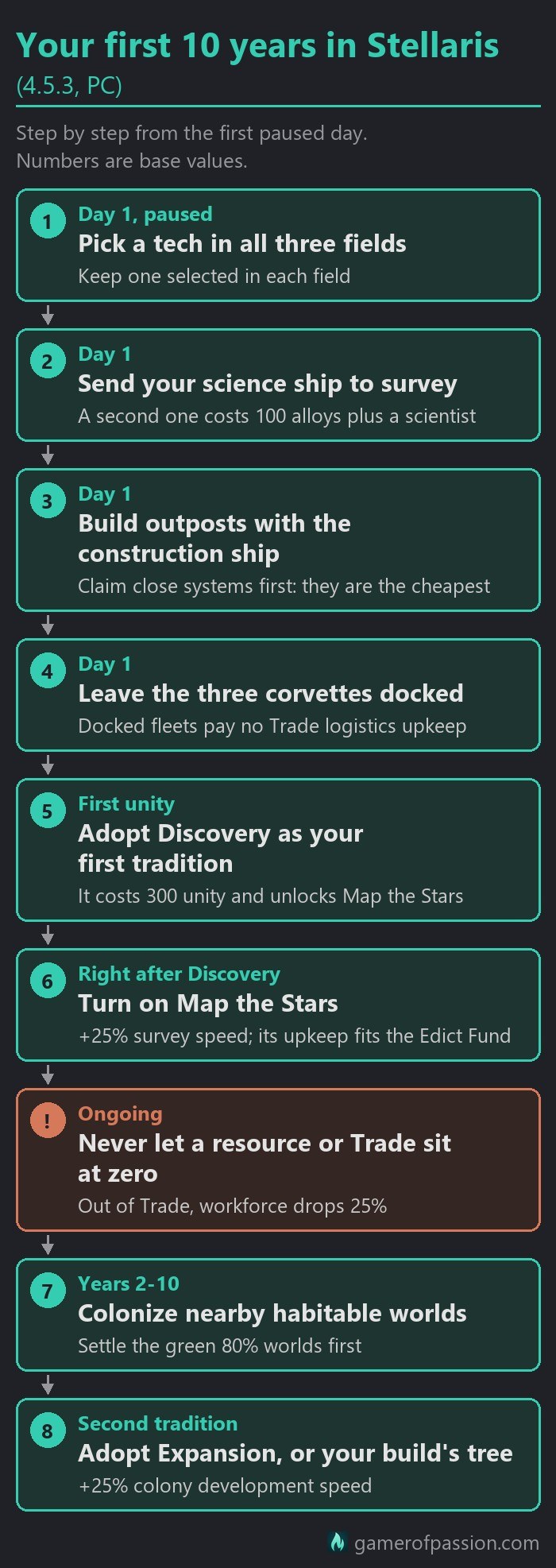
A few rules hold for the whole decade. Make sure that no resource and no Trade sits at zero while your income is negative, open new specialist jobs only while food, energy and minerals stay positive, and keep stability above 50 with housing ahead of your pops.
Your economy
Stellaris 4.5 has nine resources you will deal with from the first day, and running short on any of them is going to slow you down.
| Resource | Where it comes from early | What you spend it on |
|---|---|---|
| Energy | Technicians: 6 per 100 jobs | Upkeep of districts, buildings and ships |
| Minerals | Miners: 4 per 100 jobs | Districts: 300 rural, 500 city; zones 1,000 |
| Food | Farmers: 6 per 100 jobs | Food upkeep of pops; 200 per colony ship |
| Consumer goods | Mixed Industry zone and its factory building | Specialist and ruler upkeep; 200 per colony ship |
| Alloys | Metallurgists in the Mixed Industry zone | Outposts, science and construction ships: 100 each |
| Trade | Civilians 1, Clerks 3, Traders 8 per 100 jobs | Warships away from starbases, colony deliveries, market buys |
| Unity | Bureaucrats 3, Politicians 5 per 100 jobs | Traditions (300 for the first), leaders (100), edicts |
| Influence | 100 at the start; +0.5 a month per rival | Outposts: 75 + 75 per jump; pacts and claims |
| Research | Researchers 3 per 100 jobs, research stations | Techs and special projects in three fields |
Jobs
In 4.x, pops are grouped by species and stratum, and each group adds workforce that fills the jobs on its planet. Job outputs are counted per 100 jobs. For reference, 100 Farmers make 6 food, 100 Technicians 6 energy and 100 Miners 4 minerals, while 100 researchers make 3 research for 1.5 consumer goods and 100 Bureaucrats 3 unity for 2 consumer goods.
Pops fill ruler jobs first (Politicians), then specialist jobs (researchers, Bureaucrats and factory jobs), then worker jobs (Farmers, Technicians and Miners). Every new research, unity or factory job can therefore pull a pop off a farm, a generator or a mine. Open specialist jobs only when your food, energy and minerals can spare the workers. Districts and buildings also charge their upkeep whether anyone works them or not, and building ahead of your pops will cost you every month.
You can mark one job as Favorite, and new pops of that stratum will fill it before other jobs of the same rank. Free citizens without a job will become Civilians, who still make a little Trade and amenities, and a few hundred of them are no emergency. Pops re-check their jobs every few months, and a new building can take a moment to fill.
Consumer goods are the everyday goods your pops use up. Rulers and specialists use more of them than workers, and every new specialist job will also raise your consumer goods bill.
Trade in 4.5
Trade is a stockpiled resource in 4.x, and you will spend it on ship and colony upkeep and on buying other resources. Guides from the 3.x days that talk about trade value collected by starbases, or about buying with energy, describe rules that no longer apply. Early Trade comes from your Civilians, Clerks and Traders, and from orbital deposits once you build a station on them.
Warships away from a starbase cost Trade every month: a corvette 1 and a cruiser 4 in neutral space, half that inside friendly borders, double in enemy space and nothing at all while they sit docked at one of your starbases. A colony that cannot cover its own energy, minerals or food will draw them from the rest of your empire and pay Trade for the delivery. If Trade runs out, your workforce will drop by 25% and your empire size will double. Keep it positive at all times.
The market runs on Trade as well. Every deal pays a fee, 30% at base and never below 5%, and until the Galactic Market is founded, you will deal on your internal market, where prices swing harder and take longer to recover. Every purchase pushes a price up and every sale pushes it down. Buy and sell in small amounts, for example as monthly orders, instead of dumping a big stockpile in one click.
Your Trade Policy decides what half of your Trade turns into. You start on Wealth Creation, which turns it into energy, and the Adaptive Economic Policies tradition in the Commerce tree adds Consumer Benefits (consumer goods) and Marketplace of Ideas (unity). A changed policy will stay locked for 10 years, and you should only switch on purpose.
Deficits
When a resource runs out while you still spend more of it than you make, a deficit situation will open in the Situation Log (where the game tracks anomalies, projects and situations) and get worse through four stages. If it reaches 100%, your empire defaults: everything will cost 25% more, and your influence and unity income will be halved.
Some shortages also hurt on their own. A consumer goods shortage halves research and unity from jobs, a food shortage cuts happiness by 25% and pop growth by 75%, and an energy deficit (Energy Shortages in the log) weakens your ships with every stage. Fix a deficit as soon as it appears.
Storage is capped too. You can hold 25,000 energy, 15,000 minerals, food, alloys and consumer goods, 50,000 Trade and 1,000 influence, and you should spend or sell before a stockpile hits its cap. A food surplus will do nothing by itself either. Sell the extra, or once the surplus is steady, switch the Food Policy to Nutritional Plenitude, which trades 25% more food upkeep for +10% pop growth.
Expanding your empire
Outposts
An outpost costs 100 alloys, 1 energy a month in upkeep and influence: 75 as a base plus 75 for every hyperlane jump (the lanes that connect the stars) of distance. The tooltip will show you the exact cost before you build, and systems right next to your border are the cheapest, while influence, the political resource you also need for pacts and claims, is what will hold your expansion back early on.
AI empires will only build outposts up to two jumps outside their own space. Claim the systems between you and a neighbor early, especially choke points (systems that block the only way in), and fill any gaps inside your borders before an AI that sits two jumps away can take them.
Colonies
You can only colonize planets inside your own borders, and the outpost always comes first. A colony ship costs 200 alloys, 200 consumer goods and 200 food and takes 360 days to build, and you can start it at your shipyard while the outpost is still under construction.
Habitability tells you how well your species can live on a planet. Your species has 80% habitability on its preferred planet type, 60% on the other two types of the same climate (Wet, Cold or Dry) and 20% on the other six types. Settle the 80% worlds first, starting with the two guaranteed ones near home. Machine species use their own set of values, and they do not get a 50% minimum on every planet.
Starbases
Outposts can be upgraded into bigger starbases, starting with the Starport for 250 alloys, which gives you room for modules such as a shipyard or an Anchorage. Only upgraded starbases count against your Starbase Capacity. It starts at 3 and grows by 1 for every 10 systems you own, and going over it will make all your starbases cost 25% more upkeep.
Empire size
Empire Size measures how big and spread out your empire is, and it has no penalty up to 100. Each colony adds 20, each system 1, each district 0.5 and every 100 pops another 0.5. Above 100, every extra point will make technologies and traditions 0.2% more expensive, and edicts and council agendas cost more too, which adds up quickly once you own a handful of colonies at 20 points each. Colonies add by far the most, which is a good reason to settle planets that are worth having.
Anomalies
Each planet your science ships survey has a small chance to hold an anomaly (5% at base, a little more after every miss). Anomalies will stay in the Situation Log until you research them, and a science ship can come back for them later. A scientist below the anomaly’s level will take longer to research it.
Running your planets
Districts
Planets are built from districts. Generator, Mining and Agriculture Districts bring Technician, Miner and Farmer jobs plus some housing. City Districts give housing, while the specialist jobs come from the city zones you pick for the planet (two once its capital building is upgraded), such as Archives (research and unity) or Mixed Industry (alloys and consumer goods). Each zone adds 3 building slots.
Mining Districts and Generator Districts can be specialized once you research the matching tech, Mineral Purification in the case of mining. Since 4.5.3, the Betharian, Rare Crystal, Volatile Motes and Exotic Gas specializations are limited to one per planet.
Designations
A colony’s designation gives a workforce bonus to the jobs that match it, for example +15% for research jobs on a Tech-World. The game will pick one from the districts and buildings unless you set it yourself. Your capital has its own designation, which adds +10% workforce for all its pops, +5 stability and 1,000 housing and amenities.
Stability
Housing is how many pops a planet can hold. Running short will cost the planet up to 20 stability and push pops to emigrate, and once a planet is 15% over its capacity, growth stops completely, while at 25% over, the planet will start losing pops instead. Build City Districts or housing buildings before you get there.
Amenities are the services your pops need to stay content. Short amenities cut happiness, which drags stability down, while twice the amenities a planet needs gives its citizens +20% happiness.
Stability itself starts at 50 on a scale from 0 to 100. Above 50, a planet’s jobs will produce more (the High Stability bonus is worth up to +30%), and below 25, unrest events and revolts start.
Pop growth
Pop growth follows a curve. A small colony will grow slowly, growth speeds up as the planet fills, and it slows down again near the planet’s capacity, which rises with housing. Moving a few hundred pops into a new colony gets it to the fast part of the curve sooner.
Moving pops by hand needs the Resettlement policy set to Allowed and costs energy plus a little unity (100 energy and 10 unity at base, and the tooltip shows the full cost). Egalitarian empires can pick that policy like anyone else, and only Gestalt empires (Hive Minds and Machine Intelligences) do not have it.
Planet automation
Planet automation will build districts and buildings for a colony based on its designation, and it fixes crime, amenity and housing problems along the way. It will probably work best on colonies that focus on a single resource. While you learn, keep your capital under manual control, and have a look at our automation guide once you have more colonies than you want to manage by hand.
Autochthon Monument
The Autochthon Monument is no longer a day-one building. It needs the Sociocultural History tech first, and once you have it, you should build it on your capital. It will add 1 unity for every ascension perk you own, +5% unity from jobs on that planet and a little unity from your Civilians.
Spending unity
Unity is the resource behind traditions, edicts, leaders and, later on, ascension perks. Factions, groups of pops who want certain things from your government, will also give you unity, and more of it the higher their approval.
Traditions are trees of permanent bonuses that you buy one pick at a time, and you can adopt up to 7 trees. The first pick costs 300 unity and each later pick a little bit more (342 for the second at base settings), and a large empire will pay extra.
For the opening, I would take Discovery first while your science ships are still surveying, and Expansion second once your colony ships are flying. Both are base game, and our tradition tier list covers the others.
Edicts are bonuses you switch on for unity, and their upkeep is paid from your Edict Fund first: 10 unity at base plus a little from your ruler’s council seat. Map the Stars (+25% survey speed, +10% anomaly chance, +1 hyperlane detection range) costs 10 unity a month and fits inside that fund.
Policies are empire-wide rules such as your Trade Policy, Food Policy or Resettlement policy. Once you change a policy, it will stay locked for 10 years, and the few changes you make early should be ones you have thought through.
Leaders also cost unity. Hiring a level 1 leader costs 100 unity, and its upkeep starts at 2 unity a month.
Ascension perks
Each tradition tree you finish will give you a slot for an ascension perk, a large permanent bonus. For a first game, Technological Ascendancy or One Vision is the simplest first pick.
Interstellar Dominion makes outposts and claims 20% cheaper in influence and cuts the empire size from systems by 25%, which suits a wide empire. An ascension path (Genetic, Cybernetic, Synthetic or Psionic) is a perk you can take once you own two other perks, and all four are in the base game. Our ascension perk tier list goes into the details.
Research
Research is split into three fields: physics, society and engineering. Each field will offer three random techs at a time, and Technocracy, the Science Division tradition from Discovery and a few other sources each add one more. A fourth card can also be a tech from an event or a debris find (wreckage from a space battle), and it will stay on offer until you research it.
Tier 1 techs cost 1,000 to 1,500 research at base, and the price will rise once your Empire Size goes past 100. There is no fixed list of techs you have to take. Early on, take techs that raise production or open up buildings and district specializations, such as Mineral Purification and Sociocultural History, and leave weapon upgrades until a war is near.
Your scientists are needed on every science ship that explores, and they also research the anomalies your ships find. Special projects are one-off research tasks from events and anomalies. One that needs research will pause normal research in its field until it is done, and it is best started when that field sits between two important techs.
Fleets for beginners
You start with 50 naval capacity at base (75 on Cadet). A corvette uses 5, a destroyer 10, a cruiser 20 and a battleship 40, and your three starting corvettes already take up 15. You can raise the cap with Anchorages on your starbases, Stronghold buildings and techs, and our fleet composition guide explains which ships to build once you need a real navy.
Going over naval capacity will raise the upkeep of every warship, not only the extra ones. A short overshoot right before a war can be worth it, but staying far over it will drain your economy.
Park the warships you are not using at a starbase. Docked fleets pay no Trade logistics upkeep, and a Crew Quarters building (50 alloys) on that starbase will cut their upkeep by another 25%.
You do not have to design ships in your first game. The Fleet Doctrine policy (Spearhead, Battle Line, Barrage, Strike Wing, Ambush or Phalanx) and the Weapon and Defense Preference policies tell the auto-designer what to build, and changing the doctrine will update your designs immediately. Once your fleets start losing fights, our ship design guide is the next step.
Every war needs a casus belli, a reason the game accepts for declaring it. If you want to take systems from a neighbor, you claim them with influence first: 50 per system at base, more for upgraded starbases, colonies and distance, and claims you make as the attacker during a war will cost double. Against genocidal empires such as Fanatic Purifiers, you will get an End Threat war instead.
War exhaustion rises as you lose ships and armies, and slowly over time. When one side reaches 100%, the other side can force a status quo peace. Reaching 100% does not make you surrender automatically.
The AI will prepare for at least a year before it declares war, and neighbors that are boxed in or aggressive are far more likely to attack. Keep a few defense platforms and your corvettes at home if a neighbor dislikes you.
Diplomacy
When your ships meet a new species, first contact will start on its own. It progresses every few months until you can talk to them, and you do not need an envoy for it. Some of the events along the way give you choices that leave an opinion modifier, so pick the friendly options if you want a calm neighbor.
Envoys are your diplomats. You can send one to improve relations with an empire, which slowly raises its opinion of you, or to harm relations with an empire you want as an enemy.
Pacts cost influence each month: 0.25 for a research agreement, a commercial pact, a migration treaty or a non-aggression pact, and 1 for a defensive pact. Declaring a rival works the other way and gives you +0.5 influence a month (up to three rivals), but it sours relations, and you can’t drop a rival for 10 years. In the first years, keep your influence for outposts and sign only the pacts you really need.
The Galactic Community is the council where empires vote on galaxy-wide resolutions. It will form once an empire has met about 70% of the other empires and at least three empires vote to found it, and joining later costs 100 influence.
Federations are lasting alliances of several empires. You can found or join a Galactic Union federation in the base game, while the other five federation types need the Federations DLC, and our federation types guide compares them.
Threats to know about
Fallen Empires
Fallen Empires are ancient civilizations that start with advanced technology and powerful fleets, but they are generally passive. At times they will make demands or offer tasks to younger empires, and they never trade with anyone. A Medium galaxy has two of them by default, and in your first game, you should simply leave them alone.
Spiritualist Fallen Empires guard Holy Worlds. The game will tell you when you find one, and you should not colonize it, because that angers the Fallen Empire. Once the end-game year has passed (2400 by default), Fallen Empires can also wake up, which can lead to the War in Heaven. If one of them becomes a problem anyway, our Fallen Empire guide explains how to deal with it.
Marauders
Marauders are raider empires that come with the Apocalypse DLC. They spend most of their time fighting among themselves and raiding their neighbors, but their raids will not start before 2225. Leave them alone early, and keep some defense ready for when they demand tribute.
Space creatures
Hostile space creatures can catch your science ships in the early game. If you own Grand Archive, the DLC tab of the galaxy settings has sliders for Voidworms and Cutholoids, and you can turn them down there. Larger guardians sit in their own systems and are best left alone until your fleet is much stronger.
Crises
By default, the mid-game will start in 2300 and the end-game in 2400. From around 2300, mid-game events such as the Machine Uprising and, if your galaxy has Marauders, the Great Khan can happen. An end-game crisis will not appear before 2425 (rare DLC events aside). The game checks for one every five years from 2450, or already from 2425 once an early trigger is met, such as any empire owning the Jump Drive. The victory year is 2500 (you can keep playing after it).
The Prethoryn Scourge, the Unbidden and the Contingency are all base game crises, while the Synth Queen needs The Machine Age. If you get the Contingency, our Contingency guide explains how to beat it.
Common beginner mistakes
- Opening too many specialist jobs. Pops fill specialist jobs before worker jobs, and a new research or factory building will pull them off your farms and generators. Open them only while food, energy and minerals stay positive.
- Building districts nobody works. Districts and buildings charge their upkeep whether anyone works them or not. Check the open jobs on a planet before you add more.
- Letting consumer goods or Trade run dry. A consumer goods shortage halves research and unity from jobs, and a Trade deficit costs you 25% workforce and doubles your empire size.
- Spending influence on pacts during the land grab. Every pact costs influence every month, and that influence is what pays for your outposts.
- Expecting every blocker to add pops. Clearing a blocker gives you room for more districts, and only a few, such as the Sprawling Slums on your capital, also add pops. Clear them when you have energy to spare.
- Thinking Egalitarians cannot resettle. Egalitarian empires can set the Resettlement policy to Allowed like any other empire that is not a Gestalt.
- Fearing a forced surrender. When war exhaustion hits 100%, the other side can force a status quo peace. You do not surrender automatically.
Stellaris beginner questions
Is Stellaris hard to learn?
Stellaris is probably one of the harder strategy games to get into, and the first hours can feel like a flood of tooltips. You do not need to understand all of them at once, though. With the tutorial on Full, the Missions window and Cadet difficulty, the game gives you enough room to learn one system at a time.
What should you do first in Stellaris?
Pause on day one and pick a tech in all three research fields. Then queue a second science ship, send your first science ship out to survey and use the construction ship to claim nearby systems with outposts, while your corvettes stay docked at home.
Do you need DLC to play Stellaris?
No. Since patch 4.3.6, the base game on PC includes everything that used to be Utopia, Synthetic Dawn and the Humanoids Species Pack, and every pick in this guide works without DLC. Our DLC tier list explains which expansions are worth buying later.
What is the best galaxy size for a first game?
Small (400 stars) or the default Medium (600 stars). At their default AI counts of 6 and 9 empires, both give each empire about 57 to 60 stars, and a Small galaxy runs faster. If you want more room, simply set 2 or 3 fewer AI empires.
How many science ships should you build early?
Two is a good number for a first game, the one you start with plus a second one you queue on day one. Every new one needs a scientist (100 unity for a level 1 leader) before it can explore unknown systems. A third one is fine once your alloys and unity allow it.
Can other empires build outposts inside your borders?
Yes, if a system inside or next to your space is still empty. AI empires build outposts up to two jumps outside their own space. Fill any gaps inside your borders early, and claim the systems between you and your neighbors before the AI does.
Why is my energy or food suddenly negative?
Most of the time, new specialist jobs have pulled pops off your Technician and Farmer jobs, because pops fill specialist jobs before worker jobs, and the new districts and buildings you just added will also cost upkeep whether anyone works them or not. Check the jobs on the planet, hold back on new specialist buildings until your workers catch up, and sell a little from another stockpile on the market if you need to bridge the gap.
When does the endgame crisis start?
With default settings, the end-game starts in 2400, but a crisis cannot appear before 2425 (rare DLC events aside). The game checks for one every five years from 2450, or from 2425 if an early trigger such as an empire with the Jump Drive is met, and you can move the End-Game Start Year in the galaxy settings before the game starts.
Conclusion
Stellaris throws a lot at you in the first hours, and it is easy to get lost in all the menus. That being said, if you keep energy, food, minerals, consumer goods and Trade above zero and claim the systems around you early, your first empire should hold up long enough for you to learn the rest as it comes.