
A lord you capture in Bannerlord can be ransomed, released or executed, and only the execution takes him off the map for good. It only takes a couple of clicks, but the bill will land on clans you may never have met and on your hidden Honor.
The rules and numbers in this guide were read from the code of v1.4.8, the current live version of Mount & Blade II: Bannerlord, and the execution rules are the same with or without War Sails.
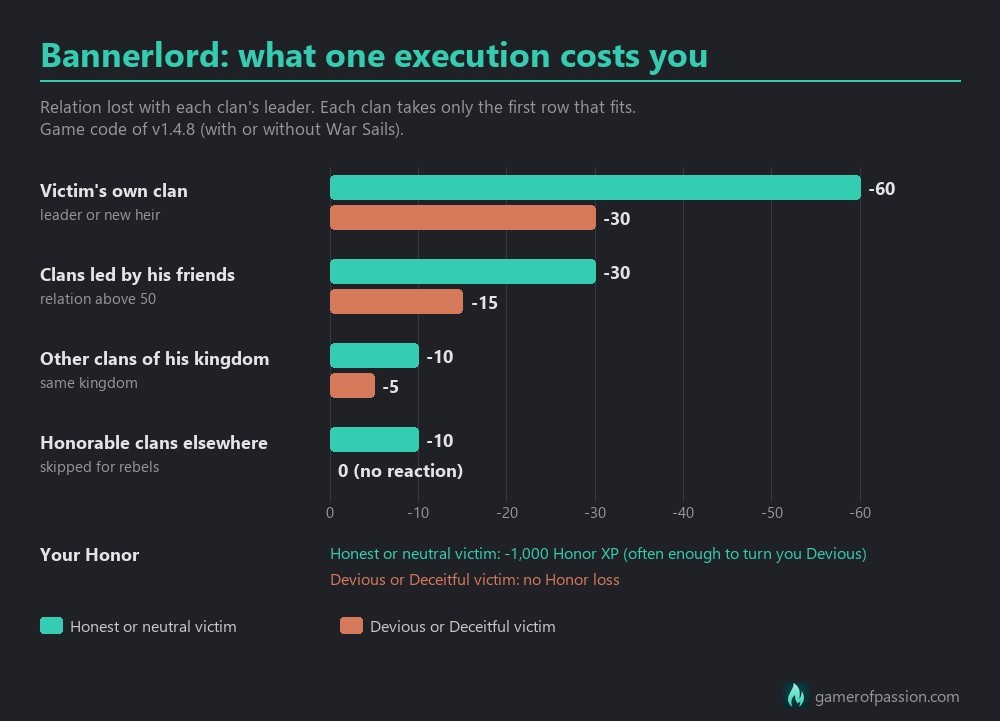
One execution of an honest or neutral lord will cost you 60 relation with his clan, 30 with every clan led by one of his friends, 10 with the other clans of his kingdom and 10 with every Honest or Honorable clan leader elsewhere, plus 1,000 points of hidden Honor. A Devious or Deceitful lord is cheaper at 30, 15 and 5, and he costs no Honor at all. It is worth it when you want a clan or a whole kingdom gone for good, because killed lords of noble clans are never replaced by new adults, and it is rarely worth it for a single lord you happened to catch.
Execution penalties
When you execute a lord, the game will go through every clan on the map except your own and only score its leader. Each clan takes only one hit, the first line of the table below that fits it. A clan in the victim’s kingdom that is led by one of his friends will lose the 30 for the friendship and nothing more.
| Who reacts | Honest or neutral victim | Devious or Deceitful victim |
|---|---|---|
| The victim’s own clan (its leader, or the heir who takes over) | −60 | −30 |
| Any other clan whose leader is the victim’s friend (relation above 50) | −30 | −15 |
| Other clans of the victim’s kingdom | −10 | −5 |
| Every other clan led by an Honest or Honorable leader (not if the victim is a rebel) | −10 | 0 |
| Your Honor (hidden trait XP) | −1,000 | 0 |
The hit lands on your relation with the clan leader, and every member of that clan will show the same number, because the game reads their relation with you through him.
The honorable clan line is what makes honest victims so expensive. When the victim is honest or neutral, every other Honest or Honorable clan leader on the map will lose 10 relation with you, whether he leads a kingdom clan, a minor faction or a mercenary band. Some players report 23 or 36 clans hit by one execution while others mostly see small -5 lines, and the difference is the victim. An honest lord triggers the map-wide -10, and a Devious one does not.
Mind that for an honest or neutral victim, the -10 from his kingdom-mates comes without a message, and they are not part of the “The execution has hurt your relations with X clans” count either.
Friends of the victim
Before you execute someone, open his encyclopedia page and check his Friends list. Every friend there who leads another clan will drop 30 with you, or 15 if the victim was Devious. A friend is anyone with a relation above 50 with the victim, which is the same check the encyclopedia uses for that list. The list leaves out his close family, though, so a father, brother or grown child who leads another clan can react too.
Clan leaders and heirs
Executing a clan leader does not dodge the clan penalty. His heir takes over first, starts at 70% of the old leader’s relation with you, and only then takes the -60 (or -30 if the victim was Devious). If the old leader was at -20 with you, for example, the heir will start at -14 and end at -74. The execute preview does not show his clan in this case, so the real hit is bigger than the list suggests.
If he was the last adult lord of his clan, the clan will disappear instead. There is no clan penalty then, and his kingdom no longer counts as his kingdom, so only his friends and, for an honest or neutral victim, the honorable clan leaders will react.
Devious and Deceitful lords
Executing a Devious or Deceitful lord is the cheap version. His own clan will drop 30, his friends 15, the lords of his kingdom 5, and honorable clans elsewhere do not care. This works correctly in 1.4.8, because the old bug that treated every executed lord as honorable was fixed in patch 1.3.0.
Honor loss
Each execution of an honest or neutral lord costs exactly 1,000 hidden Honor XP. It does not touch Mercy or any other trait, and it gives you no Roguery or Charm experience either. Your Honor level depends on that hidden XP:
- Deceitful at -4,000 or lower
- Devious from -3,999 to -1,000
- neutral from -999 to +999
- Honest from 1,000 to 3,999
- Honorable at 4,000 or more
Right after character creation, your XP sits at a fixed value: 0 if you are neutral and 1,000 if you are Honest (the “you treated people well” background is the only one that gives Honor). You cannot start Honorable, but if you continue as an Honorable heir, the XP is reset to 4,000. From there, a neutral character will turn Devious with the first execution and Deceitful with the fourth. An Honest one will drop to neutral after one and Devious after two, and an Honorable one drops to Honest with the first, to neutral with the fourth and to Devious with the fifth. The XP stops at -6,000, so executions past that point cost no more Honor.
Later in a campaign your XP can sit anywhere inside its band, which shifts the count a little bit. A neutral player with +300 from quests will stay neutral after one execution. Devious also starts at exactly -1,000, so a fresh neutral character who turned Devious with one execution is going to be back to neutral with the next Honor reward of any size.
To win Honor back, finish quests that reward it (usually +30 to +50, a few +100) and pick the honest answer in the random camp and travel events that came with 1.3 (+100 to +300). Those events have a cooldown of 8 to 15 days and are switched off during the War Sails naval storyline. Releasing lords raises relation, but it does nothing for your Honor. From the -6,000 floor, you will need +2,001 XP to get back to Devious and +5,001 to reach neutral.
How to execute a lord
You can execute a captured lord in two places:
- Right after a battle, by picking “Do not expect mercy. Off with your head!” in the conversation with each captured lord.
- On the party screen, by clicking the skull next to a lord in your prisoner list. This only works on the open campaign map or at sea.
Inside any town, castle or village, on the post-battle loot screen and during any other encounter, the skull will be greyed out with the tooltip “Cannot execute hero right now”. Simply leave and open the party screen on the map. Lords under 18 show the same tooltip, because they cannot be executed at all, and regular troops never get a skull in the first place.
Lords in your dungeon cannot be executed there, so take them into your party, leave the settlement and do it on the map. The party screen will then ask you to confirm, and hovering over its Execute button lists the clans that are going to lose relation (hold ALT if there are more than eight). Once you confirm, the lord dies on the spot, and nothing in the game will bring him back.
“Off with your head!” after a battle
The post-battle line costs exactly the same Honor and relation as the party-screen Execute, but it skips the relation preview, and the bill arrives later. After his protest, you can still back out with “Fine then. You are my prisoner now.” If you answer “I care not. Prepare to die!” instead, the lord is marked for death and will die at his next daily update, usually within a day. That is when the Honor loss and the relation hits land, and their messages pop up a day after the execution, so it is easy to miss what they are for.
Beware that if you started the campaign with Birth and Aging turned off, this option never kills anyone and costs nothing. Use the party screen instead.
Who cannot be executed
Ordinary kingdom, minor and mercenary lords are never protected, even if they gave you a quest. The exceptions are town and village notables tied to an active quest, the main story characters until the story is done, and the War Sails story heroes (Gunnar, Purig, Bjolgur, Lahar, Emira al Fahda and Salautas Crusas) until you finish the naval quest “Free the Sea Hounds’ captives”, unless you canceled the naval storyline.
Is executing lords worth it?
An execution is one of the few ways to remove an adult lord permanently. Killed lords of the big kingdom clans are never replaced by new adults, and those clans only grow back through children who come of age at 18 and through lords who marry into them. A prisoner, on the other hand, can come back through a ransom, an escape or the next peace deal.
A single execution will probably not change much, though, since a dead clan leader’s heir simply takes over the clan and its fiefs. The real effect starts once you empty whole clans, because a clan that loses its last adult lord is destroyed along with its war parties. One player who executed all 84 Vlandian lords in a single campaign saw Vlandia stop forming armies and ask for peace again and again before the kingdom was destroyed.
The costs come in several forms:
- your relations, which drop by the amounts in the table above and add up quickly with the map-wide -10
- your Honor, since a few executions are enough to make you Devious or Deceitful
- mercenary and vassal offers, because a kingdom only offers you a contract while its ruler’s relation with you is -10 or higher
- recruiting, since persuading a clan leader to join your kingdom gets hard at a relation of 0 or less and very hard at -10 or less
- your own safety, because any lord below -30 with you has a small chance to execute you if he captures you
Two things you may read about do not happen in 1.4.8. No AI kingdom can vote to expel your clan, so executions never get you kicked out. Your companions will not leave over executions either, because executions never touch your own clan’s relations.
I would say executing is worth it when you are going to finish the job: a clan you can wipe out completely, a kingdom you plan to destroy anyway, or the last adult of a clan, whose death costs you no clan penalty at all. For a single honest lord you happened to catch, a ransom or a release will usually do more for you than his head.
Executing a king or ruler
Executing a king does not automatically hand the crown to his son. If his clan still has an adult heir, the realm will vote on a new ruler from its three strongest clans, and his family usually has the edge because it still holds the throne while the vote is counted. The kingdom only falls if he leaves no adult heir and it has no other vassal clan. If his clan dies with him, his towns and castles will go to the new ruling clan.
Executions will not make the AI declare war on you directly. If you rule a kingdom yourself, though, every point of bad blood that other rulers and their lords hold against you makes them a bit keener to declare war on you and less willing to vote for peace. As a vassal, your own relations do not enter that calculation.
Of course, a king is also worth a lot alive. A wealthy king of a 20-fief kingdom, for example, sells for about 17,000 denars at a ransom broker.
Wiping out clans and kingdoms
A clan dies when its leader dies and no other adult noble of the clan is alive to take over. Killing any member other than the leader never ends a clan, and the order does not matter, because leadership passes down until the last adult standing is the leader. A captured member sitting in someone else’s dungeon still counts as an heir.
When a clan ends, its war parties vanish, its children and any other remaining members simply disappear from the game, and its towns and castles pass to the ruling clan of its kingdom. A destroyed clan never comes back. New noble clans only come from town rebellions, from companions you raise to vassals and from the conspiracy at the end of the main story.
A kingdom ends when its ruler dies without an adult heir and no other vassal clan is left, and every mercenary clan in it goes down with it. It also ends when it loses its last town or castle. Its leftover noble clans then have 28 days to find a new kingdom or a fief before they are wiped out too.
Mercenary and minor clans
Minor factions and mercenary companies are different. Every day, each empty slot below four members has a 10% chance to be filled by a new 19-year-old member, which refills a single empty slot in about ten days on average. To wipe one out, you are going to have to capture every adult member and execute them all at once, before those rolls refill it.
Executing rebels
Executing a rebel will cost you the same 1,000 Honor as executing any other honest lord, and almost every rebel leader is Honor-neutral. His rebel clan’s leader takes the usual -60 and any clan leader who counted him a close friend -30. The only thing you save is the -10 from honorable lords all over the map.
Once a rebel clan has held its town for 30 days, it becomes a normal clan, and executing its members costs the full penalty again. If it loses its town before that, the AI cleans up by itself. Every rebel held prisoner by an AI lord’s party is executed the next day, and rebels sitting in a dungeon or in your own party just disappear, which is the only time AI lords execute anyone besides you.
Can lords execute you?
When you are captured, the game checks once: if the capturing party is led by a lord whose relation with you is below -30, there is a 2% chance he executes you, and it will happen as soon as the next menu opens. The relation that counts here is between his clan leader and you, nudged by up to 4 points by your and his Honor, Valor and Mercy.
Nothing else counts. His cruelty does not matter, the lords you have executed only matter through the relation they cost you, and there is no second roll however long you sit in his cells. Bandits, caravans and town garrisons never execute you. Since the chance is a flat 2%, it makes no difference whether he is at -31 or at -100 with you. Make sure to have an heir in your clan if you plan to make a lot of enemies, because without one your campaign ends there.
In v1.4.8 the AI never executes your companions, your spouse, your children or anyone else in your clan. If they are captured, they will sit in a cell until they escape, are ransomed, are freed by peace, or you rescue them, for example with a prison break. The only person in your clan the AI can execute is you.
What to do with prisoners instead
Ransom offers
If you hold a lord, his clan has a 20% chance each day to send a courier with an offer, and 12% a day after you have declined once. Declining will not lower the next offer, while the time he spends in your cells will raise it. The first offer is about the broker price, and after five to ten weeks it can reach about 3.4 times that.
The value depends on his level, his clan’s tier, his rank and his own gold, and it scales with the number of towns and castles his kingdom holds (1.2 times with 12 fiefs, 0.44 times with 3). For an example minor lord that comes to about 1,800 denars, and for a rich clan leader about 6,100.
The money always comes from one person’s own purse (his clan leader’s, or a random relative’s if he leads the clan himself), so an offer only arrives when that person can afford it, and a lord with no other living lord in his clan never gets one. Peace frees the captured lords of the other side, so accept an offer or sell him before a war ends.
Selling to the ransom broker
The tavern ransom broker will buy lords as well as troops. He will pay a lord’s full value at once (25% more with Ransom Broker), and the lord goes free. Castles have no broker. Beware that the quick “Ransom your prisoners” option sells every prisoner you have not locked, lords included. For regular soldiers he pays a quarter of the troop’s recruitment cost, and Manhunter adds 20%:
| Prisoner | Ransom broker price | With Manhunter |
|---|---|---|
| Looter or tier 1 recruit | 5 denars | 6 denars |
| Tier 3 infantry | 25 denars | 30 denars |
| Tier 4 cavalry | 87 denars | 104 denars |
| Tier 5 infantry | 100 denars | 120 denars |
| Tier 6 cavalry | 275 denars | 330 denars |
Every troop you sell gives Roguery experience, and bandit prisoners are worth five times their ransom value in the village quest Landowner Needs Manual Laborers.
Donating for influence
Donating prisoners to a castle or town of your own kingdom that your clan does not own gives a little influence per prisoner, from about 0.4 for a looter to about 1.9 for a tier 6 horseman, and about 4 to 10 for a lord. Mercenaries can do it too. Additionally, donating a lord to a fief whose owner is not on good terms with him raises your relation with that owner.
Recruiting prisoners
Each prisoner type needs a fixed amount of conformity before one of them can join: 134 for a tier 1 troop, 474 for tier 3 and 1,359 for tier 6. Your party earns 10 conformity an hour plus 1 for every 20 points of your Leadership, and that gain goes to one prisoner group at a time, so a long mixed list will fill up slowly.
Only the party leader’s perks count. Fervent Attacker (tiers 1 to 3) or Stout Defender (tier 4 and up) add 50%, Loyalty and Honor adds 30% for non-bandits, Promises 30% for bandits, and Lead by Example (infantry) or Trusted Commander (ranged troops) another 50%. With Leadership 150, the tier perk and Loyalty and Honor, a tier 3 prisoner is ready after about 15 hours and a tier 6 one after about 43, against about 136 hours without Leadership or perks.
At sea most of these perks will switch off and the infantry and archer perks only give half, while War Sails’ Rolling Thunder adds 50% for captured pirates. Prisoners in a castle or town dungeon never build conformity, but they keep what they earned in your party when you take them back out.
Recruiting a captured clan leader
You can only recruit a lord while he is your prisoner if you rule your own kingdom. A captured clan leader, held in your party or in a dungeon of your own fief, will then give you the dialogue option “I have an offer for you: join us, and be set free.” It starts the same persuasion as with a free lord, followed by a barter, and his clan joins your kingdom if it works. It does not work on his kingdom’s ruling clan or if you failed with him recently.
The line “Your liege, X, is not worth of your loyalty.” never appears for prisoners. You only get it with a free lord of a kingdom at war with yours, through “There is something I’d like to discuss” (at peace, the same persuasion starts with “Candidly, what do you think of your liege, X?”), and vassals can use it too, to recruit for their ruler.
Releasing a lord
Letting a lord go after a battle with “You have fought well. You are free to go.” gives +4 relation, and so does choosing “I have decided to free you. You may go.” when you talk to a lord in your prisoner list or your own dungeon. Your Charm raises that (about +10 at Charm 300), and each gain also gives you a big chunk of Charm experience. Releasing him from the party screen, selling him or letting peace free him gives no relation at all.
Keeping lords from escaping
Each captive lord will roll an escape once a day. In your own party of 81 or more healthy men the chance is 4% a day, and where you keep him changes it a lot.
| Where the lord is held | Escape chance per day | Gone within 10 days |
|---|---|---|
| In your party, 100 healthy men, no perks | 4% | 34% |
| In your party, you alone | 8% | 57% |
| In your party, Mounted Patrols or Keen Sight (one of them), on land | 2% | 18% |
| In your party, Mounted Patrols + Keen Sight, on land | 0% | 0% |
| In your party, Mounted Patrols + Keen Sight, at sea | 2% | 18% |
| Your own fief’s dungeon, no governor perks | 2% | 18% |
| Your own dungeon, governor with Sweet Talker, Dungeon Architect and Mounted Patrols | 0.1% | 1% |
| An ally’s or AI lord’s dungeon | 4% | 34% |
| A companion’s party of your clan, 60 men | 8.9% | 60% |
Mounted Patrols (Riding 225) and Keen Sight (Scouting 225) are the two Bannerlord perks that matter here. On the party leader, which is you in your own party, they take off 50% each, so together they stop daily escapes completely on land. It does not matter who your scout is, because Keen Sight’s prisoner bonus is read from the leader. At sea Keen Sight stops working, so with both perks a lord still has a 2% daily chance to escape while you sail, and Ransom Broker (Roguery 200) cuts that to 0.8%.
A lord with Fleet Footed gets +30% and will be able to slip out again unless you also have Ransom Broker, and if your party ends up on rafts after losing its ships, every lord you hold escapes at once. In a fief, the governor’s Sweet Talker, Dungeon Architect and Mounted Patrols cut the dungeon chance by 20%, 25% and 50%, down to 0.1% a day with all three.
Prison limits and peace
Your party can hold 10 prisoners plus one for every two healthy men, more with Terror, Manhunter and Vantage Point (+10 each) and Stamina (+5, not at sea). For every prisoner over the limit there is a 10% chance each hour that someone escapes, soldiers first, and the extra prisoners will slow your party down.
Peace frees only captured lords, on both sides, wherever they are held, while ordinary troop prisoners will stay yours. When you take a castle or town, the lords in its dungeon will ask if they are free, and letting one go gives +10 relation.
War Sails and the 1.5 beta
War Sails did not add a new execution system. The only execution rule change in the 1.3 patch notes, which went live together with War Sails, is the 1.3.0 fix: “Executing devious lords now no longer affects honor, and the negative relation penalty is smaller than when executing an honorable lord.” Patches 1.4.0 to 1.4.8 changed no execution rules, although 1.4.0 moved “You are my prisoner now” back to the top of the post-battle options.
Blood Feuds, the system that makes executions far more dangerous, only exists on the PC beta branch (1.5.0, opened in August 2026) and is not in live 1.4.8. Going by its patch notes:
- Executing a member of another clan can start a feud with that clan.
- AI clans can start one by executing one of your clan members when relations are low (at least -50), influenced by the captor’s Mercy.
- During a feud, the rival clan always executes you if it gets the chance, its captors become more likely to execute your clan members each day, up to a guaranteed chance on day 10, and no ransom offers between the two clans are allowed.
- A feud can be settled at a ransom broker, with compensation if you executed more of their family than they did of yours, and it also ends once the two clans are back at 0 relation.
The beta notes also say executions affect Mercy, while on live 1.4.8 they only touch Honor. If you play the beta, your family can be executed too. On live 1.4.8, the only one at risk is still you.
Common questions
Is it a good idea to execute lords in Bannerlord?
Only when you want a clan or a kingdom gone for good. A single execution costs a lot of relation and Honor, while the victim’s clan simply passes to the next adult.
What is the penalty for executing a lord?
Up to -60 relation with his clan, smaller hits with his friends, his kingdom and honorable clan leaders elsewhere, and 1,000 Honor XP if he was honest or neutral.
What happens if you execute a king?
If his clan has an adult heir, his kingdom votes on a new ruler among its three strongest clans, so his son is not guaranteed the crown. If he leaves no adult heir and the kingdom has no other vassal clan, the kingdom is destroyed.
What happens if you execute everyone?
Each clan you empty of adults is destroyed for good, and its fiefs go to the ruling clan. Once the ruler dies with no adult heir and no vassal clan left, or the kingdom loses its last fief, the kingdom is gone too.