
When you want to terraform a planet in Stellaris, you first need Terrestrial Sculpting, a tier 2 Society technology that lets you change the climate of an uncolonised planet inside your borders for 2,000 energy and 5 years within the same climate group, or 5,000 energy and 10 years across groups.
Two more techs complete the set. Ecological Adaptation will let you terraform planets that you have colonised, and Climate Restoration opens up Tomb Worlds, Nanite Worlds and Barren worlds with the Terraforming Candidate modifier (Frozen and Toxic candidates need a perk as well). The nine normal planet classes (Continental, Ocean, Tropical, Desert, Arid, Savanna, Arctic, Alpine and Tundra) can all be turned into each other, while Molten worlds and Gas Giants have no terraforming option at all.
Gaia Worlds ask for a little bit more, because they are going to cost you an ascension perk. World Shaper turns any of the nine normal classes into a Gaia World for 7,500 energy and 10 years, although a few DLC routes skip the perk, such as Gaia Seeders, the Last Baol relic and Astrocreator Azaryn.
Everything below is for the PC version on patch 4.5.3, and routes that need a DLC are marked. Most costs, timers and requirements were read straight out of the 4.5.3 game files, with the official patch notes for what changed along the way.
Contents
- How to unlock terraforming
- How to terraform a planet
- Planets you can terraform
- Terraforming modifiers
- Gaia worlds
- What to terraform first
- Special planet types
- Common mistakes
- Recent changes
- Terraforming questions
- Conclusion
How to unlock terraforming
All terraforming hangs on three Society technologies from the New Worlds category, and each of them adds one kind of planet you can change. You will draw them from your research options like any other tech, so a bit of luck is involved.
| Step | Tech or perk | What it unlocks |
|---|---|---|
| 1 | Terrestrial Sculpting (Society tier 2) | Terraforming of uncolonised planets in your borders |
| 2 | Ecological Adaptation (Society tier 3) | Terraforming of inhabited (colonised) planets |
| 3 | Climate Restoration (Society tier 4) | Tomb Worlds, Barren/Frozen/Toxic candidates, Nanite Worlds |
| Perk | World Shaper: Climate Restoration + 1 earlier perk | Gaia terraforming, Terraforming Cost -25% |
| Perk | Hydrocentric: Terrestrial Sculpting + aquatic species | Ocean cost -25%, Frozen candidates and Gaia to Ocean |
| Perk | Detox: Climate Restoration, Toxoids Species Pack | Toxic candidates to any of the nine normal classes |
| Perks | Hive Worlds / Machine Worlds: Climate Restoration + 2 perks | Conversion into Hive World / Machine World |
Terrestrial Sculpting is the entry tech. Its only prerequisite is New Worlds Protocol, which every empire starts with, so what you are really waiting for is the tier 2 gate (six researched tier 1 Society techs) and the draw itself. It lets you terraform any planet of the nine normal classes that sits in your borders and has no colony on it, and it also gives you the Terraforming Gases edict.
Ecological Adaptation comes next and will let you terraform planets that already have a colony on them. Until you research it, your own colonies stay off limits, whatever other terraforming tech you own.
Climate Restoration is the last of the three. It will let you restore Tomb Worlds, turn Barren Terraforming Candidates and Nanite Worlds into normal planets and bring a Hive World or Machine World back to a normal class. It is also the requirement for the World Shaper, Detox, Hive Worlds and Machine Worlds ascension perks, although an empire with the Resource Consolidation origin can take Machine Worlds without it.
Bear in mind that Climate Restoration does not replace Ecological Adaptation. If a Tomb World or a candidate already has a colony on it, you will need both techs before you can touch it.
Getting Climate Restoration
Climate Restoration is not new, and no 4.x patch note has changed it. It is, however, one of the more frustrating techs to chase. As a tier 4 tech (base cost 8,000 research), it will only enter the draw once you have researched six tier 3 Society techs, and then it competes with every other Society option.
You can raise your odds a little:
- Adopting the Expansion tradition tree makes it 25% more likely to appear.
- A scientist with the Expertise: New Worlds trait on your council raises the draw chance of every New Worlds tech, this one included.
- With Galactic Paragons, the Conquer Nature council agenda (Adaptability tree, not for Machine Intelligence empires) adds the next terraforming tech you are missing as a research option with 25% progress, so it will only hand you Climate Restoration once you own the other two.
- Some events can grant it outright, such as a Fallen Empire’s tech gift or an event from Federations.
Additionally, the Baol Secrets project (Ancient Relics) gives you Terrestrial Sculpting outright if you have researched Epigenetic Triggers, otherwise Epigenetic Triggers, and in both cases a permanent terraforming discount.
Five ascension perks build on these techs. World Shaper adds Gaia terraforming and makes all terraforming cheaper, Hydrocentric (Aquatics Species Pack) is the ocean perk, Detox (Toxoids Species Pack) opens up Toxic candidates, and Hive Worlds and Machine Worlds let gestalt empires convert planets into their own world types. Our ascension perks ranking shows how they compare to the rest.
How to terraform a planet
There is nothing to build first. You start a terraform from the planet itself, with the Terraform button in the planet view, and the game will list every option for that planet with its cost, its duration and the habitability it will give your species.
The button only works when the planet meets a few conditions:
- It has to be inside your borders.
- Uncolonised planets need Terrestrial Sculpting, and colonised ones need Ecological Adaptation as well.
- Nobody can be colonising it at that moment.
- It cannot be one of the Consecrated Worlds.
- If your Pre-Sapient policy protects them, a planet with pre-sapient pops is off limits.
- Planets with a metallic crust (Cosmic Storms) cannot be terraformed either.
Lithoid Devouring Swarms cannot terraform at all.
Climate groups
The nine normal classes come in three climate groups of three: the wet group (Continental, Ocean, Tropical), the dry group (Desert, Arid, Savanna) and the cold group (Arctic, Alpine, Tundra). A terraform inside a group costs 2,000 energy and takes 5 years at base speed, and a terraform into another group costs 5,000 energy and takes 10 years.
These groups matter because they decide habitability, which is how well a species can live on a planet class. A species has 80% habitability on its preferred class, 60% on the other two classes of its group and 20% on the six classes of the other groups. At 0%, your pops lose 50% Job Efficiency and 50% Pop Growth Speed, and our trait tier list goes through the traits that move these numbers.
For your main species, a terraform within its own group will lift a yellow 60% planet to 80%, and a cross-group terraform lifts a red 20% planet to 80%. When you change the class, though, you are going to change habitability for every species living there at the same time, for better or worse.
On a colonised planet, the pops can also get the Ongoing Terraformation modifier, which lowers their happiness until the work is done. A world whose stability is already shaky is a poor first target.
What a terraform removes
Once the planet class changes, the planet loses the modifiers that belonged to its old surface. That includes bad ones like Bleak, Hostile Fauna, Hazardous Weather and Irradiated, good ones like Hyper Ecosystem and Docile Fauna, and the Terraforming Candidate tag itself. Any mining or research station in its orbit is removed as well, and the planet can no longer get colony events.
Deposits are a different matter. A normal terraform, Gaia included, keeps the planet’s deposits, and resource features that only fit the old climate are swapped for the matching feature of the new class. Hive World and Machine World conversions are much harsher, because they delete almost every deposit but keep strategic-resource features such as Dust Caverns, Crystal Forests and Fuming Bogs (Hive Worlds also keep the Tree of Life). Make sure to check a planet’s features before you turn it into an Ecumenopolis, Hive World or Machine World.
Planets you can terraform
The nine normal classes can all become each other, a handful of special worlds can become normal ones with Climate Restoration (Volcanic Worlds with a tech of their own), and everything else stays as the galaxy generated it.
| From | Can become | Cost and time | Needs |
|---|---|---|---|
| Wet, dry or cold class | The other two classes of its climate group | 2,000 energy, 5 years | Terrestrial Sculpting (+ Ecological Adaptation if inhabited) |
| Wet, dry or cold class | Any class of the other two climate groups | 5,000 energy, 10 years | Terrestrial Sculpting (+ Ecological Adaptation if inhabited) |
| Any normal class | Gaia World | 7,500 energy, 10 years | World Shaper perk |
| Barren World with Terraforming Candidate | Matching climate / wet / opposite climate | 5,000 / 10,000 / 15,000 energy, 10 / 15 / 20 years | Climate Restoration |
| Frozen World with Frozen Terraforming Candidate | Ocean only | 5,000 energy, 10 years | Hydrocentric + Climate Restoration (Aquatics Species Pack) |
| Toxic World with Toxic Terraforming Candidate | Any normal class | 10,000 energy, 20 years | Detox + Climate Restoration (Toxoids Species Pack) |
| Tomb World | Any normal class | 10,000 energy, 20 years | Climate Restoration |
| Normal class, Tomb, Gaia, Barren candidate | Hive World or Machine World | 10,000 energy, 20 years | Hive Worlds or Machine Worlds perk |
| Nanite World | Any normal class | 1,000 energy, 1 year | Climate Restoration (The Machine Age) |
| Volcanic World | Any normal class | 5,000 energy, 2.8 to 13.9 years | Volcanic Terraforming, rare tech (Infernals Species Pack) |
| Molten, Gas Giant, Asteroid | None | None | Cannot be terraformed |
| Ecumenopolis, Relic World, Habitat, Ring World | None | None | Cannot be terraformed |
Terraforming Candidates
A Terraforming Candidate is a Barren, Frozen or Toxic World with a special modifier that marks it as fit for terraforming. Without that modifier, those three planet types cannot be terraformed, apart from Astrocreator Azaryn’s Gaia route for Barren Worlds (Galactic Paragons).
Barren candidates need Climate Restoration, and the price depends on the climate the planet started with. A warm Barren World is cheapest to turn into a dry class and a cold one into a cold class, at 5,000 energy and 10 years, and the opposite climate costs the most.
Frozen candidates can only become Ocean Worlds. For that you need Hydrocentric (Aquatics Species Pack), Climate Restoration and an aquatic species, so Climate Restoration alone will not do it.
Toxic candidates need the Detox perk (Toxoids Species Pack) and Climate Restoration, and they can become any of the nine normal classes. Knights of the Toxic God who tame the Toxic God get the same option without the perk, although they still need Climate Restoration.
Candidates are rare. At galaxy creation, each Barren World between size 10 and 30 has about a 1% chance to become one, which the developers’ own note in the files puts at about 20 in a huge galaxy. A mid-sized Toxic World has about a 13% chance with the Toxoids Species Pack, so Toxic candidates are far more common. The Habitable Worlds galaxy setting scales these rolls, and a low setting will give you fewer of them, although they can still appear. Mars in the Sol system is a fixed candidate.
Tomb Worlds
A Tomb World is a planet ruined by nuclear war or a similar disaster, and few species want to live on one. Climate Restoration will turn it back into any of the nine normal classes for 10,000 energy, but the work takes 20 years.
You will find most Tomb Worlds already sitting in the galaxy, while Armageddon or Javorian Pox bombardment that brings a world down to 50 pops or fewer, pre-FTL nuclear wars and some events create new ones. A normal empire cannot terraform a planet into a Tomb World. Only Relentless Industrialists (Toxoids Species Pack) get that option, once the study from their policy is finished.
Planets that cannot be terraformed
Molten Worlds, Gas Giants and Asteroids have no terraforming option at all, and neither do Barren, Frozen or Toxic Worlds without the candidate modifier, Ecumenopolises, Relic Worlds, habitats and Ring Worlds. It also only works one way, since no terraform option turns a planet into a Barren, Frozen, Molten or Toxic World or a Gas Giant, although the event-unlocked Toxify World decision (Shadows of the Shroud) can make a world Toxic.
Terraforming modifiers
A handful of bonuses will change what a terraform costs and how long it takes. Speed bonuses are given as a percentage of Terraforming Speed, which shortens the job without cutting it by the same percentage, so +50% speed will not halve the time a terraform takes.
| Source | Effect | Who gets it |
|---|---|---|
| World Shaper (perk) | Terraforming Cost -25%, Gaia terraforming | Regular empires, Wilderness, individualist machines |
| Hydrocentric (perk) | Ocean Terraforming Cost -25% | Aquatic species (Aquatics Species Pack) |
| Genesis Guides (civic) | Terraforming Cost -25%, Terraforming Speed +25% | Its hive, machine, corporate versions too (The Machine Age) |
| Previously Terraformed Planet (planet modifier) | -50% cost, +50% speed | Any terraform of that planet (Cosmic Storms) |
| Baol Secrets project result | Terraforming Cost -15%, permanent | Non-nomads (Ancient Relics) |
| Terraforming Gases (edict) | Terraforming Speed +50% for 0.5 Exotic Gases a month | Any empire with Terrestrial Sculpting, not nomads |
| Cartographer (leader trait) | +25% / +33% / +50% speed | Leader on your council (Galactic Paragons) |
| Conquer Nature (council agenda) | +10% speed while it runs, +40% for 10 years after | Adaptability, not Machine Intelligence (Galactic Paragons) |
| Environmental Control Board / Paradise Initiative | +25% / +75% cost, non-Gaia results count as a breach | Galactic Community |
| Exotic Gas shortage (deficit) | -20% / -40% / -60% / -80% speed by stage | Everyone in an Exotic Gas deficit |
| Wilderness only (BioGenesis) | Speed: Expansion +25%, Adaptability +25%, techs up to +50% | Wilderness, normal empires get none |
World Shaper is the obvious discount, but if you plan your empire around terraforming from the start, the Genesis Guides civic is probably the better deal. It makes terraforming both cheaper and faster without costing you a perk slot, and its hive, machine and corporate versions do the same. All four need The Machine Age, and Natural Design locks you out of Genesis Guides. Our civics tier list has more on them and on the Gaia Seeder civics.
Hydrocentric (Aquatics Species Pack) only cuts the cost of Ocean terraforms, but that cut applies together with World Shaper’s general discount. For an aquatic empire that takes both perks, ocean terraforms get a lot cheaper.
For speed, the Terraforming Gases edict is what most empires will use. It gives +50% Terraforming Speed for as long as it runs and costs Exotic Gases, once up front and again every month (more if your empire is over its size limit). Switch it off when no terraform is running.
With Galactic Paragons, two more speed bonuses open up. The leader trait for terraforming is Cartographer (World Shaper only exists as a perk), and a leader with it on your council speeds up terraforming depending on the trait level, and the Conquer Nature agenda gives a small bonus while it runs and a much bigger one for 10 years after you launch it. Cosmic Storms, Ancient Relics and Federations add a few more through planet modifiers, relics and events.
Two Galactic Community resolutions work against you. Environmental Control Board and The Paradise Initiative both raise Terraforming Cost, the second one by 75%, and while either of them is in force, finishing any terraform that does not end in a Gaia World counts as a breach for 10 years. If you terraform a lot, vote against them.
An Exotic Gas shortage will slow every terraform down. The Expansion tree, colony ship and infrastructure techs and the Expansionist stance also speed up terraforming, but only for Wilderness empires, and a normal empire gets nothing from them.
Gaia worlds
A Gaia World is its own planet class, and it counts as the ideal planet for nearly every species. Its pops get +10% Resources from Jobs, +10% Happiness, +15% Pop Growth Speed and +100% Habitability, and unemployed pops are 50% more likely to resettle there automatically.
That +100% Habitability will bring almost every species to 100% on a Gaia World, even species that prefer Ring Worlds or Tomb Worlds, which makes these planets great for empires with many species. A few species are different:
- Noxious species still stop at 70%, because the trait lowers their maximum by 30%.
- Void Dwellers keep their -30% Happiness and -15% Job Efficiency on any planet that is not artificial, Gaia Worlds included.
- Species with Adapted Habitability from a Mutation Authority can go up to 125%, Mutagenic Habitability species with Environmental Integration up to 175%, and with Empowered Environmental Integration up to 250%. Our Biomorphosis guide explains those caps.
A Gaia World gives you no extra room, though. It keeps the normal district set, so a City District there holds 200 specialist jobs at base, while an Ecumenopolis, Hive World or Machine World holds 600 and a Ring World segment 1,000.
Gaia Worlds that the game generates never roll negative planet modifiers like Hazardous Weather or High Gravity, and they are more likely to come with Natural Beauty, Lush, Rich Microflora or special resource deposits. That only helps with Gaia Worlds you find, because terraforming a planet into one does not reroll its features.
A Gaia World is not a dead end either. With the right perk, it can still become a Hive World, a Machine World, an Ocean World (Hydrocentric) or an Ecumenopolis through the Arcology Project. Apart from Ocean, though, there is no way back to Continental, Desert or any other normal class.
Ways to get a Gaia World
World Shaper is the standard route. Besides the nine normal classes, it can turn a Tomb World, a Barren candidate or a Nanite World into a Gaia World if you also have Climate Restoration, and the Nanite World is by far the cheapest of them. There is no separate Gaia Creation or Atmospheric Manipulation technology in 4.5.3, so the perk and the routes in the table are all you have.
| Route | Needs | Cost and time | DLC |
|---|---|---|---|
| World Shaper from any normal class | World Shaper perk, planet in your borders | 7,500 energy (Wilderness 3,500 Biomass), 10 years | Base game |
| World Shaper from a Tomb World or Barren candidate | World Shaper + Climate Restoration | 12,500 energy (Wilderness 6,000 Biomass), 25 years | Base game |
| Continental with Previously Terraformed Planet | Terrestrial Sculpting, no World Shaper | 2,000 energy, 5 years base (planet: -50% cost, +50% speed) | Cosmic Storms |
| Gaia Seeders (4 phases) | Idyllic Bloom or Mycorrhizal Ideal, upgraded capital | 4 x 1,500 energy + Exotic Gases, 4 x 480 days | Plantoids Species Pack |
| Gaia Seeder Outpost on a subject | Idyllic Bloom or Mycorrhizal Ideal overlord | 1,500 energy + 200 Exotic Gases, Gaia 10 years later | Plantoids Species Pack |
| Last Baol relic + Nu-Baol Life-Seeding | Activate the relic for Unity | 3,000 Unity base, 2 years, one per 10 years | Ancient Relics |
| Astrocreator Azaryn (3 uses) | Recruit her, planet size 10+, habitable or Barren | 10,000 energy per use | Galactic Paragons |
| Composer of Strands: Transformation accord | Composer of Strands as patron (psionic) | 50 Zro every 10 years, size-10 Gaia at once | Shadows of the Shroud |
| Life-Seeded origin | Pick it at empire creation | A size-30 Gaia homeworld with rare features | Apocalypse |
| Solarpunk pre-FTL system (Helito / Dacha) | Conquer the pre-FTL owners, if it spawned | War, six Gaia Worlds (sizes 7 to 25) | First Contact |
Several DLC routes skip the perk entirely:
- With Cosmic Storms, a Continental World can come with the Previously Terraformed Planet modifier, and that planet becomes a Gaia World with Terrestrial Sculpting alone, plus Ecological Adaptation once you have colonised it.
- Idyllic Bloom and Mycorrhizal Ideal empires (Plantoids Species Pack) build Gaia Seeders in four phases, and as an overlord they can build a Gaia Seeder Outpost on a subject’s planet. On an existing Gaia World, the final seeder makes the Bloomed and Budding traits of its pops 50% stronger instead.
- The Last Baol relic (Ancient Relics) will give you one Gaia World every 10 years through the free Nu-Baol Life-Seeding decision, which also adds 400 Nu-Baol pops.
- Astrocreator Azaryn (Galactic Paragons) will turn three planets of size 10 or more into Gaia Worlds, Barren worlds included, and dies after the third.
- The Composer of Strands’ Transformation accord (Shadows of the Shroud) turns an uninhabitable world in your borders into a size-10 Gaia World every 10 years, but the game picks the planet for you.
- Life-Seeded (Apocalypse) starts you on a size-30 Gaia World, but your species only likes Gaia Worlds, which is why our origins tier list rates it so low.
- With First Contact, a pre-FTL Solarpunk civilisation that owns six Gaia Worlds can spawn, although not in every galaxy.
Is World Shaper worth it?
For most empires, I would say no, or at least not early. World Shaper takes one of your few ascension perk slots, it needs Climate Restoration and one earlier perk, so at the earliest it is your second pick, and the Gaia Worlds it gives you keep the normal districts. For the same slot, Arcology Project, Hive Worlds or Machine Worlds will give you planets with three times the jobs per district.
Its discount simply does not add up to much. World Shaper cuts every terraform by 25%, which saves you 500 energy on a terraform within a climate group and 1,250 on one across groups, so you would need six cross-group terraforms to save the price of a single Gaia World.
It is a different matter when habitability itself is your problem. World Shaper is worth a slot if:
- many species share your planets and no single climate suits all of them,
- you play with Mutagenic Habitability and Environmental Integration, since Gaia lets those pops go past 100%,
- you started as Life-Seeded, where it is the most reliable way to get more planets your species likes,
- you play a Wilderness empire, which cannot take Hive Worlds,
- or your galaxy has very few habitable worlds.
Otherwise, take it late or skip it. Regular empires (organic, lithoid or MegaCorp), individualist machine empires and Wilderness empires can take World Shaper, while other Hive Minds cannot, Machine Intelligences only as Rogue Servitors or Driven Assimilators, and Nomads not at all. Also, World Shaper does not make Ocean Worlds. That is what Hydrocentric is for.
What to terraform first
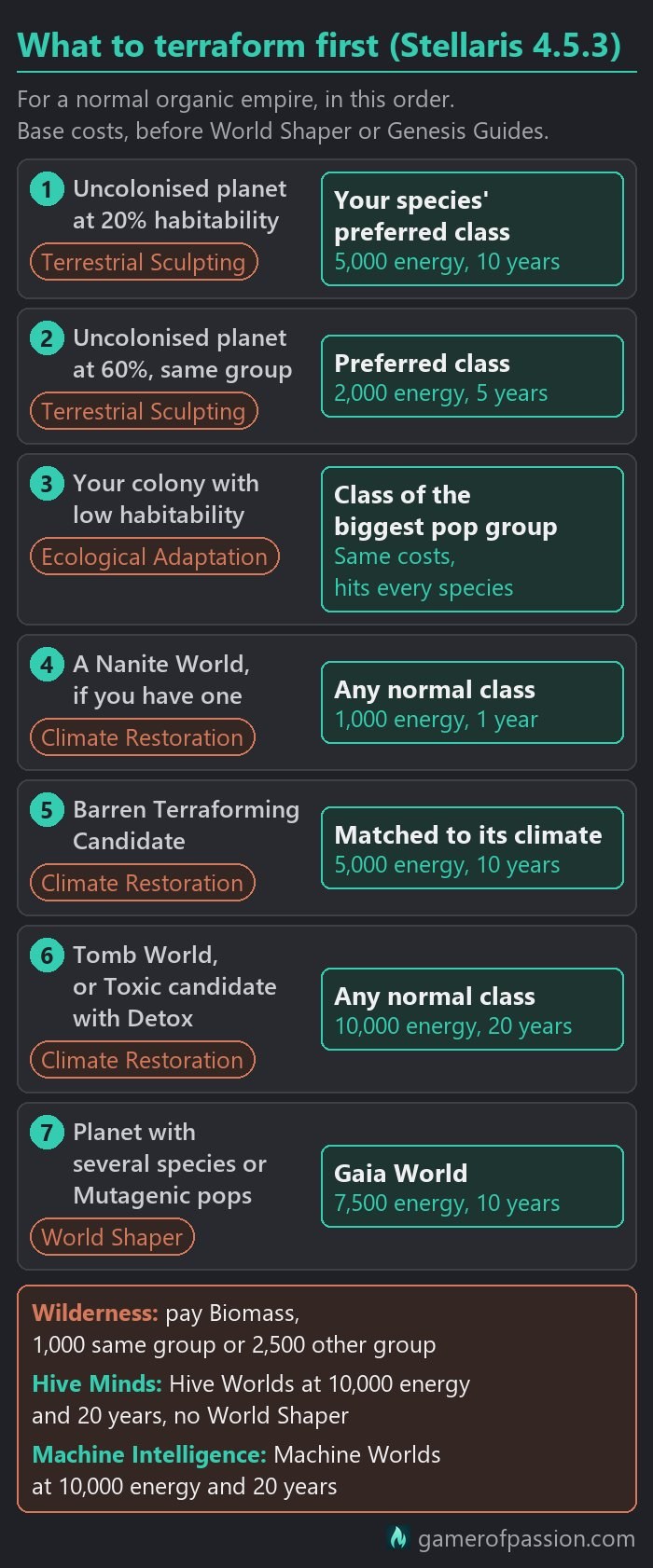
For a normal organic empire, I would go in this order. All costs are base costs, and everything needs only Terrestrial Sculpting unless it says otherwise.
- An uncolonised planet in your borders at 20% habitability (red) for your main species. Terraform it into your species’ preferred class for 5,000 energy and 10 years. That is +60 habitability points, about 83 energy per point and the best value of any early terraform, and since nobody lives there yet, you have no pops to worry about.
- An uncolonised planet at 60% (yellow, same climate group). It costs 2,000 energy and 5 years for +20 points, which is cheaper and twice as fast, so do it when energy is tight or you want the colony sooner.
- Your own low-habitability colonies, once you have Ecological Adaptation. The costs are the same, but the class change hits every species on the planet, so pick the class of the biggest pop group.
- A Nanite World, if you have one, after Climate Restoration. At 1,000 energy and 1 year to any normal class, it is the cheapest terraform in the game (The Machine Age).
- Barren Terraforming Candidates after Climate Restoration, but only into the classes that match their climate. Warm Barren to Desert, Arid or Savanna and cold Barren to Arctic, Alpine or Tundra cost 5,000 energy and 10 years, while wet targets cost 10,000 and 15 years and the opposite climate 15,000 and 20 years.
- Tomb Worlds, with Climate Restoration, at 10,000 energy and 20 years. Leave them for when energy piles up, unless your species likes Tomb Worlds anyway. Toxic candidates (Detox perk, 10,000 energy, 20 years) belong in this step too.
- Gaia Worlds with World Shaper, at 7,500 energy and 10 years each, on planets that hold several species or Mutagenic pops. The perk is only worth it if you will make several of them.
If colonising in general is still new to you, our beginner guide explains how to pick your first colonies. Gestalt and Wilderness empires play by different rules, though:
- Wilderness empires (BioGenesis) colonise by terraforming and pay Biomass instead of energy on planets they have not colonised yet, 1,000 within a climate group and 2,500 across groups (5 and 10 years), or 500 Biomass and 3 years to re-seed an uncolonised world of their own starting climate group. Stay with your preferred class and treat Gaia (3,500 Biomass with World Shaper) as a late luxury.
- Hive Minds should work toward the Hive Worlds perk (Climate Restoration and two earlier perks). Any normal class, Gaia World, Tomb World or Barren candidate can become a Hive World for 10,000 energy and 20 years, with three times the jobs per district.
- Machine Intelligences should work toward Machine Worlds (Climate Restoration or the Resource Consolidation origin, plus two earlier perks), at 10,000 energy and 20 years per planet. Climate terraforms help machines less. A machine climate trait gives 75% on all three classes of its climate group and 50% on the six others, which means a terraform within a group gains them nothing and one across groups only 25 points.
Special planet types
Gestalt worlds
Leaving a Hive World or Machine World costs as much as making one: 10,000 energy and 20 years back to a normal class, and you need Climate Restoration.
Machine Worlds are uninhabitable for most organic species, and finishing the conversion will kill part of the organic population on the planet (cybernetic pops are spared). Resettle your organic pops before it completes.
Evolutionary Predators hive minds on the Mutation path (BioGenesis) are a special case. Every 5 years, the game will start a Hive World conversion on their capital, then on another populous planet once the capital is done. The free planet decision Prevent Hive World Growth exempts a planet and stops a conversion that is already running.
Nanite Worlds
A Nanite World is the cheapest special world to fix. With Climate Restoration, it becomes any of the nine normal classes in a single year, and the Nanite Worlds from The Machine Age can also become a Gaia World with World Shaper. Their terraform options are hidden if you adopted the Nanotech tradition tree, so decide early which way you want to go with them.
Volcanic Worlds
Volcanic Worlds (Infernals Species Pack) need their own tech. Once you have Deep Crust Engineering and Terrestrial Sculpting, Volcanic Terraforming (a rare tier 2 Society tech) can appear among your research options, three times as often when a Volcanic World sits in your borders. Every normal class costs 5,000 energy, while the time depends on the class: Desert takes under 3 years, Arid and Savanna 5, Ocean almost 14 and the rest 10.
Going the other way is much harder. Normal empires cannot terraform anything into a Volcanic World. Planet Forgers get the Volcanic Forge building instead, which slowly turns its planet into a Volcanic World (faster with more Miners and Metallurgists), and empires on the Galactic Hyperthermia crisis path can pick Volcanic as a terraform target from the path’s third level on.
Toxic Worlds
Nomadic empires cannot research the terraforming techs, but since 4.5.2, nomadic Knights of the Toxic God who tame or slay the Toxic God can use their Arkships to detoxify Toxic Terraforming Candidates into habitable worlds. Detox and the Knights both need the Toxoids Species Pack, which you will find fairly high in our DLC tier list.
Worlds that stay as they are
An Ecumenopolis is not made by terraforming at all. It comes out of the Arcology Project decision (200 influence and 10,000 alloys, 10 years), which works on a Gaia World too, and after that the planet cannot be terraformed again. Relic Worlds, habitats and Ring Worlds cannot be terraformed either. When you run out of planets worth terraforming, our guides on habitats and Ring Worlds show you the alternatives.
Common mistakes
The most common one is waiting for Climate Restoration to terraform your colonies. It will never do that, because colonised planets of any kind need Ecological Adaptation.
Planning World Shaper as your first ascension perk will not work either. It needs one earlier perk and Climate Restoration, so your second slot is the earliest it can go.
On a colony with several species, match the new class to the biggest pop group, even if a smaller species loses some habitability.
Keep an eye on the Galactic Community, too. Two of its resolutions make every terraform more expensive and count anything but a new Gaia World as a breach.
Never turn a planet with organic pops into a Machine World without moving them out first. Part of the organic population will die when the conversion completes.
Check deposits before any Hive World or Machine World conversion, because most of them will be deleted. A Gaia World also loses its Wenkwort modifiers as soon as it stops being a Gaia World.
Finally, do not build a mining or research station around a planet you are about to terraform, because the terraform removes it when it finishes.
Recent changes
These patches touched terraforming, Gaia Worlds or the habitability display:
- 4.2 gave Gaia Worlds +15% Pop Growth Speed and let Knights of the Toxic God terraform Toxic candidates if they spare the Toxic Entity.
- 4.2.3 made Hive World and Machine World terraforms keep special deposits such as the Life-Seeded ones.
- 4.3 made Wenkwort modifiers go away when a planet stops being a Gaia World, and Wilderness empires now pay Biomass to terraform a Volcanic World into a normal one.
- 4.4.4 let the Baol Life-Seeding decision target artificial worlds, where it grants a unique deposit instead.
- 4.5.2 let nomadic Knights of the Toxic God detoxify Toxic candidates with their Arkships.
- 4.5.3 (4 November 2026) fixed the habitability shown in the terraforming panel and the colonisation view for species that can go above 125%, and the Deluge Machine can now turn Gaia Worlds into Ocean Worlds.
Patch 4.6 and Willpower are due on 23 November 2026, and the dev diaries so far announce no terraforming changes.
Terraforming questions
Do Gaia worlds count as wet worlds?
No. Gaia Worlds are not part of any climate group, so they do not count as Wet worlds. Aquatic species still take no dry-world penalty there, because a Gaia World counts as ideal for everyone.
Is a Gaia World better than an Ecumenopolis?
Not for raw output. An Ecumenopolis gets +20% Resources from Jobs against the Gaia World’s +10%, and three times the jobs per district. What a Gaia World has going for it is the price, 7,500 energy and 10 years with no alloys or influence, and it keeps its farming, mining and generator districts. Since the Arcology Project also works on a Gaia World, you can make a Gaia World first and turn it into an Ecumenopolis later.
Can Hive Minds get Gaia Worlds?
Yes, just not through World Shaper, which is closed to every hive mind except Wilderness. A Mycorrhizal Ideal hive gets Gaia Seeders, the Last Baol relic works for any empire that holds it, and a psionic hive with the Composer of Strands can use its Transformation accord. Most hives are probably better off with Hive Worlds anyway.
Does terraforming cost more on bigger planets?
No. Every terraform has a flat price, so a big planet costs exactly as much as a small one, and neither the number of pops nor the size of your empire changes it. The only terraforming cost that grows with your empire is the Exotic Gases for the Terraforming Gases edict, which rise once you are over your empire size limit.
Conclusion
Terraforming is cheap and fairly early for what it gives you, as long as you pick the right targets. Get Terrestrial Sculpting, fix the red and yellow planets in your borders before you settle them, and add Ecological Adaptation for your own colonies. Climate Restoration and the special worlds can wait until your energy income can carry 10,000-energy projects, and World Shaper is simply a perk for empires whose real problem is habitability, which most empires do not have.