
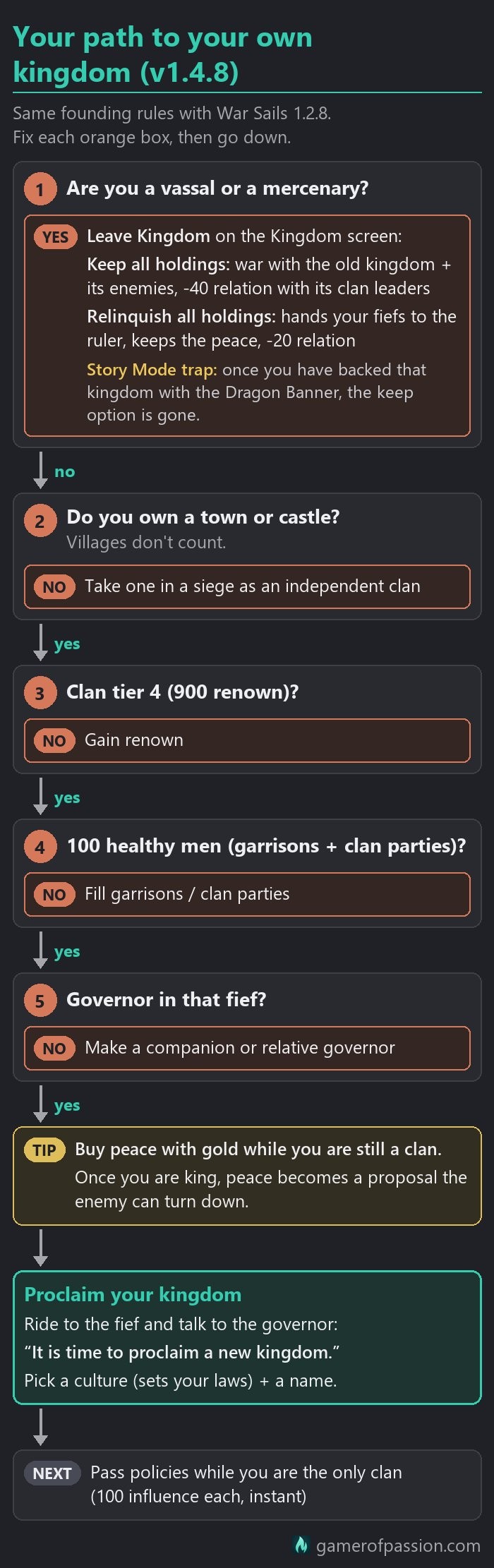
If you plan to start your own kingdom in Bannerlord, you will need clan tier 4, a town or castle, 100 healthy men and a clan that serves no other kingdom, and then you proclaim it by talking to the governor of your fief.
The proclamation itself only takes a minute. Whether your kingdom survives its first year is decided by everything around it: where your first fief sits, which wars you carry into the new realm, how much gold you have saved and which policies you pass before anyone else gets a vote.
Every requirement, cost and line of dialog in this guide was checked against the code of the live version, v1.4.8 with War Sails 1.2.8, while the advice on gold, timing and where to settle is my own.
Before the option appears at your governor, you will need:
- Clan tier 4, which is 900 renown
- At least one town or castle owned by your clan (villages do not count)
- 100 healthy men across your garrisons and all of your clan’s parties
- Independence, which means you are neither a vassal nor a mercenary of any kingdom
- A companion or family member as governor of that town or castle
Once you have all five, ride to that fief, talk to the governor and pick “It is time to take a momentous step… It is time to proclaim a new kingdom.” The kingdom itself costs you no gold and no influence.
Contents
- Kingdom requirements
- How to create a kingdom
- Three ways to get there
- Getting your first fief
- Preparing your clan
- Can you create a kingdom without war?
- First policies to pass
- Recruiting lords
- Running your new kingdom
- The main quest
- Patch history
- FAQ
- Conclusion
Kingdom requirements
The game only checks four things before it lets you found a kingdom, and as mentioned above, none of them is a price. There is no age limit either.
| Requirement | Value | What counts |
|---|---|---|
| Clan tier | 4 (900 renown) | Clan renown, same tier in the main quest |
| Fief | 1 town or castle | Owned by your clan, villages don’t count |
| Troops | 100 healthy men | All your fiefs’ garrisons + all your clan’s parties |
| Independent clan | Not a vassal, not a mercenary | The governor’s kingdom line is hidden otherwise |
| Governor | Companion or adult relative | Talk to that governor in his fief |
| Cost | No gold, no influence | Only your garrison and peace money |
| Culture | Your clan’s, or that of a town or castle you own | Decides your starting laws, you can’t pick laws one by one |
| Name | 1-50 characters, unique | No special characters, leave ‘The’ out |
Clan tier 4 means 900 renown, and while your clan is still at tier 3, its renown tooltip lists “Eligible to create a Kingdom” among the rewards of the next tier. If you are still a little bit short, winning battles and tournaments is the way to close the gap.
The fief has to be a town or a castle. Villages do not count, and a small castle meets the rule just as well as a rich town.
The 100 men are counted across your whole clan. The game adds up the healthy troops in the garrisons of all your fiefs and in every war party your clan has, your own and your companions’ included. Wounded soldiers do not count.
Mind that the Story Mode quest journal only counts the men in your own party. It can therefore show fewer than 100 while you already qualify.
A mercenary contract counts as serving a kingdom, just like a vassal’s oath. While you serve one in either way, your governor will simply not offer the founding line at all. Once you are independent, the line appears, and if you still miss a requirement, it stays greyed out with the reason in its tooltip.
The governor is easy to overlook. Any member of your clan can govern a fief as long as it is not you and the hero is not leading a party, a child, a prisoner or travelling. Usually that will be a companion, and my guide to Bannerlord companions lists the best candidates for the job.
You cannot reach your own governor from a distance either, so you are going to have to ride to the fief.
How to create a kingdom
Start by putting the governor in place. Open the clan screen, go to your fiefs, select the town or castle and assign a companion or relative as governor. Then ride there, enter the keep and talk to the governor.
Among the usual options you will find “It is time to take a momentous step… It is time to proclaim a new kingdom.” From there, the conversation goes like this:
- The governor will ask whose language and customary laws the new realm should use.
- You choose a culture, three per page. “I have another people in mind.” brings up the next page.
- The governor will then list the policies that this culture’s law is going to institute. “Very well.” accepts them, while “Perhaps we should choose another set of laws and customs.” takes you back to the cultures.
- “I’ll name it…” opens a text box for the kingdom’s name.
- “So it shall be.” proclaims the kingdom, and a short cutscene will play.
The cultures on offer are your clan’s own culture plus the culture of every town and castle you own. A Battanian clan holding a Vlandian castle, for example, can choose Battanian or Vlandian law, but Aserai law will never be on its list. You cannot pick laws one by one either, since every culture comes with a fixed set of starting policies:
- Empire: Senate, plus Coastal Guard Edict with War Sails
- Aserai: Council of the Commons and Senate
- Sturgia: Lawspeakers and Precarial Land Tenure
- Vlandia: Feudal Inheritance and Castle Charters
- Battania: Cantons and Lawspeakers
- Khuzait: Grazing Rights and Sacred Majesty
- Nords (War Sails only): Lawspeakers and Precarial Land Tenure
Apart from the laws it brings, the kingdom’s culture does nothing for loyalty, though. The loyalty penalty for a foreign town compares your clan’s culture with the town’s, and picking a kingdom culture does not fix it. The kingdom culture still matters in Story Mode, where it decides whether you are building Istiana’s empire or Arzagos’ kingdom, and lords who share it are a little bit easier to recruit.
The name can be 1 to 50 characters long, without special characters, and it must not match an existing kingdom. I would leave “The” out of it, since plenty of game messages already put “the” in front of a kingdom’s name.
There is no banner choice, as the kingdom simply takes over your clan’s banner and colors. The ruler can rename the kingdom later from the kingdom screen.
Three ways to get there
There are three realistic routes to a fief and independence, and the biggest difference between them is how many enemies you will start with.
| Route | What you need | What it costs you | Best for |
|---|---|---|---|
| Independent clan conquers (or buys) a fief, then founds | Win a siege as a clan, tier 4, 100 healthy men, a governor | Only the war with the fief’s former owner, peace money | Recommended default, cleanest start |
| Vassal leaves with fiefs, then founds | A fief won in a vote, ‘Keep all holdings’, not in an army | War with the old kingdom + all its enemies, -40 relation | Fastest fief for players already serving |
| Main quest (Istiana or Arzagos) | Dragon Banner, same requirements, within 20 years | Conspiracy wars at 2,000 strength, peace locked | Story completionists only |
Taking a fief as an independent clan
The cleanest start is to stay out of every kingdom and take a fief yourself. When an independent clan wins a siege, the town or castle belongs to it outright, with no vote and no liege who gets it first.
Attacking the fief will put you at war with its owner, but that can stay your only war, and you avoid the relation hit with a whole kingdom that comes with walking out on a liege. As long as your clan has no kingdom, AI kingdoms never pick you as the target of a war declaration either. That gives you time to buy peace and to grow before you proclaim anything.
The drawback is recruiting. Until the kingdom exists, you cannot recruit lords, free or captured, and you cannot hire mercenary clans.
Leaving a kingdom with your fiefs
If you are a vassal and have already won a fief or two, you can take them with you through “Leave Kingdom” on the kingdom screen. Asking your ruler in person to release you means surrendering every fief you hold. The kingdom screen gives you two options:
- “Keep all holdings” keeps every town and castle, but you will go to war with your old kingdom and with every faction it is fighting, and you will lose 40 relation with the leader of each of its clans.
- “Relinquish all holdings” will hand your fiefs to the ruler and keep the peace, at a cost of 20 relation with each of those clan leaders.
Only the first option leaves you with a fief to build on. There is no minimum time you have to serve, but you cannot leave while you are in an army, held prisoner or in the middle of an encounter. Additionally, you will lose the workshops you own in the towns of every kingdom you are now at war with.
Story Mode adds one trap. Once you have presented the Dragon Banner to the ruler you serve, the keep option disappears. Leaving will fail your quest, and your fiefs stay behind with the ruler.
Istiana or Arzagos
With all three pieces of the Dragon Banner, Istiana gives you “Create an Imperial Faction” and Arzagos gives you “Create a Non-Imperial Kingdom”. Neither quest lowers the bar, and you found the kingdom through the same governor dialog.
Afterwards, you go back to the mentor and declare the banner, which completes the step and starts the conspiracy. That conspiracy will eventually lock you into wars without a peace option until you have beaten each enemy down to half of what its towns, castles and troops were worth at the start.
Which route is best?
Personally, I would go with the first route whenever the map allows it. You start with a single war that you chose yourself, you keep your relations with the lords you will want to recruit later, and you inherit nobody’s enemies.
Leaving with “Keep all holdings” is quicker if you are already a vassal with fiefs, but you are going to start with your old kingdom and all of its enemies against you. The main quest route is really only for players who want to see the story through. Everyone else can found a kingdom in Story Mode without ever declaring the banner.
Getting your first fief
As a vassal, every fief you capture will go to a vote among the kingdom’s clans. A clan without a town or castle gets a big bonus in those votes, and so does the clan that took the fief, which gives a fiefless vassal a good shot at its first one.
As an independent clan, the siege decides everything. Win it and the fief will be yours.
When you can choose the target, look for the following:
- A town with a castle next to it. The town brings in the taxes for your garrisons, while the castle is usually easier to take, can never revolt and has villages that give noble recruits.
- Fiefs that touch each other, ideally in a corner of the map with only one or two neighbours.
- Your clan’s own culture, since a town of another culture is going to fight you on loyalty every single day.
- A rebel town, or a fief of a kingdom that is busy losing a war elsewhere. A rebel town has no big kingdom behind it, and a kingdom in trouble has fewer armies to spare.
Port towns and island fiefs from War Sails count exactly like any other fief. Do not treat an island as a shield, though, because the game measures borders by land and sea routes. If you settle on the coast, a few solid ships will make moving troops and food a lot easier, and my guide to the best ships will help you choose them.
There is also a way without a siege. The Trade perk Everything Has a Price at Trade 300 lets you trade settlements in a barter, but for most characters, taking a castle by force will be far quicker than getting Trade that high.
Preparing your clan
Meeting the four rules is easy. Getting through the first year as a king is harder, and most of that work happens before you ever talk to the governor.
Gold comes first. Founding is free, but peace deals, recruiting lords and bigger garrisons are not. A reserve of 3 to 5 million denars is a comfortable cushion, and I would not go much below 1 million.
Workshops are one of the easiest ways to build that money, and my workshop guide shows which ones earn the most on the current patch.
Your army should be well beyond the 100 men the rule asks for. Fill your garrisons, stock your fiefs with food and give your companions parties of their own. Once you are king, calling your own clan’s parties into an army costs no influence at all, and my troop tier list will help you decide which troops deserve a place in them.
Your spouse joins your clan when you marry, which makes a good match one of the cheapest ways to get another governor or party leader (my guide to the best wife or husband goes through the candidates).
Make sure that you or a companion has Stonecutters or Siege Engineer, both at Engineering 150, if you want fire siege engines, as the perk has to sit on your party’s Engineer. Clan tier 5 is no requirement, but it is worth waiting for if you want the Noble Retinues policy, which only helps clans of tier 5 or higher.
Influence is harder to stock up on. A clan without a kingdom gets no influence at all from battles, sieges or raids, and the only steady sources are supporter notables, influence buildings, the Immortal Charm perk and some quests. After a long spell as an independent clan, you are going to start your reign with very little of it.
Release captured lords instead of executing them. Every clan leader you plan to recruit later will be cheaper if he likes you and your clans.
Finally, pick your moment. The best time is while your neighbours, or the kingdom you just left, are tied up in other wars. Buy peace with gold for every war your clan still has, because that option closes the moment you are king. Then save the game and make the proclamation.
Can you create a kingdom without war?
Yes, at least on the day you found it. Proclaiming a kingdom will not start a single new war. Your new kingdom will only take over the wars your clan already has, and after a “Keep all holdings” exit, that means your old kingdom plus every enemy it had.
That is why the order matters so much. As an independent clan, you can end a war by talking to any lord of the enemy kingdom who is not a mercenary and choosing “Our realms should make peace.” A barter screen will open, and you can add gold until they accept.
Once you are king, that line will no longer work. Their lords will answer that they do not have the authority, and peace becomes a kingdom proposal that costs 100 influence and that the enemy can refuse. If the enemy is far ahead in a war that started less than 150 days ago, you cannot even propose it, as the game greys the proposal out with “The enemy is not open to negotiations.” The terms can also include a daily tribute for 100 days.
There is no grace period after founding either. Any AI kingdom with a town or castle next to yours can vote for war on you, and the chance grows when:
- you are weak compared with that kingdom
- your fiefs are rich and worth taking
- it is fighting few other wars
- many of your fiefs share its culture
- its ruler and lords dislike you
Good relations will not protect you, by the way. Only a negative relation adds to a kingdom’s wish for war.
Since patch 1.4.5, a kingdom with no town or castle bordering yours will not declare war on you at all. Borders count land and sea routes, which is why an island does not keep you out of trouble by itself. After a peace, the same kingdom also has to wait at least 20 days before it can vote for war on you again.
AI kingdoms will sometimes offer you peace on their own. Declining that popup costs you no influence, and since 1.4.5, neither does ignoring or closing it.
First policies to pass
Every policy proposal costs 100 influence. While your clan is the only clan in the kingdom, a proposal will pass the moment you make it, with no vote and no extra support costs.
Your first recruited lord or companion clan ends that window, and from then on every policy will go to a real vote. A hired mercenary clan may already end it too, which is why you should ideally pass your policies before you hire mercenaries as well.
| Policy | Effect | When to pass it |
|---|---|---|
| Disavow Lawspeakers | +1 influence a day above 100 Charm, else -1 | Day one, if your Charm is 100 or less |
| Sacred Majesty | +3 influence a day for you, other clans -0.5 | While you are alone, doubles the king bonus |
| Royal Guard | Your party +60 troops, vassal clans -0.2 influence a day | Free for you, later it would be a vote |
| Forgiveness of Debts | +2 loyalty a day in every town and castle, workshops -5% | If your clan’s culture differs from the town’s |
| Tribunes of the People | +1 loyalty a day in towns, town tax -5% | With Forgiveness of Debts, cancels Owner Culture in towns |
| Castle Charters | Castle building cost x0.8, cheaper walls and barracks | If you hold castles (Vlandia start has it) |
| Noble Retinues | Tier 5+ clans: +40 party size, -1 influence a day | Only once your clan is tier 5 and can carry -1 a day |
| Trial by Jury | +0.5 loyalty, -1 influence a day for you, -0.2 security | Avoid early |
Look at your starting laws first. Sturgian, Battanian and Nord law all come with Lawspeakers, which gives influence to every clan whose leader has more than 100 Charm and takes it from everyone else, your own clan included. Unless your Charm is above 100, disavowing it should be your first proposal. The policy has only really worked since patch 1.4.5, so older advice that calls it harmless is out of date.
After that, Sacred Majesty is probably the best deal you can get. It doubles your daily king bonus, and the only clans that pay for it are the ones you have not recruited yet. Royal Guard makes your own party bigger and is free for you as well, since it only costs your future vassals a little influence.
Forgiveness of Debts and Tribunes of the People are the loyalty pair. Together they cancel the daily penalty for owning a town of another culture, which is exactly what a conqueror needs. Castle Charters makes castle buildings cheaper and is already part of Vlandian law.
Noble Retinues has to wait until your clan reaches tier 5. Each clan of tier 5 or higher, yours included, loses influence every day under it, so pass it once your income can carry that.
Trial by Jury is best left alone early on, as its small loyalty bonus does not make up for the influence it takes from every clan, including yours. If your culture started you with Senate, Council of the Commons or Feudal Inheritance, simply keep them, since all three pay your own clan influence.
Recruiting lords
As soon as the kingdom exists, you can start recruiting. Talk to the leader of a clan in another kingdom and steer the conversation towards his liege. Win the persuasion and he will either join at once or ask for support, which opens a barter screen where you pay the rest.
The price falls when he:
- holds no towns or castles, since every fief makes him harder to move
- has low Honor, which makes Devious and Deceitful lords much easier to sway
- dislikes his own king
- has good relations with you and your clans
- shares your kingdom’s culture
Your kingdom’s size counts as well. Joining a small kingdom is more attractive, and that bonus shrinks with every clan you add. Members of a ruling clan will always refuse, and if a lord’s price is far too high, he will tell you that neither your purse nor your relationship is deep enough.
Where he comes from decides what happens to his fiefs. A lord whose kingdom is at war with yours will bring his towns and castles along, while a lord from a kingdom at peace with you leaves them behind with his old ruler. Clans of a destroyed kingdom can only be recruited after they have joined another one.
The Athletics perk Imposing Stature multiplies your persuasion success chance by 1.3, and my Bannerlord perk guide covers it together with the Charm, Steward, Leadership, Trade and Engineering perks worth having before you found a kingdom.
Captured clan leaders
Once you rule a kingdom, you can also offer a clan leader you hold prisoner “I have an offer for you: join us, and be set free.” He has to be in your party or in a fief your clan owns, and it will not work on the clan of his own kingdom’s ruler.
Every lord you execute is one you can never ask, and my guide on executing lords explains what an execution does to your relations with the rest of his clan.
Companion clans
Your own companions are the quickest vassals. As ruler, talk to one and choose “I wish to reward you for your services.” It costs 20,000 denars, which go to the companion, and 500 influence. You hand over one of your towns or castles, and the companion founds a tier 2 clan with two new lords and one war party until it reaches tier 3.
The new clan will take the culture of the fief you hand over instead of the companion’s culture. Give a companion a conquered foreign town, and the loyalty penalty for a foreign owner disappears there. Beware that every companion clan is a voting clan, which ends your window for instant policies.
Defections
There is no minimum stay for clans you recruit, but the game weighs leaving a player’s kingdom so heavily that noble clans rarely go. Minor clans are a different story. They join you as mercenaries and can walk away much more easily, especially when your clan owes the kingdom money.
Running your new kingdom
Influence
The king bonus alone will give you 3 influence a day. A war proposal costs 200, peace and policies 100 each, and as long as yours is the only clan, you never pay for support in a vote. Every clan that joins will make votes more expensive, which is one more reason to keep their number modest at first.
Armies
You cannot form an army until your clan is in a kingdom. Once you rule one, calling your own companion and family parties costs no influence, while other lords cost influence depending on relation, strength and distance.
Fief votes
When your kingdom takes a town or castle, its clans vote on who gets it. As king you have the last word, but overruling the clans’ favourite will cost you influence.
Loyalty
If your clan’s culture differs from the town’s, you will lose 3 loyalty a day there. A governor of the town’s culture adds 1, and one of another culture costs 1 more.
A town turns rebellious at 25 loyalty or lower, and it can only revolt at 15 or lower, when its militia reaches 1.4 times the strength of the garrison plus any of your lords inside. Then there is a 25% chance each day. Castles never revolt, and no town will revolt while you are standing in it.
If a town drops to 15, ride there and stay inside until a governor of the right culture, the two loyalty policies and a stronger garrison have sorted it out.
Tribute
Tribute depends on how the war is going. Whichever side is behind will pay a daily tribute of up to 15% of 35% of its own fiefs’ total prosperity, for 100 days. A small kingdom that keeps winning can collect tribute from a big one, while a new kingdom that has lost its first battles will usually be the one paying.
Mercenaries
Mercenary clans are paid every day from the influence they earned, which means mercenaries you keep out of battles and armies cost almost nothing. While you are the only clan, you pay nearly all of that yourself.
Firing one always costs a little relation, and if it still has unpaid influence, you either pay that off or lose more. Make sure your clan’s debt to the kingdom stays below 10,000 as well, or mercenaries will start to leave on their own.
The main quest
The main quest’s kingdom step uses the very same requirements, and you have to complete it within 20 years of the first story phase starting, the same deadline as “Investigate ‘Neretzes’ Folly'”. Older guides still mention 10 years, but the limit was raised to 20 back in patch e1.6.1.
Your kingdom’s culture decides the side. An imperial kingdom completes Istiana’s quest, and any other culture completes Arzagos’ quest. Imperial law is only on offer if your clan is imperial or you own an imperial town or castle.
Declaring the Dragon Banner to your mentor starts the conspiracy. Once its strength reaches 2,000, the three strongest non-imperial kingdoms (on Istiana’s side) or all imperial kingdoms (on Arzagos’ side) will go to war with you. Peace with them stays locked until you have beaten each one down to half of what its towns, castles and troops were worth when the war started, and leaving your kingdom at that point fails the quest.
A kingdom founded without declaring the banner never starts the conspiracy, which makes it the better choice if you mainly want a realm of your own.
Patch history
A lot of kingdom advice online predates these changes:
- e1.6.1 raised the main quest’s first phase from 10 to 20 years.
- e1.6.5 made governors the way to proclaim a kingdom.
- 1.3 added alliances and trade agreements as kingdom decisions and reworked how war, peace and tribute are scored.
- 1.4.5 stopped kingdoms without neighbouring settlements from declaring war on each other, fixed six policies that had no effect before (Lawspeakers and Castle Charters among them), stopped charging influence for closing a peace offer and kept Nord settlements out of the targets of the conspiracy quests.
- War Sails made the Nords a full culture you can found a kingdom with and added eleven naval policies. If you are thinking about a Nord-law kingdom, my post on how strong the Nords really are is a good place to start.
In the 1.5.0 beta, which is not live yet, you can start new games as the ruler of a faction once you have reached King rank in a regular game, executions start Blood Feuds that block defections, and a governor of another culture no longer costs loyalty.
FAQ
How much money do you need to start a kingdom?
None for the proclamation itself, but a reserve of a few million denars will pay for the peace deals, garrisons and lords that come after it.
Why can’t I create a kingdom?
If the governor does not offer the line at all, your clan is still a vassal or a mercenary, or the hero does not govern one of your fiefs. If the line is greyed out, its tooltip will name the missing requirement. Remember that wounded men do not count towards the 100.
What happens if you lose all your fiefs?
Your kingdom will survive. AI kingdoms that lose every fief are destroyed, but the game makes an exception for the player’s own kingdom.
Can you inherit a kingdom instead?
You can, but it is slow. When a ruler dies, the kingdom votes among its three strongest clans, measured by their lords’ skills, their influence and their fiefs, and relations play no part in that vote. Rulers have no hidden longevity either, and deaths from old age can start at 55 for everyone.
Where is the best place to start a kingdom?
A corner or an edge of the map where only one or two kingdoms can reach you, with fiefs of your clan’s culture next to each other. Since 1.4.5, every kingdom you border is one that can declare war on you, and the middle of the map borders almost everyone.
Can you give up your kingdom later?
Yes, the ruler can abdicate from the kingdom screen, as long as no decisions are pending and you are not in a battle or a siege. If yours is the only clan that is not a mercenary, the kingdom will be destroyed and you will become an independent clan again, keeping its wars.
Conclusion
Proclaiming a kingdom in Bannerlord takes four requirements and a short talk with your governor. The hard part is what you bring into it. If you take your first fief as an independent clan, buy peace with gold before the proclamation and pass your policies while you are still the only clan, your kingdom will probably start out in a much better spot than one that was founded in a hurry.