
Whenever you start to pile up a bit of spare gold in Mount & Blade II: Bannerlord, a workshop is probably going to be one of the first things you spend it on. It keeps earning while you are out on campaign, and it gives you a steady trickle of Trade experience on the side.
Picking the right one is harder than it looks. The same workshop can earn well in one town and sit halted in the next, and a lot of the per-town lists out there date from before patch 1.3 and War Sails, which changed what quite a few villages produce. The numbers here are taken from the game data and code of version 1.4.8 with the War Sails DLC installed, and the town table includes all 57 towns, the four new Nord towns among them.
If you just want a name, the smithy, the olive press and the linen weavery earn the most per day as long as they get enough input. After them come the silversmith, the wool weavery, the tannery and the pottery shop. Which one is best for you depends on what the villages around a town bring to its market, so make sure to check the table for your town before you buy anything.
Best workshop types
Every workshop runs one or more production lines, but only one of them pays you. It is the line that turns a trade good into another trade good, for example olives into oil or flax into linen, and it is the only line that changes the workshop’s capital. If you rank the workshops by the most that line can earn in a day at base item values, after the 100 denars the shop pays its workers every day, you will get the following order.
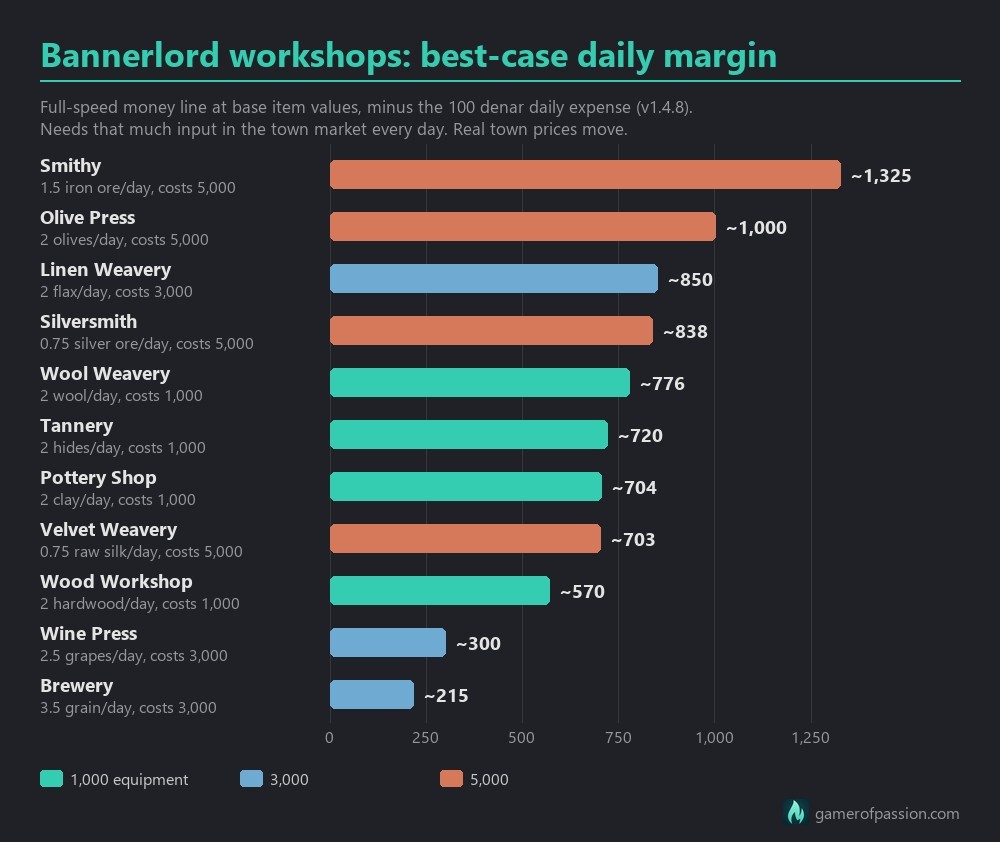
| Workshop | Money line | Cycles per day | Best case per day |
|---|---|---|---|
| Smithy | 1 iron ore into 4 tools | 1.5 | ~1,325 |
| Olive Press | 1 olives into 2 oil | 2 | ~1,000 |
| Linen Weavery | 1 flax into 2 linen | 2 | ~850 |
| Silversmith | 1 silver ore into 2 jewelry | 0.75 | ~838 |
| Wool Weavery | 1 wool into 2 felt | 2 | ~776 |
| Tannery | 1 hides into 2 leather | 2 | ~720 |
| Pottery Shop | 1 clay into 2 pottery | 2 | ~704 |
| Velvet Weavery | 1 raw silk into 2 velvet | 0.75 | ~703 |
| Wood Workshop | 1 hardwood into 2 planks | 2 | ~570 |
| Wine Press | 1 grapes into 2 wine | 2.5 | ~300 |
| Brewery | 1 grain into 2 beer | 3.5 | ~215 |
Of course, these are best cases. They assume that the town market has enough input for every single cycle and that the goods sell at their base value.
Town prices will move around a lot, so the chart tells you which types have the most room to earn, and the gold you actually see is going to be different.
The smithy is at the top because a single iron ore turns into four tools. That being said, a smithy only pays well next to iron mines, because it turns iron into weapons and armour for the town market first, and only the tools make the shop money.
There are eight of these gear lines, and all of them run before the tools line. Between them they can eat up to 4.15 iron ore a day, so in the worst case your smithy alone needs around 5.65 iron ore a day to run its tools line at full speed, and the town’s hidden artisan shop takes up to about 1.7 more before yours gets a turn. That is quite a lot of iron. For reference, an iron mine of medium size makes 10 iron ore a day, which is why the smithy really belongs in towns that have one close by.
The gear lines do not cost the shop any capital. They simply use up iron that the tools line would need.
The wool weavery has a similar but smaller problem. It runs a garment line before its felt line, and that line can take up to one wool a day. The wood workshop is luckier, since its bow, crossbow and shield lines only come after the planks line.
Patch 1.3 changed both of these shops, by the way. The wood workshop now makes planks instead of tools, and the wool weavery makes felt, which is a trade good, so older advice that calls the wool weavery the worst workshop in the game is probably out of date.
The silversmith and the velvet weavery make the most per cycle of all, but they only run 0.75 cycles a day. That makes them slower earners than their margins suggest, and it also means a cycle needs a margin of at least 267 before the game lets it run at all.
At the bottom of the list, you will find the wine press and the brewery. Both of them make cheap goods. A brewery turns grain worth 10 into two beers worth 100 together, and a wine press turns grapes worth 20 into two wines worth 180 together, so even at full speed they cannot keep up with the other types at base prices.
The brewery is also a bit of a trap. A wheat farm of medium size makes 50 grain a day, so if you only match a town’s inputs, a brewery will look like the right pick in a lot of towns. A second brewery in the same town can push the price of beer down fast, and grain is also what the town eats.
The wine press is a different story. At base prices it earns less than every other type except the brewery, but players still like it in towns with several vineyards, since wine sells well where it is scarce.
Town prices for trade goods can climb to ten times their base value or drop to a tenth of it, so in a town that is short of wine the real margin can be a lot higher than the chart shows. In a Reddit thread about the best workshop locations from August 2025, a few months before War Sails came out, the olive press and the wine press were the two favourites, with Jaculan and Dunglanys named as good spots for them. For the olive press, the base values agree with the players.
That makes the wine press a fair pick for towns like Galend or Zeonica, which get grapes from two vineyards and have nothing better on offer.
Best workshop for every town
The table below gives a best pick and a runner-up for each of the 57 towns on the War Sails map.
It looks at the villages that trade with each town at the start of a campaign and how much of each workshop input they make. A village’s output depends on its hearths, so a village with fewer than 200 hearths makes half the normal amount and one with 600 or more makes one and a half times as much. Villages that belong to a town will always trade with that town. Villages that belong to a castle usually trade with the nearest town of the same kingdom, so they are counted for that town.
Hides are a special case. They are made by a hidden artisan workshop in every town, which slaughters the cows that villagers bring in, at most two a day. Cattle farms supply most of those cows and wheat farms add a few, so a tannery needs cattle farms nearby, and the towns where the table says “input short” for it simply do not get enough cattle.
Each workshop type then gets an estimated margin per day at base item values, minus the 100 denar daily wage, and the smithy is only counted after its gear lines have taken their share of the iron. Other workshops in the same town that buy the same goods are not part of it, and neither are caravans that bring goods in from other towns. You should treat the table as a shortlist and have a look at the town’s own workshops before you buy.
A pick marked “input short” means the villages will not deliver enough for that workshop to run at full speed, and all margins are rounded to the nearest 10.
If you would like the raw numbers for every workshop in every town, the fan database bannerlorddb.com lists each town’s workshop inputs and how long a workshop takes to pay for itself.
| Town | Kingdom | Start prosperity | Best pick (est. margin/day) | Runner-up | Local workshop inputs | Notes |
|---|---|---|---|---|---|---|
| Askar | Aserai | 2,100 | Silversmith ~840 | Tannery ~230 (input short) | hides, silver ore | port; without War Sails: Tannery |
| Hubyar | Aserai | 3,200 | Linen Weavery ~850 | Brewery ~220 | flax, hides | without War Sails: Olive Press |
| Husn Fulq | Aserai | 4,200 | Pottery Shop ~700 | Brewery ~220 | clay, hides | |
| Iyakis | Aserai | 1,800 | Pottery Shop ~700 | Brewery ~220 | clay, hides | |
| Qasira | Aserai | 3,500 | Olive Press ~1,000 | Brewery ~220 | hides, olives | port; without War Sails: Brewery |
| Quyaz | Aserai | 4,000 | Olive Press ~1,000 | Brewery ~220 | olives | port |
| Razih | Aserai | 4,500 | Brewery ~220 | – | – | port |
| Sanala | Aserai | 4,300 | Tannery ~390 (input short) | Brewery ~220 | hides | port; without War Sails: Silversmith |
| Car Banseth | Battania | 2,200 | Wood Workshop ~570 | Brewery ~220 | hardwood | port; without War Sails: Silversmith |
| Dunglanys | Battania | 4,000 | Silversmith ~840 | Pottery Shop ~700 | clay, grapes, hardwood, hides, silver ore | without War Sails: Pottery Shop |
| Marunath | Battania | 5,000 | Smithy ~1,330 | Pottery Shop ~700 | clay, grapes, hides, iron ore | |
| Pen Cannoc | Battania | 3,800 | Smithy ~1,330 | Pottery Shop ~700 | clay, grapes, hides, iron ore | |
| Seonon | Battania | 2,400 | Linen Weavery ~850 | Pottery Shop ~700 | clay, flax, grapes, hardwood, hides | |
| Akkalat | Khuzait | 1,700 | Wool Weavery ~780 | Brewery ~220 | wool | |
| Baltakhand | Khuzait | 1,800 | Linen Weavery ~850 | Wool Weavery ~780 | flax, hides, wool | |
| Chaikand | Khuzait | 3,900 | Silversmith ~840 | Wool Weavery ~780 | hides, silver ore, wool | port |
| Makeb | Khuzait | 3,700 | Wool Weavery ~780 | Velvet Weavery ~700 | hardwood, hides, raw silk, wool | port; without War Sails: Smithy |
| Odokh | Khuzait | 1,700 | Smithy ~1,330 | Wool Weavery ~780 | clay, hides, iron ore, wool | |
| Ortongard | Khuzait | 3,200 | Wool Weavery ~780 | Tannery ~720 | clay, hardwood, hides, wool | |
| Gretysfjord | Nords | 3,100 | Tannery ~720 | Wood Workshop ~570 | hardwood, hides | port; War Sails only |
| Hargard | Nords | 3,100 | Smithy ~1,330 | Linen Weavery ~850 | clay, flax, hides, iron ore, wool | port; War Sails only |
| Hvalvik | Nords | 3,100 | Wood Workshop ~570 | Brewery ~220 | hardwood, hides | port; War Sails only |
| Thronderlag | Nords | 3,100 | Smithy ~1,330 | Tannery ~720 | hardwood, hides, iron ore | port; War Sails only |
| Amprela | Northern Empire | 2,300 | Linen Weavery ~850 | Tannery ~720 | flax, hides, raw silk | |
| Argoron | Northern Empire | 2,800 | Tannery ~720 | Velvet Weavery ~700 | hardwood, hides, raw silk | port; without War Sails: Wood Workshop |
| Diathma | Northern Empire | 4,700 | Silversmith ~840 | Tannery ~720 | hides, silver ore | port |
| Epicrotea | Northern Empire | 5,100 | Smithy ~1,330 | Tannery ~720 | hides, iron ore | |
| Myzea | Northern Empire | 3,900 | Wool Weavery ~780 | Tannery ~720 | hides, raw silk, wool | |
| Saneopa | Northern Empire | 4,600 | Linen Weavery ~850 | Velvet Weavery ~700 | flax, hides, raw silk | without War Sails: Tannery |
| Danustica | Southern Empire | 4,900 | Wool Weavery ~780 | Pottery Shop ~700 | clay, hardwood, hides, wool | port |
| Lycaron | Southern Empire | 3,800 | Wool Weavery ~780 | Pottery Shop ~700 | clay, hides, wool | |
| Onira | Southern Empire | 3,400 | Silversmith ~840 | Wool Weavery ~780 | hides, silver ore, wool | without War Sails: Wool Weavery |
| Phycaon | Southern Empire | 2,600 | Pottery Shop ~700 | Velvet Weavery ~700 | clay, hardwood, hides, raw silk | |
| Poros | Southern Empire | 4,500 | Linen Weavery ~850 | Brewery ~220 | flax | port |
| Syronea | Southern Empire | 4,000 | Linen Weavery ~850 | Velvet Weavery ~700 | flax, hides, raw silk | port |
| Vostrum | Southern Empire | 5,100 | Tannery ~230 (input short) | Brewery ~220 | hides | port |
| Balgard | Sturgia | 2,300 | Smithy ~1,330 | Tannery ~720 | hides, iron ore | port |
| Omor | Sturgia | 3,200 | Linen Weavery ~850 | Brewery ~220 | flax, hides | port |
| Revyl | Sturgia | 3,100 | Tannery ~720 | Brewery ~220 | hides | |
| Sibir | Sturgia | 1,900 | Linen Weavery ~850 | Wood Workshop ~570 | flax, hardwood | without War Sails: Tannery |
| Tyal | Sturgia | 1,700 | Wool Weavery ~780 | Tannery ~720 | hides, wool | |
| Varcheg | Sturgia | 3,100 | Tannery ~720 | Brewery ~220 | hides | without War Sails: Linen Weavery |
| Varnovapol | Sturgia | 3,300 | Wood Workshop ~570 | Brewery ~220 | hardwood | port |
| Charas | Vlandia | 3,000 | Olive Press ~1,000 | Brewery ~220 | olives | port |
| Galend | Vlandia | 1,900 | Wine Press ~300 | Brewery ~220 | grapes | port; without War Sails: Olive Press |
| Jaculan | Vlandia | 4,000 | Olive Press ~1,000 | Tannery ~230 (input short) | hides, olives | |
| Ocs Hall | Vlandia | 4,200 | Linen Weavery ~850 | Pottery Shop ~700 | clay, flax, grapes, hardwood | |
| Ostican | Vlandia | 3,900 | Linen Weavery ~850 | Pottery Shop ~700 | clay, flax | port; without War Sails: Pottery Shop |
| Pravend | Vlandia | 3,200 | Wine Press ~300 | Brewery ~220 | grapes, hides | port |
| Rovalt | Vlandia | 2,800 | Smithy ~1,330 | Brewery ~220 | hides, iron ore | |
| Sargot | Vlandia | 4,500 | Smithy ~1,330 | Linen Weavery ~850 | flax, hides, iron ore | |
| Amitatys | Western Empire | 4,400 | Tannery ~310 (input short) | Brewery ~220 | hides | |
| Jalmarys | Western Empire | 2,700 | Wine Press ~300 | Brewery ~220 | grapes, hides | |
| Lageta | Western Empire | 5,200 | Olive Press ~1,000 | Wool Weavery ~780 | grapes, hides, olives, wool | port |
| Ortysia | Western Empire | 5,600 | Silversmith ~840 | Wine Press ~300 | grapes, hides, silver ore | port |
| Rhotae | Western Empire | 4,900 | Silversmith ~840 | Tannery ~720 | hides, iron ore, silver ore | port |
| Zeonica | Western Empire | 4,500 | Wine Press ~300 | Brewery ~220 | grapes, hides | port |
The Nord towns
You will only find Gretysfjord, Hargard, Hvalvik and Thronderlag with War Sails installed. All four have a port and start at 3,100 prosperity.
Hargard and Thronderlag both get iron ore from a nearby castle village, which should be enough for a smithy to reach its tools line at full speed. Gretysfjord gets cattle and a forester, so a tannery is the pick there, with a wood workshop as the runner-up. Hvalvik mostly gets whale oil, walrus tusks and fish, which no workshop uses, so its forester makes a wood workshop the realistic choice there.
In December 2025, a few weeks after War Sails came out, one player on Reddit reported that their workshops in Hargard and Hvalvik were bringing in over 1,000 a day each, with both towns above 10,000 prosperity by then.
Port towns
Out of the 57 towns, 29 have a port. If your own kingdom has the Maritime Weal Edict from War Sails, the workshops you own in those towns will work 25% faster.
The table does not include that bonus, so a port town with a solid pick will do even better under that policy, as long as its villages can keep up with the extra input. Royal Navy Prerogative works the other way and slows your smithies and wood workshops down by 5% if your kingdom has it.
Without War Sails
War Sails changes the type of 30 existing villages, adds 34 new ones in the Nord lands and redraws the map, so some towns get a different best pick on the base map. You will find these marked in the Notes column.
Makeb is a good example. Its village Hanekhy is an iron mine without the DLC and a wheat farm with it, so Makeb is a smithy town in the base game and a wool weavery town with War Sails.
The other towns whose pick changes are Askar, Hubyar, Qasira, Sanala, Car Banseth, Dunglanys, Argoron, Saneopa, Onira, Sibir, Varcheg, Galend and Ostican.
Towns with few inputs
Razih is the poorest town for workshops. Its villages make salt, dates and fish, and the only workshop input they bring in is the bit of grain that almost every village grows on the side, so a brewery is all it can feed. Sanala, Vostrum and Amitatys are not much better off, as the only workshop inputs they get are grain and a few hides.
In towns like these, the warehouse is your best option if you want a workshop to run properly. You can haul the input in yourself, and the shop will take it from there for free. Rich towns with a lot of trade also get goods from caravans, which the table cannot see, so a town like Sanala can still do better than its row suggests. Players have reported well-paying smithies in Sanala both before and after War Sails, even though no iron mine trades with the town.
Buying a workshop
You buy a workshop from the notable who owns it. If you talk to the worker inside, the worker will tell you whose shop it is, and you can then find that notable and ask to buy it.
The price you will pay is the equipment cost of the workshop type, plus four times the town’s prosperity, plus 2,000.
For example, a wool weavery in a town with 2,000 prosperity will cost you 1,000 + 8,000 + 2,000, so 11,000 denars. A smithy in a town with 5,000 prosperity costs 5,000 + 20,000 + 2,000, which comes to 27,000. As you can see, the town’s prosperity drives the price far more than the workshop type does.
The 2,000 at the end is a fifth of the 10,000 capital the shop gets as soon as you own it, and you do not pay that 10,000 yourself.
How many workshops you can own depends on your clan tier. You get one more than your tier, so a tier 0 clan can own one workshop and a tier 6 clan can own seven.
| Clan tier | Renown needed | Max workshops |
|---|---|---|
| 0 | 0 | 1 |
| 1 | 50 | 2 |
| 2 | 150 | 3 |
| 3 | 350 | 4 |
| 4 | 900 | 5 |
| 5 | 2,350 | 6 |
| 6 | 6,150 | 7 |
The game will stop you from buying when you are at your limit, when you do not have enough money, or when the town belongs to a faction that is at war with you. In that last case, you will get the line “You cannot own a workshop in an enemy town.”
Apart from that, you can buy in any town whose owner is at peace with you, and that includes the towns of other kingdoms.
If you want to sell a workshop later, a notable will pay you the sum of the equipment cost, half the town’s prosperity and the shop’s current capital, divided by two. Any goods in your warehouse there are moved to your party when you sell.
How workshops make money
Each workshop has its own capital, and it will start at 10,000 the moment you buy it.
On every cycle of the money line, the shop buys its input from the town market at the town’s price, or takes it from your warehouse for free if you allow it. It will then sell the output to the town market at the town’s price, capped at 1,000 per item, and the town pays for it out of its own gold.
That money does not go to you straight away. Every day, you will be paid a fifth of whatever the shop holds above 10,000. A shop at or below 10,000 capital pays you nothing at all, so after a bad stretch it has to earn its way back above that line before you will see a single denar from it.
The shop also pays its workers 100 denars a day. As long as the capital is above 5,000, that wage is taken from the shop.
Once the shop’s capital is down to 5,000, the daily 100 is taken from your own gold, and it will appear as a workshop expense in your clan finances. The shop is only lost if neither can pay. In that case it goes to a notable, and you will get the notable’s buying price for it.
Not every day is a production day either. Even with input in the market, a cycle on the money line is skipped in three cases:
- The output would not sell for more than the input cost plus 200 divided by the line’s speed. For a silversmith or a velvet weavery, that means a cycle needs a margin of at least 267 before it runs, while a brewery only needs 58.
- The shop’s capital has dropped below the price of the input.
- The town does not have enough gold to pay for the output. In version 1.4.8, storing the output in your warehouse does not get you around this check.
Workshops also train your Trade skill. Every item your workshop puts into the town market, the unpaid weapons and armour from a smithy’s gear lines included, gives you Trade experience based on a tenth of the item’s base value. Output you store in the warehouse gives no experience.
This was bugged before patch 1.3, so if you come across older posts saying that workshops give no Trade XP, that is probably the reason.
Lastly, workshops in a rebellious town will not produce anything, but the 100 a day is still charged. In version 1.4.8, a town counts as rebellious once its loyalty is at 25 or lower.
Why is my workshop not making money?
If your workshop says Halted or your income from it sits at zero, one of these causes will usually be behind it.
| What you see | Likely cause | What to do |
|---|---|---|
| The shop is running, but you get no income | The shop’s capital is at or below 10,000 | Wait. Profit goes into the capital first, and you only get a fifth of what is above 10,000 each day. |
| Halted, with input in the market | The output sells too cheap, often because your own goods or other shops of the same type flood the market, or the capital is below the input price | Switch to another type, or haul the input in yourself and turn on “Get Input from the Warehouse”, since input from the warehouse counts as free in that check |
| Halted, no input in the market | The villages were raided, or castle villages now trade with another town after a war or a change of owner | Fill the warehouse with input and turn on “Get Input from the Warehouse” |
| Halted in a poor town | The town does not have enough gold to pay for your goods | Sell the shop and buy in a richer town, or wait until the town’s gold recovers |
| Nothing is produced, but the wage is still charged | The town is in rebellion | Wait until loyalty recovers, or sell the shop |
| A workshop expense line in your clan finances | The shop’s capital is at 5,000 or below, so you pay the 100 daily wage | Fix the cause above, or sell the shop before it drains your own gold |
| The workshop is gone | A war with the town’s kingdom, or bankruptcy | See the war section below |
Competition is probably one of the easiest causes to miss. Notables run their own workshops in the towns, and if two or three of them make the same goods as you, or the towns nearby do, the price of your output will drop until your cycles stop passing the margin check.
Poor towns are a problem as well. A town that was just besieged or captured will usually be poorer for a while, and raided villages do not produce anything until they recover.
If one of your workshops suddenly stops earning after a war passed through, that is probably why, and it will often pick up again once the town and its villages have recovered.
Changing production
If the workshop you bought makes the wrong thing, you can change its production type by talking to your worker. The game charges the equipment cost of the workshop you switch to (1,000, 3,000 or 5,000), even though the worker’s line quotes the cost of the current one. So if you turn a pottery shop into a smithy, the dialog will say 1,000 and you will actually pay 5,000. It also works the other way, so turning a smithy into a pottery shop will cost you less than the dialog says.
Mind that the dialog only checks your gold against the price it quotes. If you carry less than the new type’s cost, the game simply takes all the gold you have and converts the shop anyway, so do not be surprised by an empty purse.
For reference, the tannery, pottery shop, wood workshop and wool weavery cost 1,000. The brewery, linen weavery and wine press cost 3,000, and the olive press, silversmith, smithy and velvet weavery cost 5,000. Converting also resets the production progress, so the shop starts its cycles from zero.
There is a cheaper way, though. At the start of a campaign, notables build workshops that favour the inputs of their town and avoid doubling up on a type that is already there. As a result, the best workshop for a town often already exists and belongs to a notable. If you buy that one, you will not pay any conversion cost at all.
When a notable gets a workshop back after a bankruptcy or a war, the game switches it to a different type, picked with similar logic plus a look at which inputs are cheap in the town. A shop you sell yourself keeps its type.
Workshops and war
War is the fastest way to lose a workshop. If your kingdom goes to war with the kingdom that holds the town, the workshop goes to a local notable the same day, and you get nothing for it.
The game checks this whenever a war is declared, whenever your clan changes kingdom and whenever a town changes owner. Goods in your warehouse there will be moved to your party if you happen to be in that town. Otherwise they are lost.
This also applies when you serve as a mercenary. Your clan fights the wars of your employer, so a workshop in a town of your employer’s enemy is gone as soon as that war starts. Additionally, the same happens the moment you sign on with a kingdom that is already at war with the town’s owner.
The Trade perk Rapid Development softens this a little bit. Rapid Development pays 5,000 denars per workshop when an enemy captures the town. It pays nothing when you lose a shop because a war was declared.
That leaves a simple rule for where to buy. Workshops in the towns of your own kingdom are safe from war declarations, and you will only lose them if an enemy or a rebellion takes the town. Workshops in a neutral kingdom are lost the day your kingdom and theirs go to war.
If your clan is not part of any kingdom yet, there is no safe kingdom of your own. Attacking a kingdom’s parties, or a crime rating that gets too high, puts you at war with that kingdom, and every workshop you own in its towns goes with it.
If you are still a mercenary or plan to switch sides at some point, it is going to save you a lot of gold to buy in a town that belongs to the kingdom you expect to stay with.
Warehouse
Once you own a workshop in a town, you will also get a warehouse there. You can enter it from the town menu or through your worker, and it holds 6,000 weight, which is about 600 trade goods, since each one weighs 10.
Two options in the Clan screen under Workshops decide how your shops use it. “Get Input from the Warehouse” lets a shop take its input from the warehouse for free, and the shop will go back to buying from the market once the warehouse runs dry. “Store Outputs in the Warehouse” puts a share of the output into the warehouse instead of selling it. You set that share as a percentage, and once the warehouse is full, the shop sells to the market again.
This is what makes a workshop possible in towns without the right villages. You can buy cheap raw goods like iron ore or raw silk somewhere else, haul them to the warehouse, and the workshop will run on them without paying any input price.
Stored output is useful as well, for example when the local price is low and you would rather sell the goods yourself in another town.
Beware that the warehouse goes with the workshop. Selling the shop moves the goods to your party, and losing it to a war while you are away means they are gone.
Perks and policies
A few perks and policies change how fast your workshops produce. Speed only helps if the market has enough input, and a faster shop will also eat more input every day.
- Sweatshops (Steward) gives the workshops you own 20% more production.
- Mercenary Connections (Trade) adds 25% to workshops in a town whose governor has the perk, as long as the governor is in the town.
- The Warehouse project in the town’s building list adds 5%, 10% or 15% at levels 1 to 3. It shares its name with the warehouse you get as a workshop owner, but it is a town building.
- Maritime Weal Edict (War Sails) adds 25% to your workshops in port towns if your kingdom has the policy.
- Royal Navy Prerogative (War Sails) slows your smithies and wood workshops by 5% if your kingdom has the policy.
- Forgiveness of Debts and State Monopolies slow workshops by 5% and 10% when the kingdom that owns the town has them.
Conclusion
A workshop in the right town keeps bringing in gold and Trade experience while you are busy elsewhere, and it can take a fair bit of pressure off your troops’ wages later on.
If you want a simple rule, buy in a town of your own kingdom, pick the type whose input the town’s villages actually make, and check that the notables do not already run the same kind of shop there. I would say a smithy next to iron mines or an olive press in a town full of olive groves is about as good as it gets, and if your town has nothing to offer, you are going to lean on the warehouse a lot.