
Should you produce your own Exotic Gases, Volatile Motes and Dark Matter in Stellaris, or keep buying them on the market? Make Exotic Gases yourself first, because every research building past tier 1 costs strategic upkeep each month and most of that upkeep is gas. Rare Crystals come next and Volatile Motes by the mid game, each through the District Specialization of a planet that has the matching feature.
Until those planets are running, simply buy small amounts on the market, about 4 a month of each and 2 of Dark Matter. Dark Matter itself needs research stations on black-hole deposits once Dark Matter Drawing is offered to you, and until then you can buy the first few for your ship parts.
Zro, Living Metal and Nanites only matter when your build uses them, and the refinery buildings only pay off on big industry worlds. Since patch 4.5.3 there is one more rule to plan around: a planet can hold one of each strategic specialization.
This guide will tell you where each of the seven resources is found, what eats them and which ones are worth making yourself. Most of it is based on the official patch notes and the game files of PC version 4.5.3, which still hold after the 4.5.4 hotfix of 11 November 2026, because that hotfix has no line on strategic resources.
Contents
- The seven strategic resources
- How to get each resource
- The one per planet rule
- Produce or buy
- What to secure first
- What they are spent on
- Dark matter in 4.5
- Other empire types
- Strategic resource FAQ
- Conclusion
The seven strategic resources
In the game’s own list, Volatile Motes, Exotic Gases and Rare Crystals are the Strategic Resources, while Living Metal, Zro, Dark Matter and Nanites sit under Rare Resources, which, apart from Nanites, cost twice as much on the market. This guide calls all seven strategic resources, because you get and spend them in much the same way.
- Volatile Motes go into alloy and forge upgrades, kinetic weapons and a few edicts.
- Exotic Gases pay for research upgrades and better shields.
- Rare Crystals pay for consumer goods upgrades, lasers, crystal armor and hyper relays.
- Dark Matter goes into the best ship parts and a handful of edicts.
- Zro is used by psionic empires.
- Living Metal speeds up megastructures and makes Living Metal armor.
- Nanites are for Nanotech builds and can never be traded.
Betharian Processing is a District Specialization that makes energy and does not count as a resource. Minor Artifacts and Astral Threads are not strategic resources either.
A deposit is a source of a resource on a planet, moon, asteroid or star. Deposits in space need a mining station or a research station (100 minerals, 1 energy a month), while those on a colony are planet features that only work once the planet is yours and you have the matching tech. Upkeep is a monthly cost, and a shortage is what the game calls it when you spend more of a resource than you have.
How to get each resource
Most routes are locked behind a technology that the game is only going to offer once the resource is near you.
| Resource | Main sources | Station | Unlock tech |
|---|---|---|---|
| Volatile Motes | Deposits, Dust Desert feature, Volatile Motes Harvesting | mining | Mote Stabilization (Physics T2) |
| Exotic Gases | Deposits, Fuming Bog feature, Exotic Gas Capture | mining | Exotic Gas Extraction (Engineering T2) |
| Rare Crystals | Deposits, Crystal Forest feature, Rare Crystal Extraction | mining | Rare Crystal Mining (Engineering T2) |
| Dark Matter | Black-hole deposits, Red Giant origin, Stellar Observatory | research (Red Giant: mining) | Dark Matter Drawing (Physics T3) |
| Zro | Deposits on toxic and shrouded bodies | research | Zro Distillation (Society T3, rare) |
| Living Metal | Deposits (rare), Living Metal Mass (Galvanic) | mining | Living Metal (Engineering T5) |
| Nanites | Distant Stars deposits, Nanotech Aggregation Systems | research (deposits) | Distant Stars or Machine Age (DLC) |
Volatile Motes
Motes sit as deposits on molten worlds, asteroids and toxoid stars, and a mining station will collect 1 or 2 a month from each. You need Mote Stabilization (Physics, tier 2, 2,000 research), which is only offered once you own a planet with a motes feature or have a motes deposit inside your borders. Until you research it, a station on that deposit will give you nothing.
The bigger source is a colony with Dust Caverns or a Dust Desert, which add 3 Generator Districts and 0.05 or 0.10 motes per 100 Technicians. There you can turn the Generator Districts into Volatile Motes Harvesting (1,000 minerals, 360 days), and every 100 Technicians will produce 0.75 motes for 3 less energy, plus 0.15 more with Mote Harvesting Traps (200 minerals, 1 energy a month).
Chemical Plants (Volatile Material Plants, Physics tier 2) are the refinery version and add no jobs of their own. A Stellar Observatory at a toxoid star adds 5 motes and 5 Exotic Gases a month, and modifiers such as Molten Mineral Rivers make Miners produce motes too.
If you need motes quickly and the market lists them for you, buying about 4 a month at base price is the fastest fix. Then claim a motes deposit, research Mote Stabilization when it is offered and specialize a Dust Desert or Dust Caverns colony as soon as you have one.
Exotic Gases
Gas deposits sit on gas giants, toxic worlds, ice asteroids and toxoid stars, again with a mining station. Exotic Gas Extraction (Engineering, tier 2, 2,000 research) follows the same rule as the motes tech.
On a colony with a Bubbling Swamp or a Fuming Bog, switch the Agriculture Districts to Exotic Gas Capture, and every 100 Farmers will make 0.75 Exotic Gases for 3 less food (0.15 more with Gas Extraction Wells). Exotic Gas Refineries are the refinery version, and a Nebula Refinery in a nebula system adds 1 Exotic Gas a month after you research Exotic Gas Extraction.
The quickest way to a steady gas income is to research Exotic Gas Extraction as soon as it is offered, put stations on every gas deposit and specialize your first swamp or bog world. In a biological empire, an Advanced Bio-Reactor (-3 food, +2 energy, +0.1 Exotic Gases per 100 Farmers) will bring those farms to zero food and 0.85 gas per 100 before other bonuses. Machine and robot empires use the plain Bio-Reactor instead.
When a world turns Volcanic, a Fuming Bog turns into Fumaroles, which give only 0.05 Exotic Gases per 100 Miners and no Exotic Gas Capture.
Rare Crystals
Crystal deposits sit on frozen worlds, ice asteroids and rare crystal or crystal asteroids, and they need a mining station plus Rare Crystal Mining (Engineering, tier 2, 2,000 research), which again is only offered once a crystal planet or deposit is yours.
Colonies with Crystalline Caverns, a Crystal Forest or a Crystal Reef can run Rare Crystal Extraction on their Mining Districts. Every 100 Miners will then make 0.75 Rare Crystals for 2 fewer minerals, Crystal Mines add 0.15 more per 100 Miners, and Synthetic Crystal Plants from Rare Crystal Manufacturing are the refinery version.
Without a crystal planet, buy about 4 a month or take a Muutagan deal from a Trader Enclave (Leviathans Story Pack). Bear in mind that Hyper Relays, an Overlord tech, are only offered once you have Rare Crystal Mining, Rare Crystal Manufacturing or market access.
Dark Matter
Random dark matter deposits only sit on black holes and need a research station, and nothing will come out of them until you have Dark Matter Drawing (Physics, tier 3, 6,000 research, after Tachyon Sensors). The dark matter section further down covers when that tech is offered and every other source.
Zro
Zro deposits sit on toxic and shrouded bodies, more often inside nebulas, and a research station will collect 1 or 2 a month from each. The tech is Zro Distillation, a rare Society tech (tier 3, 5,000 research) that is offered far less often without Psionic Theory or a councilor with psionic expertise.
Living Metal
Living Metal deposits are rare, so most regular empires buy it. A few anomalies, events and special systems place them, the L-Cluster of Distant Stars among them, and they use a mining station, and the Living Metal tech (Engineering, tier 5, 16,000 research) is only offered with a Living Metal planet inside your borders. Galvanic civics from Infernals start with that tech and a homeworld Living Metal Mass that makes 1 a month, and one of their edicts turns alloys into Living Metal at 0.25 per 100 Metallurgists.
Nanites
Nanites have two main sources: Nanite deposits in Distant Stars systems (3 a month, research station) and the Nanotech ascension’s Aggregation Systems, which make every 100 Farmers and Miners produce 0.2 Nanites. They cannot be traded and will never appear on the market.
Their best use is the Nanite Transmuter, from the rare Engineering tech Nanite Transmutation (Distant Stars). It costs 1,000 minerals plus 5 energy and 2 Nanites a month and makes 5 Volatile Motes, 5 Exotic Gases and 5 Rare Crystals. It has no one-per-planet cap, needs an upgraded capital building and a Nanite income, and stops producing while you are short of Nanites.
The one per planet rule
Since patch 4.5.3, every planet can hold one of each strategic specialization: one Volatile Motes Harvesting, one Exotic Gas Capture, one Rare Crystal Extraction and one Betharian Processing. The cap is on the District Specialization itself. It will not limit deposits, districts, the deposit buildings or the refineries, and those buildings were one per planet already.
One copy is all you need anyway, because its bonus is a planet-wide modifier on every Technician, Farmer or Miner there. Each specialization still needs the matching planet feature (on a habitat, a deposit anywhere in its system) and the mining tech, and a planet with both a crystal feature and a Betharian deposit should still be able to run one of each.
| Specialization | District | Output per 100 jobs | Jobs give up |
|---|---|---|---|
| Volatile Motes Harvesting | Generator District | +0.75 motes | 3 energy |
| Exotic Gas Capture | Agriculture District | +0.75 gases | 3 food |
| Rare Crystal Extraction | Mining District | +0.75 crystals | 2 minerals |
For reference, each specialization adds 0.75 of its resource per 100 Technicians, Farmers or Miners for 3 energy, 3 food or 2 minerals less per 100, the planet feature adds 0.05 or 0.10 so that most planets will show 0.80 to 0.85, and the deposit building pushes that to 0.95 to 1.00 per 100 before other multipliers.
Switching a district type to its specialization keeps the jobs. Your Technicians will become Mote Harvesters, Farmers Gas Extractors and Miners Crystal Miners. What else such a planet should build is in our build order by planet type.
Produce or buy
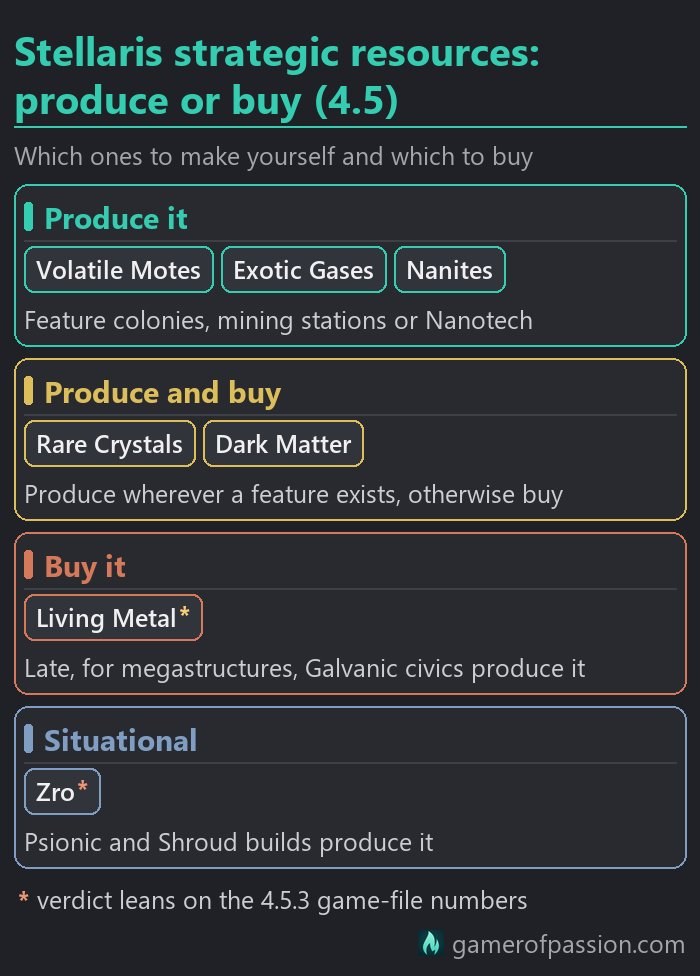
Each resource gets one of four verdicts: produce it, produce and buy, buy it, or situational. They are based on what your own production costs compared with the market. Zro and Living Metal carry an asterisk, since their verdicts rest mainly on the numbers in the 4.5.3 files and less on how current games play out.
| Resource | Verdict | Base price | When |
|---|---|---|---|
| Volatile Motes | Produce it | 10 Trade | Mote feature colony or deposit, buy 4 a month meanwhile |
| Exotic Gases | Produce it | 10 Trade | Early, before Research Complexes and Advanced Shields |
| Nanites | Produce it | not tradable | Nanotech (Machine Age) or deposits (Distant Stars) |
| Rare Crystals | Produce and buy | 10 Trade | Wherever a crystal feature exists, otherwise buy 4 a month |
| Dark Matter | Produce and buy | 20 Trade | As soon as Dark Matter Drawing is offered, buy 2 a month |
| Living Metal* | Buy it | 20 Trade | Late, for Living Metal Mega-Construction or armor |
| Zro* | Situational | 20 Trade | Psionic and Shroud builds produce it, everyone else trades |
Volatile Motes, Exotic Gases and Nanites are the three you should produce. Volatile Motes Harvesting costs 4 energy per mote and Exotic Gas Capture 4 food per gas, against 10 Trade at base price, or about 13 with the Market Fee. Start on motes as soon as a mote colony or mote deposit is working, and buy up to 4 a month until then.
You will need Exotic Gases earlier, before the first Research Complexes, which take 1 a month each, and Advanced Shields. Volcanic empires that only have Fumaroles should buy gas or take a XuraCorp deal from the Leviathans Story Pack.
Nanites are a produce verdict because nothing else is possible. Since they cannot be traded, you will mostly get them from the Nanotech ascension (Machine Age) or Nanite deposits (Distant Stars).
Rare Crystals and Dark Matter get the produce and buy verdict. Rare Crystal Extraction costs about 2.7 minerals per crystal against 10 to 13 Trade, but not every empire has a crystal planet. Without one, buy 4 a month, take a Muutagan deal (Leviathans Story Pack) or refine on an industry world with 600 or more industrial jobs.
For Dark Matter, build research stations on black-hole deposits as soon as Dark Matter Drawing is offered, and buy the first 2 a month (20 Trade at base price, about 26 with the fee) for your Dark Matter components. For a real income, look at the Red Giant origin (far more with a Dyson Swarm in that system), killing the VLUUR or the Dark Consortium civic.
Living Metal gets the buy verdict. With its deposits as rare as they are, buy about 2 a month at a base price of 20 Trade, which keeps the price stable. You will want it late, for the Living Metal Mega-Construction edict or Living Metal armor, unless a Galvanic civic makes it for you.
Zro is situational. Psionic and Shroud builds produce it, and everyone else should trade what they find to AI empires in diplomacy.
Market prices are in Trade, the market currency of 4.x, and every deal pays the Market Fee, 30% at base. The shown price should already include it, which is why a Volatile Mote at base price costs about 13 Trade and a Dark Matter about 26. On the Internal Market, safe monthly buys are about 4 for the basic three and 2 for Dark Matter, Zro and Living Metal, since bigger buys will push the price up for years. Our energy guide explains how the market works in 4.5 and how to get the Market Fee down.
What you can buy also depends on your access. Before you have Galactic Market access, the Internal Market probably only offers the strategic resources your own empire produces. On the Galactic Market, Dark Matter, Zro and Living Metal are listed once any Galactic Community member has an income of them, and Nanites are never listed. Fanatic Purifiers and Devouring Swarms get no Galactic Market at all.
Refineries are the other part of the question. Chemical Plants, Exotic Gas Refineries and Synthetic Crystal Plants each add 0.1 of their resource per 100 Metallurgists and per 100 Artisans, for 3 energy a month plus 0.5 minerals per 100 of those jobs. On a planet with 1,000 industrial jobs, one refinery will make 1 unit a month. That breaks even with buying at about 600 Metallurgist and Artisan jobs at base prices, or about 375 once you count the 30% fee, which is why a refinery on a small industry world wastes the slot.
Trader Enclaves (Leviathans Story Pack) are a fixed-price alternative. XuraCorp sells Exotic Gases, the Riggan sell Volatile Motes and the Muutagan sell Rare Crystals, 1 to 5 a month for ten years. For every unit a month you pay 10 energy a month plus 500 energy up front, about 14 energy per unit over the whole deal, and the deal never moves market prices.
Several routes depend on DLC: the enclaves need the Leviathans Story Pack, Nanite deposits Distant Stars, the Red Giant origin Infernals, the Dark Consortium Astral Planes and the Dark Matter Eruption BioGenesis. If you are unsure which of those packs to pick up, the DLC tier list ranks every one of them.
What to secure first
| Step | Resource | When | How |
|---|---|---|---|
| 1 | Exotic Gases | Early game, before Research Complexes or Advanced Shields | Exotic Gas Capture on a gas feature colony, buy 4 a month |
| 2 | Rare Crystals | Early to mid game, before Civilian Fabricators, Energy Nexus | Rare Crystal Extraction, no crystal planet: buy 4 a month |
| 3 | Volatile Motes | Mid game, before Alloy Mega-Forges or Fortress | Volatile Motes Harvesting on a mote-feature colony |
| 4 | Refineries for the basic three | About 600 industrial jobs, or the rare Ancient Refinery tech | Ancient Refinery first, then the refinery for your shortage |
| 5 | Dark Matter | Mid game, once Dark Matter Drawing is offered | Research stations on black-hole deposits, buy 2 a month |
| 6 | Zro, Living Metal, Nanites | Only when your build uses them | Psionics produce Zro, buy Living Metal for megastructures |
In the early game, Exotic Gases come first. Research Exotic Gas Extraction when it is offered, put Exotic Gas Capture on the Agriculture Districts of a gas colony and stations on gas deposits, and buy up to 4 a month in the meantime. Every research upgrade past tier 1 costs strategic upkeep, most of it gas, and a gas shortage is going to slow your ships by up to 80%.
Rare Crystals follow in the early to mid game, before Civilian Fabricators, the Energy Nexus and the engineering upgrades, through Rare Crystal Extraction and crystal stations. Without a crystal planet, buy 4 a month or take a Muutagan deal (Leviathans Story Pack), because a crystal shortage cuts energy weapon damage by up to 90%.
Volatile Motes can wait a little bit longer, until the mid game, when you plan Alloy Mega-Forges, a Ministry of Production, a Fortress or an Alloy Reclamation Plant. Each of those takes 1 or 2 motes a month, and a mote shortage cuts kinetic weapon damage by up to 90%.
Refineries for the basic three come in once an industry world passes about 600 Metallurgist and Artisan jobs, or once you get the rare Ancient Refinery tech (Society, tier 3, 6,000 research, Ancient Relics), and that building goes in first. It costs 600 minerals, 200 Minor Artifacts and 5 energy a month, adds 0.1 of each basic resource per 100 Metallurgists and per 100 Artisans, raises their upkeep by 1 mineral per 100 and gives +10% strategic resource output from jobs on its planet.
After that, add only the one refinery for the resource you are short of, or use a Trader Enclave deal from the Leviathans Story Pack as a fixed-price top-up. At 200 industrial jobs, a refinery costs about 20 Trade’s worth of energy and minerals per unit, which is more than buying.
Dark Matter becomes a mid-game goal once Dark Matter Drawing is offered. Put research stations on every black-hole deposit and buy 2 a month for your first Dark Matter Reactor or Deflector. If you play the Red Giant origin, a Dyson Swarm in your home system will multiply what that deposit makes.
Zro, Living Metal and Nanites only matter when your build uses them. Psionic empires produce Zro, megastructure builders buy Living Metal for its edict and Nanotech empires produce Nanites. If you do not use them, simply trade any surplus Zro or Dark Matter to AI empires in diplomacy, which pays no Market Fee.
What they are spent on
| Resource | Main uses | Shortage |
|---|---|---|
| Volatile Motes | Alloy Mega-Forges 2 a month, Fortress 1, kinetic weapons | kinetic damage up to -90% |
| Exotic Gases | Research Complexes 1 a month, Theorem Facility 4, shields | ship speed up to -80% |
| Rare Crystals | Civilian Fabricators 2 a month, Repli-Complexes 4, lasers | energy weapon damage up to -90% |
| Dark Matter | Reactor 1 to 32 once, Dark Consortium edicts 1-4 a month | job output -30%, ships -75% speed |
| Zro | Psionic components, Zro edicts, patron accords 50-300 | psionic Job Efficiency -75% |
| Living Metal | Mega-Construction edict 0.5 a month, Living Metal armor | job output -30% |
| Nanites | Nanite components, Nanite Transmuter 2 a month | stops the Nanite Transmuter |
Strategic resources are spent once when you build a ship part or a building, and every month as upkeep on buildings, edicts and some pop traits. Ship components never have strategic upkeep.
Volatile Motes keep your forge worlds and kinetic fleets running. Alloy Mega-Forges and the Alloy Reclamation Plant take 2 a month each, the Ministry of Production and the Fortress 1, and kinetic weapons such as the Gauss Cannon cost motes once per component.
Exotic Gases are the research resource. Research Complexes take 1 a month, Advanced Research Complexes 2 and the Data-Driven Theorem Facility 4, while the specialised lab upgrades take 1 or 2 motes, gases or crystals for the physics, society and engineering versions, plus 0.25 per 100 of their researchers. With Advanced and Hyper Shields also needing gas, it will usually be the first resource you run short of, even though tier-1 labs cost no strategic upkeep.
Rare Crystals pay for consumer goods and engineering. Civilian Fabricators take 2 a month and Repli-Complexes 4, and every Hyper Relay costs 100 to build (refunded if you dismantle it).
Dark Matter goes into your best ship parts, where a Dark Matter Reactor costs 1, 2, 4, 8, 16 or 32 by hull size, once per ship. Our ship design guide shows which shield and weapon parts need gas, crystals or dark matter.
Zro only matters for psionic empires, whose components, Zro edicts, Shroud decisions and patrons all cost it. Living Metal is a late-game luxury for the Living Metal Mega-Construction edict (+50% megastructure build speed) and Living Metal armor, and Nanites go into the Nanite Transmuter and nanite ship parts.
Running out works differently for the two groups. A shortage of one of the basic three gets worse in stages, from -5% to -20% job output, and each resource adds its own hit: up to -90% kinetic weapon damage for motes, up to -80% ship speed for gases and up to -90% energy weapon damage for crystals.
The rare resources hit you at once, for as long as your stockpile is negative. The Dark Matter Shortage costs 30% job output and 75% ship and building speed, Living Metal 30% job output, and a Zro shortage cuts psionic pops’ Job Efficiency by 75%.
A few mistakes will cost you more strategic resources than anything else:
- A Chemical Plant, Exotic Gas Refinery or Synthetic Crystal Plant on a planet with fewer than about 600 Metallurgist and Artisan jobs costs more than buying the same resource before the fee, and below about 375 even with it.
- Trade a Dark Matter or Zro surplus to AI empires in diplomacy, where it pays no Market Fee, instead of selling it on the market.
- Make sure to count the Exotic Gas upkeep before you upgrade research labs, as each upgrade adds 1 to 4 a month.
- In a machine empire, pair Exotic Gas Capture with the plain Bio-Reactor, because the Advanced one pushes those farms below zero food.
- Get a Dark Matter income before you give Dark Matter Engines to most of your pops, as a shortage costs more than the trait gives.
- Do not use the Volcanic Forge on your Exotic Gas world. It loses its specialization and keeps only a trickle of gas.
Dark matter in 4.5
| Source | Amount | Needs |
|---|---|---|
| Black-hole deposit | +1 or +2 | Research station, Dark Matter Drawing |
| Stellar Observatory at a black hole | +1 | Dark Matter Drawing, Subspace Sensors |
| Red Giant origin | 5 plus 10 energy, near 155 with a Dyson Swarm | Mining station, Machine Age for the Dyson Swarm |
| Killing the VLUUR | Up to four deposits of 1 to 3 each | Research stations, Dark Matter Drawing |
| Dark Consortium civic | 3 from its start deposit | Astral Planes, starts with Dark Matter Drawing |
| Dark Matter Eruption (about four years after settling) | 48 months of income once, at least 2,000, then +2 a month | BioGenesis, Dark Matter Drawing for the payout |
| Entangled Dark Matter (Astral Rift) | – | Astral Planes |
| Market | 20 Trade at base | Galactic Community member with an income |
Everything starts with Dark Matter Drawing, which the game will not offer until you have found dark matter, have a deposit inside your borders or have contact with an empire that has it. Nomads also qualify through a waystation system with dark matter.
Once you have the tech, put a research station on every black hole with a deposit, which will give 1 or 2 a month each. Randomly generated deposits only appear on black holes, while a few special systems and events, such as some anomalies, add them elsewhere. Additionally, a Stellar Observatory (Subspace Sensors, 100 alloys, 2 energy a month) at a black hole adds 1 Dark Matter a month, though only with Dark Matter Drawing.
The Red Giant origin is probably one of the biggest single sources. Its event chain turns your home star into a deposit worth 5 Dark Matter and 10 energy a month, and this one is collected by a mining station. A finished Dyson Swarm adds +3,000% to station output in that system, which takes the deposit to roughly 155 Dark Matter a month. Our origins tier list has the rest of that origin.
Killing the VLUUR can turn up to four empty planets or moons of the system where it dies into dark matter deposits of 1 to 3 each, which research stations will collect.
The Dark Consortium civic (Astral Planes) starts with Dark Matter Drawing and a 3 Dark Matter research-station deposit on a random body inside your borders other than your capital, or in the capital system for Nomads. Its researchers do not make Dark Matter. Your income will be the stations on that deposit and on any black hole you claim. The civic’s council position should add 20% Dark Matter from research stations for each level of its leader, and taken at game start, the civic is locked.
It also unlocks five Dark Matter edicts: Shadow Matrix (1 a month), Obsidian Veil (2, needs First Contact), Dark Matter Forging (3, +5% alloys), Dark Matter Unravelling (4, +10% energy) and Baryonic Insight (1, +10% physics). Each takes its amount once to switch on and again every month, more over your empire size limit.
Dark Matter Eruption
Dark Matter Eruption is a BioGenesis event that can hit a colony about four years after you settle it. It never hits your homeworld, your capital or an artificial world, it happens at most once per empire, and it only fires if you have found dark matter, have Dark Matter Drawing or hold any Dark Matter.
The planet will get a Dark Matter Geyser that shuts down its jobs, construction and growth for 180 days. If you have Dark Matter Drawing, you will get 48 months of your dark matter income at once, at least 2,000. Afterwards the planet keeps a Liquid Dark Matter deposit worth 2 Dark Matter a month.
A follow-up choice decides the rest. A quarantine halves the planet’s job output for 180 days and then lets you give its pops the Inner Darkness trait or take a one-off reward. Studying the dark matter instead brings a Micro Black Hole a year later, which kills a quarter of every pop group on the planet and leaves Dark Matter Statues. Inner Darkness adds a small Dark Matter output and +15% Physicist workforce, but it also lowers leader lifespan by 20 and growth and assembly by 20%.
Entangled Dark Matter
Entangled Dark Matter is an Astral Rift from Astral Planes. You will not find it as a resource or a deposit, but exploring the rift can pay out dark matter, along with other rewards.
Most of your dark matter is going to end in ship parts, and our dangerous technology guide lists the routes to the Dark Matter Deflectors, Dark Matter Power and Dark Matter Propulsion techs. Do not plan on Fallen Empire wrecks for those.
Other empire types
Volcanic or thermophile empires have one thing to watch. On Volcanic Worlds, Fumaroles give only 0.05 Exotic Gases per 100 Miners and a Stifling Atmosphere 0.05 Volatile Motes per 100 Miners, and neither counts for a specialization. Never use the Volcanic Forge on your gas world, and get gas from stations, other colonies, a XuraCorp deal with the Leviathans Story Pack, or the market.
Machine Intelligence
Agri-Drones in a machine empire start at 5 food per 100 instead of 6. With Exotic Gas Capture, the plain Bio-Reactor (-2 food, +2 energy per 100) will bring them to 0 food, while the Advanced Bio-Reactor would push them to -1 per 100. Neither Bio-Reactor can go on a Machine World.
Machines cannot take the Dark Consortium, and robot traits move motes and Dark Matter up your list: Mote-powered Tools costs 0.02 motes per 100 pops and Volatile Mote Reactor 0.05. Dark Matter Engines (2 trait points, +20% Job Efficiency) costs 0.03 Dark Matter per 100 pops, and running out does not switch it off, but the -30% job output of the shortage more than cancels it. Our ascension path guide has the Modularity builds around it. Galvanic Retrofitting gives a small Living Metal income.
Hive Mind
Hive Minds use the same specializations through Agri-Drones at 6 food. Here the Advanced Bio-Reactor brings a gas world to 0 food. They cannot take the Dark Consortium either, and Galvanic Symbiosis is their Living Metal civic.
MegaCorp
MegaCorps get the Shadow Corporation, their version of the Dark Consortium, and the Biometallic Cartel, the corporate Galvanic civic for Living Metal. Otherwise the order stays the same, and every Market Fee cut you pick up makes the buy route cheaper.
Nomads
Nomads play by different rules. Strategic Extraction covers all three basic resources, most of their buildings cost strategic resources instead of minerals and their specializations cost alloys. As such, the basic three become a construction currency from the start and steps 1 to 3 move up. Operational Reserves lets them trade motes, gases and crystals without producing them, they cannot build deposit buildings, and arkship specializations add strategic upkeep.
Strategic resource FAQ
What happens if you settle on a strategic resource?
Orbital strategic deposits never sit on worlds you can colonize, so the only way to settle on one is a habitat. A habitat built over a strategic deposit should keep it: the station will go on collecting, and the deposit lets the habitat run that specialization. Planet features such as a Dust Desert work once the planet is colonized and you have the tech. Our habitat guide has the details.
What is Zro used for?
Zro pays for psionic components, Zro edicts, Shroud decisions and patron accords. It only matters if your empire is psionic or deals with the Shroud, and everyone else should trade it to AI empires in diplomacy.
Can you buy Dark Matter you never produced?
On the Galactic Market you can, as soon as any Galactic Community member has a Dark Matter income. Before that, the Internal Market probably only offers what your own empire produces, so you will have to wait for the Galactic Market or claim a black hole.
Why is Dark Matter Drawing not showing up?
It’s a normal tier 3 Physics card after Tachyon Sensors, but the game won’t put it in your draw until you have found dark matter, have a dark matter deposit inside your borders or have contact with an empire that has it. Claim a black hole system with a deposit and it should come up in a later draw.
What changed in 4.5.3?
Patch 4.5.3 of 4 November 2026 limited Volatile Motes Harvesting, Exotic Gas Capture, Rare Crystal Extraction and Betharian Processing to one of each per planet. The 4.5.4 hotfix touches this topic only with two market bug fixes and a crash fix for enclave trade offers.
Patch 4.0.22 added the three strategic specializations, 4.1 brought them to Hive and Machine worlds, and 4.3 made Exotic Gas Capture as cheap as the others and let habitats build all three. Patch 4.6 is due on 23 November 2026, and this guide will be checked again once it is out.
Conclusion
Strategic resources in 4.5 mostly depend on which planets you own. If you specialize one gas world and one crystal world early, buy small amounts to bridge the gap and claim a black hole before you need Dark Matter, you will rarely run short. That being said, I would watch the gas upkeep every time you upgrade a lab, because that is where the first shortage usually starts.