
When you need money in Bannerlord, your best sources are tournaments and bandit hideouts early on, a caravan once you have 15,000 denars, and towns of your own later in the campaign. In between, a mercenary contract and the loot from beaten armies are going to carry you a long way.
Almost every one of these methods stops working at some point. Caravans start dying the day you join a kingdom at war, workshops are taken from you when your side goes to war with their town, and a castle can cost more in garrison wages than it brings in. This guide will put the main ways of earning denars in the order you are going to use them, and it will also show you where your money leaks away.
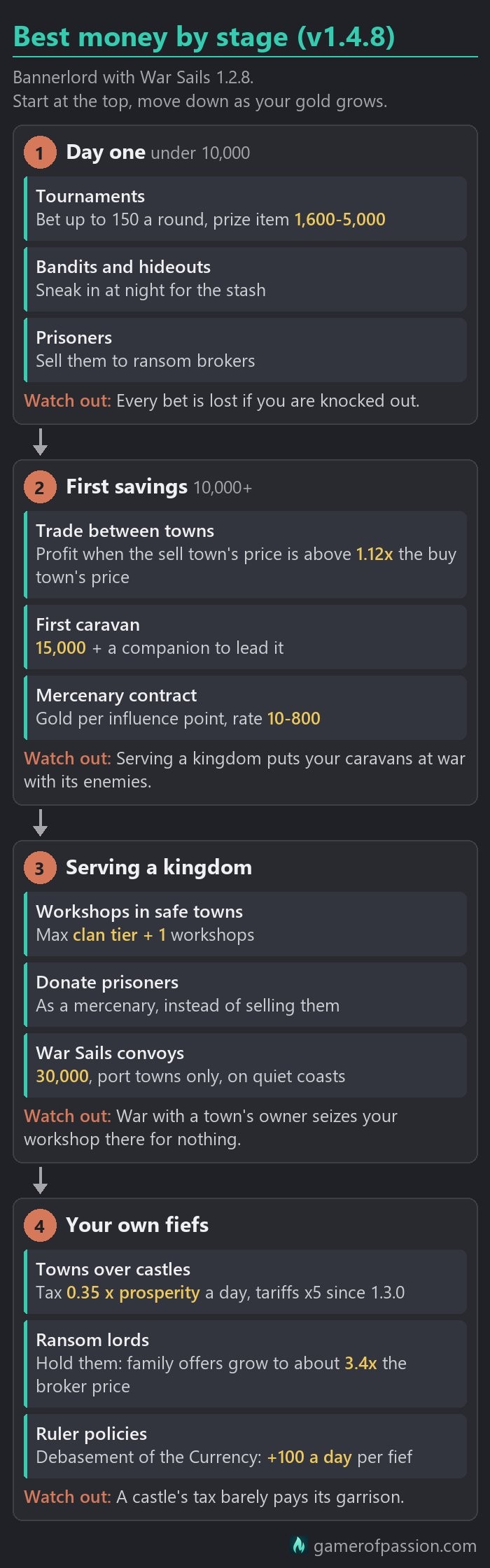
Most of the costs and payouts below were read straight from the v1.4.8 game files with War Sails 1.2.8 installed. This is the order I would follow in a new campaign:
- Up to about 10,000 denars: tournaments with the maximum bet, looters and bandits, hideouts at night, village and town quests, cheap goods traded between nearby towns, and prisoners sold to ransom brokers.
- From about 10,000 denars: your first caravan for 15,000 while your clan is still independent and at peace, more trading by hand, then a mercenary contract. In War Sails, a trade convoy on a quiet coast works too once you have 30,000.
- Serving a kingdom: workshops in safe towns of your own side, and regular prisoners donated instead of sold while you are a mercenary.
- Fiefs and the late game: a town rather than a castle, captured lords held for bigger ransom offers, and ruler policies once the kingdom is yours.
Contents
- Best ways to make money
- Early game money
- Trading between towns
- Caravans
- Caravans or workshops?
- Smithing for money
- Mercenary pay
- Ransoming lords
- Fief income
- Selling ships
- Why you are losing money
- Patch changes to the economy
- Bannerlord money questions
- Conclusion
Best ways to make money
Every method below has a start cost, which is what you will have to put down before it pays anything, and a best stage, which is the point of the campaign where it beats the alternatives. Caravans, workshops and fiefs have no fixed daily income. They pay out of what they really earn, and that will depend on markets, wars and the prosperity of each town.
The one source of money that does not fit into a row is battle loot. Beating a lord’s army and selling the loot is the biggest single payday in the game, but how much you get depends on who you beat and how much of the fight your own party did.
| Method | Start cost | What it pays | Best stage |
|---|---|---|---|
| Tournaments | 0, max bet 150 a round (300 with Deep Pockets) | Prize item of 1,600-5,000 value, bets paid only if you win | Day 1, fades as odds drop |
| Trading by hand | Any cash, carry capacity | Margin when sell town’s price is above 1.12x the buy town’s | Day 1, levels Trade |
| Alleys | No denar price, clan member with Roguery 30 + 5-10 troops | Prosperity / 50 per day (34-112 at game start) | Day 1, small top-up + Roguery XP |
| Bandits and hideouts | Party wages only | Your loot share (+0.25% per Roguery point), night stash | Early, low-level players short of cash |
| Selling prisoners | 0, prisoners slow the party | 5 (looter) to 275 (T6 cavalry) per prisoner | Early, donate them as a mercenary |
| Land caravan | 15,000 + a companion to lead it, Aserai 10,500 | 10% a day of its trade gold above 10,000 | Early-mid, while independent and at peace |
| Smithing | Smithy free, materials + skill grind | Value x town factor, town purse is the limit | Early-mid, if you accept the grind |
| Mercenary pay | Clan tier 1, no settlements owned | Gold for influence, rate 10-800, recalculated every 30 days | Early-mid, before your first fief |
| Selling captured ships (War Sails) | A fleet that wins sea battles | 30% of the shipyard price minus repairs, no drop per sale | Early-mid, once you own a warship |
| Trade convoy (War Sails) | 30,000, armed 45,000, port towns only | 10% a day of its trade gold above 10,000, 0 wages at sea | Mid, on peaceful coasts |
| Workshop | Equipment cost + 4 x prosperity + 2,000 | 20% a day of capital above 10,000, trains your Trade | Mid, safe interior towns, max clan tier + 1 |
| Lord ransom | Hold him in your dungeon or party | Broker 14,200-22,900 for a king, family offers grow to 3.4x | Mid-late, with a secure dungeon |
| Town and castle taxes | Taking the fief | Tax 0.35 x prosperity per day, tariffs x5 since 1.3.0 | Mid-late, towns over castles |
| Ruler policies | Ruling a kingdom + influence | Debasement +100 a day per town and castle, War Tax 5% | Late, for kingdom founders |
Early game money
In the first weeks you have no capital to invest, and everything you earn is going to come from fighting, running errands and carrying goods from town to town. Keep your party small and cheap while you do it.
Tournaments and betting
Tournaments are probably one of the best ways to make money on day one, as long as your character can hold a sword. The prize is always an item. With fewer than four heroes in the bracket, it will usually be a weapon, mount or piece of armour worth 1,600 to 5,000 denars.
Once four or more heroes enter (you and your companions count, while AI lords need 100 One-Handed or Two-Handed to take part), the prize is picked from a fixed list of noble horses, named weapons and top helmets, and with ten or more heroes it will be drawn from the more valuable half of that list.
Selling the prize at a market will get you roughly a quarter to a third of its value for a weapon or piece of armour, and about half for a horse. That is still the real money of a tournament, because betting is capped at 150 denars a round, or 300 with the Roguery perk Deep Pockets (Roguery 50). The odds run from 1.1 to 4.0, and every bet is only paid if you win the whole tournament.
At the best odds, four maximum bets turn 600 denars into 2,400. Those odds will not last. They get worse the more tournaments you have won and the higher your level climbs, which makes your first few tournaments the time to bet big.
If a companion in your party wins, you will get the prize item but lose your bets. If a clan member outside your party wins a tournament somewhere else, you will receive the item’s town price in gold, far more than you would get by selling it yourself. How often that happens is up to the AI.
A town can only start a tournament when at least three lords are inside, and each town only gets that chance one week in three. Busy capitals in peacetime tend to host the most, and War Sails did not change these rules.
Bandits and hideouts
Looters and bandits are where most campaigns start earning. Your share of the battle loot follows how much your party did in the fight, and every point of Roguery on the party leader adds 0.25% to it (+50% at Roguery 200). That makes Roguery one of the better skills for a character who lives off fighting. Veterinarian does not add any loot. It only saves some horses from your own fallen cavalry.
Mind that losing a battle costs you 5% of your gold, up to 10,000 denars. Do not carry a fortune into risky early fights.
Hideouts are the best early target. Clear them yourself at night with Sneak in, because only that option adds a bonus stash of trade goods to the battle loot. A daytime Assault will only give you battle loot, and Send troops gives no loot or experience at all.
Village headmen will sometimes ask you to clear a nearby hideout as a quest, which adds 3,000 denars to a fight you were going to take anyway.
Prisoners
Every bandit or soldier you capture can be sold to the ransom broker in a town tavern, or through “Ransom your prisoners” in the town menu. Both will pay a quarter of the troop’s recruit cost, which is only 5 denars for a looter and 275 for tier 6 cavalry. Manhunter (Roguery 100) adds 20% for regular troops.
Looters sell much better elsewhere. The village quest Landowner Needs Manual Laborers pays five times the ransom value for bandit prisoners.
Prisoners also slow your party down, and a slow party gets caught. As a mercenary, donate your regular prisoners instead of selling them (see Mercenary pay below).
Quests
Notable quests are a steady side income. Caravan Ambush pays 1,300 to 4,000 denars depending on its difficulty, Army of Poachers 800 to 3,500, and Escort Merchant Caravan pays by the day, up to 8,000. Delivery quests pay by the value of the goods, and your profit will depend on how cheaply you buy them.
Trading your first goods
You can start trading on day one with whatever cash you have. Simply buy what the villages around a town produce, since a town with plenty of a good in stock sells it cheaply, and carry it to a town a day or two away that has little of it. Every denar of profit also gives you half a point of Trade experience.
Trading between towns
Trading by hand is simple on paper. The problem is the mark-up. Every purchase costs you a little more than the town’s market price and every sale pays a little less, and buying and selling in the same town will lose you about 11%.
In order to make a profit, the town you sell in has to value the goods at least about 12% higher than the town you bought them in (about 10% at Trade 100). Anything below that gap is a loss.
A few things make the mark-up a lot worse:
- Trading with a town of a faction you are at war with adds a big extra penalty. Since patch 1.4.5, you cannot trade with villages of factions at war with you at all.
- Selling to a village or to a caravan costs you a large penalty too. Buy in villages if you like, but sell in towns.
- Weapons, armour and horses carry a much higher selling penalty than trade goods, which is why loot sells for so little.
Trade goods are the thing to trade. Their prices can swing from a tenth to ten times their value between a glutted market and a starved one, while weapons and armour only ever move between 0.8 and 1.3 times the value.
Every item you sell will be added to the town’s stock before the next price is worked out. With jewelry in an empty market, the second piece fetches only about two thirds of the first. Sell expensive goods one or two at a time across several towns.
Trade rumours are exact prices, but they are snapshots up to 10-19 days old and leave out your own mark-up. Treat them as a shortlist and expect a slightly worse deal on arrival. A caravan you meet will also tip you about a real trade from the last 7 days that made at least 20%.
A town can only pay you what is in its purse. That purse refills by a quarter of the gap each day toward 10,000 plus 12 times the town’s prosperity, which is about 30,000 to 77,000 denars at game start, and if you are carrying a big haul, you will simply have to split it across several towns or come back the next day.
Your Trade skill lowers the mark-up a little at every level, and perks like Whole Seller (15% off the penalty on selling trade goods) lower it further. Our Bannerlord perks guide covers the Trade perks worth taking.
Caravans
A caravan is probably the most popular passive income in Bannerlord. You form one by talking to a merchant or artisan notable in a town (“I wish to form a caravan in this town.”), and you need the money plus one free companion or family member in your party to lead it.
It costs 15,000 denars for 20-29 guards, or 22,500 for the “better troops” version with 23-49. The money you pay becomes the caravan’s trading purse. An Aserai character pays 30% less, and the purse still starts at the full amount.
When it comes to buying and selling, only the leader’s Trade skill and perks count. Caravans already trade at half the normal mark-up, and even a good trader will only move the profit a little bit. Personally, I would pick a leader who keeps the caravan alive and moving first. A high-Trade wanderer such as a Spicevendor is still a fine choice, and our Bannerlord companions guide lists the best ones. Hired caravan leaders still count toward your companion limit.
Every day the caravan will send you 10% of its trade gold above 10,000, and your clan will top it back up when it drops below 5,000. That top-up also covers the goods it just bought, so the first week usually shows red.
This is normal. The line will turn positive once those goods sell, and the caravan will pay you wherever it is. Over time the payout settles at whatever the caravan really earns, although the first payouts are partly your own capital flowing back.
The 22,500 version follows the same rule, but there is no proof that the extra guards keep it alive any better. Losses are not replaced for free either. A land caravan hires whatever mercenaries the local tavern has, paid out of its own purse, and its elite guards slowly turn into tavern hires.
Insurance Plans (Trade 175) will pay you a flat 5,000 denars for every caravan or convoy you lose, and it has to be on your own character. At Trade 125 you choose between Great Investor (+1 renown a day per caravan that paid you) and Artisan Community (the same for workshops).
The biggest risk for a caravan is war. While your clan is independent, only bandits and anyone you are personally at war with will chase your caravans, but the day you sign on as a vassal or a mercenary they become fair game for every lord at war with your kingdom, including the mercenary clans your enemies have hired.
In one long test on an older patch, almost all caravans survived two years at peace, and almost none survived inside a kingdom at war.
Since patch 1.3, you can talk to a caravan’s leader to change its home town or to stop it trading with a certain kingdom.
War Sails trade convoys
With War Sails, any town with a port only offers trade convoys, for 30,000 denars or 45,000 for the armed version (30% less for Aserai). Make sure to form your land caravans in inland towns.
A convoy will pay you by the same rule as a caravan. The standard one even starts with 35,000 in its purse, 5,000 more than you paid. It spends up to 3,000 denars per category of goods instead of 1,500, pays no wages at sea, and refills its crew for free at every town it visits.
Convoys follow the caravan war rules too, and patch 1.4.5 had lords at war patrol enemy ports. On a quiet coast, a convoy is a fairly solid choice once you have 30,000 to spare.
Caravans or workshops?
Both pay you by the same logic. A caravan pays 10% a day of its trade gold above 10,000, a workshop 20% a day of its capital above 10,000, and over time each one pays out what it earns.
The difference is risk. A caravan costs 15,000 plus a companion, has no cap of its own (a hired leader still counts toward your companion limit) and trades across the whole map, but it becomes fair game for every faction at war with your kingdom as soon as you are a vassal or a mercenary. A workshop is capped at your clan tier + 1 and only earns from one town’s market. It only stops paying when your side goes to war with the town’s owner (an enemy taking the town counts too), when the town’s loyalty drops below 25, or when its capital sinks to 10,000 or less.
That gives a fairly simple rule:
- Independent and at peace: caravans first, formed in an inland town for 15,000.
- Serving a kingdom as a vassal or mercenary: workshops in deep towns of your own side, never in towns of your employer’s enemies.
- War Sails with quiet coasts: convoys, which refill their crew for free and pay no wages at sea.
Workshops are the easiest and safest passive income, but they are rarely the fastest. One costs its equipment plus 4 times the town’s prosperity plus 2,000, and it pays you nothing while its capital sits at or below 10,000. Its workers cost 100 denars a day, which you only pay yourself when the capital drops below 5,000.
When your side goes to war with a town’s owner (your employer’s wars count while you are a mercenary), every workshop you own there will pass to a local notable for nothing. Rapid Development (Trade 175) only refunds 5,000 per workshop when an enemy captures the town.
Additionally, workshops have trained your own Trade skill since patch 1.3. Our Bannerlord workshops guide has the best workshop for every town.
Smithing for money
Smithing can earn a lot once your skill and stamina allow good weapons, but it takes a long grind to get there. When you sell a crafted tier 5 weapon in a town that pays its full value, you keep about 28% of that value with no help, about 43% with the Artisan Smith perk on your party leader, and up to about 65% with 300 Trade and the right perks. Expensive weapons usually sell at the lowest town price, though, which leaves you between about a fifth and a half of their value. The real limit is the purse of each town’s traders, which you are going to drain quickly with expensive weapons.
No patch since 1.2 has changed what a crafted weapon sells for. Patch 1.4.5 cut the smelting outputs of cheap items instead (Highland Dagger, Tribesman Throwing Daggers, Wooden Hammer and Pitchfork). Our Bannerlord smithing guide covers which weapons to build and how to level the skill.
Mercenary pay
A mercenary contract is the first real income for most fighting characters. Once your clan reaches tier 1 and serves no kingdom, a kingdom may send a courier with an offer, or you can ask one of its lords for work. Every influence point you earn fighting for your employer will then be paid out in gold every day at your contract rate, a fifth at a time.
The rate can be anything from 10 to 800 denars per influence point. Weak or small kingdoms will pay more and strong ones less, a rich kingdom pays more than a poor one, and your clan tier raises it. Your own army or fleet does not.
The rate is recalculated every 30 days, which means it will change as the war map changes.
As a mercenary, donate regular prisoners to a dungeon in your employer’s towns instead of selling them. Each one will turn into influence that is paid out at your contract rate, and the conversion favours cheap troops. At 250 denars per influence point, a looter worth 5 denars at the broker brings in about 95, a tier 3 soldier about 181 instead of 25, and a tier 5 cavalryman about 436 instead of 225. Lords are the exception. Sell or ransom them.
A clan that owns any settlement cannot offer its service as a mercenary. Take the contract money before you own land, and remember that your caravans are at risk for as long as you serve, and that any workshop in a town of your employer’s enemies is seized the moment you sign.
Ransoming lords
Captured lords are worth far more than regular troops. A ransom broker will pay a lord’s value at once and set him free. For a king at the start of the game that is roughly 14,200 to 22,900 denars, depending on his wealth and the size of his kingdom, and a clan leader is worth more than an ordinary lord. The Roguery perk Ransom Broker (Roguery 200) adds 25% to the broker price and also cuts the escape chance of hero prisoners by 30%.
The better deal is usually to wait. Keep him in your party or a dungeon instead, and his family will send couriers with ransom offers that grow every week he is held, up to about 3.4 times the broker price after five to nine weeks.
Declining an offer does not raise the next one, but holding him longer does. Declining only lowers the daily chance of a new offer, and every offer expires after two days. An offer also only arrives if the person paying it can afford it and the lord’s clan has at least two living lords. I would only sell a lord to the broker when I need the gold right away or cannot hold him safely.
If you would rather be rid of a lord for good, our guide on executing lords in Bannerlord explains what that will cost you.
Fief income
Fiefs are where the late-game money is, and towns are where most of it sits. A town or castle pays 0.35 times its prosperity in tax every day before modifiers, which at starting prosperity is about 595 to 1,960 denars a day for a town and only about 147 to 385 for a castle. Towns also earn tariffs from their market, and every bound village adds its own income.
Patch 1.3.0 raised town trade commissions five-fold, which means about a third of a town’s income can now be tariffs, and guides from before late 2025 will understate what a town is worth.
A castle’s tax pays for roughly 30-75 tier 3 garrison troops. Keep castle garrisons small and low-tier and a castle will pay its way, but fill one with a large garrison and it is going to cost you money.
Loyalty decides whether you see any of it. Below 25 loyalty a town pays no tax at all, between 25 and 50 it loses up to half, and above 75 it pays up to 20% more. A governor with Logistician (Steward 125) adds 10% to the tax, and one with Content Trades (Trade 150) adds 10% to tariffs.
Alleys
An alley will pay the town’s prosperity divided by 50 each day, roughly 34-112 denars at game start. You need a clan member with 30 Roguery and 5-10 of your troops to hold it. It is a small early top-up that also trains Roguery, and you should not expect more from it.
Trade agreements
Each time a caravan from a trade-partner kingdom visits one of your kingdom’s towns, your kingdom banks 500 denars (1,000 for a sea convoy), shared out daily among its vassal clans as Trade Income. Mercenaries get no share, and your own caravans earn this for the partner kingdom when they visit its towns. Since patch 1.4.5, only neighbouring kingdoms can sign trade agreements.
Ruler policies
Once you rule a kingdom, a few policies pay your clan directly. Debasement of the Currency gives the ruling clan 100 denars a day for every town and castle in the kingdom (the tooltip only mentions towns, but castles count too). War Tax gives you 5% of all settlement taxes in the kingdom, Crown Duty 5% of the tariffs, and Land Tax 5% of the income of every village owned by another clan.
These policies come with downsides for loyalty, prosperity or the opinion of your vassals, and you should read each tooltip before you vote. Our guide on how to start a kingdom in Bannerlord covers the first policies to pass and how much money to save before you found one.
Selling ships
Captured ships can be a big source of money in War Sails. After a sea battle, each enemy ship still afloat has an even chance of becoming loot, and allied lords who fought beside you can claim some of those ships before you do. A port will pay 30% of what the same ship costs in its shipyard, minus whatever repairs it needs, and the price does not drop as you sell more. An undamaged Corbita brings about 7,200 denars, a Dromon about 36,000.
A badly damaged ship will sell for a lot less, since the repairs come straight off the price. If the port’s owner rules a kingdom with the Royal Navy Prerogative policy, you will also get 10% less.
Unlike workshops, ships are never confiscated when a war starts. They sail with your party or your convoy, and you only lose them in battle or by selling them. Our Bannerlord ships guide lists the shipyard price of every hull and explains how fleet size works.
Why you are losing money
If your daily balance is red, the first place to look is your wages. Troop wages depend only on tier: 2 denars a day for a tier 1 recruit, then 3, 5, 8, 12 and 17 up to tier 6, and tavern mercenaries cost 50% more. Each tier costs roughly half again as much as the one below it, which makes upgrading a whole party past tier 4 (8 to 12 denars) expensive.
A 42-man party of tier 3-4 troops costs roughly 200-350 denars a day, while the same party all at tier 6 would cost 714. Our Bannerlord troop tier list shows which troops are worth their wage.
Companions cost 2 denars plus 2 per level every day, but your spouse and children in your party cost nothing.
A few perks cut the bill. Content Trades (Trade 150) will halve your wages while your party sits in a settlement, which makes towns the place to do your waiting. Frugal (Steward 25) cuts wages by 5% on your quartermaster and recruitment costs by 15% on the party leader, Efficient Campaigner takes 25% off while you are in an army, and Paid in Promise takes 25% off companion wages. In War Sails, your whole party’s wage bill drops by 20% while you are at sea.
Garrisons are the other big drain. Set a wage limit for each garrison in the Clan screen, because it caps how many troops the garrison will recruit on its own, and keep castle garrisons small and low-tier. Governors with garrison perks help as well (Stiff Upper Lip takes 20% off in castles), and so does an owner of Empire culture, who pays 20% less.
If you own port towns in War Sails, do not pass the Coastal Guard Edict unless you need it. It adds 15% to the cost of port garrisons.
A new caravan usually shows red in its first week, and a workshop with less than 5,000 capital bills you its 100 denars a day. If you cannot pay your wages at all, your party will lose morale.
| Cost | What it costs you | How to cut it |
|---|---|---|
| Troop wages | 2/3/5/8/12/17 a day from tier 1 | Content Trades -50% in a settlement, -20% at sea |
| Upgrading past tier 4 | 42 men: 504 a day at tier 5, 336 at tier 4 | Don’t upgrade everyone past tier 4 |
| Tavern mercenaries | Wage x1.5 (42 men at tier 6: 1,050 a day vs 714) | Fewer tavern mercenaries, recruit from villages |
| Companions | 2 + 2 x level a day, 42 at level 20 | Family members in your party free, Paid in Promise -25% |
| Garrisons and castles | Castle tax 147-385 a day pays only 30-75 tier-3 troops | Garrison wage limit in the Clan screen, low-tier troops |
| Coastal Guard Edict (War Sails) | +15% port garrison expenses | Don’t pass it unless you need it |
| Losing a battle | 5% of your gold (max 10,000) | Don’t carry a fortune into risky fights early |
Patch changes to the economy
Most money guides you will find online were written before patch 1.3, and quite a lot has changed since then:
- Patch e1.0.7 (2020) cut the maximum tournament bet from 300 to 150 per round. A guide that says 300 without Deep Pockets is older than that.
- Patch 1.3.0, which went live with War Sails in November 2025, raised town trade commissions five-fold and town and castle taxes by 130%, plus village taxes by 30%.
- The same patch fixed the bug that kept player workshops from giving you Trade experience, stopped workshops in towns below 25 loyalty from producing, stopped charging you wages for family members in your party, and let you set a caravan’s home town and the kingdoms it avoids.
- Patch 1.3.13 fixed the double gold you could get by selling prisoners to the ransom broker through dialogue.
- Patch 1.4.5 split hideout loot between Sneak in and Assault, cut wages at sea, limited trade agreements to neighbours with gold for every partner caravan visit, and cut the smelting outputs of four cheap weapons and tools.
The 1.5.0 beta adds more, such as trait effects worth up to 20% more workshop income, but none of that is live yet.
Bannerlord money questions
What is the most profitable business in Bannerlord?
No business has a fixed daily rate. While you are independent and at peace, caravans are usually the better earner for the money you put in. Once you serve a kingdom, workshops in safe towns are the safer bet, and in the late game your towns will probably out-earn both.
Is it worth attacking caravans?
It is, as long as the caravan belongs to a faction you are already at war with. Attacking a neutral caravan or convoy declares war on its faction, costs 60 relation with its owner plus a crime rating, and ends a mercenary contract on the spot. Bullying it into handing over goods avoids the war but still costs crime rating and relation. If you play Nords, you will get 30% more loot from caravans, villages and villagers.
Does it matter where you start a caravan?
It matters mostly for the price. In War Sails, a port town only offers trade convoys (30,000 denars, or 45,000 armed), and land caravans have to be formed in inland towns. The town you start it in also becomes the caravan’s home, which you can change later by talking to its leader.
What can I do with my money?
Most of it will go into your party, its troops and the gear of your companions. After that, caravans, workshops and ships turn spare denars into more denars. Before you found a kingdom, a cushion of 3 to 5 million denars is comfortable, and once you rule one, turning a companion into a vassal lord costs 20,000 denars, 500 influence and one of your towns or castles. At Trade 300, the perk Everything Has a Price even lets you trade whole settlements in a barter.
How do you make money as a vassal?
A vassal gets no mercenary pay. Battle loot and captured lords are the big earners, workshops in deep towns of your own kingdom are the safe passive layer, and your fiefs pay taxes and tariffs. Your clan also gets a share of the kingdom’s trade-agreement income.
Conclusion
Making money in Bannerlord is mostly a question of timing. Tournaments, hideouts and quests carry you through the first weeks, a caravan works best before you join anyone, and once you serve a kingdom your money should sit in workshops and later in towns. For a steady income without much babysitting, one caravan while you are independent and a few workshops once you are a vassal is probably the way to go. That being said, nothing will fill your purse faster than beating a lord’s army and selling what it leaves behind.