
Which galaxy settings should you pick for a new game of Stellaris 4.5? For your first game, a Medium galaxy in the Elliptical shape with Hyperlane Density at 1x and Ensign difficulty is the safest start, and every other kind of game only changes a few of those picks.
If you want chokepoints to defend, go with Barred Spiral or Spoked and turn Hyperlane Density, the slider for how many lanes connect the stars, down to 0.5x or 0.75x. For an open and fair map, Elliptical at 1x or a little bit higher will serve you better. Small or Medium suits most games, since both will give every empire about the same room, and a Small galaxy runs faster.
For difficulty, Ensign is the level where neither you nor the AI empires get a bonus, and you can climb one level at a time from there. Scaling Difficulty, which lets the AI’s difficulty bonus grow over the years instead of handing it all out on day one, only does something from Captain up. Turn it off if the AI falls behind you by the mid-game, and put it on Mid Game if early AI rushes keep ending your games.
The settings and numbers in this guide match Stellaris 4.5.4 ‘Cygnus’ on PC, the hotfix released on 11 November 2026. Most of them are part of the base game, and a few depend on DLC: L-Gates need Distant Stars, Marauder Empires need Apocalypse, The Machine Age adds The Synthetic Queen as a crisis, and Randomized Nomadic Empires need Nomads. Most numbers here are taken straight from the 4.5.3 setup and difficulty files, which the 4.5.4 hotfix did not change, and the picks per goal are my recommendations based on them.
Contents
- Best galaxy settings by goal
- Galaxy shape tier list
- Galaxy size
- Hyperlane Density
- Other galaxy settings worth changing
- Difficulty levels
- Scaling Difficulty
- End-game crisis settings
- Achievements without Ironman
- Best starting system
- Settings for a faster late game
- Multiplayer host settings
- Outdated settings advice
- Patch 4.6 (Willpower)
- Galaxy settings questions
- Conclusion
Best galaxy settings by goal
There is no single best setup in Stellaris, because a first game, a long defensive war and a multiplayer evening will each want something different from the same sliders. I would start from one of six presets, one per goal, and only then change single sliders to taste.
| Goal | Map | Rules |
|---|---|---|
| First game | Medium or Small, Elliptical, density 1x | Ensign, scaling Off, Crisis Type Random |
| Chokepoint defence | Medium+, Barred Spiral or Spoked, density 0.5x to 0.75x | Captain or Commodore, scaling Mid Game, Crisis Type All |
| Open, even map | Any size, Elliptical, density 1x to 1.5x | Ensign to Commodore, scaling Off, Crisis Type Random |
| Performance | Smallest size you enjoy, any shape, density 1x | Any difficulty and scaling, Victory Year 2400 or 2450 |
| Multiplayer | Small or Medium, Elliptical, density 1x | Ensign or Captain, scaling Off, Mid-Game 2250, End-Game 2300 |
| Challenge | Any size, any shape, Guaranteed Habitable Worlds 0 | Grand Admiral, scaling Off, Crisis Strength 10x or 25x |
First game
Next to the size, shape and difficulty, keep Habitable Worlds, Pre-FTL Civilizations, Wormhole Pairs and Abandoned Gateways at their default of 1x, leave L-Gates on and Guaranteed Habitable Worlds at 2, and set Advanced AI Starts to 0 with Advanced Neighbors off. For Empire Placement, the setting that decides whether empires start in loose groups or spread across the map, Clusters will usually give you a few neighbours early, while Random can leave you isolated or boxed in.
On the rules side, Scaling Difficulty and the two difficulty-adjusted settings can all stay off, with AI Aggressiveness on Normal, Crisis Type on Random, Crisis Strength (the multiplier on the end-game crisis fleets) at the default for your galaxy size or lower, and Ironman off, since only the Victorious achievement needs it. Ensign gives neither you nor the AI empires a bonus, an even disc with normal lanes leaves the least to spawn luck, and the default years of 2300, 2400 and 2500 will give you 200 years before any end-game crisis, which is why these picks match the first-game settings in our beginner guide.
Chokepoint defence
Pair the shape with Wormhole Pairs and Abandoned Gateways at 0 to 0.5x, because both bypass chokepoints, and with Random placement, which tends to leave you more room to claim the chokepoints before a neighbour does. Habitable Worlds and Pre-FTL Civilizations stay at 1x, L-Gates on and Guaranteed Habitable Worlds at 2.
For the rules, I would play Captain or Commodore with Scaling Difficulty on Mid Game, AI Aggressiveness on High, Crisis Type on All and Crisis Strength at the default for your size or one step above, with the Mid-Game Start Year at 2250 to 2300 and the End-Game Start Year at 2350 to 2400. Mid Game scaling gives you the early decades to fortify before the AI bonus peaks, and High aggressiveness will make the AI actually test your chokepoints, although it still needs a hostile attitude. A first chain of hyper relays toward your border chokepoints is going to help you move fleets between them.
Open map
Keep Wormhole Pairs and Abandoned Gateways at 1x or more, since they bypass chokepoints, and use Random placement with the other map sliders at their defaults and L-Gates on. Difficulty can be anything from Ensign to Commodore depending on your skill, with Scaling Difficulty and both difficulty-adjusted settings off, AI Aggressiveness on Normal, Crisis Type on Random, Crisis Strength at the size default and the default years. With scaling off, the AI will have its full difficulty bonus from 2200 on, which keeps the race even and leaves you no early window to snowball.
Performance
Pick the smallest galaxy you still enjoy, since Galaxy Size carries the in-game warning about late-game performance, and any shape you like, because the shape will not change speed. Keep Hyperlane Density, Pre-FTL Civilizations, Wormhole Pairs and Abandoned Gateways at 1x (lower values have no measured speed gain), Habitable Worlds at 1x or lower but never above, and Naval Capacity and Command Limit at 1x or lower.
Logistic Growth Ceiling at its default of 5 or lower and Growth Required Scaling at its default of 0.25 or higher are enough, while difficulty, scaling and L-Gates are up to you. A Victory Year of 2400 or 2450 can end the campaign before the late game drags, although with the default End-Game Start Year the crisis window opens in 2425 or 2450, which means the score game ends before it opens or soon after.
Multiplayer
Size the galaxy for the slowest PC in the group, use Distributed Players placement for a competitive game or Clustered Players for co-op, and keep Guaranteed Habitable Worlds at 2 and Advanced Neighbors off, so that every player gets a fair start. Hyperlane Density can stay at 1x, or go to 0.75x for a defensive group, with the other map sliders at 1x and L-Gates on.
For the rules, Ensign or Captain with scaling off suits mixed groups, and Grand Admiral with Scaling Difficulty on Late Game suits veterans. Add Technology and Tradition Cost at 0.75x, Crisis Type on All, Crisis Strength at the size default for new players and above it for veterans, and years of 2250, 2300 and 2400. The shorter years and cheaper research and traditions are a common group choice, and they will fit a whole campaign into a few sessions.
Challenge
The shape is free here, because the challenge sits in the rules: Grand Admiral, Scaling Difficulty off, Difficulty Adjusted AI Modifiers on, AI Aggressiveness on High, Crisis Type on All and Crisis Strength at 10x or 25x, the two high stops in the game files, or lower for a weaker build. Set Guaranteed Habitable Worlds to 0, add more Advanced AI Starts with Advanced Neighbors on, and move the Mid-Game and End-Game Start Years to 2250 and 2300. Difficulty Adjusted Technology Costs can stay off unless you want slower tech, because it will most likely slow you as well.
The developers themselves advised turning scaling off in patch 4.0.14 when high difficulties feel easy, the AI modifiers keep late AI economies growing, and on All every crisis you beat will at least double Crisis Strength for the next one. That makes it a good test for any of our best Stellaris builds.
Galaxy shape tier list
Stellaris 4.5 has ten galaxy shapes: Elliptical, Ring, Spiral (2 Arms), Spiral (3 Arms), Spiral (4 Arms), Spiral (6 Arms), Barred Spiral, Starburst, Cartwheel and Spoked. The original four are Elliptical, Ring, Spiral (2 Arms) and Spiral (4 Arms), the other six came with the 3.6 ‘Orion’ update in November 2022, and no 4.x patch has added or removed a shape since.
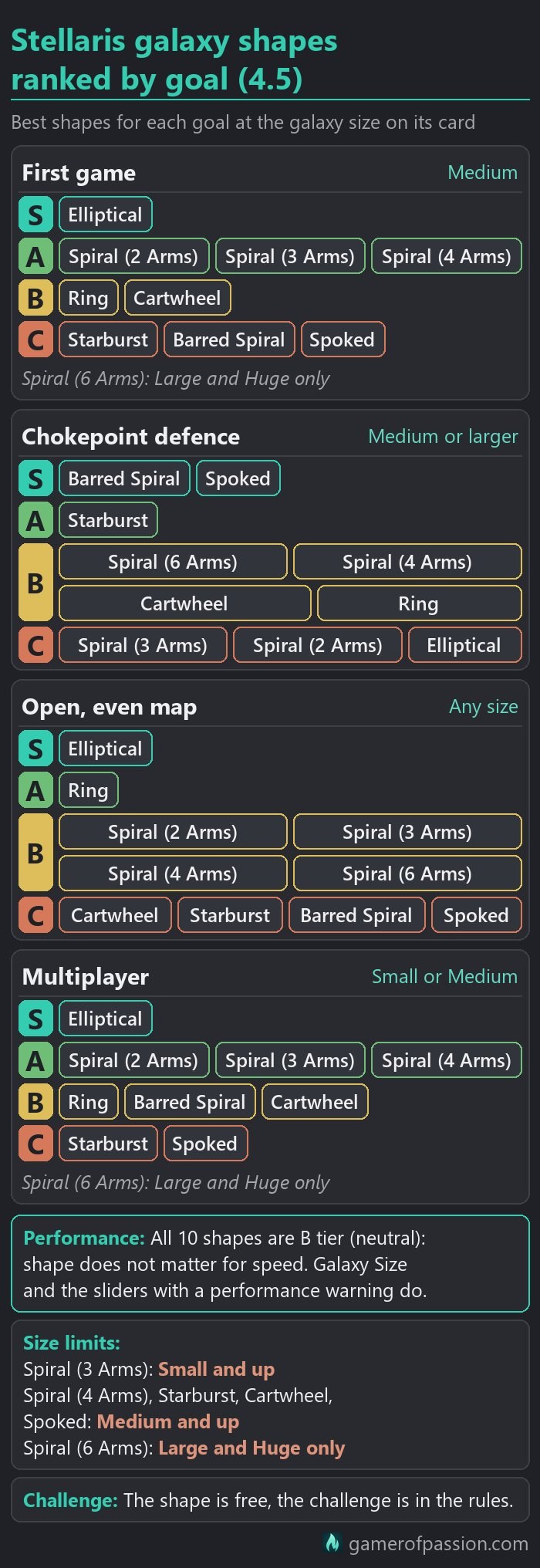
Not every shape is open on every size. Tiny offers only Elliptical, Ring, Spiral (2 Arms) and Barred Spiral, Small adds Spiral (3 Arms), Medium has nine of the ten, and Spiral (6 Arms) needs a Large or Huge galaxy. The shape will never change how many stars you get, because the galaxy size alone sets that.
For a first game, Elliptical is S tier. Its stars are evenly spread, it leaves the least to spawn luck and it makes it easy to meet everyone, which you will want for the Galactic Market. The plain spirals with 2, 3 or 4 arms sit in A tier (Spiral (4 Arms) gives the familiar Milky Way look but needs Medium or larger), Ring and Cartwheel in B, and Starburst, Barred Spiral and Spoked in C, because lopsided arms or a Fallen Empire or Marauder on one of the few bridges can wall a new player off early.
Chokepoint defence needs a Medium or larger map, and there Barred Spiral and Spoked share S tier, with Starburst and its thin, bunched arms in A. B tier holds Spiral (6 Arms) with the thinnest arms and long corridors (Large and Huge only), Spiral (4 Arms) for turtling in a corner of one arm, Cartwheel with its thin arms and some dead ends, and Ring, which seems to get choke-heavy only at the lowest density. Spiral (3 Arms), Spiral (2 Arms) and Elliptical are C tier here, since their wide arms or even disc give few natural chokepoints at 1x.
An open, even map flips that order. Elliptical is S tier again with the most even spread of stars, Ring follows in A with every empire on the same band, and the four spirals are B tier, because their arms add a few fronts and corners. Cartwheel, Starburst, Barred Spiral and Spoked land in C with ragged borders, lopsided arms, two halves with few links or separated slices, which is the opposite of an open map.
Multiplayer on a Small or Medium map follows the first-game list closely. Elliptical is S tier for even spawns and early contact, Spiral (2 Arms), Spiral (3 Arms) and Spiral (4 Arms) are A tier (the last one on Medium only), and Ring, Barred Spiral and Cartwheel are B. Starburst and Spoked are C tier, because lopsided starts are unfair between players and a new player can get stuck at the end of a spoke.
For performance, all ten shapes rate the same, since the shape does not change speed. For a challenge game, the shape is free, and the challenge sits in the rules.
Chokepoint shapes
A chokepoint is a system you have to pass through to get from one part of the map to another, which makes it the natural place for your starbases and fleets. Barred Spiral and Spoked are the two chokepoint shapes. The in-game text describes Barred Spiral as two thick spiral arms ‘with only a few connections’, and Spoked as a galaxy split into ‘slices’ that are ‘mostly separated from one another’. The shape file draws seven of those slices.
That being said, Hyperlane Density matters as much as the shape. Lowering it to 0.5x or 0.75x will add chokepoints on any shape and turn even a plain spiral into a defensive map, while Ring only starts to feel choke-heavy at the very bottom of the slider.
Fallen Empires on a bridge
The downside of both chokepoint shapes is the bridge itself. A Fallen Empire or a Marauder that spawns on one of the few links between two parts of the map can wall off half the galaxy early. If one does block your way, our guide on how to deal with a Fallen Empire has the options.
Most Guardians, at least, will not do this to you. The game never spawns the Ether Drake, the Dimensional Horror, the Automated Dreadnought or the Enigmatic Fortress in a bottleneck system, and the same goes for most hostile systems and a few relic and special systems. A bottleneck system is the game’s own term for a system whose lanes do not meet up again within 2 jumps. Fallen Empires and Marauders have no such rule and can sit right on a bridge.
Cartwheel has a related story. It is three arms plus an outer ring with the tightest star spacing of all shapes, and a comment in its file says the distances between empires were set closer because of that, since Fallen Empires and the like got ‘shunted into single dead end systems’.
| Shape | Galaxy sizes | What the map is like |
|---|---|---|
| Elliptical | All sizes | No arms, a round disc of evenly distributed stars |
| Ring | All sizes | No arms, stars in a ring with a small core |
| Spiral (2 Arms) | All sizes | 2 wide arms (80°) curving out from the core |
| Spiral (3 Arms) | Small and up | 3 arms (60°) curving out from the core |
| Spiral (4 Arms) | Medium and up | 4 arms (40°) curving out from the core |
| Spiral (6 Arms) | Large and Huge only | 6 thin arms (20°) curving out from the core |
| Barred Spiral | All sizes | Two thick spiral arms with only a few connections |
| Starburst | Medium and up | 3 thin arms only 80° apart, one side stays open |
| Cartwheel | Medium and up | 3 arms plus an outer ring, the densest stars |
| Spoked | Medium and up | 7 straight spokes, slices mostly separated from one another |
These tiers rest on each shape’s in-game description and its layout in the 4.5.3 files, plus player reports and one hand count, and no timed or measured test stands behind them. In r/Stellaris threads from 2025 and 2026 (patch 4.0 and later), Barred Spiral was the most-named favourite with 12 of about 53 author picks, followed by Spiral (4 Arms) and Spoked with 9 each, counting each author once for every shape they named.
Galaxy size
| Size | Stars | Default empires | Shapes |
|---|---|---|---|
| Tiny | 200 | 3 AI, 0 Fallen, 1 Marauder | 4 of 10 |
| Small | 400 | 6 AI, 1 Fallen, 1 Marauder | 5 of 10 |
| Medium (default) | 600 | 9 AI, 2 Fallen, 2 Marauder | 9 of 10 |
| Large | 800 | 12 AI, 3 Fallen, 2 Marauder | All 10 |
| Huge | 1,000 | 15 AI, 4 Fallen, 3 Marauder | All 10 |
Galaxy size sets the number of stars, from 200 on Tiny to 1,000 on Huge, and Medium with 600 stars is the default. It also sets the default number of AI empires, which works out to 1.5 empires per 100 stars on every size, and the AI Empires slider will go up to twice that. The Fallen Empire and Marauder numbers are maximums the game is allowed to spawn, which means you can get fewer of them.
For a first game, Small or Medium is probably the best choice. At their default counts of 6 and 9 AI empires, both will give every empire about 57 to 60 stars, and a Small galaxy runs faster. Our beginner guide gives the same answer in its beginner questions.
Huge is not the roomiest map either. It has the same radius as Large with 25% more stars, which makes it as packed as Tiny, while Medium is the most spread-out of all five sizes. If you want the stars to sit further apart, Medium is going to give you that more than Huge.
Bigger maps also cost performance. The size tooltip itself warns that increasing it has ‘significant late game performance implications’, and the default number of AI empires grows with it. If the late game gets too slow on your PC, the galaxy size is the first setting to lower in your next game.
Hyperlane Density
Hyperlanes are the routes your ships travel between star systems, and Hyperlane Density multiplies the standard number of them that the game generates. The slider runs from 0.5x up to Full, its top stop, and the default is 1x on every galaxy size.
Lower values cut lanes. You will get more chokepoints and longer detours, which helps a defensive player who wants to hold a few entry systems. Higher values add routes until almost every system has several ways in, which will leave you fewer natural chokepoints and more directions an enemy can come from.
Wormhole Pairs and Abandoned Gateways work against chokepoints, since both let ships skip past them. Each runs from 0 to 5x with a default of 1x. For a defensive map, set them to 0 or 0.5x, and for a fair one, simply leave them at 1x.
Which value to pick depends on the goal. I would leave Hyperlane Density at 1x for a first game and for most multiplayer groups, go down to 0.5x or 0.75x for chokepoint defence, and use 1x to 1.5x for an open map. Lowering it gives no measured speed gain, and the game shows no performance warning on this slider.
Older threads and videos still talk about a 0.25x setting. That stop does not exist in vanilla Stellaris 4.5, where the lowest value is 0.5x.
Other galaxy settings worth changing
| Setting | Range | What it does |
|---|---|---|
| Habitable Worlds | Rare to 5x (1x default) | Chance of habitable planets, performance warning above 1x |
| Pre-FTL Civilizations and Pre-Sapient Species | Off to 5x (1x default) | Prevalence of pre-FTL civs and pre-sapients |
| Wormhole Pairs | 0 to 5x (1x default) | Multiplies wormhole pairs, which bypass chokepoints |
| Abandoned Gateways | 0 to 5x (1x default) | Multiplies abandoned gateways, which bypass chokepoints |
| Guaranteed Habitable Worlds | 0 to 2 (default 2) | Planets of your homeworld’s class near your start |
| Advanced AI Starts | Default 0/1/2/3/4 (Tiny to Huge) | A stronger starting position only, no bonuses after that |
| Advanced Neighbors | On / Off | Lets advanced AI starts spawn near a player |
| Empire Placement | Clusters / Random, MP adds Distributed / Clustered Players | Loose groups of neighbours (Clusters) or spread out (Random) |
| L-Gates (Distant Stars) | On / Off | Switches the L-Gates and the L-Cluster behind them |
| Technology Cost | 0.25x to 5x (1x default) | How quickly technologies are gained by regular empires |
| Tradition Cost | 0.25x to 5x (1x default) | How quickly traditions are gained by regular empires |
| Logistic Growth Ceiling | 1 to 10 (default 5) | Higher is faster pop growth, performance warning above 5 |
| Growth Required Scaling | 0 to 1 (default 0.25) | Higher is slower pop growth, performance warning if lowered |
| Naval Capacity | 0.5x to 5x (1x default) | Multiplies it for all empires, performance warning above 1x |
| Command Limit | 0.5x to 5x (1x default) | Multiplies it for all empires |
| Resource Abundance | 0 to 5 (default 2) | Chance of resource deposits on celestial objects |
Habitable Worlds
Habitable Worlds changes how often the planets in a star’s habitable zone can be lived on. It runs from Rare up to 5x with a default of 1x, and on Rare, habitable worlds will only appear in special systems. Lowering it to 0.25x will leave you far fewer colony targets, but not exactly a quarter of them, because your Guaranteed Habitable Worlds and the special systems do not shrink with the slider.
The game shows a performance warning above 1x, and a low setting will also leave you fewer terraforming candidates. Pre-FTL Civilizations and Pre-Sapient Species works in a similar way, from Off up to 5x with a default of 1x, and it also decides how often a pre-FTL Earth appears.
Guaranteed Habitable Worlds
Guaranteed Habitable Worlds places planets of your homeworld’s class near your start. With the default of 2, the first one will spawn within 1 to 3 jumps of your home system at size 12 to 18, and the second within 1 to 3 jumps of a neighbouring system at size 14 to 24. At 0 you may find no habitable world nearby at all, which suits a challenge far better than a first game. The Shattered Ring origin also depends on this slider for its extra ring segments.
Empire Placement
Empire Placement sits on the Advanced tab, and you should check it before you start. Clusters places empires in loose groups, which will usually give you a few neighbours early and empty space beyond them. Random spreads everyone across the galaxy and can leave you isolated or boxed in, depending on the seed and how many AI empires you add. Multiplayer games add Distributed Players and Clustered Players, which place the human players spread out or close together.
Advanced AI Starts
Advanced AI Starts gives some AI empires a stronger starting position with extra ships, systems and colonies, and no bonuses after that. Advanced Neighbors decides whether those empires may spawn next to a player, and with it off you may get fewer advanced starts than you set. For a first game, set the starts to 0, while a challenge game can raise them with Advanced Neighbors on.
Other sliders
Technology Cost and Tradition Cost are two separate sliders, each from 0.25x to 5x with a default of 1x. The first sets how fast research moves for regular empires, and the second scales the cost of every tradition pick, which our tradition tier list explains in more detail.
Logistic Growth Ceiling (1 to 10, default 5) and Growth Required Scaling (0 to 1, default 0.25) decide how fast pops grow. A higher ceiling will make pops grow faster and a higher scaling will make them grow slower, and both sliders carry a performance warning if you raise the ceiling or lower the scaling.
Naval Capacity and Command Limit, both added in patch 4.3.3, multiply the Naval Capacity and Command Limit of all empires, from 0.5x to 5x with a default of 1x. Naval Capacity carries a performance warning if you raise it. Resource Abundance (0 to 5, default 2, added in 4.4.5) sets how often resource deposits appear when the galaxy is made, and at its lowest they will only show up in special systems.
Difficulty levels
| Level | Who gets a bonus | Main bonuses |
|---|---|---|
| Civilian | Player only | Resources from Jobs and Naval Capacity +100%, Stability +20 |
| Cadet | Player only | Resources from Jobs and Naval Capacity +50%, Stability +10 |
| Ensign | NPCs and crises only | No empire bonuses, NPC ships +30%, crises +90% |
| Captain | AI empires | Job Efficiency +25%, ship upkeep/cost -10%, Stability +5 |
| Commodore | AI empires | Job Efficiency +50%, ship upkeep/cost -20%, Stability +10 |
| Admiral | AI empires | Job Efficiency +75%, ship upkeep/cost -30%, Stability +15 |
| Grand Admiral | AI empires | Job Efficiency +100%, ship upkeep/cost -40%, Stability +20 |
The seven difficulty levels split into two groups. Civilian and Cadet help only you, Ensign gives neither you nor the AI empires a bonus, and Captain, Commodore, Admiral and Grand Admiral help only the AI empires.
The bonuses have different names as well. On Civilian you will get +100% Resources from Jobs (+50% on Cadet), the same boost to the output of mining and research stations, more Naval Capacity and extra stability, and Civilian adds +20% First Contact Speed. From Captain up, the AI gets Job Efficiency instead, from +25% on Captain to +100% on Grand Admiral.
Job Efficiency raises everything a job produces, but it also raises what that job consumes, which has been the case since patch 4.0.16. Additionally, the AI will get cheaper ship upkeep and ship building (10% to 40% off), more stability, more resource storage and cheaper resettlement.
NPC ship bonuses
Ensign is only even between empires. From Ensign up, Fallen Empires, Marauders and other non-playable empires will get +30% ship weapons damage, hull, armor and shields, rising to +50% on Grand Admiral. End-game crises get three times that, from +90% on Ensign to +150% on Grand Admiral, before Crisis Strength is applied, and the first Unbidden fleet waves through each portal are doubled from Commodore and tripled on Grand Admiral, with later waves doubled from Admiral.
Civilian extras
On Civilian, randomly generated AI empires will never roll Fanatic Purifiers, Barbaric Despoilers, Scorched World Heralds, Void Reavers, Devouring Swarm, Bodysnatcher, Pyromanic Instinct, Determined Exterminator, Driven Assimilator or Criminal Heritage, and Fanatic Xenophobes become rarer. The AI will never take the Galactic Nemesis or Galactic Hyperthermia ascension perks, and opening the L-Gates cannot release the Gray Tempest.
Your own deficit, Planetary Revolt and Machine Uprising situations will tick at a tenth of the normal speed on Civilian, or at half speed on Cadet. Difficulty also changes the speed of the Forever Cruise passenger situation, from a quarter speed on Civilian up to double on Grand Admiral.
Which difficulty to pick
For a first game, I would say Ensign is the right level, or Cadet if you want a cushion. Once the AI stops being a threat, climb one level at a time, and keep Grand Admiral for when you want a real challenge.
Scaling Difficulty
Scaling Difficulty decides when the AI gets its difficulty bonus. On Off, the AI will have its full bonus from the first day in 2200. On Mid Game, the bonus starts at zero and reaches its full size at the Mid-Game Start Year, 2300 by default, and on Late Game it gets there at the End-Game Start Year, 2400 by default.
The ramp ends at whatever year you set. If you move the Mid-Game Start Year to 2250, a Mid Game scaling AI is going to reach its full strength 50 years sooner. Since normal AI empires get no bonus on Civilian, Cadet or Ensign, Scaling Difficulty only changes something from Captain up.
Turn it off if the AI falls behind you by the mid-game, which is what the developers advised in patch 4.0.14 for players who find high difficulties too easy. Leave it on Mid Game if strong AI neighbours rushing you in the first decades is what ends your games. Either way, scaling only delays the AI’s bonus and adds nothing to it.
Difficulty Adjusted AI Modifiers
This switch, added in patch 3.5, multiplies the AI’s empire-wide economic bonuses by its difficulty. Such a bonus grows by a quarter on Captain, by half on Commodore, by three quarters on Admiral and doubles on Grand Admiral, and the game’s own example is a +20% technology bonus that becomes +40% for a Grand Admiral AI. It does nothing on Ensign or below and will make late-game AI economies much stronger, which makes it a setting for challenge games.
Difficulty Adjusted Technology Costs
Added in patch 3.11.1, this setting raises research costs with the difficulty level, and high-tier technologies get the biggest increase. It has five options (Off, Low, Normal, High and Extreme), and on Extreme the game warns that end-game opponents may become impossible to defeat. It will most likely slow your own research as well, so I would keep it off for every goal except a deliberately slow-tech challenge.
AI Aggressiveness
AI Aggressiveness has three options. Low halves the AI’s base chance to declare war and High doubles it, but an AI will still need a hostile enough attitude before it attacks anyone. Empires boxed in without room to expand get far more warlike on any setting, which can matter a lot on a chokepoint map.
End-game crisis settings
| Setting | Range | What it does |
|---|---|---|
| Crisis Type | Random, All or a single crisis | Which crises roll, All doubles strength per crisis survived |
| Crisis Strength | Off, 0.5x to 1.5x by size (default), 10x, 25x | Crisis fleet strength, Off stops the regular crisis roll |
| Mid-Game Start Year | 2225 to 2600 in 25-year steps (2300 default) | Earliest mid-game events, end of the Mid Game scaling ramp |
| End-Game Start Year | 2250 to 3000 in 25-year steps (2400 default) | Earliest end-game crises, end of the Late Game scaling ramp |
| Victory Year | 2300 to 3250 in 50-year steps (2500 default) | Score winner if no crisis or War in Heaven is active |
| Fallen Empire Strength | 0.25x to 5x (1x default) | Fallen and Awakened Empire fleet size |
| Marauder Empires | Up to 1/2/2/3/3 by size (default 1/1/2/2/3) | Spawn only if the host owns Apocalypse, Great Khan source |
Before you copy your old crisis settings, bear in mind that patch 4.3 changed the balance. It cut crisis fleets by about a third, but it cut player fleet power by more, and the developers called the crises a much greater challenge than before 4.3. Pick your Crisis Strength fresh for 4.5 instead of taking a value from a 3.x game.
Crisis Type
Crisis Type decides which crisis can come: Random, All, the Prethoryn Scourge, the Extradimensional Invaders, the Contingency or The Synthetic Queen, who needs The Machine Age. On All, the crises will come one after another, and since 4.3 the next one may start 25 years after the previous one. Every crisis you survive on All doubles Crisis Strength for the rest of the game, and beating one quickly raises it more, to 2.5 times within 10 years of the roll and 3 times within 5 years.
Crisis Strength
Crisis Strength defaults to 0.5x on Tiny up to 1.5x on Huge, and the slider also offers 10x and 25x. On Ensign and above, it will scale mid-game crises such as the Great Khan as well. Setting it to Off stops the regular crisis roll, but a crisis can still be summoned on purpose through the Defender of the Galaxy ambition from the Nomads DLC.
If you lower Naval Capacity or Command Limit, remember that the crisis will not shrink with them. As far as the files show, end-game crisis fleets are spawned by events and scale with Crisis Strength and difficulty, which leaves you a smaller navy against the same crisis.
When the crisis comes
The crisis never comes on a fixed year. With the default End-Game Start Year of 2400, the roll opens in 2450, or in 2425 once an early trigger is met, such as any empire researching the Jump Drive. Only the Ultima Vigilis relic event or both crisis resolutions of the Galactic Community (Extradimensional Experimentation and Galactic Threats Committee) open it in 2400, and the crisis itself will arrive 200 to 1,000 days after the roll. Our guide to the end-game crisis has the odds for each one.
Fallen Empire Strength
Fallen Empire Strength (0.25x to 5x, added in 4.4) scales the fleets of Fallen and Awakened Empires. A dormant Fallen Empire starts with one battle fleet, a second one at a 25% chance on Civilian up to 100% on Captain and above, and a third at 0% on Civilian up to 90% on Grand Admiral. With Apocalypse it can also start with a Colossus: 50% on Ensign, 75% on Captain and certain from Commodore at 1x. It will never start with a titan.
The slider also scales the fleet power an awakened empire aims for, which matters from the End-Game Start Year on, and our guide to the War in Heaven goes through that in detail.
Marauder Empires
Marauder Empires only spawn when the host owns Apocalypse. The slider also appears for Nomads owners, but without Apocalypse no Marauders are placed, and without Marauders there is no Great Khan to rise from them.
Achievements without Ironman
Since patch 4.0, you can earn achievements without Ironman. The one exception is Victorious, the achievement for winning the game, which still needs it.
No difficulty or galaxy setting turns achievements off, so a Civilian game with the weakest crisis setting will still count. What does switch them off for that game are console commands and mods that change the checksum.
Ironman itself disables the console and saves the game automatically to a single file. It is single-player only and needs Steam Cloud, and for a first game you are better off leaving it off and saving often.
Best starting system
When you design a custom empire, you can pick its home system from two trinary, two binary and two single-star layouts, Titawin (Upsilon Andromedae), Sol and Deneb. That choice is mostly about looks and layout. The early planets that matter are your Guaranteed Habitable Worlds, and the slider decides those whichever system you pick.
Several origins replace the home system entirely, such as Shattered Ring, Void Dwellers or Ocean Paradise, and our list of the best Stellaris origins goes through them. Imperial Fiefdom is a special case, because the systems of your overlord scale with the galaxy size.
If you force two custom empires to spawn and both use the same starting system, they can clash. Set one or both of them to a Random starting system instead.
Is Sol always in the galaxy?
Sol is not guaranteed. If no empire starts there, the game will roll once at the start, and at default settings about half of all galaxies get a Sol, usually with a pre-FTL Earth. Lowering Pre-FTL Civilizations makes it rarer. If you want to be sure, pick Sol as your own starting system or force an Earth empire to spawn.
Settings for a faster late game
Only a handful of galaxy settings carry a performance warning in the game itself, and you should keep an eye on exactly those: Galaxy Size, Habitable Worlds above 1x, Naval Capacity, Logistic Growth Ceiling and a lower Growth Required Scaling.
Fleets are a big share of the late-game load, and patch 4.3 cut the number of ships in the game partly for performance. Later patches fixed a recurring daily stutter caused by science ship automation and made fleet order checks cheaper in large late-game galaxies, and 4.5.2 reduced late-game micro-freezes with nomad AIs.
The galaxy shape does not matter for speed, and there is no measured gain from fewer hyperlanes, fewer wormholes and gateways or L-Gates turned off. If your PC struggles, a smaller galaxy is going to do more than any of those.
Multiplayer host settings
In multiplayer every computer has to keep up with the same game, so pick a galaxy size that the slowest PC in your group can run. Make sure everyone is on 4.5.4, a hotfix that fixed dozens of out-of-sync and hotjoin bugs.
The host’s DLC decide which DLC content and settings exist in the game, such as Marauder Empires, and our Stellaris DLC tier list shows what each one adds. Ironman is not available in multiplayer.
Transfer Speed decides how the save file reaches the other players when you host. It has three options, Fast, Compatibility and None, and you can switch to Compatibility if Fast causes trouble.
Outdated settings advice
Plenty of older settings advice is still around, and these points from it no longer hold in 4.5:
- Achievements have only needed Ironman for Victorious since patch 4.0.
- The Xeno-Compatibility setup switch is gone, and Xeno-Compatibility is now an ascension perk you pick during the game.
- Hyperlane Density stops at 0.5x, with no 0.25x setting below it.
- The size sets the star count for every shape, which makes ‘Elliptical is the biggest galaxy’ wrong.
- Technology Cost and Tradition Cost are two separate sliders now.
- Ensign still gives Fallen Empires, Marauders and crises their ship bonuses.
- Six shapes, Barred Spiral included, came with 3.6 in 2022, which makes ‘the four new shapes’ wrong too.
- Crisis settings from a 3.x game will feel different after the 4.3 rebalance.
- Difficulty Adjusted AI Modifiers make the late AI economy much stronger and do not confuse the AI.
- Scaling Difficulty only delays the AI’s bonus and adds nothing to it.
- Sol is missing from about half of default galaxies when nobody starts there.
- Random placement promises no fixed number of neighbours.
- Habitable Worlds at 0.25x will not leave exactly a quarter of the planets, because guaranteed and special worlds stay.
- A dormant Fallen Empire starts with one fleet for sure, more only by chance and difficulty, a Colossus only with Apocalypse and no titan.
Patch 4.6 (Willpower)
Patch 4.6 arrives on 23 November 2026 together with the Willpower DLC. As of 12 November 2026, dev diaries #435 to #439 announce no change to galaxy shapes, sizes, hyperlanes, difficulty or crisis settings. Paradox has also announced Scenarios for the 4.7 ‘Capricornus’ update, which the dev diary says is currently planned for Q1 2027. This guide will be updated once 4.6 is out.
Galaxy settings questions
What is the rarest galaxy shape?
No shape is rare in the sense of a random roll, because you pick the shape yourself. Spiral (6 Arms) is the hardest one to get, though, since it only appears on Large and Huge galaxies.
Is there a Milky Way galaxy shape?
There is no Milky Way map in the base game. The real Milky Way is a barred spiral, which makes Barred Spiral the closest match, while Spiral (4 Arms) gives you the familiar look. For a hand-drawn galaxy you will need a Workshop mod such as Paint a Galaxy, which is not part of vanilla Stellaris.
What is the best galaxy size?
For most games, Small or Medium is the best size, since both give every empire about the same room and Small runs faster. Large and Huge give you more stars and more empires, but only pick them if your PC handles the late game well, because Galaxy Size carries the game’s own performance warning.
Does Stellaris end at 2500?
The default Victory Year is 2500, and if no crisis or War in Heaven is active at that point, the game can end with the highest score winning. You can play on after it, and setting the Victory Year slider to its maximum will turn the timed victory off entirely.
Should I turn scaling on or off?
Turn Scaling Difficulty off if the AI falls behind you by the mid-game, and set it to Mid Game if early AI rushes end your games. On Ensign or lower, it makes no difference.
Conclusion
For a first game, a Medium Elliptical galaxy at 1x Hyperlane Density on Ensign will probably serve you best, and it leaves very little to bad luck. Once you know what you want from a campaign, move the shape, the lanes and the rules toward that goal one at a time, and keep the galaxy small enough that your PC can still run it smoothly when the crisis arrives.