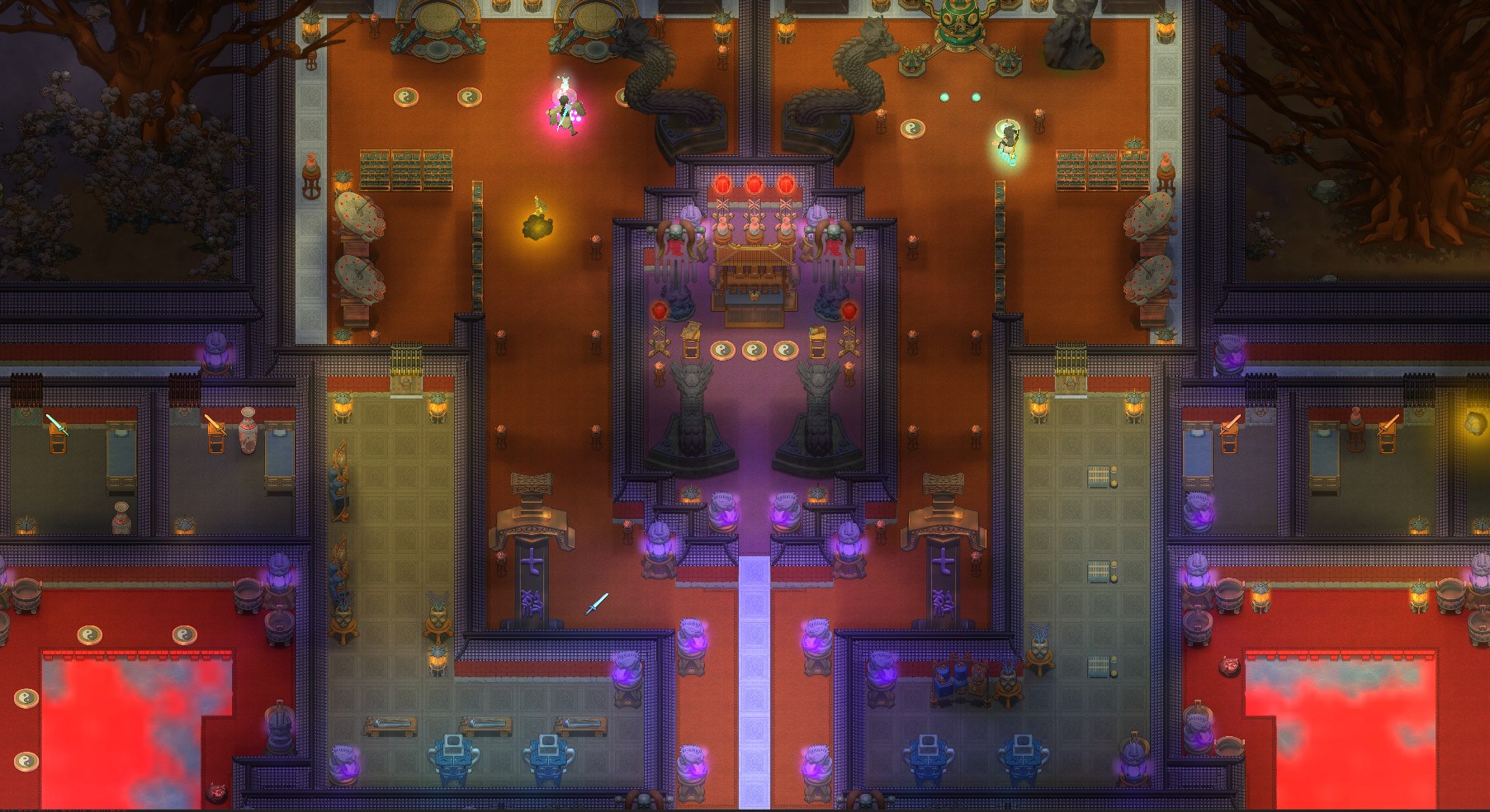
Amazing Cultivation Simulator explains very little about how a cultivation room works, and most of what you will find online is either a dense wiki reference or a guide from 2022 whose numbers no longer all match the game. The recipe itself is simple, though: put the element that feeds your law’s element on the tile your cultivator sits on, gather as much Qi around that tile as you can, and sit them on a good seat such as a Qi Cushion.
Every number below was checked against the game files of the current Steam build (version 1.26), which means correcting a few things you will still see repeated a lot. A tile is one square of the map, and for element and Qi, cultivation speed, breakthrough chance and Golden Core quality only look at the tile your cultivator sits on.
Quick setup for your first cultivation room
- Pick a spot away from your other arrays, so their items will not spill the wrong element onto the new seat. If the spot is Spiritual Soil, leave it bare.
- Build the seat in the middle. A Qi Cushion is the standard choice, and until you have one, a plain Cushion made of any fabric still beats the ground.
- Put the element that feeds your law on the seat tile with a wall, a floor or items on display stands.
- Place Qi gathering items on display stands in rings around the seat, each one close enough that its range actually reaches the seat.
- Close the room with exactly one door to the outside.
- Leave every gathering item alone for 5 in-game days.
- Open the cultivation panel. The Element row should show +5 and the Qi row should have no red marks. Laws with no element will always show 0 on the Element row.
That is enough for a room that works. The rest of this guide is going to explain why each step matters and what you can improve later.
Which element feeds your law?
The most common beginner mistake is to surround a Fire cultivator with Fire items. What you want on the seat tile is the element that generates your law’s element in the five-element cycle.
| Law element | Laws | Feed with | Avoid | Neutral (only dilutes) | Start on plain soil | Feeding element needed on soil for x1.5 |
|---|---|---|---|---|---|---|
| Fire | True Sun Refining, Primordial Alchemy, Emotion Severing | Wood | Water | Earth, Metal | x1.0 | about 37 |
| Earth | Sunflower Refining, Heaven Stealing | Fire | Wood | Metal, Water | x1.0 | about 30.3 |
| Metal | Grand Chariot Wisdom, Seven-Slaughtering Sword | Earth | Fire | Water, Wood | x1.2 | about 10.3 |
| Wood | Six Paths Reincarnation, Myriad Artifact | Water | Metal | Fire, Earth | x1.0 | about 27 |
| Water | Sixteen Supreme Steps | Metal | Earth | Wood, Fire | x0.5 | about 60.3 |
| None | Jade Purity Immortal, Primordial Symbols, Nimbus Conquest (DLC) | n/a | n/a | n/a | x1.0 always | n/a |
The game counts the feeding element double, your law’s own element once and the two unrelated elements not at all (they only dilute the mix), while the element that overcomes your law counts double against you. As such, a tile of only your law’s own element tops out at x1.2, and you will only reach the x1.5 top step with a tile that is almost pure feeding element.
“Start on plain soil” shows where each law begins on bare Soil with nothing else around it. Soil is mostly Earth, so a Water law starts at x0.5, since Earth overcomes Water, while a Metal law already starts at x1.2. The last column is how many points of feeding element the seat tile will need on Soil to reach x1.5.
The ground matters quite a bit. On Rocky Terrain a Metal or Water law needs only about 5.4 points of feeding element for the top step, which is a huge difference for Water laws, but Wood laws are better off elsewhere, since Rocky Terrain carries Metal.
First room per law element
- Fire laws are usually considered the easiest. With nothing else around, 8 raw Spiritwood within 2 tiles of the seat will reach x1.5 on plain Soil, while 7 still only give x1.2, and 5 Phoenixwood do the same job.
- Metal laws are almost as easy. One Holy Stone (B) wall directly beside the seat (not diagonally) lifts plain Soil to the top step all by itself.
- Earth laws feed on Fire items like Igneocopper Bars and Fire Essence Bars, and the room is going to get very hot. Stay away from Huge Ginkgo Trees, since Wood overcomes Earth.
- Wood laws feed on Water items like Ice Crystal Bars, Ice Essence Bars, Soul Pearls and Prism Lotus, and these rooms get very cold instead.
- Water laws are the hardest, simply because Metal items are scarce early on. Build on Rocky Terrain if you can and keep Earth items like Holy Stone away from the seat.
Element strength steps
Element strength is the number the game calculates for your law on the seat tile, from +2 on a tile of pure feeding element down to -2 on pure overcoming element. The game sorts it into six steps, and each step sets a multiplier for cultivation speed, a bonus for regular breakthroughs and a multiplier for the Golden Core score.
| Element strength on the tile | Cultivation speed | Regular breakthrough chance | Golden Core score |
|---|---|---|---|
| 1.85 or more | x1.5 (Element row +5) | +10 points | x1.5 |
| 1 to 1.85 | x1.2 (Element row +3) | +5 points | x1.25 |
| 0 to 1 | x1.0 | +2 points | x1.1 |
| -1 to 0 | x0.8 | -2 points | x0.9 |
| -1.9 to -1 | x0.5 | -5 points | x0.75 |
| below -1.9 | x0.1 | -10 points | x0.5 |
The top step is x1.5. The 2022 Steam guide still lists x2 there, but there is no x2 step anywhere in the current files. The Element row on the cultivation panel will only show +5 at the x1.5 step, and a +3 means you are sitting at x1.2.
To reach x1.5, the feeding element has to supply 85% of all the element on the seat tile if the rest is your law’s own element, 92.5% if the rest is a neutral element and 96.25% if the rest is the element that overcomes your law. These shares are the same for every law. The Observatory’s element bars will not add up to 100% when all five elements are present, so trust the Element row instead.
Element strength also sets a mood for elemental cultivators, from Perfect Alignment (+15) at 1.9 or more down to Restraining Each Other (-15) below 0. A Fire cultivator on bare Soil sits at exactly 0 and will get Disarray (-8).
Element sources: floors, walls and items
You can put element on the seat tile with a floor under it, walls beside it or items around it, usually on display stands. All numbers in the table are element points, the same unit as the last column of the feed table, and points from different sources on one tile add up. The Huge Ginkgo Tree in the last column is a tree rather than an item, so you will have to build the room around one.
| Element | Floor (offcut) | Wall (block) | Items on stands |
|---|---|---|---|
| Wood (feeds Fire) | Wood Offcut 1, Spiritwood Offcut 2, Phoenixwood Offcut 3 | Timber 2, Goldwood Timber 4, Spiritwood 7, Parasol Timber 9 | Spiritwood 5, Phoenixwood 8, Gnarled Vine 12, Huge Ginkgo Tree 12 |
| Fire (feeds Earth) | Igneocopper Offcut 2 | Igneocopper Bar 6, Fire Essence Bar 10 | Igneocopper Bar or Ore 5, Fire Essence Bar 12, Crimson Fruit 12 |
| Earth (feeds Metal) | Stone Offcuts 1, Jade Offcut 2, Holy Stone Offcut 3 | Graystone or Brownstone (B) 2, Jade (B) 4, Holy Stone (B) 12 | Jade 3, Holy Stone (B) 8, Ocher Essence 12 |
| Water (feeds Wood) | Ice Crystal Offcut 2 | Ice Crystal Bar 6, Ice Essence Bar 10 | Ice Crystal Bar or Ore 5, Ice Essence Bar 12, Prism Lotus 12 |
| Metal (feeds Water) | Iron Offcut 1, Darksteel Offcut 3, Lumina Core Offcut 5 | Iron Bar 3, Darksteel Bar 9, Lumina Core Bar 13 | Darksteel Bar or Ore 8, Sage Fruit 12 |
Reach matters just as much as strength. Element fades with distance, measured as a true circle, so diagonal tiles drop out sooner. Counted in tiles out from the source:
- Walls and doors reach 1 tile, and only the 4 tiles directly beside them.
- Floors only affect the tile they cover, and display stands give off nothing at all.
- Most stone or wood decorations, such as vases and censers, reach 2 tiles, and so does Spiritwood.
- Holy Stone, Soul Pearls and Fire or Ice Essence Bars reach 3 tiles.
- Spirit fruits (Sage Fruit, Gnarled Vine, Prism Lotus, Crimson Fruit, Ocher Essence) reach 4 tiles, at 12 on their own tile and 1 tile out, then 10.8, 9.7 and 8.8 at 2, 3 and 4 tiles.
Walls do not hold Qi or element in. The same items in the open will give the seat the same Qi and the same element, and Qi flows through walls freely. A wall only matters through its material, which puts its element on the floor tiles directly beside it, and most bricks soak a little Qi on the wall tile itself, while Spirit Stone and Spirit Crystal bricks soak none.
An item on a display stand works exactly as if it lay on that tile, so it still gives off its element, its Qi gathering and its heat or cold. The stand itself gives off no element.
Floors are the weakest option. A Graystone Offcut floor alone still leaves a Metal law on Soil at x1.2, and an Iron Offcut floor only lifts a Water law to x0.8. A Phoenixwood Offcut floor alone lands a Fire tile right on the x1.2 line, and the game’s rounding leaves it just short, so you are going to need one more Wood source.
Bear in mind that a stack counts as one item, so ten Spiritwood on one stand give the element of one. For ready-made layouts, the Cultivation Rooms page on the Fandom wiki has a big collection, but it has not been updated since 2023, so check the Element row of every layout in your own game.
Qi gathering
Qi is the second half of every room, and it is where most of the confusion lies, because you are dealing with three different values. Qi on the tile is what cultivation reads. The game never prints it as a number, but a mod such as MoreGridInfo will show it. Qi gathering is the value listed on items such as Spiritwood, and it lets the tiles around the item hold more of the Qi that flows in from your map’s Qi sources. The Qi number shown on an item itself (often called LingQi) is only Qi stored inside that item.
Gather items do not create Qi, so a spot that no Qi flows to will stay weak whatever you put there. Additionally, the “Range: N” text on gathering items reaches one tile less than the number says, so Range 4 means 3 tiles out.
For planning, the Qi Cushion gathers 60 on its tile only, raw Spiritwood 20 up to 2 tiles out and 16 at 3 tiles, Holy Stone 35 up to 1 tile out and 28 at 2 tiles, spirit fruits 75 with a reach of only 1 tile and Dragon Feces 90 on its tile and 85.5 one tile away.
Raw Spiritwood is one of the most useful items in any early room, because its gathering reaches 3 tiles while its Wood only reaches 2. On the outer ring, more than 2 but no more than 3 tiles from the seat, it will add Qi without touching the seat’s element, so it works for every law. Counting every tile within 3 tiles of the seat, you will have 28 spots for display stands.
Spirit fruits are the opposite. Their element reaches 4 tiles, so a fruit of the right element is perfect right beside the seat, while one of the wrong element will spoil a seat from far away. The first big upgrade most players on the subreddit name is Dragon Feces. It counts as an Earth item, so keep it away from Water seats.
Any gather item dropped on the cushion’s tile counts at full strength, except for Spirit Roots, so you get an extra item in range without using up a ring slot. Dragon Feces is even stronger there than one tile away. The drop restarts the 5-day ramp, though, and Qi-soaking items such as Spiritwood or Holy Stone will soak a little of the Qi flowing in.
The 5-day ramp and the drain
Every Qi gathering item needs 5 in-game days to reach full strength, rising by a fifth per day. Moving or dropping any gathering item restarts that climb for every tile in its reach, including the gathering from items you did not touch, so finish the layout in one go and keep haulers from shuffling items near the cushion.
A cultivator also soaks up 10 to 30% of the Qi on their tile each time the Qi map refreshes, more when the tile’s element suits their law. That refills their Qi bar, but it lowers the Qi density they are cultivating in. Two disciples on neighbouring cushions will each drain their own tile.
Red marks on the Qi row
Qi on a tile can’t go below zero. Red marks on the Qi row only mean the cultivator’s tile holds less than 50 Qi, and all five are red at 30 or less. In the Golden Core window the Qi Bonus row stays red until 250. The usual causes are:
- no Qi reaching the area at all
- gather items placed or moved less than 5 days ago
- a Qi Drought or Qi Deficiency event
- a cursed (Fiend) Spirit Root nearby pushing Qi away
- other cultivators draining the same spot
Once the row is clear, keep going. It already shows +5 at about 70 Qi on the tile, but cultivation speed is multiplied by 0.7 + tile Qi / 250 with no cap, which is x3.1 at 600 Qi. There is no hard cap at 2,500 Qi either, as a tile above that simply drains faster (about 15% per update at 3,000 against about 1% below 2,500).
Huge Ginkgo Tree
A Huge Ginkgo Tree gives 45 Qi gathering and 12 Wood to every tile within 4 tiles, fading slightly toward the edge (a young tree gives less Wood, down to 30% of it, until it is 70% grown). Its Qi gathering does not change with the seasons. Any tile that gets its Qi also gets its Wood, though, so among the elemental laws it only helps Fire cultivators. For an Earth cultivator it is the worst neighbour possible, and a cushion 5 tiles away gets nothing from it.
Best seat for cultivation
The seat’s Cozy value multiplies cultivation speed directly, which makes the seat one of the cheapest upgrades you can make.
| Seat | Material | Cozy (speed multiplier) |
|---|---|---|
| No seat (ground or floor) | n/a | x1 (plus -15 mood) |
| Bed | Holy Stone (B) | 1.4 |
| Cushion | any fabric | 1.5 |
| Qi Cushion | Timber | 1.2 |
| Qi Cushion | Spiritwood, Spirit Crystal (B) or Lumina Core Bar | 2.0 |
| Qi Cushion | Holy Stone (B) | 2.2 |
| Altar of Magic | Holy Stone (B) | 2.6 |
| Throne of Taos | Holy Stone (B) | 3.2 |
Off a seat the multiplier is simply x1, so the x0.6 you may see quoted for bare ground is wrong. The terrain’s 0.6 only slows energy recovery, and the red Cozy icon the panel shows there is misleading. The real cost of the ground is the -15 “Sitting Meditating” mood, which works out to roughly 16% slower cultivation at mood 100.
A plain Cushion of any fabric reaches 1.5 and beats a Timber Qi Cushion at 1.2. The Qi Cushion still wins in the long run, since it adds 60 Qi gathering to its tile, has a feng shui rating and reaches 2.0 or 2.2 with better materials. Even a Holy Stone (B) bed stays below a fabric Cushion.
Qi Cushion material
You will often read that the Qi Cushion should be made of your cultivator’s element. In fact, the Qi Cushion puts no element on any tile, so its material can neither help nor spoil your cultivator’s element. The material changes its coziness and its feng shui rating, and most bricks, bars and timbers also soak up a little of the Qi flowing onto the seat tile (Spirit Crystal and Spirit Stone bricks soak none).
The game rates the cushion by how strong its material’s element is on its tile. Built from your law’s element on a well-fed tile it is Very Auspicious, built from Spirit Crystal or Spirit Stone bricks it is always Auspicious, and built from another element it can drop to Slightly Auspicious or worse. That rating only feeds the room’s and the sect’s feng shui and never touches cultivation speed.
Personally, I would go with Spirit Crystal (B) as soon as you have it, since 2.0 Cozy with a rating that is always Auspicious is a fairly solid combination. Holy Stone (B) gives the most coziness, as long as the rest of the room keeps its feng shui up.
Altar of Magic
The Altar of Magic is a common mid-game upgrade. The cultivator sits in the middle of one long side, right next to the altar’s centre, and that seat tile gets the altar’s full 600 Qi gathering. In Holy Stone (B) its Cozy reaches 2.6.
Unlike the Qi Cushion, the altar gives the seat the element of its build material, so pick the one that feeds your law. That means Holy Stone (B) for Metal laws, Lumina Core Bar for Water, Spiritwood or Parasol Timber for Fire, Fire Essence Bar for Earth and Ice Essence Bar for Wood, or Spirit Crystal (B) if you want no element at all.
The downside is space. The altar’s 15 tiles block most of the close ring, leaving only 14 free tiles within 3 tiles of the seat against 28 around a Qi Cushion. I would say it is still worth it once you can build it, as long as you pick the material by your law.
Temperature
Earth laws feed on Fire items, which heat the room, and Wood laws feed on Water items, which cool it. Temperature has no direct effect on cultivation speed, but it will change your cultivators’ mood, which does.
Heat and cold are symmetric tier for tier. An Igneocopper Ore or Bar warms a room exactly as much as an Ice Crystal Ore or Bar cools it, and the same goes for Fire and Ice Essence Bars. The imbalance is at the top: one Crimson Fruit or Blazing Feather heats as much as one and a half Soul Pearls cool, and Prism Lotus has no temperature effect at all. Each item’s effect is spread over the room’s floor tiles, so a bigger room changes less per item, and a stack counts as one item.
The usual fix is to put the Wood and the Earth array in one shared room, so the heat and the cold cancel out. The two laws do not poison each other either, since Fire is only a neutral element for a Wood law and Water only a neutral element for an Earth law, but keep each array’s strongest emitters out of reach of the other seat anyway.
For fine-tuning, a display stand built from Ice Crystal Bars cools the room about as much as one Ice Crystal Bar and gives off no element, so a few of those make a free thermostat in an Earth room. Igneocopper Bar stands do the same in a Wood room.
Feng shui and relics
Room feng shui only reaches your cultivators in indirect ways, and it never multiplies cultivation speed or Golden Core quality:
- Disciples whose bed is in the room get a mood, from +15 in a Very Auspicious room down to -15 in a Very Ominous one, and the two worst ratings get worse over time. At mood 100 that is about +17% to -16% cultivation speed, but a room without beds gives nobody this mood.
- Cultivating in Practice mode at night in a Slightly Ominous, Ominous or Very Ominous room risks an Overflow of Qi injury, at about 2.5%, 4.9% or 11.8% per night.
- Every rated room counts toward your sect’s feng shui, which is what the Feng Shui row in the breakthrough window shows, from +10% for Blessed down to -10% for Dire.
- Relics only work in a room that has a rating.
A room only gets a rating if it holds a building with a rating of its own. The Qi Cushion and beds count, while the plain Cushion, the Altar of Magic, display stands and most decorations do not. In a room with no bed, workstation or other building that gives it a room type, exactly one door to the outside gives +3, while two or more outside doors count as a feng shui leak at -3.
Never seal a cultivator in a room without a door, though. They will get “Can’t Get Out” at -40 mood, and it deepens by another -40 every 4 in-game days down to -160. Since mood counts twice, this alone can cut cultivation by a third or more.
Relics are the part of feng shui that does touch cultivation speed. A random spirit relic that rolls “Cultivation Speed Bonus” adds +15% to +60% to everyone inside its room, depending on its strength level, while the Dragon Rod gives +40% and Holy Grace +15%. If a relic’s conditions are not met in a rated room, the same effect turns negative (“Negative – Relic Channeling”). A misplaced +40% relic costs you 40%, and the room also loses 30 feng shui points, which is enough to make it Very Ominous.
Cultivation room vs breakthrough room
A breakthrough reads fewer factors than everyday cultivation, so the two rooms want slightly different things.
| Factor | Cultivation | Regular breakthrough | Golden Core |
|---|---|---|---|
| Qi on the cultivator’s tile | yes (x0.7 + Qi/250) | yes (+1 point per 30 Qi) | yes (x1 + Qi/1500) |
| Element on the tile | yes (x0.1 to x1.5) | yes (-10 to +10 points) | yes (x0.5 to x1.5) |
| Seat coziness | yes | no | no |
| Law Match | yes | no | yes |
| Mood | yes (counts twice) | no | no |
| Mental State | yes | yes | yes |
| Luck | only through Law Match | yes | yes |
| Max Qi | no | no | yes |
| Room feng shui rating | no | no (the sect rating counts) | no |
Seat coziness, mood and the cultivator’s master do nothing for a breakthrough, and neither does the room’s own feng shui rating, while Luck and (for the Golden Core) Max Qi do count. What the room itself adds is the Qi and the element on the cultivator’s tile.
For a regular breakthrough, every 300 Qi on the tile adds about 10 percentage points to the chance (before the final consciousness multiplier and the 100% limit), and the element step adds -10 to +10 points. The breakthrough window calculates its chance for the tile you pick, but the real roll will use the tile the cultivator is actually sitting on. Early on, one room can do both jobs, and later it pays off to keep your best items for a breakthrough room.
Golden Core room
The Golden Core has no success roll, and the score it builds up during the breakthrough sets its grade. The cultivator stops drawing Qi from the surroundings and burns 30 Qi per second until the bar is empty, so Qi-recovery pills and fast regeneration do nothing for core quality, apart from getting the bar full before you start (the button needs 99% Qi). What the room adds is the Qi density and the element on the cultivator’s tile, while Max Qi sets how long the core keeps growing.
Tile Qi has no cap here either. The score is multiplied by 1 + tile Qi / 1500, which is x1.4 at 600 Qi, and the element step multiplies it by x0.5 to x1.5. That is also what Manual Qi Bursting is for, a player-found trick that, according to player reports, pushes tile Qi far above what an array holds by itself for a short time, right before this one breakthrough.
The Spirit Pagoda is the classic Golden Core room item. It needs at least 100,000 Relic Qi, must be the only spirit relic in a rated room and only works in a Large room of 50 to 99 floor tiles, so a Huge room of 100 or more fails. Its Relic Qi is Qi it soaks up from the tile it lies on, so charge it on your highest-Qi spot (500 or more Qi on its tile charges fastest), and do that outside any rated room, because an uncharged Pagoda in a rated room flips to -999 Max Qi and -30 feng shui.
Once it is active, +999 Max Qi applies to everyone in that room and disappears when they leave, so fill the cultivator’s Qi bar inside the room before you start. On a cultivator with 10,000 Max Qi, that is about 10% more core score.
Why is my cultivation slow?
If a disciple cultivates slowly even in a decent room, the cause is often somewhere else. Go through their cultivation panel:
- The Law row shows how well the disciple’s attributes fit their law, and no room will change it. Law Match multiplies cultivation speed directly, so have a look at the law tier list and Law Match guide if that row is low. The Element row shows how well the room fits.
- Mental state multiplies speed by x0.1 below 30, x0.4 from 30, x1 from 50, x1.2 from 70 and x1.5 from 85.
- Practice runs at x1 and Train at only x0.25, which trades speed for three times the Inspiration. In Balance mode a disciple at Stable mental state splits sessions 50/50 between Practice and Train, at Composed 70/30, and only Practices from Harmony (85+). Below 50 they only do Mind activities. For raw speed, set the disciple to Practice.
- Mood counts twice, and sitting off a seat, “Can’t Get Out”, an unfed tile and a room that is too hot or too cold will all pull it down.
- The room itself might be the problem after all if the Element row is below +5, the Qi row is red or gather items were moved in the last 5 days.
- The Qi Sense skill feeds the Cultivation Speed Bonus stat, which the cultivation panel does not show, worth x1.0 at level 10 and x1.4 at level 20.
- A living master who is at least as far along as the disciple gives x1.5 with the same law and x1.2 with a different one.
Weather can also knock a room off the top step. Element weathers add a flat 2 to 6 points of one element to every tile on the map, indoors too: rain and snow add Water, Drought and Foehn Wind add Fire, Dust Devil adds Earth, Noxious Air adds Wood and Thunderstorms add Metal. A room that barely reaches the top step will lose it in most weather, and a storm of the element that overcomes your law costs about 150 extra points of feeding element to stay there, so build a big surplus if you want the bonus to survive storms.
Other questions
Do I need a room for every disciple?
No. One room per law element is enough for most sects, and disciples of different elements can share one big room too, as long as every seat tile still shows +5. A room can have at most 400 floor tiles, and anything bigger will not count as a room at all.
What about laws with no element?
Laws with no element, such as Jade Purity Immortal Law and Primordial Symbols Law, always get x1.0 from the element factor (the wiki’s x1.2 for them is wrong). Room element neither helps nor hurts their speed, but Qi on the tile and the seat’s coziness still count, so simply fill their room with your strongest gathering items of any element. Law of Nimbus Conquest (DLC) also ignores element for cultivation, but its two Golden Cores are graded like a Fire core (Yang) and a Water core (Yin), so Wood feeds its Yang core and Metal its Yin core.
Should I put a floor over Spiritual Soil?
No. The floor keeps the soil’s elements and adds its own, but you will lose the soil’s +40 Qi gathering (at the latest after your next save and reload), and the tile’s fertility drops to zero. Leave Spiritual Soil bare under the cushion.
Conclusion
A cultivation room looks complicated, but almost everything in it comes down to the one tile your cultivator sits on. If you just want a first room that works, then a Qi Cushion on a tile fed with the right element, raw Spiritwood on the outer ring and 5 days of peace is probably the way to go. That being said, once the Element row shows +5, the next big gains will usually come from the disciple.