
The point of a casus belli in Stellaris 4.6 is to let you pick a war goal, and the game grants one by itself whenever you claim one of their systems (Conquer), make them your Rival (Humiliate) or clearly outgrow them in overall power (Vassalize).
A casus belli is simply the reason the game accepts for a war. The game creates and removes it automatically as the situation between two empires changes, and there is no way to buy one.
Every war then follows the same chain. The casus belli gives you a war goal, your claims decide which systems can change hands, your fleets and armies occupy them, and the peace deal decides what you actually keep. If you only take one habit away from this guide, make it this one: make your claims before you declare, because the attacker pays double for every claim it adds during the war. Bear in mind as well that a status quo peace will only give you the claimed systems you occupy.
Everything here is checked against the 4.6.0 game files and the 4.6 patch notes. This guide will take you from your first casus belli to the truce after the peace, and it will also show you how to grow your borders when you would rather not fight at all.
Contents
- How war works in 4.6
- Casus belli
- How to get the subjugation casus belli
- Claims
- War exhaustion
- How wars end
- Your first war, step by step
- How to expand borders without war
- Conclusion
How war works in 4.6
Each casus belli comes with one or more war goals, and a war goal is what you will demand from the loser. When you declare, you pick one of them, and the defender picks its own in return, which leaves exactly one war goal per side. If the defender doesn’t choose anything, it is going to get Humiliate by default.
Claims are the second half of the deal. They say which of the loser’s systems you can take.
Then comes the fighting. Occupation is what turns a claim into a real gain, and a system only counts once you hold its starbase and every colony in it. A captured starbase with an enemy colony still standing behind it will not count yet.
The war will end in one of three ways:
- A surrender, where the loser gives the winner its war goal and every eligible claim.
- A status quo, where both war goals are dropped and each side keeps the claimed systems it occupies.
- A forced status quo, which one side can impose once the other has been at 100% war exhaustion for 24 months.
Whichever way it goes, a 10-year truce follows.
Not every empire can start a war. The War Philosophy policy still has three options. Unrestricted Wars lets you claim anything. Liberation Wars only allows claims in defensive wars or on Gestalt empires and gives you the old ideological war (called Overthrow Government with Willpower). Defensive Wars only allows claims in defensive wars or on Gestalt empires and stops you from declaring war at all, apart from Demarcation and Stop Stellar Cannon. Fanatic and Absolute Pacifists can’t leave Defensive Wars, which limits them to those two as long as they are independent.
Even with the right policy, a truce, a pact with the target or a guarantee of its independence will block the declaration.
Casus belli
| Casus belli | How you get it | War goals | Needs |
|---|---|---|---|
| Claim | Hold at least one claim on their systems | Conquer | Base game |
| Subjugation | Superior or Overwhelming power, target independent | Vassalize, Make Tributary | Base game |
| Subjugate | Same power rule, you are a Megacorp | Make Subsidiary | Megacorp |
| Animosity | Target is your Rival, only vs Gestalts on Liberation Wars | Humiliate | Base game |
| Ideology (Overthrow Government with Willpower) | Liberation Wars, they lack one of your ethics | Impose Ideology (base name), Overthrow Government | Base game, Willpower renames it |
| Impose Ideology (4.6) | An adopted Ideology, not after Ethical Authority | Impose Ideology (4.6) | Willpower |
| Impose Ideological Subjugation | Ethical Authority perk, replaces Impose Ideology (4.6) | Ideological Subjugation | Willpower |
| Despoliation | Barbaric Despoilers can raid anyone | Plunder | Barbaric Despoilers civic |
| Colossus | Unrestricted Wars, total war on anyone | Total War | A built Colossus |
| Containment | Target is a major threat: Purifiers, Swarm, Exterminator | End Threat | Base game |
| Genocidal civics | Purifiers, Exterminators, Swarms, Assimilators | Cleansing, Absorption, Assimilation, Devastation | A genocidal civic |
| Existential Expulsion | Any empire you’re allowed to declare war on | Wipe Them Out | Existential Campaigns tech |
| Subject | You are a subject, target is your overlord | Independence | Base game |
| Demarcation | Nomad waystation in your space or fleet in your borders | Nomadic Expulsion | Allowed even on Defensive Wars |
The Claim casus belli will probably be one of the first ones you use, and it stays the most common. Claim at least one system of theirs and you will get it, together with the Conquer war goal. Conquer is the plain land grab, and a surrender in a Conquer war hands you every system you claimed.
When another empire takes one of your systems, you will automatically get 10 claims on it, which lets you take it back later with the same Claim casus belli. Devouring Swarms and Driven Assimilators don’t get these claims, and Fanatic Purifiers only get them back from an empire of their own species.
Subjugation is the casus belli behind Vassalize and Make Tributary. The game grants it once your overall power is Superior or Overwhelming against an independent empire, and the next section goes through it in full.
Animosity is tied to rivalry. Declaring an empire your Rival still pays you +0.5 Influence a month, makes your claims on its systems 20% cheaper and gives you the Animosity casus belli with the Humiliate war goal (under Liberation Wars only against Gestalt empires). The Humiliate war goal takes no systems by itself, although a surrender still hands you every eligible claim. It gives you Influence and weakens the loser for 10 years, which makes it a decent way to punish a neighbour you cannot conquer yet.
Genocidal empires work differently. If the owner has a genocidal civic such as Fanatic Purifiers, Devouring Swarm or Determined Exterminator and you do not, the game treats it as a major threat and will not let you claim its systems. You will fight it with Containment and its End Threat war goal instead. That is a total war, which means there is no surrender and you need no claims: a system becomes yours once you hold its starbase and every colony in it. The genocidal empires themselves get their own total-war casus belli (Purification, Hunger, Sublimation and Cleansing Blaze) against everyone they hate.
Existential Expulsion is a lot rarer. The Existential Campaigns technology gives it to you against any empire you are allowed to declare war on, whether you run Unrestricted Wars or Liberation Wars. Its war goal, Wipe Them Out, is a total war where starbases are destroyed instead of captured, nobody can surrender, and the defender fights back with End Threat. Defensive Wars still blocks it like any other war, so Fanatic and Absolute Pacifists cannot use it.
A finished Colossus is another road into a total war. If you also run Unrestricted Wars, it lets you start one against anyone.
Demarcation is a special case. A settled empire will get it against a nomad whose waystation sits in its space, or whose fleet is inside its closed borders, and the Nomadic Expulsion war goal then destroys those waystations. It works even while you run Defensive Wars.
Ideology wars in 4.6
The ideology wars are where 4.6 gets confusing, because two different wars can carry the same name. Ideologies come with the Willpower DLC, and owning it decides which one you will see.
Without Willpower, there is only one ideological war. Liberation Wars gives you the Ideology casus belli against any non-Gestalt empire that lacks one of your ethics, and its war goal is still called Impose Ideology. Winning that old Impose Ideology war makes the loser copy your ethics and government.
With Willpower, that same war is renamed Overthrow Government. Next to it, Willpower adds a new Impose Ideology casus belli for empires with an adopted Ideology. This 4.6 Impose Ideology needs no particular War Philosophy, works under anything except Defensive Wars, and will make the loser adopt your Ideology.
A non-Pacifist only needs that adopted Ideology. A Pacifist gets the Willpower Impose Ideology casus belli only as the custodian of its Ideology against an Ideology rival, or after the target declines its Invite to Adopt. Fanatic and Absolute Pacifists still cannot declare at all.
Once you take Ethical Authority, the level-2 perk of Force of Will (Willpower), the 4.6 Impose Ideology casus belli disappears and Impose Ideological Subjugation takes its place. Winning it makes the loser adopt your Ideology and become your Doctrinal Proxy. Overthrow Government stays available if you run Liberation Wars.
An empire that loses either of these two Willpower wars cannot drop the imposed Ideology for 10 years, and nobody can invite it to adopt another one in that time. Our Willpower guide explains how Ideologies work in the first place.
Some wars are never your choice at all. You will only meet these as a target or as one side of a galaxy-wide event:
- Punishment wars from Fallen Empires, with goals like Stop Atrocities or Cleanse Holy Worlds
- Total War and Entertainment wars from Awakened Fallen Empires
- The War in Heaven
- Crisis and event wars, such as the Machine Uprising
How to get the subjugation casus belli
You don’t ask for the Subjugation casus belli. The game grants it automatically while your overall relative power against an independent empire is above Equivalent, which means Superior or Overwhelming, and it will take it away again as soon as you drop back. The old route of demanding vassalization, being refused and getting a one-year casus belli is gone.
Relative power is the game’s comparison of your overall strength with theirs, and you will find the rating in their diplomacy view. It looks at the overall picture and does not check fleet, economy and technology one by one, which means you can trail them in one of the three and still get the casus belli. A nomad also qualifies on fleet power alone, and Awakened Fallen Empires always qualify.
Opinion, ethics and claims play no part, and the game re-checks the casus belli every day. Of course, Defensive Wars still stops the declaration itself.
Megacorps work the same way, but they get the Subjugate casus belli and the Make Subsidiary war goal instead of Vassalize and Make Tributary. The Imperial Fiefdom origin adds a special case as well, since it can give you a Subjugation casus belli against your former overlord that lasts 30 years.
Why it does not show up
- Your overall power is not above Equivalent. This is by far the most common reason.
- They are someone else’s subject, you are a subject, or you are already their overlord.
- You are in a federation with them, or you reached level 1 of Become the Crisis (Galactic Nemesis).
- Vassalize is missing because you or they have Inward Perfection (Make Tributary still works then), because you are a Megacorp (look for Make Subsidiary), Galactic Nemesis or the Khan’s heir, or because you hold a total-war casus belli on them.
- Vassalize and Make Tributary are greyed out because you claim every system with one of their colonies, they are a Fallen Empire, the Custodian, the Emperor or a declared crisis, you’re outside the Imperium while they are inside it, or Pax Galactica is active between two Galactic Community members. Against a Fallen Empire, the tooltip blames your claims, but the real block is the target itself.
- Defensive Wars, a truce, a pact or a guarantee stops you from declaring war at all.
If the casus belli still seems to be missing, open the declare-war window and look at the war goals. If Vassalize or Make Tributary is offered there, you have it.
Conquer or vassalize
I would say that big empires are better vassalized, while you should only conquer the systems you actually want to run yourself. Vassalize needs no claims at all and brings you the whole empire as a subject. In fact, claiming every system that holds one of their colonies will grey it out, because winning would annex them outright. Leave at least one colony unclaimed if you want the option. A Vassalize win turns them into a Protectorate if their tech is under 40% of yours, and into a Vassal on your Subjugation War Terms otherwise. The vassals guide weighs both options in more detail.
Claims
A claim is your empire’s official demand on a system that another empire owns. In a Conquer war, claims are the whole point, and in most other wars they decide what you keep after a status quo.
You can claim systems inside the borders of known empires that you have visited or have intel on. You can’t claim your own systems or systems a war ally already claims. Unowned systems are never claimed at all. If you want an empty system, or one without anyone’s starbase in it, you will simply build an outpost there, which the borders section further down explains.
Your War Philosophy sets the next limit. Under Unrestricted Wars you can claim any of those systems. Under Liberation Wars and Defensive Wars, you can only claim the systems of Gestalt empires and of an empire that is attacking you.
Defending has an upside here. When someone declares war on you, you may claim any system the attacker owns, whatever your War Philosophy, and you won’t pay the double price that attackers pay.
| Claim | Influence | Note |
|---|---|---|
| Base claim | 50 | You can claim the same system more than once |
| Each hyperlane jump to your space | +25 | – |
| Upgraded starbase | +25 | – |
| Colonised system | +25 | – |
| Cap | 1,000 | Only a very distant target reaches it |
| Example: colonised, upgraded starbase, three jumps out | 175 | – |
| Same system, owner is your Rival | 140 | Rival -20% |
| Same system, you attack in a war | 350 | Claim it before you declare |
| Same system, Absolute Militarist | 122 | Willpower |
| Same system inside your Ideological Reach | 140 at level 0, 70 at level 3 | Willpower and an adopted Ideology |
A claim costs 50 Influence, plus 25 for every hyperlane jump between the system and your space, plus 25 if it has an upgraded starbase and 25 if it is colonised. A single claim never costs more than 1,000. A colonised system with an upgraded starbase three jumps out is going to cost you 175 Influence in peace. Claim that same system as the attacker during the war, and it costs 350. That alone is the reason to make your claims before you declare.
Several things make claims cheaper. Your Rival’s systems cost 20% less, and the Militarist ethics cut the price too, with Absolute Militarist (Willpower) cutting it the most. The influence guide goes through the other discounts.
Willpower adds one more. With an adopted Ideology, claims and outposts on systems inside your Ideological Reach cost 20% less Influence, rising to 40%, 50% and 60% as your Ideology climbs to level 3. Other empires pay 10%, 20%, 25% and then 30% more to claim systems there. The colonised three-jump claim from above drops from 175 to 140 Influence at level 0 and to 70 at level 3.
You can still add claims once the war has started (attackers pay double), but you cannot remove any. The game will simply tell you “We cannot remove claims while at war”.
Claims also stack. You can claim the same system more than once, and when allies win a war together, the empire with the most claims on a system will get it. The claims window shows the Strongest Claimer of each system together with its number of claims. Mind that you cannot claim systems your war allies already claim, which makes it a good idea to stack your claims before an ally joins.
As mentioned above, losing one of your systems will give you 10 claims on it, unless you are a Swarm or an Assimilator, and Fanatic Purifiers only get them back from their own species.
The trap to avoid is claiming everything. Once you claim every system that holds one of their colonies, Vassalize, Make Tributary, Humiliate, Overthrow Government and most other non-conquest war goals grey out, because winning would annex the empire outright. If you want one of those goals, leave a colonised system unclaimed.
Why you cannot claim a system
- You will see “Our War Philosophy policy does not permit claiming this system except in a defensive war” when you are not on Unrestricted Wars and the owner is neither a Gestalt empire nor attacking you. Any Pacifist ethic, Crusader Spirit or Inward Perfection rules out Unrestricted Wars, and Fanatic and Absolute Pacifists are stuck on Defensive Wars.
- “We have no need to claim the systems of hostile space entities” shows up on pirates, crises and space creatures.
- “We have no need to claim the systems of major threats” means the owner has a genocidal civic and you do not. Use Containment and End Threat instead.
- Genocidal empires get their own versions of that message: a Devouring Swarm reads about the systems of prey, a Driven Assimilator about assimilation targets, Fanatic Purifiers about lesser species and Determined Exterminators about organic filth.
- Nomads cannot claim systems at all.
- You have no contact or intel, the system lies outside a known empire’s borders, it is your own, or a war ally already claims it.
- “Nothing to claim” simply means that you have no claimable system selected.
War exhaustion
War exhaustion measures how tired each side is of a war, from 0% to 100%. The war overview tracks it from space battles, ground battles, planet destruction and attrition, plus occupation. Together these can add up to 100%, and the higher the enemy’s war exhaustion climbs, the more likely it will be to accept a peace deal.
| Source | Effect on war exhaustion | Note |
|---|---|---|
| Lost ships | Count double | Avoid trading ships |
| Lost armies | Count a quarter | Assault 1.0, Clone/Robotic 0.5, Gene Warrior 3.0, defense 0 |
| Destroyed planets | Count five times | Also pacified, neutron swept or nano-assimilated |
| Attrition | Rises on its own until 100% | Creeps up the longer a war lasts |
| Every colony occupied | +1% a month | Hopeless War +5% per month to other gains |
| Absolute Militarist | -50% War Exhaustion Gain | Willpower |
| Gestalt Consciousness | -20% War Exhaustion Gain | – |
| Never Surrender | -25% War Exhaustion Gain | Fortification Traditions |
| Nationalistic Zeal | -20% War Exhaustion Gain | Civic |
| Supremacist / Belligerent stance | -20% / -10% War Exhaustion Gain | – |
| Interstellar Campaigns and Galactic Campaigns | -10% War Exhaustion Gain each | Techs |
| Sow Peace on an attacker | +10% War Exhaustion Gain per stack, up to +50% | Willpower |
| At 100% | Alert, then status quo can be forced 24 months later | You never surrender automatically |
Losses are the part you control best. Lost ships count double toward war exhaustion, while lost armies only count a quarter, multiplied by the army’s own factor. Destroying a planet counts five times as much, and that includes planets that are pacified, neutron swept, faith enforced or nano-assimilated.
Next to the losses, war exhaustion also creeps up on its own the longer a war lasts, until it reaches 100%. Once a side is at 100%, further losses stop adding to it.
Occupying every enemy colony does not end the war, and allies that never fight will stay in it as well. Instead, a slow clock starts. While a side’s main participant has every colony occupied, that side gains 1% war exhaustion a month, and the empire gets Hopeless War, which adds 5% to all its other war exhaustion gain for every month it lasts. After 12 months, the hopeless side has gained 12% from that alone, and its other gains run 60% faster.
A few things will make your own war exhaustion grow slower. Absolute Militarist (Willpower) halves your War Exhaustion Gain, and Gestalt Consciousness cuts it by 20%. Plain and Fanatic Militarist have no war exhaustion effect in 4.6 and only make your claims cheaper. Older advice that militarist empires tire slower is outdated. The ethics guide has the rest of what each ethic does.
Additionally, Never Surrender from Fortification Traditions cuts War Exhaustion Gain by 25%, and a handful of civics, stances, techs and council agendas add smaller cuts. All of these change how fast war exhaustion grows. None of them lowers the war exhaustion you already have.
The war goal itself plays a little bit of a role too. Ideology war goals carry a 0.75 war exhaustion factor for the side that picked them, which means that side will tire about a quarter slower.
You can also make an attacker tire faster. With Willpower, you get Sow Peace from the Social Concord civic or from finishing Diplomacy Traditions, and you use it on an empire that is the attacker in a war. Each use costs you 50 Influence and 25 of its opinion of you. Each stack of Peace Sown gives it +10% War Exhaustion Gain and -5 stability, up to five stacks, and the stacks go away once it stops being the aggressor. Sow Peace won’t end a war by itself, but it speeds up the clock against the empire that started it. The Shock Doctrine tenet (Willpower) makes enemies tire faster as well.
Reaching 100% war exhaustion does not end the war or make you surrender. You will get the High War Exhaustion alert, and a 24-month clock starts. When it runs out, the other side can force a status quo on you, and the alert shows how many days are left until then. You never surrender automatically. If both sides are at 100%, each one can force the status quo once 24 months have passed since the other side hit 100%.
How wars end
| How the war ends | Claimed systems you occupy | Other occupied systems | Afterwards |
|---|---|---|---|
| Surrender, Conquer | Every claimed system, occupied or not | Go back to the owner | 10-year truce |
| Surrender, Vassalize / Tributary / Subsidiary | Come to you first | Stay with the new subject | 10-year truce, Protectorate if its tech is under 40% |
| Surrender, Humiliate | Ceded to you | Go back | 10-year truce, loser Humiliated for 10 years |
| Status quo | Each side keeps them | Go back, a white peace if nobody holds a claim | 10-year truce |
| Status quo, subjugation or Overthrow Government war | Become yours | With a planet: new subject or allied empire | 10-year truce |
| Forced status quo (24 months after 100%) | As in a status quo | As in a status quo | 10-year truce |
| Claims on every colony, then surrender | All ceded, the empire is annexed | Unclaimed outposts disappear | No enemy left, build outposts in the freed systems |
| Total war (End Threat, Cleansing, Absorption) | No claims needed | Yours once its starbase and every colony are held | No surrender, 10-year truce after a status quo |
| Independence war (subject vs overlord) | Overlord claims all the subject’s systems | Subjects on your side go free, even on a status quo | 10-year truce |
A status quo drops the war goals. Each side keeps the claimed systems it occupies, everything else goes back, and if nobody holds a claim, the war ends as a white peace with no border changes. A forced status quo is a normal status quo too, which is why you want the claims you care about occupied before the enemy’s clock runs out.
Subjugation wars add one extra to that. In a Vassalize, Make Tributary or Make Subsidiary war, and in the Liberation Wars ideology war (Overthrow Government with Willpower), the occupied systems you did not claim will become a new empire that turns into your subject or ally. Only systems that contain a planet and that you fully hold count for this. The peace screen shows you the new empire before you accept.
A surrender is the other main ending. It gives the winner its war goal and every eligible claim. In a Conquer war, that means every system you claimed, occupied or not, while anything you took without a claim goes back.
Humiliate gives you 100 Influence and leaves the loser Humiliated for 10 years. A Supremacist loser is also forced into the Belligerent stance.
Win a Vassalize war and the whole empire will become your subject, with your claimed systems coming to you first. What a Vassal owes you depends on its subject terms, which start from your Subjugation War Terms policy and can be renegotiated later. A Tributary starts on the standard Tributary terms instead. The subject terms are listed in our vassals guide.
In the two Willpower ideology wars, the 4.6 Impose Ideology and Impose Ideological Subjugation, you should aim for a surrender. That is the outcome that puts your Ideology on the loser.
If your claims cover every colonised system and the enemy surrenders, the whole empire is annexed and its unclaimed outposts disappear. Have construction ships ready to claim the freed systems with outposts of your own.
Total wars follow their own rules. In End Threat and the genocidal wars, there is no surrender, and you keep what you fully occupy. Wipe Them Out allows no surrender either, but it destroys starbases instead of capturing them. These wars end with a status quo or with the loser’s end.
If you are a subject yourself, the way to break free is the Independence war goal against your overlord. It frees you even on a status quo. If the overlord wins, it keeps you as a subject and takes the claims it occupies, and it gets claims on all of your systems the moment you declare.
Every peace starts a 10-year truce. Neither side can declare war on the other or close its borders to it until the truce ends, which gives you a decade to settle what you took.
Your first war, step by step
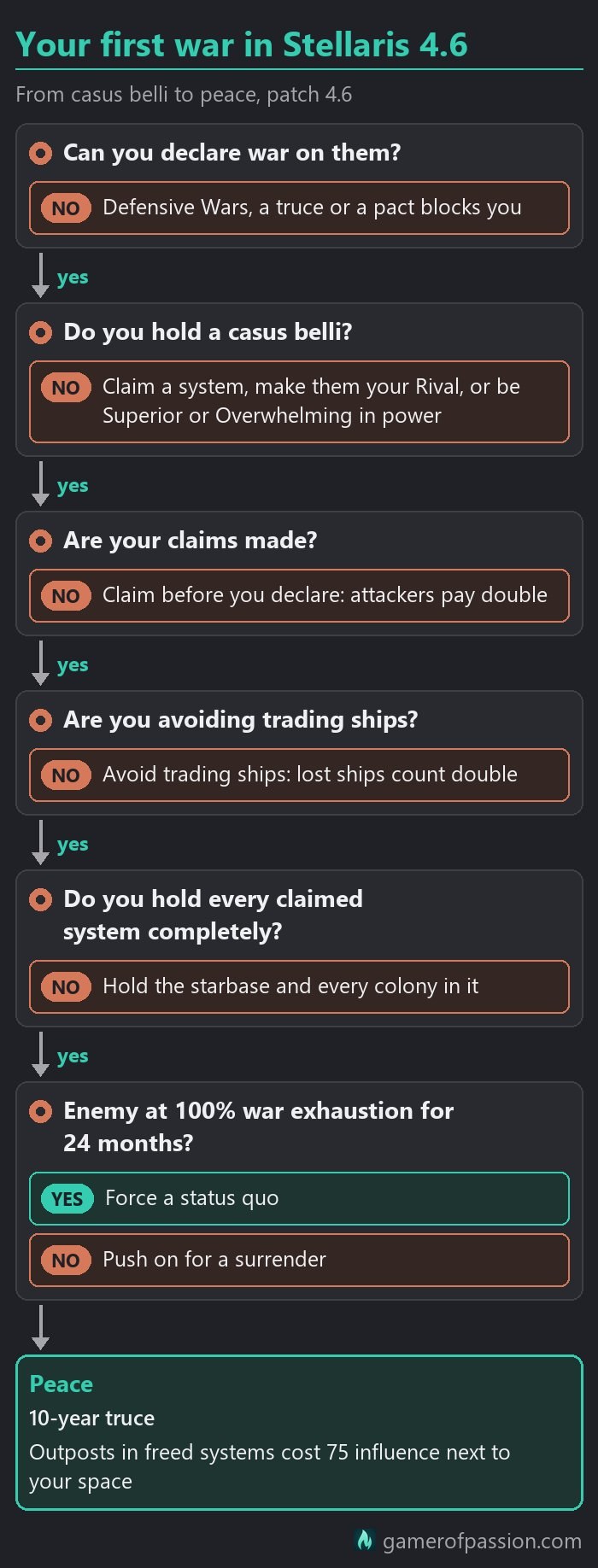
If you have never fought a war in Stellaris before, these steps will get you through the first one in the right order.
- Check that you may declare at all. Look at your War Philosophy, your pacts and any truce with the target before you spend a single point of Influence. A truce from an earlier war will block you while it lasts.
- Pick the war goal from what you want. Conquer takes systems and needs claims, while Vassalize takes the whole empire and needs none (claiming every colony would grey it out). If you want both, claim a few key systems and declare with Vassalize. Your claimed systems are going to come to you first, and the rest becomes your subject.
- Make your claims before you declare, and only on systems you will actually occupy: the capital, chokepoints and good colonies. Claiming late is one of the most expensive mistakes in a first war, since every claim costs double once you are the attacker. I would advise you to pick a small neighbour you have clearly outgrown as your first target, because its systems are close and cheap to claim.
- Prepare your armies. Set Orbital Surrender Acceptance to Allowed when the game asks you, and make sure your fleet uses Selective or Indiscriminate bombardment. Build Assault Armies anyway, because Hive Minds, Machine Intelligences, genocidal empires and planets with defense armies left never surrender to bombardment. Clone and Robotic Assault Armies carry half an Assault Army’s war exhaustion factor, and our transport ships guide explains invasions in more detail.
- Avoid trading ships in your first battles, because lost ships count double toward war exhaustion and lost armies only a quarter. For the fleet itself, have a look at the best fleet composition and our ship design guide.
- Occupy each claimed system completely, starbase and every colony, before you talk about peace. A half-taken system is going to go straight back in a status quo.
- Watch both war exhaustion bars. Once the enemy has sat at 100% for 24 months, you can force a status quo, and the same clock runs against you. The alert will show you how many days are left.
- Take the status quo once your claims are held, or keep pushing for a surrender when you want the war goal itself (Vassalize, Humiliate or an ideology).
- If the enemy has lost every colony and still will not quit, keep up the occupation. Its side gains 1% a month, and Hopeless War grows by 5% a month.
- After the peace, you have 10 years of truce. Use them to build outposts in any systems the war freed up, at 75 Influence next to your space, and to make your claims for the next war while they are still cheap.
How to expand borders without war
Your borders in 4.6 are simply the systems where you own an outpost or a starbase. Colonies, starbase upgrades and techs will not add systems to your space. You can also only colonise inside your borders, so the outpost always comes first.
An outpost costs 100 alloys (150 for a Machine Intelligence), 1 energy a month and 75 Influence in a system next to your space. Every extra hyperlane jump adds another 75, up to 1,000. Skipping systems saves you no Influence at all: a system three jumps out costs 225, the same as the three outposts on the way. It only saves alloys and time, while the three outposts in a row will give you three systems for the same Influence.
| Item | Value | Note |
|---|---|---|
| Outpost alloys | 100 | 150 for a Machine Intelligence |
| Outpost influence next to your space | 75 | Each extra jump adds 75 |
| Two jumps | 150 | – |
| Three jumps | 225 | Same as the three outposts on the way |
| Cap | 1,000 | Reached from 14 jumps |
| Next door with Reach for the Stars and Interstellar Dominion | 52.5 | Starbase Influence Cost cuts add together |
| Station Capacity at start | 3 | Upgraded starbases only, never outposts |
| Owned systems | About 1 per 10 | – |
| Stellar Expansion and Manifest Destiny | +2 each | Techs |
| Mega-Engineering | +3 | Tech |
| Grasp the Void | +5 | – |
| Fortification Traditions and Fortress Doctrine | +2 each | – |
Influence discounts add together. Reach for the Stars from Expansion Traditions takes 10% off and the Interstellar Dominion ascension perk another 20%, which brings an outpost next door down to 52.5 Influence. Xenophobe ethics cut the price as well, up to 60% for Absolute Xenophobe (Willpower). The Expansionist stance only lowers the alloy cost (90 instead of 100), and the Willpower tenet Sovereignty cuts outpost alloys by 5%, 10% or 20%.
With Willpower, Ideological Reach makes outposts cheaper too, with the same discounts as for claims in the claims section above.
Outposts never count against your Station Capacity (the old Starbase Capacity), which is the number of upgraded starbases you can run. You start with 3, and every 10 systems you own will add 1 more. Techs such as Stellar Expansion and Manifest Destiny, Fortification Traditions and the Grasp the Void ascension perk raise it further, and with Willpower so do the Sovereignty tenet and Preparation from Force of Will. Going over it raises your starbase upkeep. Galactic Ambition from Expansion Traditions gives -20% starbase upkeep, while its capacity bonus is for Nomads only.
For the very first outposts of a new game, the beginner guide has more on early expansion.
Conclusion
In the end, the matter is simple. A war in Stellaris 4.6 is decided before the peace screen ever opens, by the claims you made before you declared and by the systems you fully occupy when the fighting stops. The casus belli and the war goal only set the frame around that. If your claims sit on systems you actually hold, even a status quo will hand them to you.
Remember that you can still add claims after you declare, but as the attacker every one of them is going to cost you twice as much as it would have the day before.