
If you have ever opened the Ship Designer in Stellaris and stared at the long list of bow, core and stern sections for a new hull, chances are you have let the auto-designer handle your ships up to now. That works for a while, but it builds from your policies and your latest research, while a design made by hand can target the enemy you are actually fighting. In the current version, the best designs are a picket corvette with flak and lasers early on, cruisers with hangars or neutron launchers in the mid game, and artillery or carrier battleships for the late game. Which of these is right for you is going to depend on that enemy, because most weapon families deal extra damage to one defense layer and reduced damage to another.
Every slot count, reactor value and component stat below is taken from the Stellaris 4.5.2 game files. They are base values, so techs, traditions and leaders will change some of them in your own game.
Best Ship Designs in 4.5
These are the nine designs in this guide, from the first corvette to the defense platform:
| Stage | Hull | Sections | Weapons | Computer |
|---|---|---|---|---|
| Early | Corvette | Picket Ship | Flak Battery, 2 Small Red Lasers | Swarm |
| Early to mid | Corvette | Interceptor | Small Autocannon, 2 Small Plasma Throwers | Swarm |
| Mid (starbases) | Frigate | Torpedo Boat | Space Torpedoes, Small Autocannon | Siege |
| Early to mid | Destroyer | Gunship Bow, Interceptor Ship Stern | Medium Autocannon, Small Autocannon, 3 Small Plasma Throwers | Picket |
| Mid | Cruiser | Broadside Bow, Hangar Core, Gunship Stern | 2 Swarmer Missiles, 2 Antimatter Missiles, 2 Barrier Point-Defense, Improved Strike Craft | Carrier |
| Mid to late | Cruiser | Artillery Bow, Torpedo Core, Gunship Stern | Kinetic Battery, 2 Neutron Launchers, 3 Small Plasma Accelerators, Small Ripper Autocannon | Artillery |
| Late | Battleship | Spinal Mount Bow, Artillery Core, Artillery Stern | Tachyon Lance, 4 Kinetic Artillery | Artillery |
| Late | Battleship | Spinal Mount Bow, Carrier Core, Broadside Stern | Tachyon Lance, 2 Advanced Strike Craft, 2 Whirlwind Missiles, 2 Flak Artillery, 2 Small Plasma Cannons | Carrier |
| Mid onward | Defense Platform | Hangar Station Section, Point-Defense Station Section | Improved Strike Craft, 4 Barrier Point-Defense | Platform |
You will find every loadout in detail further down, with defenses, auxiliary parts, reactor and spare power. The component tiers in them are only an example to show the power math. Make sure to slot in the best tier you have researched and check the power again before you save, since higher-tier shields draw more power.
How the Ship Designer Works
Every ship in the designer is built from sections. Corvettes and frigates have a single one, destroyers have a bow and a stern, while cruisers, battleships and titans have a bow, a core and a stern. The sections decide which slots a ship gets, so picking them is the biggest decision you will make in the designer.
Weapon slots are marked with letters:
- S, M and L are small, medium and large weapon slots.
- X is the extra large spinal slot of the battleship Spinal Mount Bow, and T is the titanic slot on a titan.
- G is a torpedo slot that takes torpedoes, proton and neutron launchers and Zro launchers.
- P is a point defense slot, used for point defense and flak.
- H is a hangar for strike craft.
Utility slots also come in S, M and L sizes and hold your armor and shields, while auxiliary slots take extras like afterburners or a reactor booster. On top of that, every ship design needs a reactor, thrusters, an FTL drive, sensors and a combat computer (defense platforms skip the thrusters and FTL drive). Almost everything apart from armor will draw power from that reactor.
The designer also has a Ship Role selector. Its tooltip says it will “Automatically design this ship for a Ship Role. This will select ship sections and replace components to best fit the selected role.” It is a quick way to get a starting point that you can then change by hand.
Two checkboxes in the designer are easy to mix up. “Auto-generate designs” is described as “Toggle automatic generation of ship designs when researching new technologies.” “Auto-upgrade” says “Auto upgrade components to a higher level when they are unlocked”. The first one has the game create and rebuild whole designs as you research, while the second one only moves the components of a design up to a higher level.
If you want to build a design by hand, this is a simple order to follow:
- Pick the hull and a section for each of its parts.
- Fill the weapon slots with weapons of a similar range.
- Put shields into the utility slots as far as your reactor allows and fill the rest with armor.
- Add the auxiliary parts and choose the combat computer.
- Check that the power does not go negative, give the design a name and save it.
Army transports do not go through this designer. For those, have a look at the guide on Stellaris transport ships.
Sections and Slots per Hull
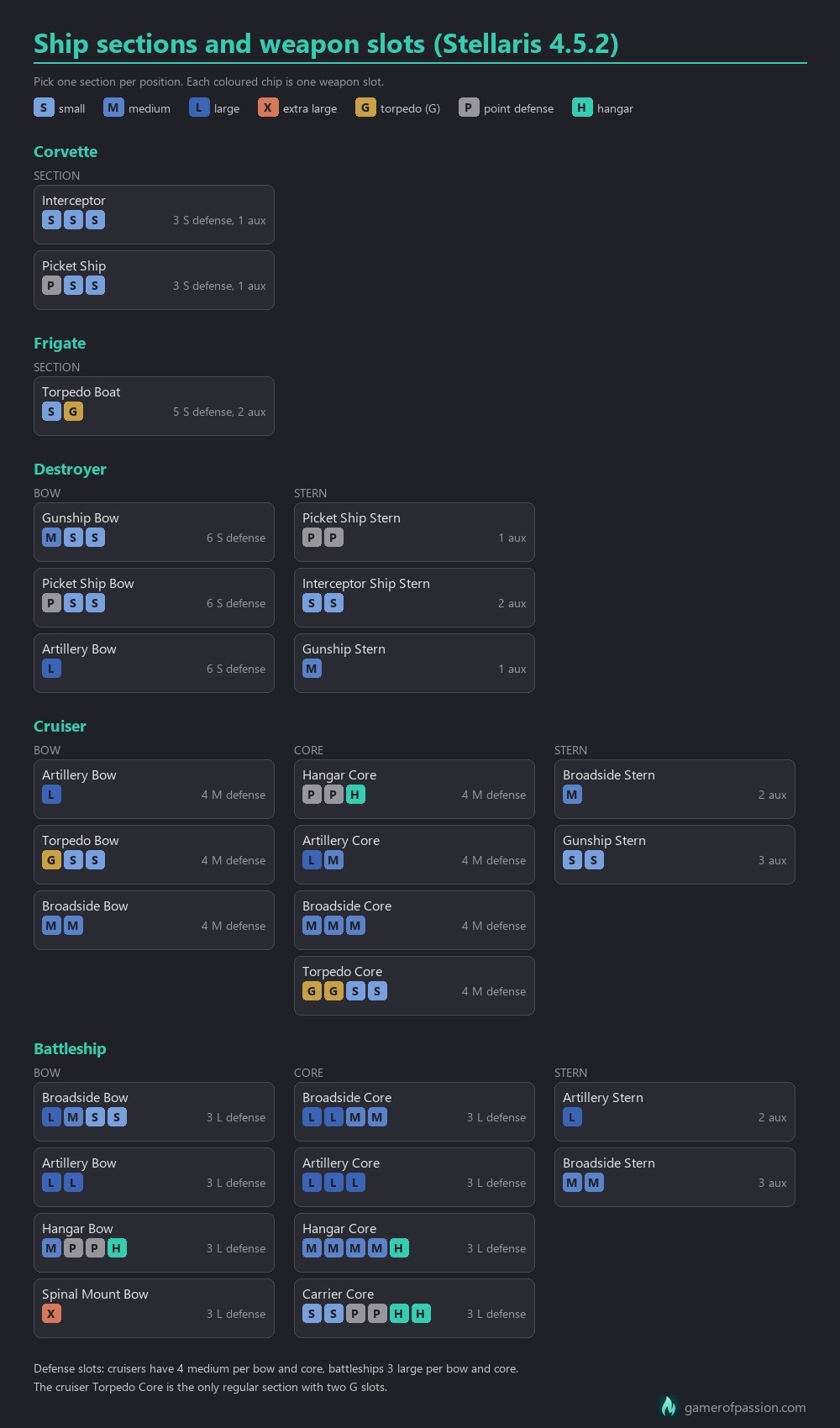
These are all sections of the regular hulls with their weapon, utility and auxiliary slots. Corvettes, frigates and destroyers first:
| Hull | Section | Weapon slots | Utility | Aux |
|---|---|---|---|---|
| Corvette | Interceptor | 3 S | 3 S | 1 |
| Corvette | Picket Ship | 1 P, 2 S | 3 S | 1 |
| Frigate | Torpedo Boat | 1 G, 1 S | 5 S | 2 |
| Destroyer bow | Gunship Bow | 1 M, 2 S | 6 S | – |
| Destroyer bow | Picket Ship Bow | 1 P, 2 S | 6 S | – |
| Destroyer bow | Artillery Bow | 1 L | 6 S | – |
| Destroyer stern | Picket Ship Stern | 2 P | – | 1 |
| Destroyer stern | Interceptor Ship Stern | 2 S | – | 2 |
| Destroyer stern | Gunship Stern | 1 M | – | 1 |
Cruisers, battleships and titans:
| Hull | Section | Weapon slots | Utility | Aux |
|---|---|---|---|---|
| Cruiser bow | Artillery Bow | 1 L | 4 M | – |
| Cruiser bow | Torpedo Bow | 1 G, 2 S | 4 M | – |
| Cruiser bow | Broadside Bow | 2 M | 4 M | – |
| Cruiser core | Hangar Core | 2 P, 1 H | 4 M | – |
| Cruiser core | Artillery Core | 1 L, 1 M | 4 M | – |
| Cruiser core | Broadside Core | 3 M | 4 M | – |
| Cruiser core | Torpedo Core | 2 G, 2 S | 4 M | – |
| Cruiser stern | Broadside Stern | 1 M | – | 2 |
| Cruiser stern | Gunship Stern | 2 S | – | 3 |
| Battleship bow | Broadside Bow | 1 L, 1 M, 2 S | 3 L | – |
| Battleship bow | Artillery Bow | 2 L | 3 L | – |
| Battleship bow | Hangar Bow | 1 M, 2 P, 1 H | 3 L | – |
| Battleship bow | Spinal Mount Bow | 1 X | 3 L | – |
| Battleship core | Broadside Core | 2 L, 2 M | 3 L | – |
| Battleship core | Artillery Core | 3 L | 3 L | – |
| Battleship core | Hangar Core | 4 M, 1 H | 3 L | – |
| Battleship core | Carrier Core | 2 S, 2 P, 2 H | 3 L | – |
| Battleship stern | Artillery Stern | 1 L | – | 2 |
| Battleship stern | Broadside Stern | 2 M | – | 3 |
| Titan bow | Titan Bow | 1 T | 6 L | – |
| Titan core | Titan Core | 4 L | 6 L | – |
| Titan stern | Titan Stern | 2 L | – | 3 |
The cruiser Torpedo Core is the only ship section with two G slots (only the Missile Station Section of defense platforms also has two), and no battleship or titan section has a G slot at all, which is why neutron launcher designs are built on cruisers. All six defensive slots of a battleship are large, three on the bow and three on the core, while its stern has no defensive slots.
For reference, each hull comes with the following base stats:
| Hull | Hull points | Base evasion | Naval capacity | Default computer |
|---|---|---|---|---|
| Corvette | 200 | 60% | 5 | Swarm |
| Frigate | 600 | 20% | 8 | Siege |
| Destroyer | 1,200 | 35% | 10 | Picket |
| Cruiser | 2,400 | 10% | 20 | Line |
| Battleship | 4,800 | 5% | 40 | Artillery |
| Titan | 20,000 | 5% | 80 | Artillery |
| Defense Platform | 3,000 | none | – | Platform |
Reactor Power
Reactor output depends on the hull and on the reactor tech you have:
| Hull | Fission | Fusion | Cold Fusion | Antimatter | Zero Point | Dark Matter |
|---|---|---|---|---|---|---|
| Corvette | 75 | 100 | 130 | 170 | 220 | 285 |
| Destroyer and Frigate | 140 | 180 | 240 | 320 | 430 | 550 |
| Cruiser | 280 | 360 | 480 | 620 | 800 | 1,030 |
| Battleship | 550 | 720 | 950 | 1,250 | 1,550 | 2,000 |
| Titan | 1,100 | 1,450 | 1,900 | 2,500 | 3,200 | 4,200 |
| Defense Platform | 200 | 260 | 340 | 440 | 575 | 750 |
Frigates are a bit of an odd case. They use corvette-grade thrusters and other parts, but destroyer-grade reactors, which is why they share the destroyer row.
Weapons, shields, thrusters, sensors, the FTL drive and the combat computer all draw power. Thrusters scale with the hull, so Plasma Thrusters will cost 20 power on a corvette, 40 on a destroyer, 80 on a cruiser, 160 on a battleship and 320 on a titan. Armor plates use no power at all, while Medium Shields cost 50 each and Large Hyper Shields 180 each. As such, the usual rule is to fit as many shields as your reactor allows and fill the rest with armor.
If the numbers do not add up, the Reactor Booster auxiliary part raises the reactor output by 20%, the Improved version by 33% and the Advanced version by 50%. It needs no power itself, and since it works as a percentage (since 4.0.22), it will add more on a big reactor than on a small one. A design that still uses more than the reactor gives will not save, and the designer shows “This Ship Design does not have enough power.”
Spare power gives a small bonus of up to +10% damage, speed and evasion, but only once you have at least about 5% spare, and the full bonus needs a lot of spare power. That being said, I would not strip shields from a design just to chase it.
Weapons Against Shields, Armor and Hull
Every ship has three layers of health. Damage goes into the shields first, then the armor and then the hull, and each weapon family deals a different multiplier of its damage to each layer, with the following base values:
| Weapon | vs Hull | vs Shields | vs Armor | Range (S / M / L) |
|---|---|---|---|---|
| Lasers | 1.25x | 0.5x | 1.5x | 40 / 60 / 80 |
| Mass Drivers to Gauss Cannons | 1.0x | 1.5x | 0.5x | 50 / 75 / 100 |
| Plasma | 1.5x | 0.25x | 2.0x | 40 / 60 / 80 |
| Autocannons | 1.25x | 1.5x | 0.25x | 30 / 35 / 40 |
| Kinetic Battery and Kinetic Artillery (L) | 1.0x | 2.0x | 0.5x | 120 |
| Tachyon Lance (X) | 1.5x | 0.5x | 2.0x | 150 |
| Proton and Neutron Launchers (G) | 1.75x | 0.5x | 1.5x | 120 |
Kinetic weapons and autocannons tear down shields, while lasers, plasma, lances and neutron launchers are made for armor and hull. A good design either mixes both or leans toward whatever defense the enemy relies on most.
Since 4.3, hardening matters a lot more. From tier 2 up, every armor plate and shield adds a little hardening of its own, 1% at tier 2 up to 4% at tier 5, and it stacks per component. Hardening cuts how much of a penetrating shot gets through, so the more high-tier plates and shields an enemy carries, the less your penetrating weapons will get past them.
Bypass weapons changed as well. Arc emitters still have full shield and armor penetration, so only hardening stops part of their damage from going straight through. Disruptors only get through half at tier 1, rising to 70% for Phased Disruptors, and then hardening cuts that further.
Missiles and torpedoes skip shields but not armor, so armor hardening does nothing against their bypass. The shield bypass is what hardening fights here. Small missiles reach 100 and swarmers and whirlwinds 120, while torpedoes only reach 30 and deal 1.5x against armor.
Neutron launchers hit instantly at 120 range, so point defense cannot stop them, and they deal extra damage to bigger hulls.
Point defense and flak both shoot at missiles and strike craft, at a range of 30. Point defense deals 2.0x against armor and 0.25x against shields, and flak deals 2.0x against shields and 0.25x against armor, with better tracking. Missiles in 4.5 carry armor and no shields, so on paper point defense is the better pick against missile fleets, while flak is fine early on. Hangars fight enemy strike craft, but they do not shoot down missiles, so bring point defense or flak for that.
Keep the main weapons of one ship on a similar range and put short-range and long-range weapons on different ships. For example, a torpedo with a range of 30 does not belong on the same ship as guns with a range of 120.
Tracking is what counters evasion. Small weapons track better than large ones, and kinetic artillery and the Tachyon Lance have no tracking at all. With no tracking, they are likely to miss small, evasive ships more often, but cruisers and battleships have little evasion to begin with (10% and 5%). Evasion caps at 90% for every ship, and larger ships try to shoot something less evasive when a target is above 70%.
Combat Computers
The combat computer decides how a ship moves in battle and gives it a bonus. When you design by hand, pick the computer yourself. Not every hull can use every computer:
| Computer | Hulls | Behaviour | Bonus (basic / advanced / sapient) |
|---|---|---|---|
| Swarm | Corvette | Closes in and orbits the target | +5/+10/+15% fire rate, +5/+10/+25% evasion |
| Picket | Corvette, destroyer, cruiser | Stays at median range | +5/+10/+15% fire rate, +10/+20/+30 tracking |
| Line | Destroyer, cruiser, battleship | Stays at median range | +5/+10/+20% fire rate, +5/+10/+20 accuracy |
| Artillery | Corvette, frigate, destroyer, cruiser, battleship, titan | Keeps its distance at maximum range | +5/+10/+20% fire rate, +5/+10/+20% weapon range |
| Carrier | Cruiser, battleship | Keeps its distance at maximum weapon or strike craft range | +25/+50/+100% engagement range |
| Siege | Frigate, cruiser | Charges in to range 10 | +5/+10/+15% explosive weapon damage, +50/+65/+80% vs starbases and orbital bombardment |
| Platform | Defense platforms | Stationary | +25/+30/+35% fire rate, +15/+20/+25 tracking |
Ships aim for 90% of their preferred range. Artillery and carrier computers aim to fight near their maximum range. Since 4.5, a carrier computer uses whichever is longer, weapon or strike craft range, so a carrier without hangars no longer charges in. Whatever you pick, keep the ships of one fleet on similar ranges.
The sapient versions add a little bit extra on a few computers, with +10% evasion on picket and siege and +10 accuracy on platform. Autonomous Ship Intellect uses the sapient values, while the Precognitive Interface has its own set of bonuses.
Defenses and Auxiliary Slots
The shields-first rule from the reactor section holds on every hull. 4.5.2 changed the cost side of it, since armor upkeep now equals the upkeep of a shield of the same tier (it used to be double). Shields still have one cost that armor does not have, because Advanced and Hyper Shields need exotic gases to build (the top tiers need dark matter or Zro), while armor plates only need alloys.
| Tier | Armor | Shield | Per slot (S / M / L) | Hardening each |
|---|---|---|---|---|
| 1 | Nanocomposite | Deflectors | 100 / 300 / 900 | none |
| 2 | Ceramo-Metal | Improved Deflectors | 125 / 375 / 1,125 | +1% |
| 3 | Plasteel | Shields | 160 / 480 / 1,440 | +2% |
| 4 | Durasteel | Advanced Shields | 205 / 615 / 1,845 | +3% |
| 5 | Neutronium | Hyper Shields | 260 / 780 / 2,340 | +4% |
| Top | Dragonscale | Dark Matter Deflectors | 325 / 975 / 2,925 | +5% |
| Top | – | Psionic Shield | 400 / 1,200 / 3,600 | +5% |
Shields get more power-hungry as the tiers go up. For reference, Deflectors draw 15, 30 and 60 power for small, medium and large, Shields 25, 50 and 100, and Hyper Shields 45, 90 and 180. If you need more hardening than the plates give, a Shield Hardener adds 15% shield hardening (25% for the Advanced version), and Reactive Armor adds 15% armor hardening (25% for Living Reactive Armor).
The auxiliary parts come with these base values:
| Auxiliary part | Effect | Power |
|---|---|---|
| Afterburners / Advanced Afterburners | +10% / +20% speed, +5% / +10% evasion | 10 / 20 |
| Auxiliary Fire-control | +5 accuracy | 10 |
| Reactor Booster / Improved / Advanced | +20% / +33% / +50% reactor output | 0 |
| Shield Capacitor | +10% shields | 20 |
| Regenerative Hull Tissue | +5% hull and +10% armor regeneration | 10 |
| Shield Hardener / Advanced | +15% / +25% shield hardening | 15 / 25 |
| Reactive Armor / Living Reactive Armor | +15% / +25% armor hardening | 15 / 25 |
Afterburners are the default pick for most designs. Long-range cruisers that sit back with kinetic artillery or neutron launchers can get more out of Auxiliary Fire-control, since both weapons start at only 75% accuracy, and the Reactor Booster goes in whenever the power does not add up.
Early Game Designs
The small hulls are what you will be fighting with until cruisers arrive. The first design works from the start of the game, since flak, the Reactor Booster and red lasers are starting techs (only the swarm computer needs Specialized Combat Computers first), and the other two come in once you have plasma and better reactors. The example parts in the plasma corvette and the destroyer (Antimatter Reactor, Advanced Combat Computer, Plasma Thrusters) are tier 3 techs, the same tier as cruisers, so fit whatever reactor and computer you have before that.
Starter Picket Corvette
This corvette uses the Picket Ship section with one P slot and two small slots.
| Section | Picket Ship |
| Weapons | Flak Battery, 2 Small Red Lasers |
| Utility | 2 Small Deflectors, 1 Small Nanocomposite Armor |
| Auxiliary | Reactor Booster |
| Computer | Combat Computer (Swarm) |
| Other parts | Chemical Thrusters, Radar System, Hyper Drive I |
| Power | Fission Reactor 90, 80 used, 10 spare |
| Defense | 200 shields, 100 armor, no hardening |
The two lasers deal 1.5x against armor and 1.25x against hull, and the flak battery will take care of enemy missiles and strike craft. The swarm computer takes the corvette in close, which suits weapons with a range of 30 to 40. The Reactor Booster is there because this design uses 80 power, more than the base 75 of a corvette Fission Reactor. With the booster, the reactor gives 90.
It loses out against shield-heavy designs, since lasers only deal 0.5x against shields. Destroyers with a picket computer can be a problem as well, because that computer adds tracking, which cuts into the corvette’s evasion.
Plasma Corvette
Once you have plasma and better reactors, switch your corvettes to the Interceptor section with three small slots.
| Section | Interceptor |
| Weapons | Small Autocannon, 2 Small Plasma Throwers |
| Utility | 1 Small Shields, 2 Small Plasteel Armor |
| Auxiliary | Afterburners |
| Computer | Advanced Combat Computer (Swarm) |
| Other parts | Plasma Thrusters, Subspace Sensors, Hyper Drive II |
| Power | Antimatter Reactor 170, 139 used, 31 spare |
| Defense | 160 shields (2% hardening), 320 armor (4% hardening) |
The autocannon deals 1.5x against shields and tracks well, while the two plasma throwers hit armor for 2.0x and hull for 1.5x. The defenses lean toward armor, which costs no power and leaves room for an afterburner in the auxiliary slot instead of a Reactor Booster.
Its weak spot is that armor-heavy defense. Lasers and plasma both deal extra damage to armor, so an enemy built around them is a bigger threat to this corvette than one using kinetic weapons. Once cruisers and battleships take over your main fleet, keep one fast corvette fleet around to grab undefended outposts and starbases.
Gunship Destroyer
Destroyers are a big step up in toughness, with 1,200 hull points for 10 naval capacity against the corvette’s 200 for 5. This design takes the same autocannon and plasma idea and adds a picket computer.
| Sections | Gunship Bow, Interceptor Ship Stern |
| Weapons | Medium Autocannon, Small Autocannon, 3 Small Plasma Throwers |
| Utility | 4 Small Shields, 2 Small Plasteel Armor |
| Auxiliary | 2 Afterburners |
| Computer | Advanced Combat Computer (Picket) |
| Other parts | Plasma Thrusters, Subspace Sensors, Hyper Drive II |
| Power | Antimatter Reactor 320, 285 used, 35 spare |
| Defense | 640 shields (8% hardening), 320 armor (4% hardening) |
The Gunship Bow gives a medium slot for the bigger autocannon, and the Interceptor Ship Stern adds two small slots and two auxiliary slots for the afterburners. The picket computer adds tracking, which is exactly what you want against evasive corvettes, and keeps the destroyer at median range. Shields take four of the six utility slots, since the destroyer reactor has room for them.
Its weakness is range. Autocannons and small plasma reach 40 at most, so the destroyer is going to struggle against long-range designs that keep their distance, like artillery cruisers.
Frigates or Corvettes?
Corvettes are your line ship in the early game, while frigates are a specialist. A frigate has 600 hull points and 20% base evasion for 8 naval capacity, where a corvette has 200 hull points and 60% for 5.
The reason to build frigates is the siege computer. It gives +5/+10/+15% explosive weapon damage and +50/+65/+80% damage against starbases and for orbital bombardment, and it charges the ship in to range 10, which fits a torpedo with a range of 30. That turns the frigate into a starbase and big-target killer.
| Section | Torpedo Boat |
| Weapons | Space Torpedoes, Small Autocannon |
| Utility | 3 Small Shields, 2 Small Plasteel Armor |
| Auxiliary | 2 Afterburners |
| Computer | Combat Computer (Siege) |
| Other parts | Plasma Thrusters, Subspace Sensors, Hyper Drive II |
| Power | Cold Fusion Reactor 240, 208 used, 32 spare |
| Defense | 480 shields (6% hardening), 320 armor (4% hardening) |
For fights against other fleets, stay with corvettes or move on to destroyers. Add a group of siege frigates when you need to crack starbases or bombard planets.
Mid Game Cruiser Designs
With a bow, a core and a stern, cruisers have enough room to give each design one clear job.
Carrier Cruiser
This design keeps its distance and lets strike craft and missiles do the work.
| Sections | Broadside Bow, Hangar Core, Gunship Stern |
| Weapons | 2 Swarmer Missiles, 2 Antimatter Missiles, 2 Barrier Point-Defense, Improved Strike Craft |
| Utility | 4 Medium Shields, 4 Medium Plasteel Armor |
| Auxiliary | 3 Afterburners |
| Computer | Advanced Combat Computer (Carrier) |
| Other parts | Plasma Thrusters, Subspace Sensors, Hyper Drive II |
| Power | Antimatter Reactor 620, 454 used, 166 spare |
| Defense | 1,920 shields (8% hardening), 1,920 armor (8% hardening) |
Everything on it fights at long range. Strike craft have a base engagement range of 125 (about 187 with the advanced carrier computer), swarmers reach 120 and the small missiles 100, and the carrier computer will keep the cruiser near the longest of those ranges. Missiles and strike craft both skip shields, and the two point defense guns are there for enemy missiles, since the hangar will not shoot those down. 4.5 also fixed a bug where strike craft lost their target and dealt no damage. With 166 spare power, there is plenty of room for better parts later.
Its weakness is any enemy with a lot of point defense and flak, since both can shoot at missiles and strike craft.
Neutron Artillery Cruiser
The neutron cruiser is the most recommended cruiser right now and very good against big ships and starbases, but testers found it weak against corvettes and mixed AI fleets. For the late game, battleships did better in their tests. That makes it a strong mid-game pick, especially against an enemy that builds big hulls.
| Sections | Artillery Bow, Torpedo Core, Gunship Stern |
| Weapons | Kinetic Battery, 2 Neutron Launchers, 3 Small Plasma Accelerators, Small Ripper Autocannon |
| Utility | 2 Medium Advanced Shields, 6 Medium Durasteel Armor |
| Auxiliary | 3 Auxiliary Fire-control |
| Computer | Sapient Combat Computer (Artillery) |
| Other parts | Plasma Thrusters, Subspace Sensors, Hyper Drive III |
| Power | Zero Point Reactor 800, 756 used, 44 spare |
| Defense | 1,230 shields (6% hardening), 3,690 armor (18% hardening) |
The Kinetic Battery in the Artillery Bow strips shields at 120 range. The two neutron launchers in the Torpedo Core hit at the same range, deal 1.75x against hull and 1.5x against armor, and point defense cannot shoot them down. The small plasma and the autocannon in the remaining small slots are for whatever gets close. Three Auxiliary Fire-control parts add accuracy for a ship that fights from far away, and the sapient artillery computer adds both fire rate and range.
The defenses are mostly armor, because armor costs no power and the reactor has only 44 power to spare with two shields. Mind that AI empires pick a fleet doctrine too in 4.5, so their designs vary more than before, and a mixed fleet with plenty of corvettes is where this cruiser will have a hard time.
Torpedo Cruiser
A third option is a torpedo cruiser built on the Torpedo Bow and Torpedo Core with the siege computer. It plays like a bigger siege frigate, so it is mostly a tool against starbases and big targets. Keep long-range weapons off it, since its torpedoes only reach 30.
Late Game Battleship Designs
Battleships bring the X slot. The Spinal Mount Bow is the only regular section that has one, and it takes weapons like the Tachyon Lance and arc emitters, which reach 150. If you want one battleship design for 2026, I would say the artillery battleship is the safer default, with the carrier battleship as the alternative when the enemy brings little point defense or flak.
Artillery Battleship
| Sections | Spinal Mount Bow, Artillery Core, Artillery Stern |
| Weapons | Tachyon Lance, 4 Kinetic Artillery |
| Utility | 3 Large Hyper Shields, 3 Large Neutronium Armor |
| Auxiliary | 2 Advanced Afterburners |
| Computer | Sapient Combat Computer (Artillery) |
| Other parts | Impulse Thrusters, Tachyon Sensors, Jump Drive |
| Power | Zero Point Reactor 1,550, 1,479 used, 71 spare |
| Defense | 7,020 shields (12% hardening), 7,020 armor (12% hardening) |
The Tachyon Lance deals 2.0x against armor and 1.5x against hull at 150 range, and the Kinetic Artillery deals 2.0x against shields at 120, so the ship covers every layer from far away. The sapient artillery computer adds +20% fire rate and +20% weapon range and will keep the battleship near its maximum range. All six defensive slots are large, which gives it 7,020 shields and 7,020 armor with 12% hardening each.
The weak spots are power and tracking. With only 71 spare power, there is little room for upgrades, so better parts are going to need a better reactor or a Reactor Booster in one of the auxiliary slots. The lance and the artillery also have no tracking of their own (the Tachyon Sensors only add 15), which makes swarms of evasive small ships the hardest target for this design.
Carrier Battleship
| Sections | Spinal Mount Bow, Carrier Core, Broadside Stern |
| Weapons | Tachyon Lance, 2 Advanced Strike Craft, 2 Whirlwind Missiles, 2 Flak Artillery, 2 Small Plasma Cannons |
| Utility | 3 Large Hyper Shields, 3 Large Neutronium Armor |
| Auxiliary | 3 Advanced Afterburners |
| Computer | Sapient Combat Computer (Carrier) |
| Other parts | Impulse Thrusters, Tachyon Sensors, Jump Drive |
| Power | Zero Point Reactor 1,550, 1,353 used, 197 spare |
| Defense | 7,020 shields (12% hardening), 7,020 armor (12% hardening) |
The Carrier Core is the only battleship core with two hangars, and it adds two P slots for flak and two small slots. The Broadside Stern carries two medium slots for the whirlwinds and three auxiliary slots, where the Artillery Stern only has two. Strike craft engage at 125, whirlwinds reach 120 and the lance 150, and the sapient carrier computer adds +100% engagement range on top. With 197 spare power, this design also has far more room for upgrades than the artillery version.
Like the carrier cruiser, it will have a hard time against fleets heavy on point defense and flak. The two small plasma cannons only matter once something gets close.
Battleships or Cruisers?
For the late game, battleships did better as the main line in community tests. A battleship has 4,800 hull points for 40 naval capacity and a cruiser 2,400 for 20, but between the two, only the battleship gets an X slot and large defensive slots. Cruisers keep their place because battleships have no G slots for neutron launchers, and you can of course run both in one fleet. If you want ratios and the counter triangle between hull types, have a look at our Stellaris fleet composition guide.
Titans
Titans sit above both, with 20,000 hull points for 80 naval capacity and a T slot in the bow. You will find a full titan loadout in the Stellaris titan build guide.
Defense Platform Designs
Defense platforms are built from two sections that you pick from six options. Each section comes with three medium utility slots and one auxiliary slot:
- Light Station Section with 4 S slots
- Point-Defense Station Section with 4 P slots
- Medium Station Section with 2 M slots
- Missile Station Section with 2 G slots
- Heavy Station Section with 1 L slot
- Hangar Station Section with 1 H slot
| Sections | Hangar Station Section, Point-Defense Station Section |
| Weapons | Improved Strike Craft, 4 Barrier Point-Defense |
| Utility | 3 Medium Shields, 3 Medium Plasteel Armor |
| Auxiliary | Shield Capacitor, Auxiliary Fire-control |
| Computer | Advanced Combat Computer (Platform) |
| Other parts | Subspace Sensors |
| Power | Cold Fusion Reactor 340, 283 used, 57 spare |
| Defense | 1,584 shields with the Shield Capacitor (6% hardening), 1,440 armor (6% hardening) |
Platforms get +30% weapon range and -25% upkeep, and with 3,000 hull points they are fairly tough, but they have no evasion at all. Afterburners cannot be fitted on defense platforms at all, so the auxiliary slots go to a Shield Capacitor and Auxiliary Fire-control instead. Half hangar and half point defense is the most common platform setup among players. The point defense keeps the platforms alive against missiles, while the strike craft engage from a range of 125.
Since 4.5.2, defense platforms also have their own weapon and defense preference policies for the auto-designer, separate from the starbase ones. Nomadic empires do not get the starbase and platform policies.
Auto-Design in 4.5
4.5 rebuilt the auto-designer around policies. The Fleet Doctrine policy has six options and sets which role the auto-designer gives each hull, both for you and for the AI. Where a cell shows two roles, the numbers are the weights between them.
| Doctrine | Corvette | Frigate | Destroyer | Cruiser | Battleship | Titan |
|---|---|---|---|---|---|---|
| Spearhead | Brawler 70 / Gunship 30 | Siege | Brawler 70 / Gunship 30 | Gunship | Gunship | Gunship |
| Battle Line | Gunship 70 / Screen 30 | Siege | Gunship 70 / Screen 30 | Gunship | Gunship | Gunship |
| Barrage | Artillery | Energy Torpedo 70 / Siege 30 | Artillery 70 / Screen 30 | Artillery | Artillery | Artillery |
| Strike Wing | Screen | Energy Torpedo | Screen | Carrier | Carrier | Artillery |
| Ambush | Brawler | Siege | Artillery | Energy Torpedo | Artillery | Artillery |
| Phalanx | Screen 70 / Gunship 30 | Siege | Screen 70 / Brawler 30 | Gunship 70 / Artillery 30 | Gunship 70 / Artillery 30 | Gunship 70 / Artillery 30 |
The in-game descriptions sum them up fairly well. Spearhead is there to “close to point-blank range”, Battle Line gives “sustained mid-range fire, a flexible all-purpose formation”, and Barrage is meant to “stand off to deliver long-range bombardment, with a screen”. Switching the doctrine will rebuild your auto designs immediately.
The Weapon Preferences (Fleets) policy (Energy, Kinetic or Explosive Weapons, or Strike Craft) tells the game that “Automated ship designs and weapon research programs will favor” that weapon type, and Defense Preferences (Fleets) does the same with Shield Priority, Balanced Defenses or Armor Priority. Auto-generated designs are fully rebuilt (on the next day) whenever you research new tech, and since 4.5 they no longer leave weapon or strike craft slots empty after upgrades or power rebalancing.
Auto-design is good enough in the early game and during long stretches of peace, and a doctrine that fits your plans will save you a lot of clicks with every new tech. Once you are at war with an enemy you know, design by hand, since you can build against the exact shields, armor and hull sizes they field. If you want your own designs to stay exactly as you built them, make sure to untick Auto-upgrade on them.
Ship Designer Not Working
Most save problems come with a message that tells you what is wrong, and the 4.5.2 designer can show the following ones:
| Problem | Cause | Fix |
|---|---|---|
| “Cannot Save Auto-Generated Designs” with the text “Auto-generated designs cannot be overwritten. To save the current design, rename it or disable auto-generated designs for all ships.” | You edited an auto-generated design and tried to save over it | Click “Save As New Design” or rename it, or click “Disable” to turn off auto-generated designs for all ships |
| “This Ship Design does not have enough power.” | The parts use more power than the reactor gives | Use a better reactor, add a Reactor Booster or swap a shield for armor |
| “Not all sections have been assigned.” | A part of the hull has no section yet | Pick a section for every part |
| “Ship Design does not have a name.” | The name field is empty | Type a name |
| “A Design of that name already exists for another Ship Size” | A design of another hull uses the same name | Pick a different name |
| “Selected component cannot be added to this slot” | Wrong slot type, for example flak in a slot that is not a P slot | Switch to a section with the right slot |
| “Cannot remove automatically generated design if auto-design is enabled” | You tried to delete an auto design while auto-generation is on | Untick “Auto-generate designs” first |
| “Empire cannot build … ships.” (with the hull size in place of the dots) | That hull size is not available to your empire | Research the hull’s technology or pick a hull your empire can build |
Older guides and forum threads quote the message “Cannot manually design ships while auto design is turned on.” That message belongs to the designer from before 4.0. In 4.x, the save pop-up you get is “Cannot Save Auto-Generated Designs”, which offers Save As New Design.
One problem has been around for a long time. Players have reported since late 2025 that Auto-upgrade switches itself back on for some designs after loading a save, so ships get upgraded even though you turned it off. The 4.3.0 patch notes listed a fix for designs regaining auto upgrade on loading, and whether it still happens in 4.5.2 is unclear. The workaround players use is to untick Auto-upgrade, restore the design and then re-select the design in the Fleet Manager for every fleet that uses it.
Conclusion
For most games, the path is fairly simple. Build picket corvettes with flak and lasers at the start, move to autocannon and plasma destroyers once you have them, and switch to carrier or neutron cruisers in the mid game. In the late game, artillery battleships are the safe main line, with carrier battleships as the alternative against enemies that bring little point defense.
The auto-designer is good enough while you are at peace or still in the early game. Once a war with a known enemy is coming, I would design by hand, since you can see whether they rely on shields or armor and pick the weapons to match.