
Building slots are the real limit on a Stellaris 4.5 planet, and what you put into them decides how fast the planet grows and how much it pays back.
The first thing to build is the growth building, and it goes on every planet you own. In a regular empire that means Clone Vats or Robot Assembly Plants, while a Hive Mind builds Spawning Pools and a Machine Intelligence builds Machine Assembly Plants. On your capital, the Autochthon Monument goes in as soon as you have Sociocultural History, and after that you will fill the capital’s Archives with Research Labs as pops free up. Luxury Residences are what you add whenever amenities or housing run short.
The slot rule fits in one line: building slots come from District Specializations, every colony starts with the six slots of the Government Zone (five of them free), each specialization adds three for matching buildings, and the second urban specialization opens with the Planetary Administration at 1,000 pops.
What you can mostly skip are Holo-Theatres as your default amenities building and resource boosters such as the Energy Grid on planets that only have one or two districts of that type.
This guide is for the PC version 4.5 ‘Cygnus’, with values from the 4.5.3 game files, since the 4.5.4 hotfix of 11 November 2026 changed no building. Most of the tiers below weigh those base numbers against how players have been building their planets since patch 4.3. The Willpower expansion and the 4.6 ‘Corona Borealis’ update are due on 23 November 2026 and bring Ethical buildings and Galactic Halls, and I will update this guide once they are out.
Contents
- How building slots work
- First buildings on your capital
- Build order by planet type
- Building tier list
- Buildings that waste a slot
- Building swaps for other empires
- Questions about buildings
- Conclusion
How building slots work
A building slot is a space on a planet that takes one building, and in 4.5 nearly all of them belong to District Specializations. A District Specialization is a focus you pick for a district type, such as Archives for your City Districts or Mineral Extraction for your Mining Districts. City Districts and capital upgrades add no slots by themselves.
Every colony starts with the six slots of the Government Zone, the basic zone every planet has. The capital building fills one of them, which leaves you five free slots that will take almost any building. Each District Specialization then adds three slots for the buildings that match it (the hive Spawning Nest and the machine Replication Hub add one).
Your City District can take one urban specialization from the start. The second opens once the colony has a Planetary Administration, which is the first upgrade of the colony’s starting building (the Reassembled Ship Shelter) and needs 1,000 pops and the starting technology Unified Government. Generator, Mining and Agriculture Districts will each take one specialization after Global Energy Management, Mineral Purification or Food Processing, as long as the planet has at least one district of that type.
| Source | Slots | Unlock |
|---|---|---|
| Government Zone | 6 (5 free, the capital building takes one) | every colony from day one |
| 1st urban specialization | 3 | from the start |
| 2nd urban specialization | 3 | Planetary Administration (1,000 pops) |
| rural specialization (Generator, Mining, Agriculture) | 3 | tier 1 technology + at least one district of that type |
| Spawning Nest / Replication Hub | 1 | gestalt |
A specialization costs 1,000 minerals and takes 360 days. If you change it later, the game is going to demolish every building the new specialization cannot host, so make sure to read the tooltip before you switch.
Buildings also add no Empire Size, the number that drives up your costs as the empire grows. Each district adds 0.5, which makes filling a building slot free in Empire Size while another district is not.
First buildings on your capital
| Step | What to do |
|---|---|
| 1 | Queue a Mining District in month 1, buy minerals if idle |
| 2 | Clear blockers for district room and Planet Capacity |
| 3 | Mineral Extraction, then Purification Plants at 3 districts |
| 4 | Sociocultural History, then build the Autochthon Monument |
| 5 | Research Labs in the Archives slots as pops become free |
| 6 | Robot Assembly Plants or Clone Vats as soon as tech arrives |
| 7 | Luxury Residences when amenities or housing run short |
| 8 | Energy Grid only at 3+ specialized Generator Districts |
| Planetary Capital at 2,500 pops with Colonial Centralization |
Your homeworld starts with a Planetary Administration already in place, which means both urban specializations are open from day one. The capital begins with Archives and Mixed Industry, and its Civilian Industries are already built.
Queue a Mining District in your very first month. Whenever the build queue would sit idle, simply buy minerals on the market to keep it going. After that, clear the starting blockers as your minerals allow, since every blocker you remove will give you room for one more district and more Planet Capacity.
Next, research Mineral Purification and specialize your Mining Districts with Mineral Extraction. It costs 1,000 minerals, takes 360 days, adds 100 Miner jobs to every Mining District and opens its building slots. Once three Mining Districts are specialized, add Mineral Purification Plants, which cost only 200 minerals and will add 0.5 minerals per 100 Miners.
Sociocultural History is the research you want after that, because it lets you build the Autochthon Monument (400 minerals, no upkeep) in the Government Zone. It’s no longer a day-one building in 4.5.
As pops become free, fill the Archives slots with Research Labs. Each one wants 180 pops and will give you 5.4 research for 2 energy and 2.7 consumer goods a month, and your capital is going to be your first research planet anyway.
The growth building follows as soon as the technology arrives, which means Robot Assembly Plants with Artificial Workforce or Clone Vats with Cloning. Then add Luxury Residences whenever amenities (the services that keep a planet’s pops content) or housing run short. Leave Holo-Theatres and Precinct Houses out unless a planet really needs them.
With Global Energy Management, you will specialize your Generator Districts as well. Hold the Energy Grid back until three or more of them are specialized, though, because it barely pays its own upkeep on a smaller planet. If this is your first game, our Stellaris beginner guide goes through the first ten years step by step.
The last big step is the Planetary Capital at 2,500 pops, which also needs Colonial Centralization. It will raise the capital building’s housing and amenities from 1,000 to 1,500 each and open the Ministry of Production, the Resource Processing Center, the Hypercomms Forum, the Military Academy and a third Clone Vat once the Cloning traditions are finished. It gives your capital no new specialization slot, because both urban ones are open already.
Build order by planet type
Every planet type follows the same pattern. The specialization goes first, the matching booster comes once the planet is big enough, the growth building sits in the Government Zone and the rest waits until you have spare pops or slots.
| Planet type | Specialization | Build first | Then | Later |
|---|---|---|---|---|
| Capital | Government Zone, Archives, Mixed Industry | Autochthon Monument | Robot Assembly Plants or Clone Vats | Labs, Purification, Residences, Energy Grid (3+), Capital |
| Mining world | Mineral Extraction (or Rare Crystal Extraction) | Mineral Purification Plants at 3+ districts | Robot Assembly Plants / Clone Vats | Industrial Mining Site, Automation or Resource Silos |
| Generator world | Energy Generation (or Volatile Motes Harvesting) | Energy Grid at 3+ specialized districts | Robot Assembly Plants / Clone Vats | Conductive Works Complex, Automation or Resource Silos |
| Farming world | Agricultural Focus (or Exotic Gas Capture) | Food Processing Facilities at 3+ districts | Robot Assembly Plants / Clone Vats | Crop Development Hub, Automation or Resource Silos |
| Forge / industry world | Heavy Industry or Civilian Industry (Mixed for both) | Ancient Refinery (rare tech) | Chemical Plants / Crystal Plants / Gas Refineries | Foundries, Ministry, Metallurgical Research Lab, Reclamation |
| Research world | one-field Research Specialization or Research Enclave | Research Labs | Field Dynamics / Xenobiological / Materials | Research Institute, Theorem Facility, Supply Depot |
| Unity world | Administrative Hub (Spiritual Enclave for Spiritualists) | Autochthon Monument | Administrative Offices (Temple for Spiritualists) | Auto-Curating Vault, Administrative Complex, Park |
| Fortress world | Military Defenses | Stronghold | Fortress (Planetary Administration, 1,000 pops) | Planetary Shield Generator, Military Academy |
| Hive Mind swaps | Spawning Nest (1 slot) plus the normal specializations | Spawning Pools | Hive Warren | Synaptic Nodes, Auto-Curating Vault |
| Machine swaps | Replication Hub (1 slot) plus the normal specializations | Machine Assembly Plants | Drone Storage | Simulation Site, Alpha Hub |
| MegaCorp swaps | Commercial Nexus on trade worlds | Corporate Culture Site | Commercial Zones | Vault of Acquisitions |
Mining worlds
A mining world takes Mineral Extraction. Rare Crystal Extraction and Betharian Processing are the alternatives, and since 4.5.3 each of them is limited to one per planet. Start the specialization as soon as you have your first Mining District and Mineral Purification, and for 1,000 minerals and 360 days it will add 100 Miner jobs to every Mining District and open its building slots.
Mineral Purification Plants follow at three or more specialized Mining Districts. They add 0.5 minerals per 100 Miners for 2 energy of upkeep (the monthly cost of a building) and reach their break-even, the point where they pay that upkeep back, at 400 Miners. At 900 Miners they will repay their build cost in about 7 years at base prices.
The growth building goes into the Government Zone once you have it, and the Industrial Mining Site (+2 max Mining Districts) comes when the planet runs out of district room. A spare slot can take an Automation Building for Miners if you are short on pops, or Resource Silos otherwise. When automation is worth it is explained in our Stellaris automation building guide.
Generator worlds
Generator worlds take Energy Generation, or Volatile Motes Harvesting, which is also limited to one per planet. The specialization needs your first Generator District and Global Energy Management, and it will add 100 Technician jobs to every Generator District.
Build the Energy Grid once the planet has three or more specialized Generator Districts, which means 900 Technicians or more. It adds 0.5 energy per 100 Technicians for 2 energy. Once you have Planetary Power Grid and the planet has a Planetary Administration, upgrade it to the Energy Nexus, which makes 1.0 energy per 100 Technicians for 600 minerals and 50 Rare Crystals, then 2 energy and 1 Rare Crystal a month. On a Ring World, the Nexus costs 200 Rare Crystals and 5 energy plus 3 Rare Crystals a month, and it gives 0.5 more energy per 100 Technicians.
After that, the growth building, the Conductive Works Complex (+2 max Generator Districts) and an Automation Building for Technicians or Resource Silos follow in the same order as on a mining world. For everything else that feeds or drains your energy, have a look at the Stellaris energy credits guide.
Farming worlds
Farming worlds take Agricultural Focus, or Exotic Gas Capture, which is limited to one per planet. It needs Food Processing and your first Agriculture District, and it adds 100 Farmer jobs to every Agriculture District.
Food Processing Facilities (400 minerals) come at three or more specialized Agriculture Districts and add 0.5 food per 100 Farmers for 2 energy, the same deal as the Energy Grid. Their upgrade, the Food Processing Centers, will make 1.0 per 100 for 2 energy and 1 Exotic Gas a month, once you have Advanced Food Processing and a Planetary Administration. You will then add the growth building, the Crop Development Hub once district room runs out, and an Automation Building for Farmers or Resource Silos in a spare slot.
Industry worlds
An industry world takes Heavy Industry for alloys or Civilian Industry for consumer goods, or Mixed Industry if you want both. Once the City Districts are built, the specialization (1,000 minerals) will give you 100 Metallurgist or Artisan jobs per City District and three slots.
If you have the rare Ancient Refinery technology, that building goes in first, because it gives all three strategic resources from industrial jobs. Chemical Plants, Synthetic Crystal Plants or Exotic Gas Refineries come next on a planet with 600 or more industrial jobs, but only for a resource you actually need. Alloy Foundries and Civilian Industries are for the moment you have pops free for 200 more jobs, at 6 alloys or 12 consumer goods per building.
The Ministry of Production waits until you have about 2,000 Metallurgists and a Planetary Capital. The Metallurgical Research Lab and then the Alloy Reclamation Plant only belong on very large forge worlds such as an ecumenopolis, since the Reclamation Plant breaks even near 4,200 Metallurgists at base prices.
Research worlds
Research worlds take a Physics, Society or Engineering Research Specialization for one field, or the Research Enclave for all three. Per City District, a single-field specialization will give you 100 researcher jobs, the Research Enclave 90 (30 of each type) and the Archives 60 researchers plus 40 Bureaucrats.
Research Labs go in as soon as you have pops for 180 more jobs. The Field Dynamics Center, Xenobiological Lab or Materials Workshop follow with the matching tier 1 technology, and they pay off most on a world with that field’s research specialization. The Research Institute comes with Interplanetary Research Initiative and adds 0.5 research per 100 of each researcher (gestalts build the Planetary Supercomputer instead).
On large research worlds, the Data-Driven Theorem Facility is next, with +10% researcher Job Efficiency for 8 energy and 4 Exotic Gases. The Research Supply Depot goes last and only on huge research worlds, since its break-even sits near 8,300 researchers at base prices.
Unity worlds
Unity worlds take the Administrative Hub, or the Spiritual Enclave if you play a Spiritualist empire. The Autochthon Monument goes first after Sociocultural History, for +5% unity from jobs and no upkeep. Administrative Offices (a Temple for Spiritualists) follow once you have pops for 200 more jobs, at 6 unity each.
With Automated Curation Algorithms or Metacognitive Faith you will add your empire’s vault building. Depending on your empire, that is going to be the Auto-Curating Vault, the Citadel of Faith, the Vault of Acquisitions or the Alpha Hub, for +0.25 to +1 unity per 100 Bureaucrats. The Administrative Complex (+10% Bureaucrat Job Efficiency) needs Galactic Bureaucracy, and the Administrative Park (-10% Bureaucrat upkeep) only pays on very large unity worlds, with a break-even near 3,750 Bureaucrats at base prices.
Fortress worlds
A fortress world takes Military Defenses on a border planet with City Districts, for 100 Soldier jobs per City District. The Stronghold comes with Planetary Defenses, a starting technology, and gives 8 naval capacity for 1 energy and 2 alloys.
Its upgrade, the Fortress, needs Global Defense Grid and a Planetary Administration (1,000 pops), and it will add a planetary FTL inhibitor along with 16 naval capacity. On a habitat, the Habitat Administration already counts as an upgraded capital, which means the Fortress can go there from day one (more on that in our Stellaris habitats guide).
Add a Planetary Shield Generator with Planetary Shields and a Planetary Administration for -50% orbital bombardment damage. The Military Academy is limited to one per empire and needs a Planetary Capital and Centralized Command.
Building tier list
Always build means a building earns its slot on every planet where it fits, situational means it will only pay on the planets named in its line, and skip or trap means the slot will almost always do more with something else. An asterisk marks a thin pick. The thin picks, mostly the gestalt, unity and niche military buildings, lean on the 4.5.3 game-file numbers more than on many current games.
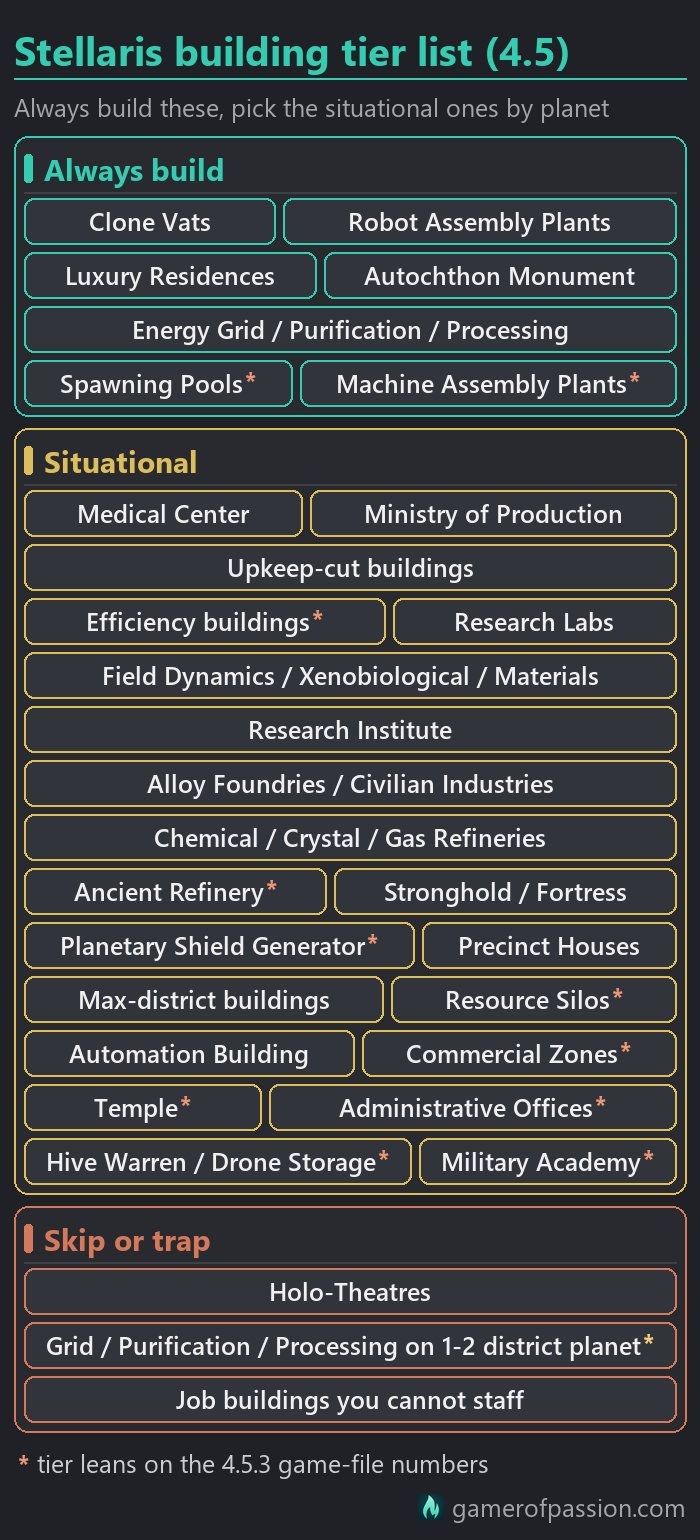
| Tier | Buildings |
|---|---|
| Always build | Clone Vats, Robot Assembly Plants, Luxury Residences |
| Autochthon Monument, Energy Grid / Purification / Processing | |
| Spawning Pools*, Machine Assembly Plants* | |
| Situational | Medical Center, Ministry of Production |
| Upkeep-cut buildings, Efficiency buildings* | |
| Research Labs, Field Dynamics / Xenobiological / Materials | |
| Research Institute, Alloy Foundries / Civilian Industries | |
| Chemical / Crystal / Gas Refineries, Ancient Refinery* | |
| Stronghold / Fortress, Planetary Shield Generator* | |
| Precinct Houses, Max-district buildings | |
| Resource Silos*, Automation Building | |
| Commercial Zones*, Temple*, Administrative Offices* | |
| Hive Warren / Drone Storage*, Military Academy* | |
| Skip or trap | Holo-Theatres |
| Grid / Purification / Processing on 1-2 district planet* | |
| Job buildings you cannot staff |
Always build
Clone Vats are the first building on every planet of an organic empire once you have Cloning, a society tier 2 technology. They need no jobs and cost 500 minerals and 500 food, plus 2 energy and 15 food a month (30 food once you adopt the Genetic or Cloning Traditions). They will give you +1.5 Monthly Organic Pop Growth, which rises to 3 once you adopt the Genetic or Cloning Traditions and to 4.5 with Stem Cell Stimulation from the Genetic Traditions. You get one per planet, plus one more per capital upgrade once the Cloning traditions are finished, for four at most (the five-vat limit belongs to the Clone Army origin’s Ancient Clone Vats). Our Stellaris tradition tier list explains where the Cloning traditions come from.
Robot Assembly Plants are the growth building for a regular empire that builds robots, and they go into the Government Zone of every planet. They will give you +2 Monthly Mechanical Pop Assembly from 100 Roboticists, for 5 energy and 2 alloys a month, and they cost 600 minerals and are limited to one per planet. Per slot, Clone Vats still come first, because they don’t need any workers. How both of them fit into the rest of your growth is in our Stellaris pop growth guide.
Luxury Residences are the answer on any colony short of amenities or housing. They give +1,500 housing and +1,500 amenities with no jobs for 400 minerals and 2 energy, and the Paradise Dome upgrade will double both to 3,000 after Idyllic Architecture, once the planet has a Planetary Administration. Mind that not every empire can build them: Shared Burdens and Forever Cruise empires cannot, and on habitats you need Void Dwellers, Voidforged or Voidborne.
The Autochthon Monument belongs on your capital and your unity worlds, and on other colonies only if they keep many Civilians. It costs 400 minerals, has no upkeep, is limited to one per planet and needs Sociocultural History. In return it will give you 1 unity a month for every Ascension Perk you have, +5% unity from all jobs on the planet and 0.1 unity per 100 Civilians, who also pay 0.1 more consumer goods per 100. The Heritage Site upgrade (+10%) needs a Planetary Administration, and the Hypercomms Forum (+15%) a Planetary Capital.
The Energy Grid, Mineral Purification Plants and Food Processing Facilities are always worth a slot on resource worlds with three or more specialized districts of that type, which means 900 jobs or more. Each adds 0.5 per 100 Technicians, Miners or Farmers for 2 energy, with the break-even at 400 jobs. At 1,200 Technicians the Energy Grid makes 4 energy a month after upkeep and repays its 400 minerals in about 8 years at base prices, and Mineral Purification Plants cost only 200 minerals to begin with.
Spawning Pools go on every Hive Mind planet for 400 minerals and 2 energy, with 100 Spawning Drone jobs, one per planet and no technology required. Machine Assembly Plants do the same job for a Machine Intelligence (400 minerals, 2 energy, 100 assembly jobs, one per planet), unless you plan to go Virtual.
Situational
The Medical Center is a growth building too, but it needs 200 Medical Workers. Staffed, it will give you +10% Pop Growth Speed, a +10% organic growth multiplier and 1,500 amenities for 2 energy and 2 consumer goods, and its upgrades (Gene Clinics and Cyto-Revitalization Centers) keep those 200 jobs. Build it on planets that need amenities and have pops to spare, and on every planet if you play a Purity or bio build.
The Ministry of Production adds 0.2 alloys per 100 Metallurgists and 0.2 consumer goods per 100 Artisans for 5 energy and 1 Volatile Mote a month, one per planet. It needs a Planetary Capital and only breaks even near 1,900 Metallurgists at base prices, which is why it belongs on industry worlds with about 2,000 Metallurgist jobs or more, such as an ecumenopolis or a big forge world.
The upkeep-cut buildings (Alloy Reclamation Plant, Recirculation Center, Research Supply Depot, Administrative Park and Commerce Megaplexes) only make sense on your very largest specialized worlds. Each removes 10% of one job’s upkeep for 5 energy and 1 or 2 strategic resources a month, and at base prices that breaks even at about 4,200 Metallurgists, 4,200 Artisans, 8,300 researchers or 3,750 Bureaucrats, depending on the building.
The efficiency buildings (Metallurgical Research Lab, Distributed Design Center, Data-Driven Theorem Facility and Administrative Complex) go on large specialized worlds once the job buildings are in. Each gives +10% Job Efficiency, a percentage bonus to what one job produces, for 8 energy and 2 to 4 strategic resources a month, with the Data-Driven Theorem Facility at 8 energy and 4 Exotic Gases.
Research Labs are the general research building for research worlds and the early capital, whenever you have pops for 180 more jobs. They give 5.4 research for 2 energy and 2.7 consumer goods, and 10.8 and 16.2 research after the two upgrades.
The Field Dynamics Center, Xenobiological Lab and Materials Workshop are for research worlds that focus on one field. Each holds 200 jobs for 6 research plus 0.25 more per 100 of that researcher on the planet (0.5 at tiers 2 and 3), is limited to one per planet and pays off most on a world with that field’s research specialization. Only the tier 3 version adds +10% Job Efficiency.
The Research Institute is the regular-empire pick for research worlds, one per planet. It adds 0.5 research per 100 of each researcher on the planet for 5 energy and 1 Exotic Gas. Additionally, your researchers there will pay 1 more consumer goods upkeep per 100. Gestalts get the Planetary Supercomputer instead, which needs a tier-3 capital building.
Alloy Foundries and Civilian Industries belong on industry worlds that have pops for more jobs than the districts give. A building holds 200 jobs for 6 alloys or 12 consumer goods, paid with 2 energy and 12 minerals. The tier 2 and 3 upgrades add 2 to 4 strategic resources of upkeep and give you less output for it, dropping from 3 to 2.4 and then 2.25 alloys per energy.
Chemical Plants, Synthetic Crystal Plants and Exotic Gas Refineries are for industry worlds with 600 or more Metallurgist and Artisan jobs that need that resource. They add no jobs. Each one makes the industrial jobs produce 0.1 of its resource per 100 jobs for 0.5 more minerals per 100 and 3 energy, one per planet, which puts the break-even at about 600 jobs at base prices.
The Ancient Refinery goes on every industry world once you have the rare Ancient Refinery technology. It adds 0.1 Exotic Gas, 0.1 Rare Crystals and 0.1 Volatile Motes per 100 industrial jobs and 10% to strategic resource output from jobs, for 1 more mineral upkeep per 100. It costs 600 minerals and 200 Minor Artifacts plus 5 energy a month, and it will break even at about 250 jobs at base prices.
The Stronghold and its Fortress upgrade are for border worlds and naval capacity, with 200 or 400 Soldiers for 8 or 16 naval capacity at 1 energy and 2 or 4 alloys. Only the Fortress adds a planetary FTL inhibitor, and it needs Global Defense Grid, a Planetary Administration and 1 Volatile Mote a month.
The Planetary Shield Generator suits border and storm-hit worlds and needs a Planetary Administration and Planetary Shields. It will cut orbital bombardment damage by 50%, and storm devastation by 50% if you play with Cosmic Storms, for 600 minerals and 5 energy, one per planet.
Precinct Houses are only for planets whose crime stays high. The Planetary Administration already adds 100 Enforcers, and 100 Enforcers remove 25 crime.
The max-district buildings (Conductive Works Complex, Industrial Mining Site and Crop Development Hub) are for resource worlds that have run out of district room. Each adds 2 max districts of its type for 400 minerals and 2 energy, and its upgrade chain goes to +4, +6 and +8.
Resource Silos fill a spare rural slot with +5,000 storage (+5,000 more with Construction Templates) for 200 minerals and 1 energy. The Automation Building fits resource worlds of low-pop builds, where it automates 25% of one job, a Technician, Miner or Farmer, for 600 minerals and 8 energy.
Commercial Zones are for planets that must cover a Trade shortfall, since 200 Traders make 16 Trade for 2 energy and 2 consumer goods.
The Temple is for Spiritualist empires, for example with Cybernetic Creed or Gospel of the Masses, and holds 200 Bureaucrat-type jobs with +5% Spiritualist attraction and no upgrade. Administrative Offices fill leftover slots on unity worlds and the capital, where 200 Bureaucrats make 6 unity for 2 energy and 4 consumer goods, again without an upgrade.
The Hive Warren and Drone Storage are the gestalt Luxury Residences for planets short of amenities or housing, with the same +1,500 housing and +1,500 amenities, no jobs, 400 minerals and 2 energy.
The Military Academy is limited to one per empire and goes on a planet with a Planetary Capital. It needs Centralized Command (tier 3) and costs 600 minerals and 50 Volatile Motes, plus 5 energy and 1 Volatile Mote a month.
Skip or trap
Holo-Theatres make a poor default amenities building, with psionic or slot-starved planets as the exception. A staffed Holo-Theatre gives 2,500 amenities (1,250 per 100 Entertainers) and 1 unity from 200 Entertainer jobs, for 2 energy plus 2 consumer goods of job upkeep. Luxury Residences give 1,500 amenities and 1,500 housing with no jobs at all, which means the Holo-Theatre will only give you more when 200 pops are spare.
An Energy Grid, Mineral Purification Plants or Food Processing Facilities on a 1-2 district planet are a waste of the slot. There, 300 to 600 jobs make +1.5 to +3 for 2 energy of upkeep, and the build cost takes well over ten years to come back, if it ever does.
Job buildings you cannot staff are the last trap, because building upkeep runs whether or not anyone works there. If you’ve overbuilt, disable the building instead of demolishing it.
If you want to compare two buildings line by line, here are their base values from the 4.5.3 files.
| Building | Cost | Upkeep | Jobs | Output | Gate |
|---|---|---|---|---|---|
| Planetary Administration | 600 | 5 energy | 200 Politician + 100 Enforcer | +1,000 housing, +1,000 amenities, capital tier 2 | 1,000 pops, Unified Government (T0) |
| Planetary Capital | 800 | 8 energy | 300 Politician + 200 Enforcer | +1,500 housing and amenities, capital tier 3 | 2,500 pops, Colonial Centralization (T2) |
| Research Labs | 400 | 2 energy | 60 Physicist + 60 Biologist + 60 Engineer | 5.4 research for 2.7 consumer goods | Scientific Method (T0) |
| Field Dynamics Center (Xenobiological, Materials alike) | 400 | 2 energy | 200 of one researcher | 6 research + 0.25 per 100 of that researcher on the planet | 1 per planet, Quantum Computing |
| Research Institute | 600 + 50 gas | 5 energy + 1 gas | – | +0.5 of each research per 100 of each researcher | 1 per planet, Interplanetary Research Initiative (T3) |
| Alloy Foundries | 400 | 2 energy | 200 Metallurgist | 6 alloys for 12 minerals | Industrial Base (T0) |
| Civilian Industries | 400 | 2 energy | 200 Artisan | 12 consumer goods for 12 minerals | Industrial Base (T0) |
| Ministry of Production | 600 + 50 motes | 5 energy + 1 mote | – | +0.2 alloys per 100 Metallurgists, +0.2 CG per 100 Artisans | 1 per planet, Planetary Capital, Global Production Strategy |
| Chemical Plants | 600 | 3 energy | – | +0.1 motes per 100 industrial jobs | 1 per planet, Volatile Material Plants (T2) |
| Administrative Offices | 400 | 2 energy | 200 Bureaucrat | 6 unity for 4 consumer goods | Unified Government (T0) |
| Autochthon Monument | 400 | none | – | +1 unity per Ascension Perk, +5% unity from jobs | 1 per planet, Sociocultural History (T1) |
| Clone Vats | 500 + 500 food | 2 energy + 15 food | – | +1.5 pop growth (3 or 4.5 with Genetic or Cloning) | 1 per planet, max 4 with the Cloning finisher, Cloning (T2) |
| Luxury Residences | 400 | 2 energy | – | +1,500 housing, +1,500 amenities | no limit, no tech |
| Paradise Dome | 600 + 50 Rare Crystals | 3 energy + 1 Rare Crystal | – | +3,000 housing, +3,000 amenities | Planetary Administration, Idyllic Architecture (T3) |
| Holo-Theatres | 400 | 2 energy | 200 Entertainer | 2,500 amenities + 1 unity for 2 consumer goods | Holo-Entertainment (T0) |
| Stronghold | 400 | 1 energy | 200 Soldier | 8 naval capacity (+4 per 100 Soldiers) | Planetary Defenses (T0) |
| Fortress | 600 + 50 motes | 1 energy + 1 mote | 400 Soldier | 16 naval capacity, planetary FTL inhibitor | Planetary Administration, Global Defense Grid (T2) |
| Planetary Shield Generator | 600 | 5 energy | – | -50% orbital bombardment damage | 1 per planet, Planetary Administration, Planetary Shields |
| Energy Grid | 400 | 2 energy | – | +0.5 energy per 100 Technicians | 1 per planet, Global Energy Management (T1) |
| Energy Nexus | 600 + 50 Rare Crystals | 2 energy + 1 Rare Crystal | – | +1.0 per 100 Technicians | Planetary Administration, Planetary Power Grid (T2) |
| Mineral Purification Plants | 200 | 2 energy | – | +0.5 minerals per 100 Miners | 1 per planet, Mineral Purification (T1) |
| Food Processing Facilities | 400 | 2 energy | – | +0.5 food per 100 Farmers | 1 per planet, Food Processing (T1) |
| Resource Silos | 200 | 1 energy | – | +5,000 storage | Industrial Base (T0) |
| Commercial Zones | 400 | 2 energy | 200 Trader | 16 trade for 2 consumer goods | Interplanetary Commerce (T0) |
Buildings that waste a slot
| Building | Why it wastes a slot | Build instead |
|---|---|---|
| Energy Grid / Purification / Processing on 1-2 districts | 300-600 jobs make +1.5 to +3 for 2 energy upkeep | Build them on planets with 3+ specialized districts |
| Holo-Theatres as the default amenities building | 2,500 amenities only from 200 staffed Entertainer jobs | Luxury Residences, Holo-Theatre only with 200 spare pops |
| Upkeep-cut buildings on small worlds | -10% upkeep for 5 energy + 1-2 strategic resources a month | Keep them for your very largest worlds |
| Ministry of Production on a small forge world | +2 alloys at 1,000 Metallurgists for 5 energy + 1 mote | Big forge worlds and ecumenopolises only |
| A single refinery building on a small industry world | Costs more than it makes below 600 industrial jobs | Main industry world, where 1,000 jobs make 1 a month |
| Job buildings you cannot staff | Upkeep is paid whether or not anyone works the jobs | Build only for pops you have, disable instead of demolishing |
| Changing a District Specialization with buildings | The new specialization demolishes buildings it cannot host | Check the tooltip before you replace a specialization |
| Support specializations from a 4.0 guide | Generator, Mining and Research Support no longer exist | There are no support specializations in 4.5 |
Most slot traps in 4.5 are buildings that are fine on a big planet and too expensive on a small one. The resource boosters pay their 2 energy upkeep at 400 jobs, which is why they belong on planets with three or more specialized districts of that type, and a Holo-Theatre only beats Luxury Residences when the planet has 200 spare pops to staff it.
The -10% upkeep buildings cost 5 energy and 1 or 2 strategic resources a month. On a planet with 1,000 Metallurgists the Alloy Reclamation Plant saves only 6 minerals a month, so keep these for your very largest worlds.
The Ministry of Production is a similar case. A forge world with 1,000 Metallurgists is going to get just +2 alloys out of it for 5 energy and 1 Volatile Mote a month, which is why it only pays on big forge worlds and ecumenopolises. The +15% output that older guides give it is out of date.
Chemical Plants, Synthetic Crystal Plants and Exotic Gas Refineries scale with the planet’s industrial jobs. Put them on your main industry world, where 1,000 jobs will make 1 of the resource a month.
Only build job buildings for pops you already have. Also check the tooltip before you replace a specialization, because the buildings the new one cannot host are demolished.
Last, there are no support specializations in 4.5. Guides that give a planet Generator Support, Mining Support or Research Support were written for 4.0.
Building swaps for other empires
Gestalt empires and MegaCorps swap a few buildings for their own versions, and the build orders above will still work for them once you replace those.
Hive Minds
A Hive Mind’s capital starts with Archives and Heavy Industry, and the hive also gets the Spawning Nest, a specialization with one slot, next to the normal urban and rural ones. Spawning Pools replace Clone Vats and Robot Assembly Plants and go on every planet without any technology. The Hive Warren takes the place of Luxury Residences (1,500 housing and 1,500 amenities) when a planet runs short.
Synaptic Nodes are the hive unity job building, with Coordinator-type jobs for your unity worlds. Once you have Automated Curation Algorithms, a Hive Mind can build the Auto-Curating Vault on a unity world as well. Like every gestalt, the hive will build the Planetary Supercomputer where a regular empire would build the Research Institute.
Machine Intelligences
Machine Intelligences get the Replication Hub (one slot) and also start with Archives and Heavy Industry. Machine Assembly Plants replace the Robot Assembly Plants on every planet, unless you are going Virtual. Drone Storage replaces Luxury Residences, and the Simulation Site is the machine version of the Autochthon Monument after Sociocultural History. On a unity world, the Alpha Hub replaces the Auto-Curating Vault, and it needs a tier-3 capital building.
MegaCorps
A MegaCorp builds the Corporate Culture Site in place of the Autochthon Monument once it has Sociocultural History. Its trade worlds take the Commercial Nexus specialization, and Commercial Zones (16 Trade per building) will cover any Trade shortfall. On a unity world, the Vault of Acquisitions replaces the Auto-Curating Vault and gives +0.5 unity and +2 Trade per 100 Bureaucrats. Branch Office buildings use their own slots.
Questions about buildings
Which buildings should you build first?
The growth building goes first on every planet, then the Autochthon Monument and Research Labs on your capital, and Luxury Residences whenever amenities or housing run short. The full order for your first 20 years is in the capital section above.
What is the most powerful build?
For a single planet, the strongest setup is probably a specialized world with its growth building, the matching booster once three districts are specialized and only as many job buildings as you can staff. If you mean the strongest empire build, that depends on your origin, civics and ascension much more than on any building. Right now our best Stellaris builds list puts the Knights of the Toxic God as a nomadic empire at the top.
Do buildings add Empire Size?
No. Each district adds 0.5 Empire Size, each colony 20 and every 100 pops 0.5, while buildings add nothing at all. Filling an open building slot is therefore free in Empire Size, while every new district will cost you a little.
Do you need a Precinct House on every planet?
No. In a regular empire, every planet with a Planetary Administration already has 100 Enforcer jobs, and 100 Enforcers remove 25 crime. Build Precinct Houses (200 more Enforcers) only on a planet whose crime stays high.
Should you queue every district at once?
On a young colony, build the districts you can staff and leave the rest for later. Planet Capacity, the number your pop growth depends on, counts housing plus 400 for every undeveloped district on a normal planet. A rural district gives only 200 housing once it is built, which lowers capacity a little bit each time, while a City District (1,000 housing) will raise it.
Conclusion
Clone Vats are probably one of the easiest calls in the whole game, and the same goes for most of the always-build list. The buildings that earn their slot almost everywhere in 4.5 are the ones that need no workers or pay for themselves fast: the growth building, the Autochthon Monument, Luxury Residences and the boosters on real resource worlds. Most of the rest only pays once a planet has the pops and districts for it. If you’re not sure about a building, I would say leave the slot open until the planet has 200 spare pops or three specialized districts, since an empty slot doesn’t cost you a single energy.