When The Ghost Signal event pops up in Stellaris, the Contingency has been picked as the end-game crisis of your game, and the first Sterilization Hub is about four years away. The Contingency is a machine intelligence that will wake up four Sterilization Hubs and use them to wipe organic life out of the galaxy. You beat it by bombarding each hub down to 50% devastation (or cracking it with a Colossus) until its last world, Nexus Zero-One, appears, and then you do the same to Nexus Zero-One.

The mechanics and numbers here are taken from the Stellaris 4.5.2 (Cygnus) game files, and the player-tested setups are tagged with the patch they were played on. This guide will explain when the Contingency spawns, what the Ghost Signal does to your robots and ships, what to build against its fleets and how to take the hubs apart.
What the Contingency is
The Contingency is one of the end-game crises in Stellaris, next to the Prethoryn Scourge, the Extradimensional Invaders and the Synthetic Queen from the Machine Age DLC. It sees organic life, and every machine civilization that does not fall in line, as an infestation that has to be cleaned out.
Its four Sterilization Hubs are planets that the game sets aside when it generates the galaxy (one barren, one molten, one gas giant and one toxic world), and they will simply switch on when the crisis starts. Once all four are destroyed, Nexus Zero-One appears at the rim of the galaxy, and destroying it ends the crisis along with every Contingency fleet. On the lore side, the Cybrex, an old machine race that says it once operated much like the Contingency, may even come back to fight it.
When the Contingency spawns
The game checks for an end-game crisis every five years, as long as crises are enabled. Nothing can happen before the end-game year, which is 200 years after the start by default (2400 in a normal 2200 start). Only an empire on the Defender of the Galaxy ambition can summon a crisis earlier. After that, a check can pick a crisis if one of these applies:
- The end-game year has been reached and either the Ultima Vigilis early-start flag is set, or both the Extradimensional Experimentation and Galactic Threats Committee resolutions are active.
- 25 years have passed and any empire has the Jump Drive or Psi Jump Drive, one of those two resolutions is active, or there are no Fallen Empires (or no War in Heaven is possible any more, or one has ended or started more than 15 years ago).
- 50 years have passed. From then on, every check counts.
Each check makes one weighted pick. The Contingency, the Prethoryn Scourge and the Synthetic Queen start at a weight of 10, the Extradimensional Invaders at 8, and “nothing” at 120. The Contingency’s weight is tripled if you set the Crisis Type to Contingency and drops to zero with any other single crisis. It doubles if there are no Fallen Empires or no possible War in Heaven, and it keeps growing the longer the game runs: x2 at 35 years past the end-game year, another x2 at 50, x3 at 70, x3 at 85 and x4 at 100, all multiplied together. With the Ultima Vigilis flag, the weight of “nothing” drops from 120 to 1, which makes a crisis very likely at the first check.
None of these weights look at your empire, so nothing you research changes which crisis you get. Robots and synths only decide how much the Contingency hurts you once it is here.
In a default game with Machine Age and Fallen Empires around, that works out to these chances per five-year check:
| Years after the end-game year | A crisis is picked | The Contingency is picked | The Contingency is picked (Crisis Type: Contingency) |
|---|---|---|---|
| 50 | 55.9% | 14.7% | 50.0% |
| 70 | 79.2% | 20.8% | 75.0% |
| 100 | 97.9% | 25.8% | 97.3% |
When a crisis is picked on the default Random setting, it will be the Contingency 26.3% of the time, or 35.7% without Machine Age. With no Fallen Empires left or no War in Heaven possible, its chance at the 50-year check goes up from 14.7% to 18.9%.
Once the Contingency is picked, its event chain starts 200 to 1,000 days later. Only one crisis happens per game, unless the Crisis Type is set to All or a Defender of the Galaxy empire summons a second one. Then another one can be picked once the previous crisis is beaten or 25 years after it was picked, whichever comes first, and beating one quickly makes the next stronger (x1.5 within 5 years of it being picked, x1.25 within 10).
Warning signs and timeline
The Contingency gives you a long heads-up. From the first Ghost Signal message to the first Sterilization Hub, about four years will pass (1,450 to 1,460 days).
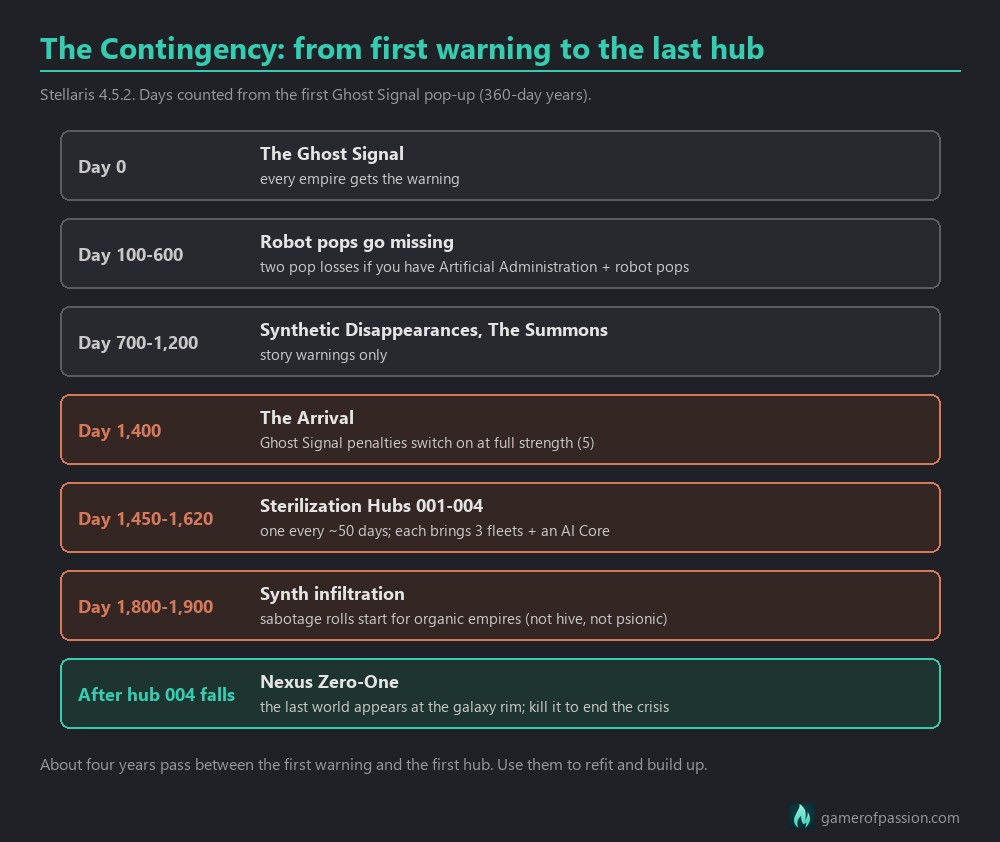
Counted from The Ghost Signal, the chain runs like this:
- On day 0, every empire will get The Ghost Signal event. It has no effect yet.
- Between days 100 and 300, and again between days 400 and 600, empires with Artificial Administration and robot pops will lose some of those robots. Machine empires lose machine pops in their own version of the first event.
- Between days 700 and 900, everyone gets the Synthetic Disappearances message, followed by The Summons between days 1,000 and 1,200.
- On day 1,400, The Arrival switches the Ghost Signal penalties on at full strength.
- Between days 1,450 and 1,460, Sterilization Hub 001 activates. Hubs 002, 003 and 004 will follow about 50 days apart, so all four are up within a few months.
- Between days 1,800 and 1,900, organic empires get the first Synth Infiltration Attempt.
For an organic empire without robot workers, those years will be quiet apart from the messages. Use them to refit, push shield and weapon technology, and stock up on alloys and naval capacity.
The Ghost Signal
From The Arrival on, the Ghost Signal works as a galaxy-wide debuff with a strength of 5. Every Sterilization Hub you destroy lowers it by one, so it will be down to 1 once the last hub is gone. Only the death of Nexus Zero-One removes it completely.
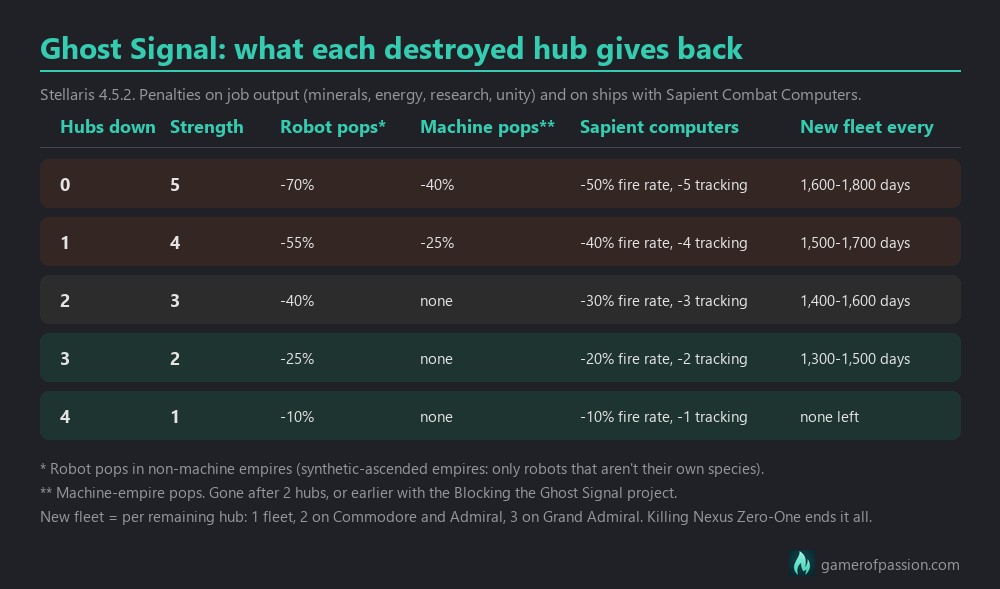
It hits three different things:
- Robot pops in non-machine empires produce 70% less minerals, energy, research and unity from their jobs at strength 5, and their government ethics attraction drops by the same amount. As hubs fall, that goes down to -55%, -40%, -25% and finally -10%.
- Machine pops in a machine empire get a smaller penalty of -40% at strength 5 and -25% at strength 4. After the second hub dies, it will be gone.
- Ships with a Sapient Combat Computer lose 50% fire rate and 5 tracking at strength 5, no matter which empire they belong to (the Siege version and the bio-ship Sapient Neural Implants are not on the game’s list, so they are spared). That shrinks with every destroyed hub, down to -10% fire rate and -1 tracking at strength 1.
Synthetically ascended empires keep their own species safe, but any other robots they own are hit like everyone else’s. On the ship side, only Sapient Combat Computers are affected, in any empire, and swapping to another computer removes the penalty from that ship. Machine and hive empires use Autonomous Ship Intellects, which the Ghost Signal doesn’t touch.
Refits and economy
For your fleet, the fix is simple. Before The Arrival, take the Sapient Combat Computer out of every design in the ship designer and upgrade your fleets. If the game updates your designs automatically, check that it has not put the sapient computer straight back in.
Your economy is harder to protect. If robots produce a big share of your research, energy or minerals, you will feel a sharp drop at The Arrival, so try not to lean on robot-worked jobs for those resources once the warnings start.
Machine empires, synthetically ascended empires and individual machine empires get a special project called Blocking the Ghost Signal. It costs 2,000 engineering research plus 0.7 per pop, or 0.5 per pop once you have Negative-Time Keys. Finishing it removes the machine pop penalty and the strength 5 penalty on robot pops. It is cancelled once two hubs are down, when a machine empire’s pop penalty runs out anyway.
Synth infiltration
Organic empires get a second problem between days 1,800 and 1,900. The first Synth Infiltration Attempt only ends in a report, but the second one follows 120 days later and marks your empire. From then on, you will face a 30% chance every year of one sabotage event:
- Synth Bombing (40%) kills pops on one of your planets, adds 20 devastation and gives a non-stacking -10% unity for five years.
- Synths scuttle one of your starbases (10%).
- A Fear and Suspicion event (10%).
- Synths try to assassinate your ruler (10%).
- A scientist is exposed as a synth (10%).
- A commander is exposed as a synth (10%).
Hive minds and empires with a psionic founder species are immune and only get an event where the infiltration fails.
Every other organic empire needs the Synth Detection Method, a society research project that will become available 200 to 400 days after the second attempt. It costs 2,000 plus 1 per pop (0.75 per pop with Negative-Time Keys), and finishing it stops the sabotage. Start it the moment it appears, because the yearly rolls are already running by then.
Machine empires roll their own events instead, at 30% per year while the machine penalty lasts: a hijacked spaceport, a terminated scientist or commander, power failures and corrupted units.
Fleets and ship design
Their ships
Contingency fleets are built from two ships, the Euthanizer battleship and the Sterilizer destroyer, backed by AI Core stations at the hubs. These are their base values before difficulty and Crisis Strength:
| Ship | Hull | Shields | Armor | Total | Weapons |
|---|---|---|---|---|---|
| Euthanizer (battleship) | 2,000 | 9,360 | 9,360 | 20,720 | 1 Particle Lance, 2 Large Plasma, 3 Medium Gamma Laser, 1 Barrier Point-Defense |
| Sterilizer (destroyer) | 800 | 3,120 | 3,120 | 7,040 | 1 Neutron Launcher, 1 Medium Plasma, 2 Medium Gamma Laser |
| AI Core (hub station) | 50,000 | 23,400 | 23,400 | 96,800 | 4 Particle Lance, 2 Titan Lance, 2 Large and 4 Medium Plasma, 4 Medium Gamma Laser, 2 Guardian Point-Defense, 8 strike craft hangars |
| Master Core (Nexus Zero-One) | 140,000 | 23,400 | 23,500 | 186,900 | Same as the AI Core, but 4 Titan Lances and 16 hangars |
| Contingency starbase | 20,000 | 20,000 | 40,000 | 80,000 | 1 Particle Lance, 2 Large Gamma Laser, 4 Medium Plasma, 2 Guardian Point-Defense |
Each hub starts with a garrison of 16 Euthanizers and 35 Sterilizers, plus two roaming fleets of 5 Euthanizers and 10 Sterilizers each. At base values, a roaming fleet has 174,000 hull, shields and armor combined, and a garrison 577,920.
Their ships really do have thin hull: 9.7% of a Euthanizer’s total and 11.4% of a Sterilizer’s, with the rest split evenly between shields and armor. The stations are the other way around, with hull making up 51.7% of an AI Core and 74.9% of the Master Core.
The AI difficulty adds +90% on Ensign up to +150% on Grand Admiral to their weapon damage, hull, armor and shields (the crisis country gets three times the normal AI difficulty bonus). That puts a Euthanizer at 39,368 combined on Ensign and 51,800 on Grand Admiral, and a Sterilizer at 13,376 and 17,600. Crisis Strength is a separate multiplier. For reference, patch 4.3.0 cut crisis fleets by about a third but player power by more, so the crisis is a bigger threat now than before 4.3.
Their weapons
All of their guns are energy weapons, and most of their damage is plasma and lances, which deal double damage to armor and only a quarter to half damage to shields. That makes shields the better layer to stack, but not the only one, because their hub stations also launch strike craft that ignore shields.
| Their weapon | Against shields | Against armor |
|---|---|---|
| Plasma | 0.25x | 2.0x |
| Particle Lance | 0.5x | 2.0x |
| Gamma Laser | 0.5x | 1.5x |
| Neutron Launcher | 0.5x | 1.5x |
| Titan Lance (AI Core, Master Core) | 0.75x | 1.5x |
| Strike craft (AI Core, Master Core) | full penetration | 0.66 penetration |
Their battleships and stations carry some point defense, the destroyers none, so missiles and torpedoes will work but some of them get shot down.
Your weapons
This is how the usual counters look in 4.5:
- Arc Emitters fully pierce shields and armor and have a range of 150.
- Cloud Lightning fully pierces as well, but only reaches 60.
- Disruptors only partly pierce (50-70%) and have very short range in 4.5, between 30 and 40.
- Kinetic Artillery deals double damage to shields and half damage to armor, at a range of 120.
- Missiles and torpedoes go straight through shields, but they have no armor penetration.
Since 4.3 their Hyper Shields and Neutronium Armor add hardening, so Arc Emitters and Cloud Lightning no longer pass through completely. Every one of those components adds a little, and each Euthanizer and Sterilizer carries four of each (the AI Cores and the Master Core ten). Penetration weapons still work, but they lose some of their edge.
Because their defenses are split evenly, a mixed loadout is the logical answer. Kinetic Artillery strips the shields, and an anti-armor weapon such as a lance, plasma or Neutron Launchers takes care of the armor underneath.
So for your own defenses, lean on shields but keep some armor, because the strike craft from the AI Cores and the Master Core skip shields entirely. A bit of point defense or flak will help in those fights as well.
Player setups in 4.x
Before 4.3, the standard answer was battleships with Arc Emitters and Cloud Lightning, often with no shields or armor at all. Since the 4.3 hardening, players have moved to long-range fleets built around Kinetic Artillery and Neutron Launchers, with shields as the main layer and no fully naked ships, which their lances and Neutron Launchers kill quickly. One in-save comparison on 4.3, against a 3x Contingency on Grand Admiral with the same titans and Juggernaut in every run, found a mix of 8 Neutron Launcher cruisers to 15 Kinetic Artillery battleships to be the best of everything tested. Carrier, missile and Arc Emitter battleships did worst there, and the artillery battleships were also the cheapest to replace.
If you want one setup to start from, I would say a long-range battleship with Kinetic Artillery and an anti-armor weapon, mostly shields with some armor, and a non-sapient combat computer is the safest default in 4.5. Cruisers with Neutron Launchers make a good second line, and the rest can follow the usual fleet composition rules.
Arc Emitter battleships are still an option thanks to their 150 range, but they lose part of their damage to the hardening. In one 4.3.4 game, a player’s corvette and frigate swarms with bypass weapons beat the roaming fleets, which carry no Titan Lances, but were wiped out at the first hub, so keep swarms away from the hubs and Nexus Zero-One. If your fleet already runs heavy shields, swapping the computers and adding Kinetic Artillery is a cheaper first step than a full rebuild.
Destroying the Sterilization Hubs
When a hub activates, it will kill all pops on its planet, turn it into an AI World and replace any starbase in the system with a Contingency starbase. It then spawns one AI Core station, its garrison fleet, two roaming fleets, 20 robotic army transports and three constructors. Reloading an older save will not move the hubs, and cracking a future hub planet early does not stop the hub from appearing.
Bombardment
Hubs cannot be invaded, so your armies will not help here. A hub dies when its devastation reaches 50%, which means orbital bombardment, and AI Worlds take 75% less bombardment damage, so this is probably going to take a while. Any bombardment stance damages a hub, and Armageddon is three times as fast as Selective (planet damage 1.5 against 0.5, with Indiscriminate at 1.0 in between). Armageddon needs the matching bombardment policy.
The garrison, the AI Core and the starbase all sit in the hub’s system, so you will have to clear them before you can bombard in peace. Each AI Core carries two Titan Lances, so the splash damage described under Nexus Zero-One below applies at every hub.
A hub that you bombard to death leaves a Living Metal deposit along with minerals and energy deposits. Additionally, the first hub destroyed in the galaxy gives every player empire the Living Metal technology as a research option, or 25% progress if it already was one.
Colossus options
A Colossus is the faster way. A World Cracker, Global Pacifier or Divine Enforcer will destroy a hub once it has fired, and a Devolving Beam works too if you have the Archaeo-Engineers ascension perk. Mind that the World Cracker and Global Pacifier leave no deposits, so no Living Metal either, while a Divine Enforcer or Devolving Beam keeps them. A Stellar Cannon aimed at a hub system gets redirected, so that one is out.
Reinforcements
Every hub that is still alive will send a reinforcement wave every 1,600 to 1,800 days at strength 5. That speeds up a little bit with each hub you destroy, down to 1,300 to 1,500 days at strength 2, but with fewer hubs left, fewer waves arrive overall. Each wave is one roaming fleet below Commodore, two on Commodore and Admiral, and three on Grand Admiral. Army waves run on their own timer, which slows down from every 700 to 900 days to every 1,600 to 1,800 days.
Bombarding a hub pauses its reinforcement cycles: while the bombardment lasts, the game only checks again every 300 days, and the normal countdown starts once it stops. A wave that is already on its way still shows up, though.
Which hub to hit first
The Contingency AI tries to link its hubs up and treats megastructures as attractive targets, so its fleets may head straight for your space if you sit between two hubs or own a lot of megastructures. Start with the hub whose link would run through your territory, or simply the closest one.
Hunt the roaming fleets before you go for a garrison, since they are much weaker and have no Titan Lances or AI Core behind them. All four hubs appear within a few months, so it also makes sense to wait until they are all up before you commit your main fleet, or a new hub may pop up behind it.
Hub bugs and softlocks
Hubs that cannot be destroyed have been a common complaint for years, but several causes are fixed by now:
- Since 4.5, a hub that comes under the control of another empire, such as an ally, a vassal or another AI, detonates its failsafe, so it can no longer block the crisis.
- Since 4.1.5, the game has a fallback for a planned hub planet that was destroyed ahead of time, although in the 4.5.2 files it only covers the first hub.
- Since 4.0.22, a Devolving Beam can no longer target a hub unless you have Archaeo-Engineers.
One problem was still reported by players on 4.4, even after a fix in that patch: if the Contingency holds a colony or habitat in a system, its starbase there can respawn over and over and trap your fleet. Players got around it by retaking the planets the Contingency holds in that system first.
Nexus Zero-One
When the fourth hub falls, the CX-9881 system appears at the rim of the galaxy. It holds Nexus Zero-One, a size 35 AI World, together with a Contingency starbase, the Master Core and four AI Cores. Like the hubs, Nexus Zero-One dies at 50% devastation or to a Colossus.
This will probably be the hardest fight of the whole crisis. Every Titan Lance also hits ships near its target (500 base damage within 40 range, more with the crisis’s damage bonuses). The Nexus Zero-One system holds 12 of them, so tightly packed corvette swarms melt there. Titan collateral damage was added in 4.3 and has scaled with damage modifiers since 4.4, which is why older guides do not mention it. With a base range of 250, plus +20% weapon range on the stations, it is also hard to stay out of reach.
The tactic players use on 4.5 is to bait the beams. They send a single cheap ship, a corvette or even a transport, into the system a few times to draw the Titan Lances’ fire, and then bring in the real fleet during the long reload, which gives it time to spread out instead of sitting in one tight clump. One player on 4.4 (40x crisis) used shield-only battleships with afterburners as a bigger bait wave instead.
Once Nexus Zero-One falls, the Contingency is destroyed and all of its fleets go with it. The Ghost Signal is removed, the Synth Detection Method project is cancelled, and every empire gets The End of the Contingency event. Unless you cracked or pacified it, the planet itself becomes a broken world with no deposits.
The player empire that destroys Nexus Zero-One gets the Isolated Contingency Core relic, even if it uses a World Cracker or a Global Pacifier (the Pacifier case was fixed in 3.11.1). If an AI empire bombards it to death instead, a player whose fleet is in orbit at that moment gets the relic. If that is you, the Does Not Compute achievement will be yours as well. The relic gives you:
- +1 megastructure of each type.
- +100% mechanical pop assembly speed as a passive effect (hive minds get +150% engineering research instead).
- A Triumph called Contingency Calculation with +300% megastructure build speed.
Allies against the Contingency
The machine Fallen Empire
If a machine Fallen Empire exists, it wakes up when the first hub appears: usually as a defender, about one game in three as a corrupted, hostile one. Which of the two you will get is already decided at the start of the game, and the wake-up itself comes 30 to 60 days after the first hub. A corrupted one means a second enemy on top of the crisis, so it helps to know how to deal with a Fallen Empire.
Fallen Empire guardians
With the first hub, the game also rolls whether a Fallen Empire will step in as guardian of the galaxy: 75% that eligible Fallen Empires are marked for it (60% one, 15% all of them) and 25% that none are. Only the first marked empire to act actually wakes up, no sooner than five years after the first hub and almost always by ten, and not at all if a War in Heaven has begun. Eligible usually means fanatic materialist or fanatic xenophile with more than 60,000 fleet power.
The Cybrex
The Cybrex only show up if the Contingency gets out of hand. Once it holds more than 15% of the galaxy or more than 90 systems, Cybrex Beta, a ring world system, will appear at the rim with a mean time to happen of 12 months, and the Cybrex start sending fleets against the Contingency.
They can also hand you a fleet. A player empire that has destroyed more than 100 Contingency fleets (whole fleets, constructor and transport fleets included) and is not at war with the Cybrex can get 10 Taciturn and 20 Reticent ships for itself (mean time to happen 22 months, and only while the Cybrex have more than 30 ships). Taciturn ships are Euthanizers with a Tachyon Lance, and Reticent ships are copies of the Sterilizer. They will recall it 20 to 50 days after the Contingency is gone and leave the galaxy one to three years later.
They only arrive once the Contingency is already eating the galaxy, though, so do not plan your defense around them.
FAQ
Is the Contingency the hardest crisis?
I would say it is the hardest one to fight head-on, because its ships split their defenses evenly between shields and armor, its hubs sit behind large garrisons and AI Cores, and the final system has 12 Titan Lances. On the other hand, it is very predictable. You get about four years of warning, there are exactly four hubs and one final world, and every dead hub makes the rest of the crisis a little easier.
Can you stop the Contingency from spawning?
Once The Ghost Signal event has fired, it is coming. The only way to keep it out is in the galaxy settings when you set up the game: set the Crisis Type to a different single crisis and the Contingency’s weight drops to zero, or switch end-game crises off in the Crisis Strength setting. Only an empire on the Defender of the Galaxy ambition can still summon a crisis with crises switched off. Research, robots and synths do not change the odds.
What happens if you play a Machine Intelligence?
Your machine pops get -40% at strength 5 and -25% at strength 4, and you roll your own sabotage events instead of synth infiltration. Blocking the Ghost Signal or two dead hubs end both. Your Autonomous Ship Intellects are immune, so your fleet will fight without the computer penalty from the start.
Who gets the Isolated Contingency Core?
Only the player empire that destroys Nexus Zero-One. If an AI ally or an awakened Fallen Empire bombards it to death, the relic goes to a player whose fleet is in orbit at that moment, so keep a fleet there. If an AI cracks or pacifies it with a Colossus, nobody gets it.