
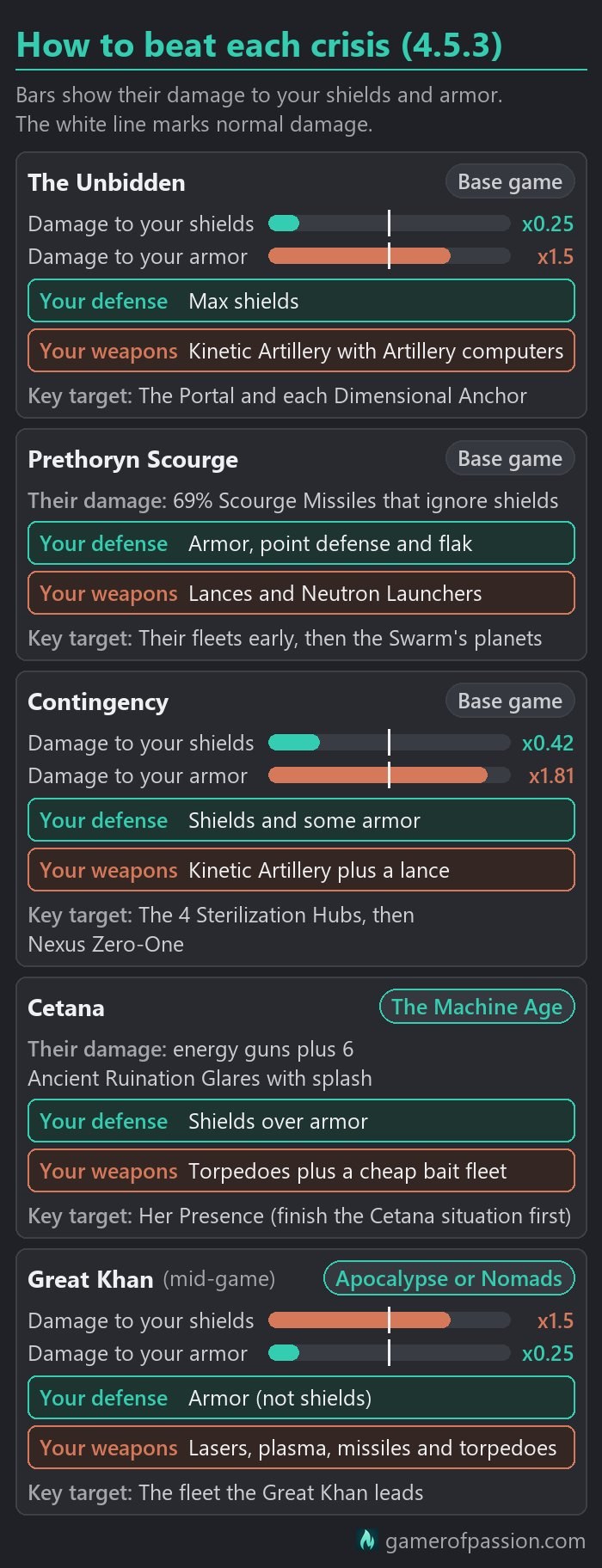
Stellaris 4.5 has four endgame crises, and each one falls to a different fleet: shields and Kinetic Artillery against the Unbidden, armor and point defense against the Prethoryn Scourge, shields with artillery and an anti-armor weapon against the Contingency, and torpedoes against Cetana’s flagship.
With default settings, the end-game year is 2400, but the first roll for a crisis will only come in 2450, or in 2425 once any empire owns the Jump Drive or Psi Jump Drive, no Fallen Empire is left, a War in Heaven has ended or can no longer happen, or one of the two crisis resolutions has passed. A roll in 2400 itself needs an event from the Ultima Vigilis archaeological site or both of those resolutions. Once a roll picks a crisis, it will arrive 200 to 1,000 days later.
Which of the four you get is down to chance. In a game with The Machine Age, the Prethoryn, the Contingency and Cetana each come up 26.3% of the time and the Unbidden 21.1%, and nothing you research will change that.
Cetana (the Synthetic Queen) needs The Machine Age, while the other three are part of the base game. Everything below applies to Stellaris 4.5.3 ‘Cygnus’ on PC. The spawn odds, ship stats and weapon multipliers were worked out from that patch’s game files, and the list of balance changes follows Paradox’s patch notes.
Contents
- The endgame crises in 4.5
- When the crisis spawns
- How to beat each crisis
- Preparing for the crisis
- Crisis strength
- The Great Khan
- Becoming the crisis
- Changes since 4.3
- Crisis questions
- Conclusion
The endgame crises in 4.5
An endgame crisis is an invasion that the game throws at the whole galaxy late in a campaign, and each of the four in the crisis roll can only happen once per game.
The Prethoryn Scourge is a swarm of living ships from beyond the galaxy. It gives you a long warning, lands in four systems at once and turns most worlds it takes into Infested planets.
The Extradimensional Invaders are better known as the Unbidden. They come through a portal from another dimension, and if they grow too big, two rival factions will follow through portals of their own, the Aberrant and the Vehement.
The Contingency is an ancient machine intelligence that wakes up four Sterilization Hubs to wipe organic life out of the galaxy.
Cetana, the Synthetic Queen, came with The Machine Age (our DLC tier list rates the rest of that expansion). She arrives with a storm around her home system, and you will not be able to hurt her at all until you have finished a situation of your own.
The Great Khan is a mid-game crisis, which means he will usually rise between the mid-game and the end-game year. The Gray Tempest behind the L-Gates and the Voidworm Plague from Grand Archive belong to the same group, and none of them is part of the end-game roll.
Neither is the War in Heaven, which the game does not count as a crisis at all. A crisis can still spawn while the two Awakened Empires are fighting.
When the crisis spawns
Three galaxy settings decide when and how hard the crisis hits you: the End-Game Start Year, the Crisis Type and Crisis Strength. By default, the end-game year is 200 years after the start, which is 2400 in a normal 2200 game, and the Crisis Type is on Random.
If you set Crisis Strength to Off, the crisis roll is switched off and no end-game crisis will come on its own. Our beginner guide goes through the rest of the galaxy settings for a first game.
| Setting | Default | What it does |
|---|---|---|
| End-Game Start Year | 2400 (200 years after start) | Opens the crisis roll windows at +0, +25 and +50 years |
| Crisis Strength | 0.5x tiny, 0.75x small, 1.0x medium, 1.25x large, 1.5x huge | Fleet strength (10x and 25x stops). Off = no end-game crisis |
| Crisis Type | Random | A single pick = only that crisis. All = several in a row |
| Super-early rolls | 2400 (+0), needs a trigger | Ultima Vigilis flag, or both crisis resolutions |
| Early rolls | 2425 (+25), needs a trigger | Jump Drive (any empire), no Fallen Empire or a resolution |
| Regular rolls | 2450 (+50 years) | Rolls with no trigger |
| Crisis roll | Every 5 years | One weighted pick: a crisis or nothing |
| Arrival delay | 200 to 1,000 days | Crisis start event after a successful roll |
| Defeat bonus to crisis strength | x2 per crisis beaten | x2.5 if beaten within 10 years of the roll, x3 within 5 |
| Mid-Game Start Year | 2300 (100 years after start) | Great Khan can rise from 2303 (+3 years) |
| Marauder Empires | 1 tiny / 1 small / 2 medium / 2 large / 3 huge | 0 = no Great Khan, more empires = slightly higher Khan odds |
The crisis roll
The game rolls for a crisis roughly every five years, which with default settings will probably put the checks in 2425, 2430, 2435 and so on. A check can only pick a crisis once a window is open, and there are three of them:
- From 2450, 50 years after the end-game year, every check counts.
- From 2425 if any empire, AI included, has the Jump Drive or Psi Jump Drive, if no Fallen Empire is left, if a War in Heaven has ended, has run for 15 years or can no longer happen, or if Extradimensional Experimentation or Galactic Threats Committee has passed in the Galactic Community.
- From 2400 itself only after an event at the Ultima Vigilis archaeological site, or with both of those resolutions in force.
Each check is one weighted pick between the four crises and “nothing”, and “nothing” starts out heavy. In a game with Fallen Empires around and The Machine Age installed, an early trigger gives you a 24.1% chance of a crisis in 2425 and 94.2% that one has been picked by 2450.
Without an early trigger, the first check in 2450 picks one 55.9% of the time, and by 2460 that is up to 91.4%. Add the 200 to 1,000 days until it arrives, and in most games with default settings you can expect the crisis somewhere between the mid-2420s and the early 2460s.
Dangerous Technology
Nothing you research changes which crisis you get. The Jump Drive and Psi Jump Drive carry the Dangerous Technology label, and so do Sapient Combat Simulations and Artificial Administration (the old Synthetics tech), but the crisis roll never looks at that label. None of the crisis weights read anything about your empire, which means robots, synths and psionics will not draw a particular crisis to you either.
The only effect of the Jump Drive is that it opens the 2425 window, and any empire that owns it will do. An AI empire researching it on the other side of the galaxy is going to move the first roll forward just as much as you would.
Crisis not spawning
A late crisis is usually just bad luck with the rolls. Even with an early trigger, the first check in 2425 comes up empty 75.9% of the time. If your game is well past 2460 and still quiet, check for these causes:
- Crisis Strength was set to Off, or the End-Game Start Year was pushed far out (the slider goes up to 800 years after the start).
- No early trigger is met, which means nothing can be picked before 2450.
- A single crisis was picked in the Crisis Type setting and has already happened, which keeps the other three out for good.
- Another crisis faction is alive. A living Great Khan, Gray Tempest or Voidworm Plague lowers the chance per check to 18.0% in 2425 and 46.8% in 2450.
- You do not own The Machine Age. Cetana then drops out of the pool, and the chance per check falls to 18.9% in 2425 and 48.3% in 2450.
How to beat each crisis
Every crisis leans on one or two damage types and one main layer of defense, and the right counter will matter more than raw fleet power. All numbers here are base values, before the AI difficulty bonus and Crisis Strength.
| Crisis | They hit with | They are protected by | Build this |
|---|---|---|---|
| The Unbidden (base game) | Matter Disintegrators: x0.25 vs shields, x1.5 vs armor | Shields (74% of HP), +25% hardening, +50% near an Anchor | Max shields, Kinetic Artillery with Artillery computers |
| Prethoryn Scourge (base game) | Scourge Missiles that ignore shields (69%), Swarm Strikers | 57% hull, 43% armor, no shields or point defense | Armor, point defense and flak, lances and Neutron Launchers |
| Contingency (base game) | All energy: x0.42 vs shields, x1.81 vs armor | 45% shields, 45% armor, shield and armor hardening | Shields and some armor, Kinetic Artillery plus a lance |
| Cetana (The Machine Age) | Energy guns (x0.5 vs shields), 6 Ancient Ruination Glares | Her Presence: 1,750,000 hull and 1,264,400 armor | Shields over armor, torpedoes plus a cheap bait fleet |
| Great Khan (mid-game, Apocalypse or Nomads) | Autocannons (87%): x1.5 vs shields, x0.25 vs armor | Half hull, a third armor, 15% shields, no point defense | Armor (not shields), lasers, plasma, missiles and torpedoes |
The Unbidden
The Unbidden give you no warning. The Galactic Power Surge event fires the moment their portal opens, and unless you have intel on that system, you will only learn where it is 30 days later.
The portal opens in a random system anywhere in the galaxy except pulsars, Binary Stars systems with a pulsar and Fallen or Awakened Empire space, and it destroys any starbase in that system. Nothing about your empire, the Jump Drive included, pulls it toward you.
They arrive as one fleet of 25 Revenants, 40 Phantoms and 60 Wraiths. Nine more fleets of 18 ships follow within about 550 days, two at a time from Commodore difficulty and three at a time on Grand Admiral.
After that, new fleets will come every 1,500 to 1,700 days while they have no Dimensional Anchor and every 150 to 200 days once they have ten or more, with a pause whenever they own more than 2,000 ships.
Every gun they carry is a Matter Disintegrator, an energy weapon that deals only a quarter of its damage to shields and 1.5 times to armor and hull, with no shield bypass. Shields are the layer to stack, and armor is a poor use of your slots. Their longest gun reaches 70, while Kinetic Artillery and Neutron Launchers reach 120 and lances 150.
About three quarters of their hit points sit in shields, and they have no armor at all. Every ship carries five Psionic Shields with 5% shield hardening each, 25% in total, and hardening blocks part of the damage that would otherwise go straight through shields.
Additionally, every Dimensional Anchor and the portal itself add another 50% to all of their ships in that system through the Dimensional Stabilizer aura. Missiles, torpedoes, strike craft and Arc Emitters lose most of their bypass there.
Their point defense, the Arc Defense Field, only reaches 20 and has three times the cooldown of yours, and the Wraiths carry none. They have no hangars either. As such, missiles and strike craft work well against them, as long as you fight away from the Anchors.
Their hulls have the same base speed as yours but no thrusters, which means your ships will be faster class for class. Every one of them has a Psi Jump Drive, though, and a jump of your own will not get you away from them safely.
The fleet I would build against them is a shield-heavy battleship or cruiser line with Kinetic Artillery, a long-range finisher such as a lance or Neutron Launchers, and Artillery computers to open fire before they are in range. Kinetic Artillery deals double damage to shields, and since it does not rely on bypass, their hardening simply does nothing against it.
Pulsars and Binary Stars systems with a pulsar give you a second option. They carry Shield Nullification, which removes the shields of every ship inside them and wipes out up to 79% of a Revenant’s hit points. Bear in mind that your own shields are gone too and their guns will hit your armor and hull at 1.5 times, so a fleet that fights there wants armor and hull-damage weapons such as plasma and lances.
Strike as early as you can, before the Anchors multiply, because every Dimensional Anchor shortens the time until their next fleet.
You should not have to clear every Anchor before you attack the portal itself (150,000 hull and no guns), and destroying it stops their reinforcements. If your empire destroys the last open portal, you get the Extradimensional Warlock relic, with +30% ship speed and +30% weapon range.
Beware that the crisis is not over when the portal falls. It only ends once every extradimensional faction is gone. If the Unbidden hold more than 15% of the galaxy or more than 90 systems, a second portal will open inside their territory, on average about a year later. That is the Aberrant, and once they and the Unbidden start fighting each other, the Vehement will follow, on average a little over three years later.
The Prethoryn Scourge
The Scourge comes with a long run-up. Every empire gets Subspace Echoes 200 to 1,000 days after the roll, and a chain of hidden rolls then leads to The First Wave, with no fixed number of years in between.
They land in four systems. The First Wave brings vanguard fleets of 16 Swarm Smalls, two per system and up to five on higher difficulties. The Second Wave will follow 400 to 600 days later with brood fleets of one Swarm Queen, five Swarm Large, four Swarm Carriers and 18 Swarm Smalls each.
Their fleets bombard on Armageddon and purge the pops of every world they take.
About 69% of a brood’s gun damage is Large Scourge Missiles, which are explosive, ignore shields and deal 0.8 times their damage to armor. The rest is Scourge Acid Blast, a kinetic weapon that hits shields at 1.5 times. Each brood also carries 19 Swarm Striker hangars, and each hangar launches ten strikers that ignore shields and pierce two-thirds of your armor.
Shields will do very little for you here. Armor is the layer to stack, and your point-defense slots (P slots) are going to matter more than in any other crisis fight.
Point defense and flak both shoot at Scourge Missiles and Swarm Strikers. Flak tracks far better, which counts against evasive missiles and strikers, while point defense deals double damage to the strikers’ armor, and a mix of the two is probably the safest setup. Their strikers cannot shoot anything down themselves, which makes carriers of your own a fairly solid way to thin them out.
The Prethoryn have no shields, no hardening and no point defense. A brood’s hit points are 57% hull and 43% armor (the vanguard fleets are mostly armor), and both regenerate through Regenerative Hull Tissue.
That makes armor-cracking energy weapons the right main guns, such as lances, plasma and Neutron Launchers, while Arc Emitters go straight through with no hardening to stop them. Leave kinetic main guns at home.
Their 18 Swarm Smalls deal almost half of a brood’s gun damage, and they are built to dodge (+65 evasion from the hull, against +5 on the big ones). Pair your lances and Neutron Launchers with some higher-tracking guns or strike craft to deal with them.
Hit their fleets early, before the Infested worlds pile up. The crisis only ends once the Swarm itself is destroyed, and their planets are the key target for that.
When they are gone, you will get Prethoryn Scourge Defeated, +20% happiness for ten years, and a large unity reward.
The Prethoryn Brood-Queen relic works differently. Each Swarm Queen that your own ships destroy has about a 5% chance to capture her, only once per game, which means a quick kill or allies taking out the Queens will leave you with fewer chances at it.
The Contingency
The Contingency announces itself with The Ghost Signal, and its first Sterilization Hub will switch on about four years later. Once all four hubs are destroyed, Nexus Zero-One appears, and destroying that ends the crisis.
All of its guns are energy weapons (Particle Lances, plasma, Gamma Lasers and Neutron Launchers), which deal well under half their damage to shields and close to double to armor. Shields are the better layer to stack, but not the only one, because the hub stations also launch strike craft that ignore shields and fire Titan Lances that splash nearby ships. Keep corvette and frigate swarms away from the hubs and Nexus Zero-One for that reason.
Their warships split their hit points evenly between shields and armor, with little hull. Each one carries four top-tier shields and four top-tier armor plates at 4% hardening each, about 16% shield and 16% armor hardening in total, and Arc Emitters and Cloud Lightning no longer pass through completely because of it.
Kinetic Artillery to strip the shields and Neutron Launchers or a lance for the armor underneath is the safer pair. Make sure your designs use a non-sapient combat computer, too, because the Ghost Signal cuts the fire rate of the sapient one.
The hubs cannot be invaded. You will have to bombard each one down to 50% devastation or crack it with a Colossus, and the player empire that destroys Nexus Zero-One gets the Isolated Contingency Core relic. Our Contingency guide has the whole timeline, the Ghost Signal penalties and the hub fights in detail.
Cetana
Cetana does not spawn at random. She will appear on a xenophobe Fallen Empire’s homeworld if one is intact, otherwise on another Fallen Empire capital, then a Relic World, then a Tomb World, and only then on any colonizable planet.
Fallen and Awakened Empires deal 90% less damage to her (Beset by Cetana), which means they will not do the job for you.
For a good while, you cannot hurt her at all. Every player empire gets a situation called Cetana: The Synthetic Queen (a situation is a progress bar with stages, where the approach you pick changes its bonuses), and it only moves through events and special projects.
Until yours has completed, attacking her ships is a disaster. Every ship in your fleet will lose 62 to 99% of its hit points, or be destroyed outright one time in six, and the survivors get thrown back home.
Meanwhile, her own situation, Cetana’s Work, runs as a doom clock that takes about 25 years to fill up at its base pace, and it will run faster at higher Crisis Strength.
All of her escorts’ guns are energy weapons, mainly Gamma Lasers and Tachyon Lances, which deal half damage to shields and 1.5 to 2 times to armor. Her Presence and the Her Protection escorts also launch strike craft that ignore shields. Her flagship, Her Presence, carries six Ancient Ruination Glares as well. Each hit deals 5,000 to 10,000 damage and splashes 500 base damage onto every other ship within 40 range of the target, and her hull adds +200% weapon damage and triple fire rate.
Her Presence has 1,750,000 hull, 1,264,400 armor and 509,000 shields with 5% shield regeneration at base values, and at size 640 she is the biggest target in the game. Torpedoes and other weapons that scale with target size will hit her hardest.
For your own ships, stack shields over armor, since all of her guns are energy. Build the damage around torpedoes, and send a cheap bait fleet in first to soak the glares and keep your main fleet out of the first exchange.
Destroying Her Presence will end the crisis and give Cetana’s Heart to whoever lands the kill. Psionic empires have another way out: once you have breached the Shroud, you can seek out the Animator of Clay, pay its price and run a 30-day ritual that reprograms her. That counts as beating the crisis, but it gives no Cetana’s Heart.
Preparing for the crisis
The best time to prepare is the 20 to 30 years before the end-game year, while you still do not know which crisis you will get. This is the list I would work through:
- Research Kinetic Artillery and one long-range anti-armor weapon, a lance or Neutron Launchers. Between them they cover the Unbidden, the Contingency and Cetana’s escorts, and the anti-armor half is what you want against the Scourge.
- Get top-tier shields and armor. Every piece adds a little hardening, which blunts the piercing missiles and strike craft of the Scourge and of the Contingency’s stations.
- Have flak and point defense ready for the Scourge, and the best thrusters you can get, since the Unbidden have none and better thrusters let you outpace them.
- Keep two designs ready to refit. One is a shield-heavy battleship or cruiser with Kinetic Artillery, a lance or Neutron Launchers and an Artillery computer (non-sapient against the Contingency), and the other an armor-heavy energy design with its P slots split between point defense and flak, plus a carrier, for the Scourge. Our ship design guide explains the slots and damage multipliers, and the fleet composition guide the mix of hulls.
- Refit as soon as the first event tells you which crisis it is. Galactic Power Surge means the Unbidden (their portal is already open), Subspace Echoes the Prethoryn, and The Ghost Signal the Contingency.
- Build strong starbases at your chokepoints. If they carry an FTL inhibitor, expect the Unbidden, the Prethoryn and Cetana to go after them on purpose, and treat them as positions you will have to hold with a fleet nearby. Note the pulsars near your core as well, as they make good battlefields against the Unbidden.
- Stack damage bonuses against crises. Galactic Threats Committee gives +20% (it needs a finished Politics tradition tree and the Galactic Council), and the federation perks Stronger Together and Galactic Peacekeepers +25% each (our federation types guide shows which federations get them). Defender of the Galaxy adds +50% as an ascension perk for empires without Nomads, while Nomads turns it into an ambition. Galactic Threats Committee also opens the 2425 window.
- If you own Apocalypse, a titan is worth having by then. Its Perdition Beam splashes 500 base damage onto ships within 40 range of its target (our titan build has the loadouts).
- Bring your doomstack home when the crisis event lands, and strike before the crisis can spread.
Crisis strength
Crisis Strength sets how strong the end-game crisis fleets are. The default depends on the galaxy size, from 0.5x on a tiny galaxy to 1.5x on a huge one, and the slider also offers 10x and 25x. On Ensign difficulty and above, it scales mid-game crises such as the Great Khan as well.
The AI difficulty is a separate bonus. Crisis countries get three times the ship bonus that Fallen Empires get, which adds +90% to their damage, hull, armor and shields on Ensign and +150% on Grand Admiral.
There can be more than one end-game crisis in a game, but only if you set the Crisis Type to All or an empire on the Defender of the Galaxy ambition summons a second one. On All, the crises come in random order, each one only once, and since 4.3 the next one can be picked 25 years after the last pick even if the previous crisis is still alive. Beating a crisis opens the way for the next one sooner.
Every crisis you beat makes Crisis Strength x2 for the rest of the game. If you beat it within 10 years of its roll, the factor becomes x2.5, and within 5 years x3.
Taking your time only saves you the extra half or full step, as the doubling itself always applies. On 25x with all four crises, three wins will already put the last one at 200x or more.
The boost will probably also land on any crisis that is still alive. That makes finishing one crisis while another one is active a little bit risky, as the survivor gets tougher too.
The Great Khan
The Great Khan rises from one of the Marauder empires, and the Marauder Empires setting needs Apocalypse or Nomads. From 2303, three years after the default mid-game year, until the end-game year, every dormant Marauder empire rolls for him.
With default settings, he shows up in most games, in roughly 57 to 84% of them by 2400 depending on galaxy size, since small galaxies start with one Marauder empire and huge ones with three. Every Void Dwelling you destroy also has about a 2% chance to wake him on the spot while the Marauders still own three or more. Setting Marauder Empires to 0 removes him from the game.
His fleets hit almost entirely with Ripper and Stormfire Autocannons, which deal 1.5 times their damage to shields and only a quarter to armor, and that makes armor the defense to stack. His ships carry no point defense, and only the one Ancestral Glory galleon per fleet has flak, which leaves them open to missiles and torpedoes.
With about half of their hit points in hull and a third in armor, lasers, plasma and torpedoes all work well, and defensive starbases at your chokepoints will help you hold the line.
The Great Khan cannot die from events during his first 20 years, but you can still beat him in battle by destroying the fleet he leads (Great Khan Meets Defeat). That does not end the horde for good, though.
After those 20 years, an AI Khan has a 2% chance each month to die, which means he will usually be gone within five more years, and old age takes him 30 to 44 years after he rose. About 200 to 300 days after his death, the horde breaks apart, usually into successor states if it holds six or more planets.
Becoming the crisis
You can also become a crisis yourself. Galactic Nemesis (Nemesis), Cosmogenesis (The Machine Age), Behemoth Fury (BioGenesis) and Galactic Hyperthermia (Infernals) are crisis paths that start with an ascension perk, and they need an independent empire that is neither the Galactic Custodian nor the Galactic Emperor.
They rule out the Defender of the Galaxy, and the crisis damage bonuses, such as Galactic Threats Committee, will count against your empire too. Our ascension perks guide goes through how each path plays.
Changes since 4.3
- 4.3 ‘Cetus’ cut the fleets of the Prethoryn, the Contingency, the Extradimensionals and the Great Khan by about a third, and Cetana’s fleets by about half. Player power dropped by more than that, which makes the crises a bigger threat than before 4.3.
- 4.3 also let the next crisis on All spawn 25 years after the previous one, made the first Unbidden fleet stronger, lowered Cetana’s odds while another crisis is active, added a little hardening to every shield and armor tier above the first and gave titan Perdition Beams and Ancient Ruination Glares their splash damage.
- 4.3.4 fixed Scourge Missiles dealing five times their intended damage, along with the Prethoryn having more fleets on lower difficulties than on higher ones.
- 4.4 ‘Pegasus’ made titan splash grow with weapon damage bonuses and turned Defender of the Galaxy into an ambition for Nomads owners.
- 4.5 ‘Cygnus’ fixed Defender of the Galaxy not spawning the second crisis, exempted crisis wars from the war-size penalty and made Contingency worlds detonate their failsafes when another empire controls them. 4.5.2 stopped Fallen Empires from declaring war on Cetana over and over.
- 4.5.3 reworked the counters for Scourge infested planets.
Patch 4.6 is due on 23 November 2026, and none of its dev diaries so far mention a change to the crises.
Crisis questions
What is the strongest crisis?
I would say Cetana is the strongest crisis in 4.5. You cannot touch her until your situation is done, her doom clock keeps running in the meantime, and her flagship pairs 1.75 million base hull with six splash weapons. The Contingency comes second, mostly because its hubs and Nexus Zero-One punish careless attacks with Titan Lance splash.
The Unbidden are the easiest to counter. One damage type that does little against shields, ships without thrusters and short range all play into a shield and artillery fleet. In an All game, of course, the last crisis will be the strongest one by far, whichever it turns out to be.
How do you trigger the crisis early?
The simplest way is to lower the End-Game Start Year before the game starts, as the slider goes down to 50 years after the start. In a running game, the Jump Drive in any empire or one of the two crisis resolutions will open the 2425 window, and both resolutions together allow a roll in 2400 itself, at 22.1% per roll. The Ultima Vigilis early-start flag pushes the chance to about 97% per roll from the end-game year on.
With Nomads, the Defender of the Galaxy ambition has special projects that summon an end-game crisis 30 to 60 days later, even with crises switched off, although the game picks which of the four it will be.
Can you stop a crisis from spawning?
You can, but only in the galaxy settings before the game starts, by setting Crisis Strength to Off or picking a single Crisis Type to keep the other three out. Even then, an empire on the Defender of the Galaxy ambition can still summon one. Once the game is running, the only way to stop a crisis is to beat it.
Does Stellaris end in 2500?
With default settings, the victory year is 2500, 300 years after the start, when the game checks the score. You can move it anywhere between 100 and 1,050 years after the start in 50-year steps.
It is a separate slider from the end-game year, which means a late victory year will not delay the crisis.
Conclusion
The endgame crisis looks overwhelming the first time, but each of the four has a clear weakness. Shields and Kinetic Artillery will handle the Unbidden and most of the Contingency, armor and point defense the Scourge, and torpedoes behind a bait fleet take down Cetana once her situation lets you fight.
If you do not know yet which one is coming, two designs ready to refit and an economy that can replace a lost fleet by 2400 will get you most of the way.