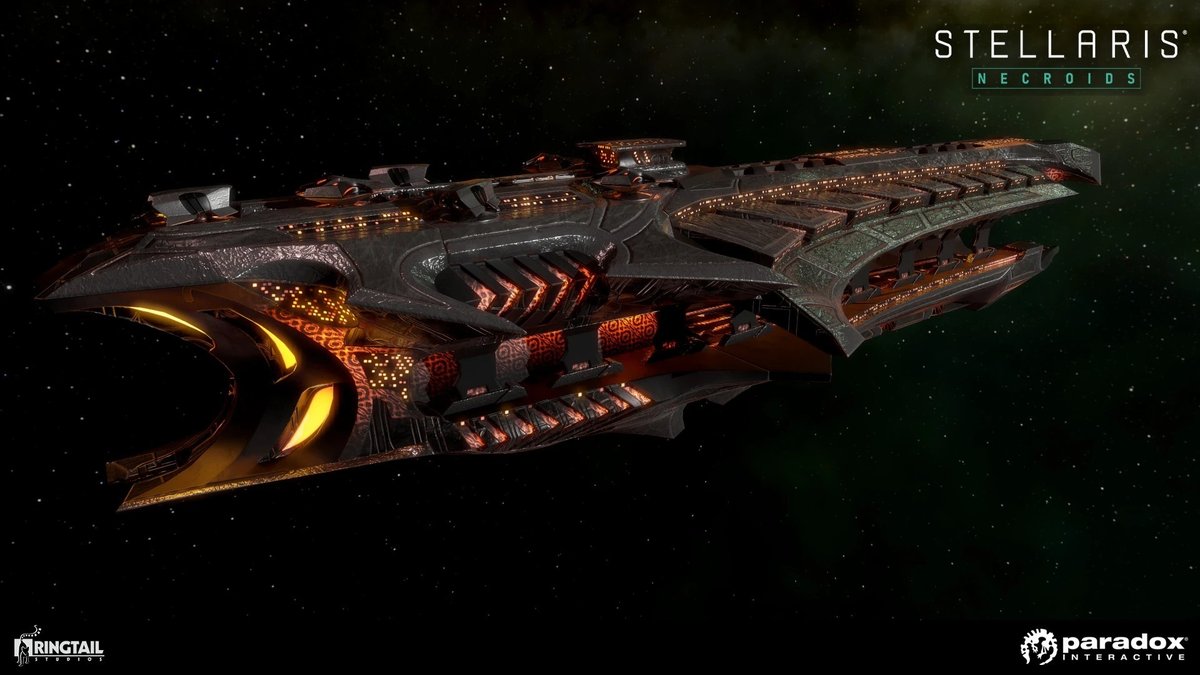
Titans changed quite a lot in Stellaris 4.3, when the Perdition Beam started to damage every enemy ship close to its target instead of only the one it hits. The same patch changed how many titans you can field, 4.4 merged the old assembly yards into a single building, and a lot of the titan advice you will find online still describes the game from before all of that.
The best titan build in 4.5 is a Perdition Beam in the T slot, Kinetic Artillery in all six large weapon slots, the best Artillery combat computer you have and a mix of armor and shields that fits the enemy you are going to fight. The titans in your main fleet should carry the hostile auras (Subspace Snare, Quantum Destabilizer and Shield Dampener), while a titan in any other fleet will do more with a support aura like Inspiring Presence or Targeting Grid.
Checked against the game files of Stellaris 4.5.1 (Cygnus).
| Slot | Pick | Why |
|---|---|---|
| T slot | Perdition Beam | 250 range, area damage on every hit, comes with the Titans tech |
| 6 large weapon slots | Kinetic Artillery | Longest range of the regular large weapons, double damage to shields |
| 12 large utility slots (defenses) | Mix of your best armor and shields | More armor against kinetic enemies, more shields against energy weapons |
| 3 aux slots | Auxiliary Fire-Control | +5 accuracy each, for a beam with 85% accuracy and no tracking |
| Aura | Snare, Destabilizer or Dampener in the main fleet, Inspiring Presence or Targeting Grid elsewhere | Hostile auras are needed once per battle, support auras once per group of ships that fights together |
| Combat computer | Sapient or Autonomous Artillery | +20% fire rate and +20% range, and titans only get Artillery computers anyway |
| Thrusters, sensor, reactor | Best titan thrusters and titan reactor, plus your best sensor | Shields need power and the sensor adds tracking |
The Best Titan Build in 4.5
The titan has a fixed layout. Every section only has one option in the ship designer, so you will not find any section variants like on a battleship, and the only thing you get to decide is what goes into the slots.
- The bow holds the Titanic (T) weapon and 6 large utility slots.
- The mid section holds 4 large weapons and 6 large utility slots.
- The stern holds 2 large weapons and 3 auxiliary slots.
That adds up to 1 T slot, 6 large weapon slots, 12 large utility slots and 3 aux slots, and each of the three sections will cost you 1,600 alloys. You will not find any hangar slots on a titan, and there is no X slot either. As such, the Tachyon Lance, Arc Emitter, Giga Cannon and the other X-slot weapons from your battleships will not fit, and neither will G-slot torpedoes like the Neutron Launcher. Every titan also needs a reactor, an FTL drive, thrusters, a sensor and a combat computer, and it has exactly one aura slot.
T slot
The Perdition Beam comes together with the Titans tech, and in most games it is going to be the only T weapon you have. It deals 5,000-10,000 damage per shot at a range of 250, with 85% accuracy and 0 tracking. It does 75% damage to shields, 150% to armor and 125% to hull, so it will hit hardest once the enemy’s shields are down.
Since 4.3, the beam also deals collateral damage. Whenever it hits, every enemy ship within 40 of the target will take 500 damage as well. Since 4.4, this collateral damage also benefits from your energy weapon damage modifiers, so every energy weapon damage bonus you pick up over the game will make the splash hit harder. That splash is the reason why corvette swarms have such a hard time against titans in the current version.
The only other T weapon is the Ancient Ruination Glare, an archaeotech weapon with the same damage per shot, twice the fire rate and half the range. It gets its own section further down, because the choice between the two is not as obvious as it looks.
The six large weapon slots
Kinetic Artillery is the best pick for the six large weapon slots. It deals 195-585 damage with 75% accuracy, does 200% damage to shields but only 50% to armor, and has a range of 120. It is also an artillery-role weapon, which matches the titan’s default artillery behaviour.
Range is the main reason for this pick. A titan fights with the artillery behaviour, which tries to stay at the maximum range of its weapons. With a Perdition Beam that is 250, so the large weapons will only start firing once the enemy closes in, and the longer their range, the sooner that happens. Weapons with a short range will rarely get to fire at all. Autocannons only reach 40, and the Large Gamma Laser and Large Plasma Cannon reach 80. Those weapons are fine on ships that are meant to get close, but on a titan they will mostly sit there doing nothing, and if they do fire a lot, your titan is probably closer to the enemy than you want it to be.
On paper, Kinetic Artillery also complements the Perdition Beam well. The artillery does double damage to shields, while the beam does 150% damage to armor and 125% to hull, so between the two of them your titan will have something for every layer of an enemy ship.
If you have archaeotech, the Large Ancient Macro Batteries reach even further at 150. They only deal 72-210 damage with 50% accuracy, though, so I would stay with Kinetic Artillery unless you really need the extra range.
Armor and shields
The 12 large utility slots will decide how long your titan survives, and there is no single right answer for them. The best split depends on what the enemy is going to shoot at you. Kinetic weapons hit shields hard and do much less to armor, while lasers and plasma do the opposite.
- Against an enemy that relies on kinetic weapons and artillery, you will want more armor.
- Against an enemy with lasers, plasma and other energy weapons, go heavier on shields.
- If you do not know yet who you will be fighting, or the enemy mixes both, a roughly even split is a safe default.
These are the strongest large defensive components you can put into those slots:
| Component | Defense | Hardening |
|---|---|---|
| Large Neutronium Armor | +2,340 armor | +4% armor hardening |
| Large Dragonscale Armor (Ether Drake reward) | +2,925 armor | +5% armor hardening |
| Large Hyper Shields | +2,340 shields, 11.7 regeneration | +4% shield hardening |
| Large Dark Matter Deflectors | +2,925 shields, 8.1 regeneration | +5% shield hardening |
| Large Psionic Shield | +3,600 shields, 18 regeneration | +5% shield hardening |
Shields also need power. Large Hyper Shields take 180 power, Large Dark Matter Deflectors 220 and the Large Psionic Shield 240, so a shield-heavy titan is going to need a strong reactor. The old advice that armor is always the better choice on big ships comes from before 4.3, which reworked both armor and shields, so I would not follow it blindly. Look at what your enemy actually uses and build against that.
The three aux slots
Auxiliary Fire-Control is a reasonable default for all three aux slots. Each one adds +5 accuracy to the ship’s weapons. The Perdition Beam only has 85% accuracy and no tracking, and since it fires far less often than any other weapon on the ship, every miss will cost you a long wait for the next shot. Additionally, the Kinetic Artillery with its 75% accuracy will benefit from it as well.
There are two good alternatives, depending on how your fights tend to go:
- Nanite Repair System (+15% hull and +20% armor regeneration) or the weaker Regenerative Hull Tissue (+5% hull and +10% armor regeneration) if your titan keeps coming out of battles badly damaged.
- Afterburners (+10% speed and +5% evasion) or Advanced Afterburners (+20% speed and +10% evasion) if you want your titan to be faster. The evasion part is a percentage of the titan’s very low base evasion, so it barely matters.
The other aux options are more situational. Shield Capacitor gives +10% shields, Advanced Shield Hardener +25% shield hardening and Living Reactive Armor +25% armor hardening. A Reactor Booster will add +20%, +33% or +50% reactor power depending on its tier, which can help if a shield-heavy design leaves you short on power.
Computer, thrusters, sensors and reactor
Titans can only use the Artillery combat computers, apart from the default one. You will not find the line, picket, carrier or swarm computers in the titan designer at all. The Basic version gives +5% fire rate and +5% range, the Advanced one +10% of each, and both the Sapient and the Autonomous versions give +20% fire rate and +20% range. The Precognitive computer gives +15% of each and adds +10 tracking.
Sapient or Autonomous is the best default. Precognitive trades a little bit of fire rate and range for tracking, which can make sense if you are going to fight a lot of corvettes and other evasive ships, since the Perdition Beam has no tracking of its own.
For the rest, simply use the best parts you have researched. Titans get their own thrusters and reactors, and the Impulse version will give you +75% base speed and +3 evasion, while the Dark Matter ones cost 16 Dark Matter. The sensor also adds tracking, with +15 for Tachyon, +10 for Subspace and +5 for Gravitic sensors. For the reactor, the Zero Point titan version gives 3,200 power and the Dark Matter one 4,200 for 16 Dark Matter, which is going to matter once you stack shields.
Which Titan Aura to Use
Every titan has a single aura slot, so each titan you build can carry one of the seven auras below. Three of them are hostile and weaken the enemy, and four are support auras that buff your own ships.
| Aura | What it does | Who it affects | When to take it |
|---|---|---|---|
| Subspace Snare | -20% combat disengagement chance, and enemy fleets have to stay in combat twice as long before they can emergency FTL out | Enemy fleets in the battle | Main fleet, so fewer beaten enemies slip away |
| Quantum Destabilizer | -10% fire rate | Enemy ships in the battle | Main fleet, for the big battles |
| Shield Dampener | -20% shields | Enemy ships in the battle | Main fleet, mainly against shield-heavy enemies |
| Inspiring Presence | +5% fire rate | Friendly ships near the titan, in practice its own fleet | Default for titans in your other fleets |
| Targeting Grid | +10 tracking | Friendly ships near the titan, in practice its own fleet | Against corvettes and other evasive ships |
| Nanobot Cloud | +5% hull and +15% armor regeneration | Friendly ships near the titan, in practice its own fleet | Long offensives where you do not go back to repair |
| Ancient Target Scrambler | +5 evasion | Friendly ships near the titan, in practice its own fleet | Only if you have the archaeotech, costs 125 minor artifacts |
Aura stacking
Different auras stack, but the same aura does not. The game file says that a ship can only be affected by one aura with the same ID, and if there are several, only the one with the highest priority will apply. Two titans with Inspiring Presence in one fleet will still only give that fleet +5% fire rate, while two titans with two different auras will give you both effects.
Who an aura affects decides where the titan should go. Support auras reach the friendly ships close to the titan, which in practice means its own fleet, so every fleet that fights on its own needs its own support titan if you want all of them to get the buff. Hostile auras hit the enemy ships in the fight instead, so one titan with each hostile aura per battle is enough, and a second Subspace Snare in the same battle will not add anything.
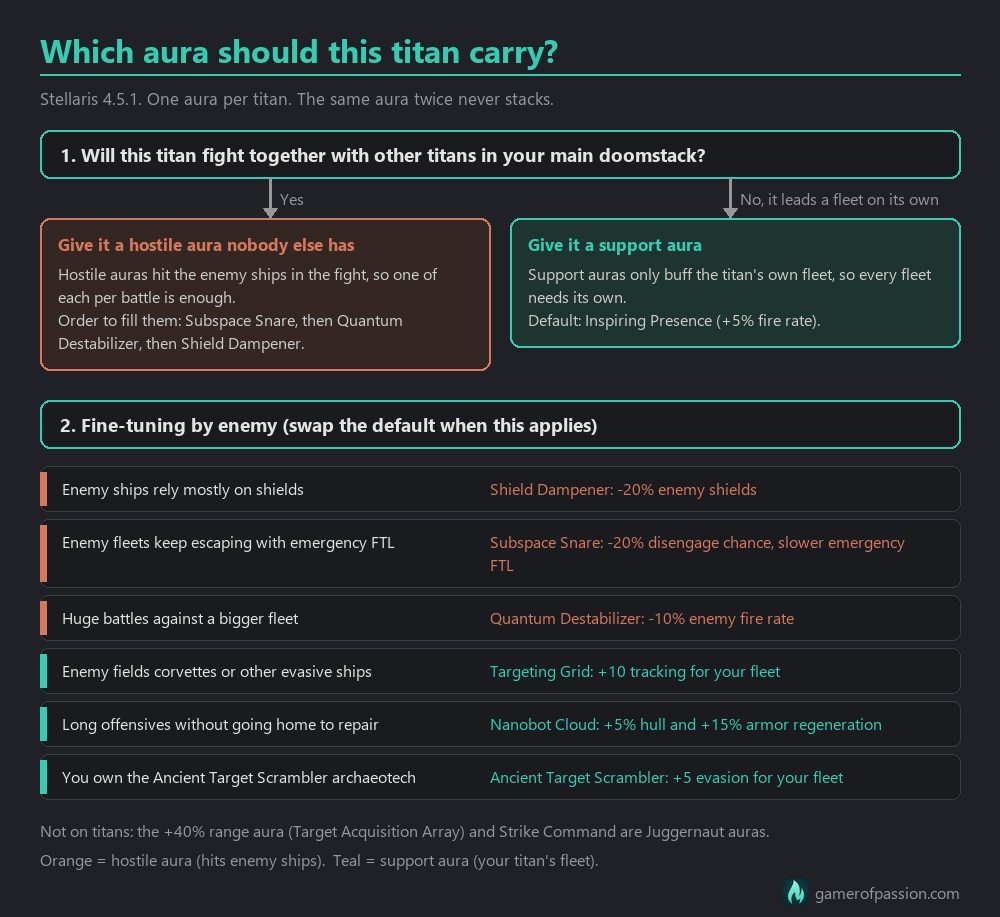
This leads to a simple default. The titans that fight together in your main doomstack should carry Subspace Snare, Quantum Destabilizer and Shield Dampener, with the Dampener mainly for enemies that rely on shields. Titans in your other fleets should carry Inspiring Presence, or Targeting Grid if those fleets are going to fight a lot of corvettes or other evasive ships. Nanobot Cloud is a decent pick for a fleet that will be on a long offensive without retreating, and the Ancient Target Scrambler is only an option if you happen to have the archaeotech for it.
For example, if you have 6 titans and three fleets, you could put Snare, Destabilizer, Dampener and Inspiring Presence into your main fleet and one Inspiring Presence or Targeting Grid titan into each of the other two. Your main fleet will then weaken the enemy in three ways and still get its own fire rate buff, and both other fleets will have a support aura of their own.
Don’t go looking for the +40% weapon range aura or Strike Command in the titan designer, because you will not find them there. The Target Acquisition Array (the range aura) and Strike Command are Juggernaut auras, along with ECM Emitters, the Subspace Amplifier and the Munitions Plant. If you want that range bonus for your titans, you will have to bring a juggernaut with the range aura into the same system. Its auras work for your ships in the whole system, so a juggernaut sitting next to a titan fleet will boost the titans as well.
Perdition Beam or Ancient Ruination Glare
The Ancient Ruination Glare is the archaeotech alternative to the Perdition Beam. Both weapons hit just as hard per shot and both have the same collateral damage, so the difference lies in fire rate, range and cost.
| Perdition Beam | Ancient Ruination Glare | |
|---|---|---|
| Damage | 5,000-10,000 | 5,000-10,000 |
| Cooldown (raw file value) | 180 | 90 |
| Range | 250 | 125 |
| Accuracy and tracking | 85%, 0 | 85%, 0 |
| Shields / armor / hull | 75% / 150% / 125% | 50% / 175% / 125% |
| Collateral | 500 to ships within 40 | 500 to ships within 40 |
| Cost | 2,083 alloys + 22 rare crystals | 2,083 alloys + 125 minor artifacts |
| Unlock | Titans tech | Rare archaeotech tech, needs Ancient Relics |
In other words, the Glare will land the same hit twice as often, but only from half the distance. It also does less damage to shields and more to armor. The upkeep is the same for both, at 12.15 energy and 1.823 alloys per month.
Getting the Glare is a little bit tricky. The tech needs the Ancient Relics DLC, and its research weight is cut to a tenth without the Archaeoengineers ascension perk and to a tenth again without an Archaeostudies Faculty building. Every Glare will also cost you 125 minor artifacts, which adds up fast once you have several titans.
I would say the Perdition Beam is the better choice for most empires. It opens the fight from 250 with a huge alpha strike, and your titan will not need to get anywhere near the enemy fleet to use it. The Glare is the damage pick, but your titan has to get within 125 of its target to fire, which is going to pull it forward into the fight next to your battleships. If your fleet already fights at around 120 range anyway, for example with Kinetic Artillery battleships, and you can afford the artifacts, the Glare is a strong upgrade.
How Many Titans Can You Have?
Your titan capacity is 80 plus 10% of your current naval capacity, and every titan will use 80 of it. In plain numbers, you will always get one titan, plus one more for every full 800 naval capacity. Naval capacity itself stops at 9,999, so 13 titans is the most you can ever have.
| Naval capacity | Titan capacity | Titans |
|---|---|---|
| 400 | 120 | 1 |
| 800 | 160 | 2 |
| 1,600 | 240 | 3 |
| 2,400 | 320 | 4 |
| 4,000 | 480 | 6 |
| 8,000 | 880 | 11 |
| 9,999 (game maximum) | 1,079 | 13 |
The old rule of one titan per 200 naval capacity is from before 4.3, and you will still find it on a lot of pages. Some pages also say you can have 20 titans. The titan limit in the game files does go up to 1,600 capacity, which would be 20 titans, but naval capacity is capped at 9,999, so titan capacity never gets past 1,079 and the real maximum is 13.
Bear in mind that titans share this capacity with a few other ships. The Paradox Titan from Cosmogenesis, the Cryptic Stinger and the bio-titans of BioGenesis empires all count against the same limit, so every one of them will leave less room for regular titans.
Researching the Titans tech also gives you +80 fleet command limit, which matches the size of one titan (Nomad empires get a different version of the tech without it).
How to Unlock and Build a Titan
Titans come with the Titans tech, a tier 5 Engineering tech in the Voidcraft category. You will need Battleships researched first, or the bio-ship equivalent if you play a BioGenesis empire, and you need the Apocalypse DLC. Without Apocalypse, the tech will never show up.
The tech is also weighted to appear late in the game:
- x0.1 before the 100th year of the game
- x2 after year 130, x6 after year 140 and x24 after year 150 (the multipliers stack)
- x1.25 if you have adopted Supremacy
- x10 if one of your neighbours already has Titans
Unless a neighbour gets there first, you are probably going to see Titans in your research options fairly late.
To build a titan, you will need either a starbase of Citadel size with the Capital Assembly Yards, or a completed Mega Shipyard (a restored one works as well). If you play as a Nomad, the capital shipyard module on your arkship does the same job. The Capital Assembly Yards replaced the separate Titan and Colossal Assembly Yards in 4.4, so one building now handles titans, colossi, juggernauts and the Star-Eater.
- It costs 1,250 alloys and 25 energy upkeep.
- It takes 720 days to build.
- It adds +2 shipyard capacity.
- It needs a Citadel and a Shipyard module, which can also be queued before the yards.
A titan will take 1,800 days to build before any shipyard or other modifiers, compared to 480 days for a battleship, so roughly 3.75 times as long. Each of the three hull sections costs 1,600 alloys, which means 4,800 alloys before you add a single component, and the Perdition Beam adds another 2,083 alloys and 22 rare crystals. The hull upkeep is 16 energy and 8 alloys per month, double that of a battleship, and every component will add a bit more. Make sure your alloy income can carry that before you start building several of them.
If you have Ancient Relics, the Grand Herald dig site can give you a damaged ancient titan early on, which you can then restore with the Grand Overhaul project. Once you have Titans, also keep an eye out for Improved Titan Hulls and Advanced Titan Hulls. Both are rare techs, and each one will add +10% hull to your titans.
How to Use Titans in Your Fleets
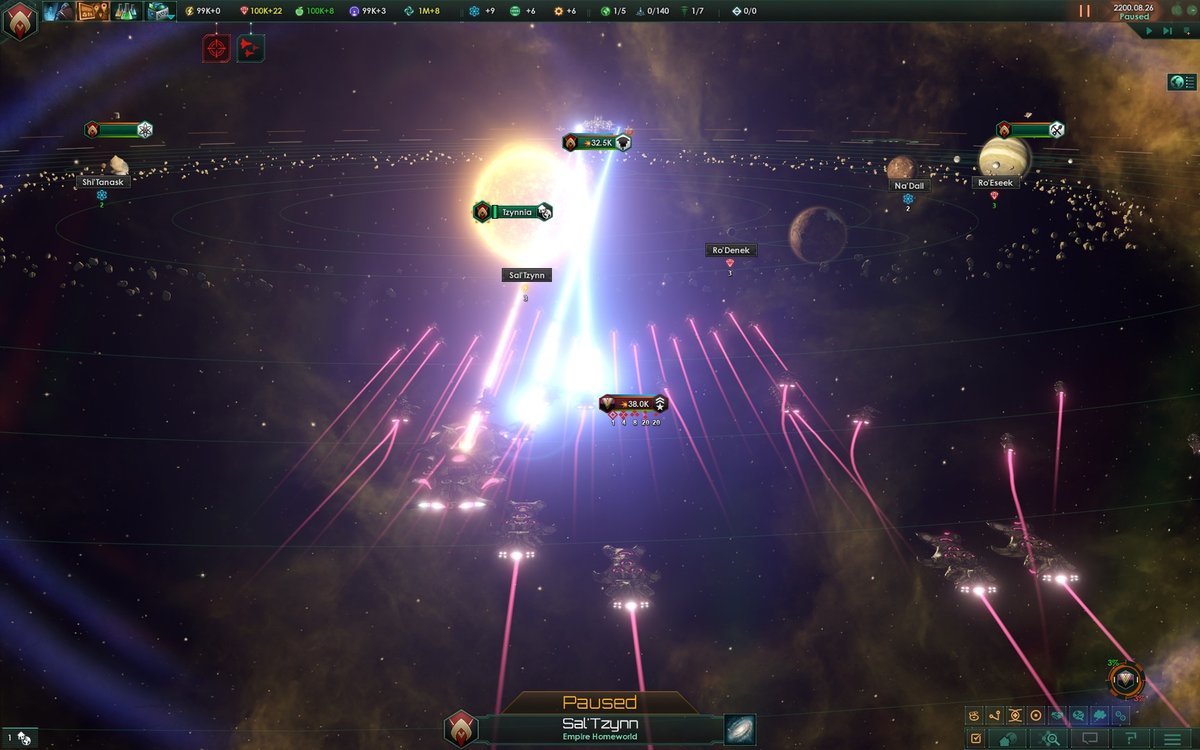
Titans belong with your battleships. They have the same base speed of 100, the same acceleration and the same rotation as a battleship, and artillery battleships use the same Artillery combat computers, so a titan is not going to slow down a battleship fleet at all.
Cruisers are a different story. They have a base speed of 120, so if you put a titan into a cruiser fleet, the whole fleet will move at titan speed on the galaxy map. Afterburners and thrusters work the same way on both hulls, so a cruiser with the same components will still be faster.
Spreading your titans out will give more fleets a support aura, while grouping them puts every hostile aura and every beam into the same battle. If you only have a few titans, I would put one into each of your main fleets. Once you have more titans than main fleets, add the extra hostile auras to the fleet that does the big fights, as described in the aura section above. For the ships around your titans, take a look at our guide to the best fleet composition in Stellaris.
Why titans die
There are a few reasons why you might lose a titan faster than its 20,000 hull suggests. Enemy titans are the biggest danger. Titanic weapons have a target weight of x3 against titans and x2 against battleships, so when you fight an empire with titans of its own, its beams will strongly prefer your titan as a target, and so will enemy Ion Cannons.
The Ancient Ruination Glare can also get your titan killed, because it has to get within 125 of its target to fire and will end up much closer to the enemy than a Perdition titan. Older guides sometimes suggest a carrier computer so the titan stays back with your carriers, but that is not possible any more, because titans can only use Artillery computers in 4.5.
Patch 4.5 also fixed a bug where the aura of a destroyed titan kept applying after you replaced it. Aura effects are now recalculated in that case, so a dead titan’s aura no longer lingers.
Titans against corvette swarms
The collateral damage is what makes titans such a good answer to corvette swarms since 4.3. Every hit will deal 500 damage to each enemy ship within 40 of the target, plus your energy weapon damage modifiers, so the more tightly a swarm is packed around the target, the more ships every single shot is going to catch.
Titan, Juggernaut or Colossus?
The three big ships get mixed up a lot, partly because all three come out of the same Capital Assembly Yards, but they do very different jobs.
| Ship | Hull | Role |
|---|---|---|
| Titan | 20,000 | Fleet flagship with an aura and an area-damage beam |
| Juggernaut | 100,000 | Mobile shipyard with system-wide auras, including the +40% range aura |
| Colossus | 30,000 | Planet killer |
The titan is the one you spread across your fleets for its aura and its beam. The juggernaut supports your ships in the whole system with its own auras, so it works well next to a titan fleet. The colossus needs the Colossus Project ascension perk, which in turn needs the Titans tech and three ascension perks already taken. If you are planning for it, have a look at our best ascension perks in Stellaris.
Conclusion
A Perdition Beam, six Kinetic Artillery, an Artillery computer and three Auxiliary Fire-Control are going to work in almost every game, and the only part of the build you really need to adjust is the split between armor and shields. The auras take a little more planning. If you just want a simple rule, put the hostile auras on the titans that fight together in your main fleet, give every other fleet a titan with a support aura, and keep building titans up to your cap as your naval capacity grows.