
Stellaris has had two kinds of navy since BioGenesis came out, and the biological one works quite differently from the other. To get bioships, you need the BioGenesis DLC and have to pick one of its two Biological shipsets when you create your empire. You cannot switch to them later or mix them with mechanical warships.
They are a good fleet for most of the game. Maulers are strong early on, Elder Harbingers carry the middle game, and the fleet mainly falls behind on long-range firepower, where bio X-slot and large weapons deal about half the damage of their mechanical versions.
Bioships also do not grow by themselves. A bioship starts as a Juvenile, the smallest of its three stages, and only grows into a Mature and then an Elder ship while a growth gland, a Weaver with Developmental Pheromones or a starbase with a Growth Chamber feeds it growth. Without one of them, its growth stays at zero.
Everything below is for Stellaris 4.5.3 ‘Cygnus’ on PC, out since 4 November 2026, and needs BioGenesis. The hull, weapon, cost and growth numbers are base values from the 4.5.3 game files, before techs and other bonuses, and damage per day is a weapon’s average by its file stats, before accuracy, tracking and evasion come into play.
Bioships arrived with BioGenesis and the free 4.0 ‘Phoenix’ update on 5 May 2025. If you come back to them with an older guide in mind, these later changes matter most:
- 4.0.3 removed the upkeep penalty of the Weaver’s growth aura.
- 4.3 (March 2026) moved bioships onto their own naval capacity scale and raised ship costs and upkeep.
- 4.5 (September 2026) made bioships immune to energy deficits, while a food deficit now cuts their weapon damage and speed.
- 4.5.2 slowed Maulers from 160 to 140 speed and made the living-metal carapace of Galvanic Synthesis bioships work like the mechanical version.
- 4.5.3 lets Behemoths gain Growth when their armies take over a planet.
Contents
- Bioship tier list
- How to get bioships
- How bioships grow
- Bioships vs mechanical ships
- Best bioship designs
- Paying for bioships with food
- Behemoths and space fauna
- Biomorphosis
- Stellaris bioship questions
- Conclusion
Bioship tier list
Bioships come in four families that roughly take the places of the mechanical hulls: Maulers for corvettes, Weavers for destroyers, Harbingers for cruisers and Stingers for battleships, plus a biological Titan. Every bioship except the Titan also has one organ slot, a special slot that holds a growth gland, a Weaver’s growth aura or a combat organ such as the Rangefinder Cluster.
The tiers rate each design (a hull with a set loadout) for 4.5.3. S is what I would build first, A is strong or strong in its niche, B works in one situation and C is best skipped.
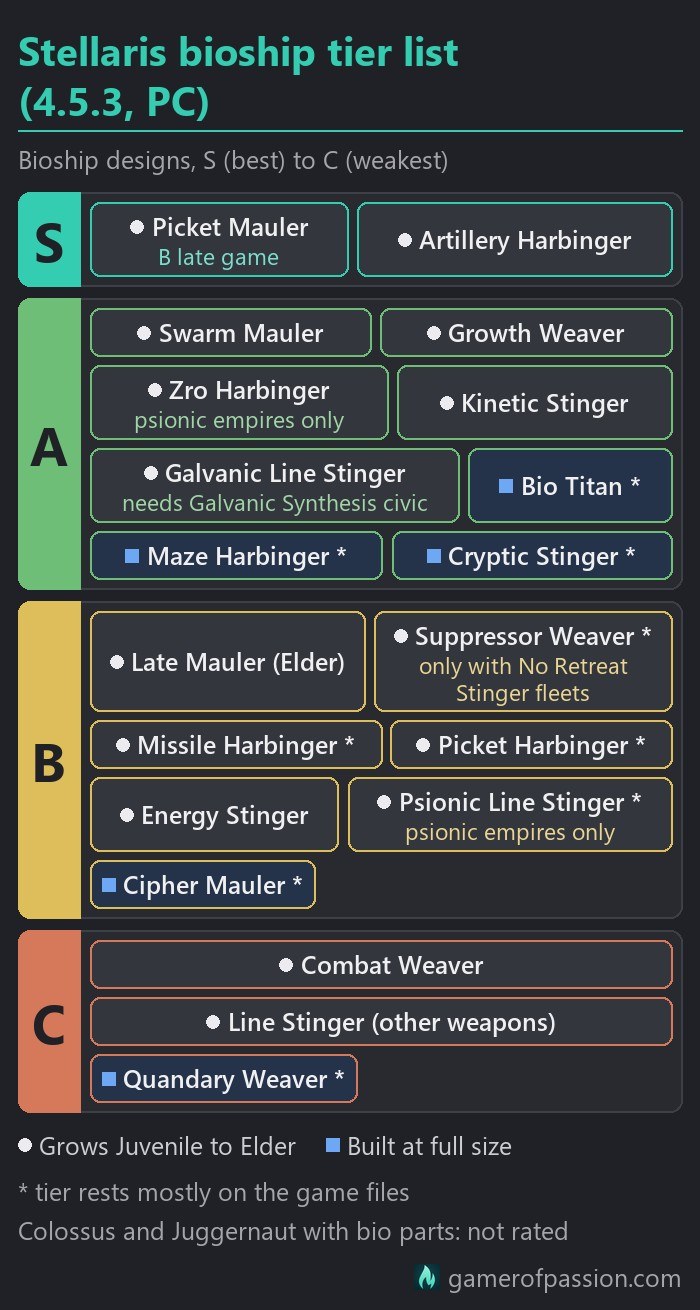
| Design | Tier | Key loadout | Best for |
|---|---|---|---|
| Picket Mauler | S (early game) | Combat Mandibles, Barb Batteries, Carapace, Afterburners | Early game brawler and screen |
| Swarm Mauler | A | Combat Mandibles, Small Quill Battery | Early brawler vs shields and hull |
| Late Mauler (Elder) | B | As Picket Mauler (Elder) | Screen ahead of Harbingers and Stingers |
| Growth Weaver | A (utility) | Exotic Developmental Pheromones, empty gun slots | Growth aura, one per fleet |
| Combat Weaver | C | Weaver Biofield Generators, Spore Launcher, Energy Burster | Buff Stingers and Harbingers |
| Suppressor Weaver* | B | Gloom Spores, Vector Lock Cannon, Reload Jammer | Debuff escort for Stingers under No Retreat |
| Artillery Harbinger | S | 4 Neutron Throwers, 4 Fighter Wings, Afterburners | Mid and late main battle line |
| Zro Harbinger | A | 4 Zro Pods, Fighter Wings | Psionic empires only |
| Missile Harbinger* | B | Bio-Whirlwind Missiles, Fighter Wings | Counter to corvette swarms |
| Picket Harbinger* | B | 8 Guardian Snapper Guns or Barb Artillery, 4 Fighter Wings | Point-defense escort vs missiles and strike craft |
| Kinetic Stinger | A | 4 Giga Cannons, 4 Chitin Artillery, Rangefinder Cluster | Long-range partner for Harbingers |
| Energy Stinger | B | 4 Focused Lightning Emitters, Chitin Artillery | Heavy armor and shields |
| Galvanic Line Stinger | A | 12 Reshaping Projectile Accelerators, Rangefinder Cluster | Galvanic Synthesis empires only |
| Psionic Line Stinger* | B | 12 Psionic Bio-Lightning | Psionic empires only |
| Line Stinger (other weapons) | C | Other large weapons (avoid) | None (avoid) |
| Bio Titan* | A | Perdition Beam, Chitin Artillery, Titan aura | Fleet anchor and aura |
| Cipher Mauler* | B | As an Elder Mauler | Elder-class brawler at full size |
| Quandary Weaver* | C | As the Weaver rows (Support / Suppressor) | Weaver role at full size |
| Maze Harbinger* | A | As the Artillery Harbinger | Harbinger role at full size |
| Cryptic Stinger* | A | As Artillery Stinger, titan-class components and reactors | Budget Titan inside the Titan limit |
For roughly the first thirty years, the Picket Mauler is the strongest bioship you can build, which puts it in S tier for the early game. Its Combat Mandibles deal about 17.3 damage per day and go fully through shields, and a Juvenile Mauler has 300 hull for 4 naval capacity against a corvette’s 200 hull for 5. The Elder Mauler will carry two Mandibles instead of one.
The Swarm Mauler (A) swaps the point defense for a Small Quill Battery, the bio autocannon, which deals about five times the damage per day of the Molecular Disruptor at the same range. A Juvenile Swarm Mauler will reach 8.7 damage per day for each point of naval capacity, against 8.5 for a corvette with three autocannons. I would take it when your enemies bring few missiles or strike craft.
The growth Weaver is A tier as a utility ship. With Exotic Developmental Pheromones in its organ slot, it will add +2 Monthly Growth Progress (the growth points a ship collects each month) to every bioship near it that can still grow. Only the strongest Pheromones aura counts, which means one per fleet is enough.
The Artillery Harbinger is the second S, and it is going to carry your fleet from the middle game on. An Elder Harbinger has four G slots where a cruiser gets three at most, 3,600 hull against 2,400, Neutron Throwers that match the mechanical launchers at half the reactor power and Fighter Wings that hit as hard as a mechanical hangar. It was the strongest bioship core in 4.3 and 4.4 testing.
Psionic empires get an A-tier version, the Zro Harbinger, with Zro Pods in the four G slots. They are the same weapon as the mechanical Zro Launchers, with a range of 120 and 50% shield and armor penetration.
The kinetic Artillery Stinger (A) is your long-range partner, at about one for every five Harbingers. An Elder with four Giga Cannons and four Chitin Artillery will deal 447.6 damage per day against 372.2 for a mechanical artillery battleship, with 6,000 hull against 4,800. However, it uses 64 naval capacity to the battleship’s 40, which works out to 7.0 damage per point against 9.3, and its guns reach 120 and 96 instead of 150 and 120.
Empires with the Galvanic Synthesis civic can do better with the Galvanic Line Stinger (A). Twelve Reshaping Projectile Accelerators are the same weapon as on mechanical ships and add up to 558 damage per day at range 120. That is 8.7 per naval capacity point, against 7.0 for a mechanical battleship with six of them.
The biological Titan (A) has the same 20,000 hull, 80 naval capacity and Perdition Beam as the mechanical one, but its large slots fire at half rate.
The B and C designs are quicker to sum up:
- The Elder Mauler drops to B late in the game. With 600 hull and 20 evasion, it will take heavy losses against strong late fleets and works best as a screen in its own fleet.
- A combat Support Weaver is C, because buffs of the same kind do not stack and its swarm behaviour puts it at the front, where it tends to die.
- The Suppressor Weaver with Gloom Spores is B, and only next to Stingers under the No Retreat doctrine.
- The missile Harbinger with Bio-Whirlwind Missiles is B, as a counter for corvette swarms.
- The Picket Harbinger is B, a point-defense escort with eight point-defense slots at Elder.
- The energy Artillery Stinger is B. Its Focused Lightning Emitters go through shields and armor, but deal 44.8 damage per day against 82.6 for a Giga Cannon, and shield hardening cuts into them.
- The psionic Line Stinger with twelve Psionic Bio-Lightning is B, at 187 damage per day with full penetration but a range of only 70.
- A Line Stinger with any other large weapon is C. Twelve Large Shard Gauss Accelerators only reach 263 damage per day, because large bio weapons fire at half rate.
The Colossus and the Juggernaut are not rated, since there is nothing bioship-specific to rate them on.
The Cosmogenesis path adds four bioships of its own: the Cipher Mauler (B), the Quandary Weaver (C), the Maze Harbinger (A) and the Cryptic Stinger (A). You build them at full size with an Elder’s hull and naval capacity, they cost alloys as well as food, and they never grow. The Cryptic Stinger uses Titan components and shares the Titan limit, which makes it a budget Titan.
The Titan, the Suppressor Weaver, the missile and Picket Harbingers, the psionic Line Stinger and the Cosmogenesis ships have little recent testing behind them, and their ratings rest mostly on the game files.
How to get bioships
Bioships need the BioGenesis expansion, which adds two Biological shipsets, Spinovore and Shellcraft. Both follow the same rules and only look different, and in multiplayer the game checks the host’s DLC for them. Our DLC tier list rates BioGenesis A.
You make the choice in the empire creator, when you pick your shipset, and no tech, civic or ascension perk will unlock bioships later. There is no in-game way to switch an existing empire over, and you cannot mix the two kinds either. A bioship empire will never build mechanical corvettes, destroyers, cruisers, battleships or the mechanical Titan, and gets Maulers, Weavers, Harbingers, Stingers and its own Titan instead. It should keep the Colossus and the Juggernaut, built with biological parts.
A few origins and civics decide the matter for you. Wilderness and the hive civics Shared Genetics and Aerospace Adaptation need a Biological shipset. Six origins cannot use one (Red Giant, Cosmic Dawn, Starlit Citadel, Fear of the Dark, Calamitous Birth and Hard Reset), and neither can eight explorer and world-forger civics: Eager Explorers, Stargazers, Exploration Protocols, Privatized Exploration, Planet Forgers, Planetary Architects, Volcanic Nesting and Thermal Optimizers. Machine Intelligences and nomads should be able to pick a Biological shipset as well.
Picking bioships also costs you a few weapons. A bioship empire cannot research the regular missile and torpedo techs (only the Nanotech tradition, the crisis path and Cosmogenesis open the first tier), and no bioship can use a Siege combat computer. Your G-slot weapons will be Bio-Swarmer and Bio-Whirlwind Missiles, Proton and Neutron Throwers, Zro Pods and, on Maulers, Combat Mandibles.
Bioship hulls, growth stages and Weaver guns are Society research, while weapons, armor, shields and reactors use the same Physics and Engineering techs as on mechanical ships. Weavers alone add 36 support-gun techs to that Society tree. You will start with Maulers and Weavers researched, and Harbingers (4,000 research) and Stingers (8,000) come later.
If you are still learning the game, I would keep your first empire mechanical and try bioships in the second, once you have the basics from our beginner guide down.
How bioships grow
Every bioship starts as a Juvenile unless you pay for a bigger stage. It will become Mature after 60 Monthly Growth Progress and Elder after another 120, and Elder is the last stage. A bioship gains no growth on its own, as every point has to come from a gland, a Weaver, a Growth Chamber or one of the rarer sources below.
Growing pays off. From Juvenile to Elder, a ship will double its hull and weapon slots and get 50% more reactor power, but it also loses evasion, triples the food upkeep of its hull and takes twice the naval capacity.
These are all the sources of growth in 4.5.3:
- A Juvenile Growth Gland in the organ slot adds +1 a month, and the Accelerated Juvenile Growth Gland +2 for 0.5 Exotic Gases. Both only fit Juveniles.
- A Mature Growth Gland adds +1 to a Mature ship. There is no gland for Elders.
- A Weaver with Developmental Pheromones in its organ slot adds +1 to every growable bioship near it, and Exotic Developmental Pheromones add +2. Only the strongest aura counts, and a second Weaver will add nothing.
- A Growth Chamber on a starbase adds +2 to every bioship parked there but doubles their upkeep while they stay, and so do the orbital ring and waystation versions.
- A nomad Arkship’s Growth Chamber gives a +3 aura to its whole system, which does not stack with the Pheromones, and Progenitor Hive Offspring ships carry +2 of their own.
- Behemoth Fury empires can take the menace perk Better Glandular Stimulation for +30% Monthly Growth Progress.
Gland, Weaver and Growth Chamber add up, which gives a Juvenile up to +6 a month and a Mature +5. No tradition, civic or edict speeds growth up.
Your first bioships cannot grow at all until you research Improved Mauler Development, or the matching Improved Development tech of the other families, which unlocks the Mature stage and the Juvenile Growth Gland. Advanced Development then unlocks the Elder stage, the Accelerated Juvenile Growth Gland and the Mature Growth Gland. The two techs cost 1,250 and 1,500 research for Maulers, 2,500 and 3,000 for Weavers, 5,000 and 6,000 for Harbingers and 10,000 and 12,000 for Stingers.
A ship without a gland will still grow when a Weaver or a Growth Chamber reaches it. Mind that the auto-generated designs often leave the gland out, and a fleet built from them will simply never grow without a Weaver or a Growth Chamber.
Growing your fleet works best in this order:
- Research Improved Mauler Development early.
- Put a Juvenile Growth Gland in the organ slot of the Juvenile column (22.5 food on a Mauler, 180 on a Stinger).
- Keep the Juvenile column bare, with only the gland and the core parts, and put weapons and armor on the Mature and Elder columns.
- Add one Weaver with Developmental Pheromones (Improved Weaver Development) to each growing fleet. Any Weaver stage works, Elder included.
- After Advanced Development, switch to the Accelerated Juvenile Growth Gland, add a Mature Growth Gland to the Mature column and give the Weaver Exotic Developmental Pheromones (Advanced Weaver Development).
- Once you have Stingers, research the Growth Chamber, build it on a starbase with a Shipyard and park growing fleets there until they reach Elder.
- On the Elder column, use the organ slot for a combat organ.
| Growth setup | Per month (Juvenile / Mature) | Juvenile to Mature | Juvenile to Elder |
|---|---|---|---|
| Growth Glands only (Juvenile, then Mature) | +1 / +1 | 60 months | 180 months (15 years) |
| Growth Chamber only, no gland | +2 / +2 | 30 months | 90 months |
| Gland + Developmental Pheromones | +2 / +2 | 30 months | 90 months |
| Accelerated gland + Exotic Pheromones | +4 / +3 | 15 months | 55 months |
| Accelerated gland + Exotic Pheromones + Growth Chamber | +6 / +5 | 10 months | 34 months (just under 3 years) |
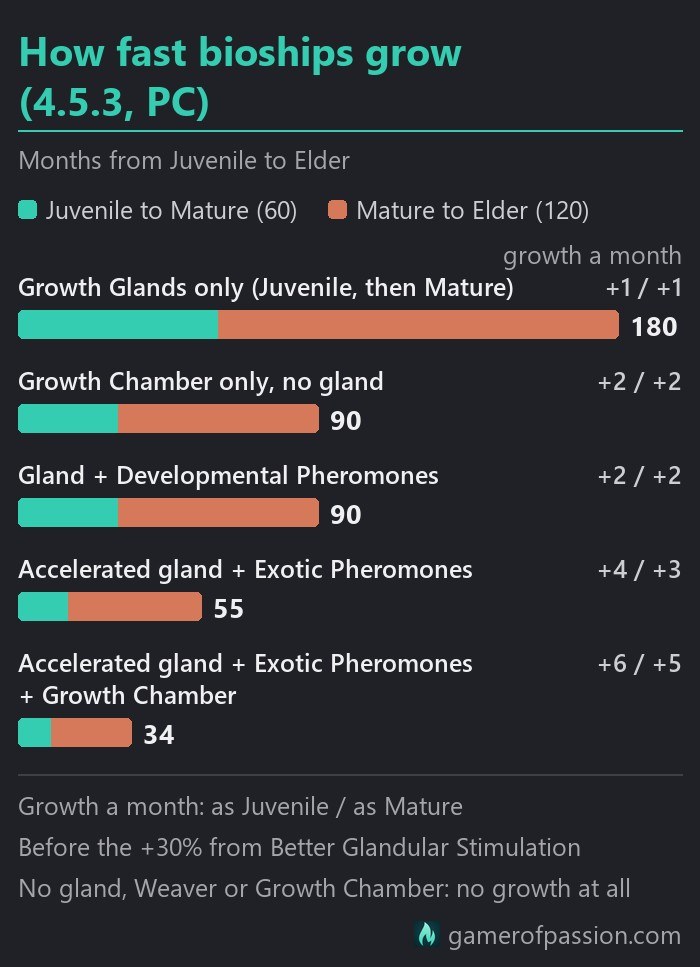
With only a Juvenile and then a Mature Growth Gland, a ship needs 15 years to become an Elder. A gland and a Weaver will halve that, and the full stack with a Growth Chamber gets it done in 34 months, just under three years.
When a bioship reaches the next stage, it switches to that stage’s column of its design, weapons and armor included, and you do not pay for those parts again. That is why it pays to design the Elder column first and build cheap Juveniles with little more than a gland, even though the grown ship will cost the bigger upkeep from then on.
Since each stage is its own column, a cloaked fleet needs a cloaking device on every stage you want cloaked. A Mauler takes the corvette-class cloak at every stage, a Stinger the battleship-class one.
Growth stops while a ship waits for an upgrade, and you should not leave growing ships with a pending upgrade. Merging fleets will not move growth between ships, because each ship tracks its own progress.
Growing ships take up more naval capacity as well. A Mauler uses 4, 6 and 8 as a Juvenile, Mature and Elder, and the other families follow the same steps from 8 (Weaver), 16 (Harbinger) and 32 (Stinger), while the command limit never changes. A fleet that fits today can push you over the cap as it grows, and it is a good idea to leave some room before you park Juveniles to grow.
You can also simply skip the wait. After Improved and Advanced Development, Mature and Elder ships can be built straight from the shipyard, at two and four times the hull food and build time and with every part of that stage paid in full. Juveniles are the cheap way to build in peacetime, and Elders will get you finished warships when a war is close. Check what the Reinforce button queues, because it can pick the Elder design.
Bioships vs mechanical ships
Bioships win early, where Maulers with Combat Mandibles go straight through shields and a Juvenile uses 20% less naval capacity than its mechanical counterpart. They win in the middle game, where Elder Harbingers carry four Neutron Throwers at half the power plus Fighter Wings with twice the craft. Elders also match or beat their mechanical counterparts on hull, and you will lose nothing on weapons that are identical on both sides, such as Reshaping Projectile Accelerators, Zro Pods or Neutron Throwers.
Where bioships fall behind is long-range firepower. X-slot and large weapons deal about half the damage per slot, X range drops from 150 to 120, Elders use 60% more naval capacity than their mechanical counterparts, an Elder Stinger takes four times as long to build as a battleship, combat Weavers add little, and regular missiles, torpedoes and Siege computers are off the table.
| Size class | Bio (Juvenile / Elder) | Mechanical | Verdict |
|---|---|---|---|
| Small: Mauler vs corvette | 300 / 600 hull; 4 / 8 naval capacity | 200 hull; 5 naval capacity | Bio: 8.7 vs 8.5 per naval point, Mandibles ignore shields |
| Destroyer: Weaver | 600 / 1,200 hull; 8 / 16 naval capacity | 1,200 hull; 10 naval capacity | Support role; combat Weavers add little |
| Cruiser: Harbinger | 1,800 / 3,600 hull; 16 / 32 naval capacity | 2,400 hull; 20 naval capacity | Bio: Elder has 4 G + 4 L vs 3 G or 1 hangar |
| Battleship: Stinger | 3,000 / 6,000 hull; 32 / 64 naval capacity | 4,800 hull; 40 naval capacity | Mechanical: 9.3 vs bio 7.0 per naval point (kinetic) |
| Titan: bio Titan | 20,000 hull; 80 naval capacity | 20,000 hull; 80 naval capacity | Same Perdition Beam; bio L slots fire at half rate |
Most bio weapons share their tech and alloy cost with a mechanical twin, but the slot size changes their stats. Small bio weapons hit 25% harder and reach only half as far. Medium weapons are identical. Large weapons keep their damage and range but fire half as often. The X-slot weapons (Giga Cannon, Focused Lightning Emitter and Tachyon Beam) lose 20% damage and 20% range and take 50% longer to reload, which leaves each of them at about 54% of the mechanical damage per day. A bio Giga Cannon deals 82.6 a day at range 120, where the mechanical one deals 154 at 150.
A few weapons are the same on both sides: Neutron and Proton Throwers, Zro Pods, Psionic Bio-Lightning, the Reshaping Projectile Accelerator, the Snapper point-defense guns, the Perdition Beam and every medium weapon. Neutron and Proton Throwers even need only half the reactor power of the mechanical launchers. Biological flak (the Barb Batteries and their upgrades) has the same damage and range as mechanical flak but fires slower.
A biological Fighter Wing launches 16 craft instead of 8 and replaces them twice as fast, while each craft does half the damage, which makes a full wing hit as hard as a mechanical hangar. The craft carry armor instead of shields, and the wing costs food (507.5 for the basic one). Bio-Swarmer Missiles keep the damage and 120 range of Swarmer Missiles, but only half of their damage goes through shields, in exchange for 50% more damage to armor and 25% more to hull.
On defense, Carapace armor gives 80% of a mechanical plate’s armor, adds hull worth 10% of that armor and regenerates armor while the ship is below half armor. Musculature shields give 80% of the shield points but regenerate twice as fast, and both cost the same alloys as mechanical parts. Galvanic Synthesis empires also get Ferrodermis, a living-metal Carapace that works like mechanical living-metal armor at the usual 80% armor value.
Harbingers and Stingers move at 120 and Maulers and Weavers at 140, which makes a Stinger faster than a mechanical battleship (100). Bio reactors give the same power as mechanical ones, plus 25% on Mature and 50% on Elder ships.
Damage per naval capacity point does not change as a ship grows. A Juvenile, Mature and Elder kinetic Artillery Stinger will all deal 7.0 per point, and Elders pay off through hull, command limit and the parts they gain as they grow. The rules for weapons against shields, armor and hull are the same as for mechanical fleets, and our ship design guide goes through them.
Best bioship designs
Set the computer by hand on every design below, because the auto-designer will not always pick the one you want.
Early game Maulers
Maulers are where a bioship empire starts, and for about the first thirty years they are going to do most of your fighting. Give the Picket Mauler Combat Mandibles in its G slot and Barb Batteries or a Sentinel Snapper Gun in its point-defense slot. Fill the utility slots with Carapace only, starting with the Small Nanocomposite Carapace, and add Afterburners, which make up a little bit for the 4.5.2 speed cut.
The organ slot gets the Accelerated Juvenile Growth Gland on the Juvenile, the Mature Growth Gland on the Mature and Metabolic Recycler or Corrosive Fluids on the Elder, and the computer is Neural Implants (Swarm). The Swarm Mauler is the same ship with a Small Quill Battery in place of the point defense.
Combat Mandibles are one of the main reasons Maulers work so well early. They have a range of 10, count as kinetic weapons, deal 50% more damage to armor and 25% more to hull and get a bonus against bigger targets. Composite and Crystalline Mandibles raise their 17.3 damage per day to 22.7 and 29.6.
Make sure to research Advanced Mauler Development (1,500 research, after Improved Mauler Development at 1,250) early, because the Elder Mauler it unlocks carries two Combat Mandibles. Keep your Maulers in a fleet of their own, which will later serve as the screen ahead of your Harbingers and Stingers.
Mid game Harbingers
Once Harbingers are in, the Artillery section will become the core of your fleet. Put Neutron Throwers in all four G slots (Proton Throwers until you have them) and Basic or Improved Fighter Wings in the four large slots. Use Carapace with some Musculature in the utility slots, Afterburners in the auxiliary slot and Chitin Growth Regulators or Incubation Matrix in the organ slot, with Neural Implants (Artillery) as the computer. Neural Implants (Carrier) fit as well.
Chitin Growth Regulators add +5 strike craft armor. Since 4.5.0, armor and shield bonuses no longer make strike craft close to immune, which takes a little off that organ, and Incubation Matrix (+5% engagement range, -5% strike craft cooldown) is a fair alternative.
Each growing fleet also gets one growth Weaver. Use the Support section with Exotic Developmental Pheromones in the organ slot (Developmental Pheromones before Advanced Weaver Development), empty medium slots, Energy Burster or nothing in the gun slots, Carapace in the utility slots and Neural Implants (Support). A Juvenile or Mature Weaver will do the job.
Combat Weavers carry buffs and debuffs with a range of 40, such as the healing Spore Launcher or the confusion of Gloom Spores (range 100). A ship only feels the strongest effect of each kind, and if you run several Weavers anyway, give each of them different guns.
Late game Stingers
For the kinetic Artillery Stinger, put Giga Cannons in the four X slots (Mega Cannons before) and Chitin Artillery in the four large slots, with Carapace plus some Musculature in the utility slots, a Rangefinder Cluster in the organ slot and Neural Implants (Artillery). An Elder with a Zero Point Metabolism has 2,325 power, and the eight guns draw 1,404 of it, which leaves room for some shields.
Range is the Stinger’s weak spot. A tier-2 Rangefinder Cluster, Artillery Neural Implants and a Weaver with Weaver Biofield Generators can together push its X weapons past a mechanical battleship’s unmodified 150, while without that support mechanical artillery will outrange it. Rapid Deployment, the war doctrine you get after finishing Supremacy, adds another 10% weapon range.
In a Galvanic Synthesis empire, build the Line section instead, with twelve Reshaping Projectile Accelerators and a Rangefinder Cluster (a Mature Line Stinger has nine large slots).
Your Titan will need the Apocalypse DLC, the Titans tech (which a bioship empire unlocks with Advanced Stinger Development, the tech for Elder Stingers) and a Citadel with Capital Assembly Yards. Give it the Perdition Beam, Chitin Artillery in the large slots (Reshaping Projectile Accelerators in a Galvanic empire), a Titan aura and Neural Implants (Artillery), and expect its hull alone to cost 16,800 food and take 1,800 days. Our Titan build guide explains how many Titans you can have and where the Cryptic Stinger fits into that limit.
Fleet setup
For the late game, I would split a bioship navy into a Mauler fleet that goes in first and a main fleet of Harbingers and Stingers behind it. In the main fleet, about one kinetic Artillery Stinger for every five Artillery Harbingers came out on top in 4.3 testing, and it is the same split our fleet composition guide uses.
Add one growth Weaver to every fleet that still has growing ships. Leave combat Weavers out, unless you want to try Suppressor Weavers with Gloom Spores next to Stingers under No Retreat, the doctrine that stops retreats and adds 33% fire rate for Militarist, Gestalt and Fanatic Purifier empires.
Paying for bioships with food
A bioship empire pays for its fleet mostly in food. Hull sections and core parts (reactors, thrusters, FTL, sensors and computers) cost 3.5 food for every alloy a mechanical empire would pay, while weapons, armor and shields cost the same alloys as on mechanical ships, apart from Fighter Wings, which cost food. A Juvenile Mauler hull will cost you 140 food and take 75 days, a Mature hull costs and takes twice that, and an Elder four times as much (560 food and 300 days).
| Hull | Juvenile: cost / upkeep | Elder: cost / upkeep | Build days (Juvenile / Elder) |
|---|---|---|---|
| Mauler | 140 Food / 1 Food + 0.25 alloys | 560 Food / 3 Food + 0.5 alloys | 75 / 300 |
| Weaver | 280 Food / 2 Food + 0.5 alloys | 1,120 Food / 6 Food + 1.0 alloys | 120 / 480 |
| Harbinger | 700 Food / 4 Food + 1.0 alloys | 2,800 Food / 12 Food + 2.0 alloys | 240 / 960 |
| Stinger | 1,260 Food / 8 Food + 2.0 alloys | 5,040 Food / 24 Food + 4.0 alloys | 480 / 1,920 |
| Titan (bio) | Does not grow | 16,800 Food / 32 Food + 4 alloys | 1,800 |
Upkeep follows the same idea. A Juvenile Mauler’s hull costs 1 food and 0.25 alloys a month, where a corvette costs 1 energy and 0.5 alloys, and weapons, armor and shields pay food where a mechanical part pays energy. A grown Elder pays three times the Juvenile’s hull food upkeep and twice its alloys.
Since 4.5, energy deficits no longer touch your bioships, but food deficits do. Depending on how deep the deficit goes, it will cut their weapon damage and speed by 20%, 40%, 60% or 80%. Keep a food surplus the way a mechanical empire keeps its alloys up, and plan for more farmers than a mechanical empire would need.
The Growth Chamber is one of the biggest food drains in a bioship empire. It will double the upkeep of every ship parked at it, and the building itself costs 100 alloys and 50 Exotic Gases, takes 360 days and needs 10 food and 2 Exotic Gases a month. Move fleets away once they are Elder, because the extra upkeep keeps running. Additionally, the Accelerated Juvenile Growth Gland and Exotic Developmental Pheromones need 0.5 Exotic Gases each.
The food bill does not stop at warships. Starbases, megastructures and civilian ships cost a bioship empire half the alloys, and the other half is paid in food at 3.5 food per alloy. That turns a 1,500-alloy habitat into 750 alloys and 2,625 food and a construction ship into 50 alloys and 175 food. Armies cost food instead of minerals, at 1.25 food per mineral.
Behemoths and space fauna
Behemoth Fury is the BioGenesis crisis ascension perk, and only bioship empires can take it. You will need three ascension perks before it, an independent empire that is not the Galactic Custodian or Emperor, and neither Xenophile nor Pacifist ethics. Wilderness empires can take it too. Our origins tier list rates Wilderness A, and S with Behemoth Fury, and the Wilderness Behemoth build shows the whole route.
Behemoths are crisis ships with their own Growth bar, separate from your bioships. They will grow by destroying ships (bigger targets give more), by bombarding planets and, since 4.5.3, when their armies take over a planet. On the way, the menace perk Better Glandular Stimulation gives your bioships +30% Monthly Growth Progress and +50% command limit. Since 4.5, the crisis itself progresses much more slowly from killing, breeding or capturing bioships and fauna, which makes the old trick of feeding it your own empty Juveniles much weaker.
Space fauna is a separate system. A bioship empire can still capture, clone and field space fauna with the Grand Archive DLC, and Primal Calling and Beastmasters are open to it. Fauna are fitted with mutations, such as the Epidermis and Mega Bombard ones, while bioships use organs, and fauna never go through the Juvenile, Mature and Elder stages.
Biomorphosis
Biomorphosis sounds like a bioship feature, but it has nothing to do with your fleet. It is the genetic ascension perk, and with BioGenesis it starts the Biomorphosis situation that ends in the Purity, Cloning or Mutation tradition tree, whether your ships are biological or mechanical. Since 4.5 it takes about half as long to complete, and our ascension perks guide explains when to take it.
Biomass is just as unrelated. It is the Wilderness origin’s own resource for districts, buildings and terraforming, and bioships never cost any of it.
Stellaris bioship questions
Are bioships good in Stellaris?
Yes, as long as you lean on what they do well. Mauler swarms are hard to beat in the early game and Elder Artillery Harbingers make a very strong core later, but bio X-slot and large weapons deal only about half the damage per slot of their mechanical versions.
Can you grow bioships faster?
Yes, by stacking growth sources. An Accelerated Juvenile Growth Gland followed by a Mature Growth Gland, a Weaver with Exotic Developmental Pheromones and a Growth Chamber will get a ship to Elder in 34 months instead of 15 years with the basic glands alone, and Behemoth Fury’s Better Glandular Stimulation adds another 30%.
How do you get bioships?
Buy BioGenesis and pick one of the two Biological shipsets, Spinovore or Shellcraft, in the empire creator. Some origins and civics, such as Red Giant or Planet Forgers, rule them out.
Can you switch to bioships mid-game?
No. The shipset is fixed when you create your empire, and the game offers no way to change it later.
Do bioships cost biomass?
No. Bioships are built with food and alloys. Biomass only exists for Wilderness empires, which use it for districts, buildings and terraforming.
Do bioships need energy?
Very little. Only their reactors keep the same small energy upkeep as mechanical reactors. Hull upkeep is food plus some alloys, and weapons, armor and shields pay food where mechanical parts pay energy. Since 4.5, an energy deficit no longer weakens them, while a food deficit will cut up to 80% of their weapon damage and speed.
Can bioships use missiles?
Only their own. The regular missile and torpedo techs are closed to bioship empires, but you still get Bio-Swarmer and Bio-Whirlwind Missiles, and Proton and Neutron Throwers are the same as the mechanical launchers.
Conclusion
Bioships ask for a little bit more planning than a mechanical fleet, mostly around food and growth. If you just want a bioship navy that wins its wars without much fuss, then Maulers early, Elder Artillery Harbingers with a kinetic Stinger for every five of them later, and one growth Weaver in every growing fleet are probably the way to go.