
You raise relations in Bannerlord fastest by running quests for notables, letting every captured lord go in the post-battle talk and marrying into the clan you need most, and since v1.5.7 an Honorable character gets 20% more out of each of them.
Notables (the headmen, landowners, merchants, artisans and gang leaders of every village and town) each keep their own number with you, while every lord shares one number with his clan leader, the head of his noble family. With your spouse, the wedding gain lands on her clan leader, and her own relation with you does nothing in the game.
Every relation value in this guide was looked up in the game files of that same patch with War Sails 1.3.7, live since 11 November 2026, and is given at 0 Charm (the social skill that makes every gain bigger) unless a line says otherwise.
Here are the quickest ways to raise relations, each with its gain at 0 Charm:
- Finish quests for notables for +5 each with the quest giver.
- Clear bandit hideouts for +2 with one notable in every village within half a day’s ride.
- Release captured lords through the post-battle talk for +4 with each lord’s clan.
- Help the lord who leads your side win a battle for about +9 in a 300-man fight.
- Donate a captured clan leader to a fief whose owner hates him for about +20 with that owner.
- Marry into a clan for +50 with its leader.
Contents
- What relation does
- Notable relations
- Lord relations
- Spouse and companions
- Relation methods ranked
- What lowers relations
- Executions and Blood Feuds
- Personality traits
- What changed in 1.5
- Odds and ends
- Conclusion
What relation does
Relation is the number that tells you how much another character likes you, and it runs from -100 to +100.
With lords, it is one number per clan. Whatever you do with any member is stored between you and that clan’s leader, and every member will show the same value. Release three lords of one clan and that single number goes up by 12. Notables, your companions and your own family keep personal numbers instead.
Above 50 a lord counts as a friend, below -50 as an enemy. The value you see also includes a small personality match, where Honor adds 2 points and Valor and Mercy 1 each when your trait leans the same way as his, and takes the same away when it leans the other way.
An heir starts with 70% of his predecessor’s relation with you, unless an execution started a Blood Feud (more on that further down).
How gains are counted
Every gain goes through one multiplier. Charm adds 0.5% per point, In Bloom (opposite sex) or Young and Respectful (same sex) 20%, Honest 10% or Honorable 20%, while Devious takes away 5% and Deceitful 10% when the other side leads a clan. Good Natured and Tribute simply add +1 to the base first, against a Merciful or a Cruel character.
For reference, 100 Charm means x1.5, 200 Charm x2 and 300 Charm x2.5, and the Charm that counts is yours whenever you are one of the two sides. The result is rounded to a whole number, but one that ends in .5 can go either way, which is why you will see ranges like 7-8 or 12-13 here.
A worked example: releasing a lord at 100 Charm as an Honorable character is 4 x 1.7 = 6.8, which will give you +7.
Losses are a different story. Neither Charm nor any trait will ever change them.
Gains also level Charm, at 400 Charm XP per point with a lord’s clan and 600 with a ruler. The Charm perks that add to all of this are in our Bannerlord perks guide.
What relation opens
Each notable has six recruit slots that open from left to right. On Realistic, a notable in a kingdom you are not part of (every settlement, for a fresh independent clan) should let you hire from the first two at relation 0, and relation 5, 10, 20 and 40 each open one more. In your own kingdom’s settlements you will start with three and have all six at relation 20. In a town of a faction at war with you, you start with one and need 60 for all six, and its villages will not let you recruit anything at all.
Relation below 0 closes one slot. Easy adds one and Very Easy two, while Firebrand adds one with village notables and Flexible Ethics one with town notables. Noble troops from castle-village landowners come out of these same slots, as our troop tier list explains.
A supporter is a notable who backs your clan with his influence. You can ask him (“Would you use your influence to support my clan?”) once your relation with him is at least 50 and at least as high as his relation with the clan he already supports. Equal is enough. A notable at 100 with his current clan cannot be asked at all.
The first supporter costs 20,000 denars and each further one 10,000 more, paid to him, and the deal adds +5 relation. He will give your clan 0.05, 0.10 or 0.15 influence a day by his power and +0.5 loyalty a day in your town when he backs its owner, while each notable there who backs a clan at war with that town’s faction costs 0.5. He leaves at once if his relation with you drops below 0, and the further it falls below 50, the more likely he is to leave (about 2% a day at 40, 5% at 25).
The “Notable Relations” line in a town’s loyalty tooltip counts these supporters rather than your relation with the notables, and a value like -2 simply means that more of them back a clan at war with the town’s faction than back its owner. As a relation method, the supporter deal is a poor one at 4,000+ denars per point.
With lords, the first number to watch is -10. A kingdom offers you mercenary or vassal contracts only while its ruler is at -10 or better with you, as our beginner guide explains.
A neutral castle owner has to be at 0 or better with you to let you in, an owner of your own faction at -4 or better. Below 0, nobody will play board games with you, and a lord of a neutral faction will not discuss his prisoners.
Good relations also make the AI less keen to hit your fiefs. At relation 25 a clan rates your villages at 60% of their normal raid value (80% for sieges), at 100 only at 20% (60% for sieges). It only shifts the odds, and bad relations add just a few percent.
| Relation | What it opens or changes |
|---|---|
| Below -50 | Enemy (lords) |
| -50 or lower (clan) | AI executions of your clan members start a feud |
| Below -10 (companions) | The companion leaves your clan on any negative change |
| -10 or lower / 0 or lower | Defection opener very hard / hard |
| -10 or better with the ruler | Mercenary or vassal contracts from his kingdom |
| Below -4 (own faction), below 0 (neutral) | Castle closed to you (rulers exempt in own faction) |
| Below 0 | Recruit slots -1, no board games, supporter leaves at once |
| Prisoner 0 or lower with the fief owner | Donating him raises your relation with the owner |
| Back at 0 or higher (feud) | The feud ends, any gain with any member counts |
| 5, 10, 20, 40 and 60 | +1 recruit slot each |
| 10 or higher (her clan leader) | Friendly family topic in courtship |
| 20 or higher | Defection opener Easy, extra ‘As your friend…’ option |
| 25 and 100 | AI raid value on your villages 60% / 20%, sieges 80% / 60% |
| 50 or higher (notables) | Ask him to back you (equal with his current clan is enough) |
| Below 50 (supporter) | Daily chance he stops supporting you |
| Above 50 | Friend (lords) |
Notable relations
Notables are probably the easier half of the relation game, since almost everything you do for the people around them will pay off sooner or later.
| Method | Tier | Gain at 0 / 100 / 300 Charm | Limit |
|---|---|---|---|
| Notable quests | S | 5 / 7-8 / 12-13 per quest, best ones +10 | Fail or timeout -5, same type from same giver every 30 days |
| Clear hideouts | A | 2 / 3 / 5 per notable | One notable in every village within half a day’s ride |
| Emissaries | A | +5 per success at 0 Charm | 5% chance a day, 10% at 300 Charm |
| Raid defence, villagers | B | 5 / 7-8 / 12-13 per battle, villagers 1-2 / 2-3 / 2-5 | Your share of the fight, villagers not for your own villages |
| Security, loyalty 75+ | C | 1 / 1-2 / 2-3 each | 5% daily chance, security under 50 reverses it |
| Perks like Pathfinder | C | 1 / 1-2 / 2-3 per proc | Pathfinder half the time on entering, once a day |
| Smithing orders | C | 2 / 3 / 5 per successful order | Experienced Smith, you pick one of the two perks |
| Supporter deal | Skip | 5 / 7-8 / 12-13 once | 20,000 denars, each further one 10,000 more |
| Map and sea events | Skip | 5 to 20 either way | Random, the option tooltip shows it |
Quests
Most notable quests give +5 with the giver when you finish them and cost 5 when you fail or let them time out. The best ones give +10, like the quest about smugglers and getting rid of a gang leader’s stolen goods. Sending a companion with troops instead usually pays the same +5, and Distributed Goods (artisans) and Local Connection (merchants) double the gain from those givers.
Mind that the same quest type from the same person will only come back after 30 days. A quest cancelled by a war you did not start costs nothing, while forcing supplies or recruits out of the giver’s village during his quest will fail it at -5 and 50 Honor.
Lords hand out quests too. Tutoring a young member of a lord’s family gives +25 with his clan and +15 with the pupil (failing it costs 40), capturing a lord’s rival +15 and raiding enemy territory for him +10, while bringing him horses or garrison troops only pays +2.
Bandits
Clearing a bandit hideout gives +2 with one notable in every village within half a day’s ride, whoever owns them, even when you send troops in. The pop-up will say +3 either way, but the real gain is +2 before Charm. Effort For The People adds +3 with the owner of the nearest town, or +1 loyalty instead if the town is yours.
Saving villagers from bandits gives up to +2 with every notable of their home village and up to +4 with the village owner, depending on your share of the fight. A saved caravan pays up to +6 with its owner, and winning a fight that stops a village raid adds +5 with one notable there. Fights your companions’ parties win will count for you as well, while saving villagers from your own clan’s villages gives nothing.
Emissaries
Every companion or family member you leave in a town or castle outside any party becomes an emissary. Each day it has a 5% chance (10% if the emissary has 300 Charm) to add +5 at 0 Charm with a random notable or a lord staying there. Castles have no notables, which means emissaries in a castle will only ever work on lords.
One emissary at 0 Charm averages a success every 20 days or so, and five of them average one about every four days. Make sure to park idle companions in the towns whose notables you need.
Smaller sources
Pathfinder (towns) and Water Diviner (villages) give +1 with a notable when you enter, half the time and once a day at most. Trickle Down gives +1 with every merchant of a town for 10,000+ denars of goods in one deal, and Best Medicine +1 a day with a notable aged 40 or older while you wait in a town. Oratory, Forgivable Grievances and some governor perks add +1 now and then.
In your own fiefs, security of 75 or more gives each artisan and merchant, and loyalty of 75 or more each village notable, a 5% daily chance of +1. That is about +1 every 20 days each. Security under 50 reverses it for the town notables.
With Experienced Smith, every successful smithing order for a notable adds +2, and Steel Maker 3 gives +4 per successful order for a lord instead. You will have to pick one of the two, and our smithing guide explains how the orders work.
A Calculating or Cerebral character starts at -3 or -6 with each town notable met for the first time (see the traits section). Finally, random map events and War Sails sea events can move your relation with a settlement’s notables by 5 to 20 either way, and the option tooltip will show you the amount before you pick.
Lord relations
Lords take more work, since every gain with any member feeds the one number you share with his clan leader. On the plus side, a whole clan will warm up to you at once.
| Method | Tier | Gain at 0 / 100 / 300 Charm | Limit |
|---|---|---|---|
| Marry into the clan | S | 50 / 90 / capped 100, courier offer +10 | Once per marriage, lands on her clan leader |
| Catch and release | S | 4 / 6 / 10 per lord | Talk to each captured lord after a battle |
| Donate hated prisoners | A | Lord 5, clan leader 20, ruler 40 at 0 Charm, 60 at -100 | Only if the prisoner is at 0 or worse with that owner |
| Help the leading lord | A | Small fight 4 / 6 / 10, 300-man battle 9 / 13-14 / 22-23 | Only when your side wins, not inside his army |
| Liberate, prison break | A | 10 / 15 / 25 (liberate), 15 / 22-23 / 37-38 (prison break) | Only when a beaten party holds lords, even enemies |
| Ransom Broker, feud only | A | Set from -100 to -49 | 5,000 + 50,000 per surplus execution |
| Lord quests | B | Tutor 25 / 37-38 / 62-63, rival captured +15 | Rare, tutor fail -40 |
| Barter overpay | B | 3 / 4-5 / 7-8 per deal | 3,500 denars near 0, 135,500 at 20, 3-day cooldown |
| Fief gifts, recruiting | B | Town 20 / 30 / 50, castle 10 / 15 / 25 | Ruler only, a clan you recruit by barter starts +20 |
| Back a sponsor’s vote | B | +2, +6 or +14, x2 with 3+ options | Slightly Favor 20, Strongly 60, Fully Push 150 influence |
| Kingdom > Clans support | C | 1 / 1-2 / 2-3 | 50 influence each, gives that clan 12 influence |
| Board games | C | 1 / 1-2 / 2-3 per win | Chance 10% plus 1% per Charm point, 3 games per hero per day |
| Vassal reward | C | 10 / 15 / 25 with the king | New vassal, once, must collect the reward |
| Steel Maker 3 orders | C | 4 / 6 / 10 per successful lord order | You pick one of the two perks |
| Lord perks | C | +1 per proc | Parade, Warlord, Good Lodging, Forgivable Grievances |
Captured lords
Catch and release is probably the best thing you can do for lord relations. After a battle, simply talk to each captured lord and pick “You have fought well. You are free to go.” for +4 with his clan (6 at 100 Charm, 10 at 300) and 1,600 Charm XP at 0 Charm. Freeing one of your own prisoners through the talk (“I have decided to free you. You may go.”) also gives +4.
Beware that releasing lords from the party screen, selling them, ransoming them or waiting for peace will give you nothing.
A lord you find among a beaten party’s prisoners gives +10 when you free him, even an enemy (“I won’t take you prisoner today”). A prison break gives +15 with his whole clan (+30 at 200 Charm), and our stealth guide shows how it works.
Donating a captured lord to a fief’s dungeon from your own party raises your relation with that fief’s owner, but only if the prisoner is at 0 or worse with him. The gain grows with rank and ransom, from about +5 for an ordinary lord and about +20 for a clan leader up to +40 for a ruler, and it is up to half again as much when the two are at -100. That is how a ruler can give you 60, the most one donation pays at 0 Charm, for the price of his ransom.
Battle help
Only the lord who leads your side gets relation, only when your side wins, and only if you are not inside his army and not at war with him. He will pay it in his thank-you talk.
Helping against a looter band gives about +4, and a 300-man lord battle about +9 at 0 Charm (13-14 at 100 Charm). You are going to get more when his side was outnumbered and only about 2 when he was winning anyway. Camaraderie doubles it (8 and 19 in those two examples), and assaults on walls pay more than a field battle of the same size.
Buying relation
Overpaying in a barter is the only real gift. The surplus buys up to +3 per deal, each point costing 1,000 denars plus 100 times your current relation squared. Near 0 that is 3,500 denars for +3, but at 20 it is already 135,500 and at -50 over 700,000. You can only do this with the same lord every 3 days and never while your factions are at war, and a crafted weapon counts only by its denar value.
Backing a lord’s proposal in a kingdom vote raises your relation with him by 2 for every 20 influence you put in, whether it passes or not. That is +2 for Slightly Favor (20), +6 for Strongly Favor (60) and +14 for Fully Push (150), doubled when the vote has three or more options, and Fully Push at 100 Charm will give you 21. Only proposals another clan sponsored count.
Voting for a different option costs 1, 3 or 7 with that sponsor (8 for Fully Push as a Sturgian). Flexible Ethics makes votes 30% cheaper, which also shrinks the gain until Slightly Favor gives nothing.
Kingdom > Clans support costs 50 influence for +1 (2 above 100 Charm) and gives that clan 12 influence. At about 50 influence per point against about 10 for votes, I would keep it for clans close to a threshold, and our influence guide has more on spending influence.
Ruler tools
As a ruler, granting a town gives +20 with the new owner’s clan and a castle +10, and the other vassals will not react to it. A clan you recruit by barter starts +20 with you, or more if it took a bad deal. Before that, as a vassal, collecting your vassal reward gives +10 with the king once.
Board games
A board game win can give +1 (2 above 100 Charm). The chance is 10% plus 1% per Charm point, with another 10% against the opposite sex, which makes it certain from 90 Charm. You can only play people at 0 or better with you, three games each per day.
Good Lodging adds +1 a day with a lord aged 40 or older while you wait in a town, and Parade and Warlord +1 now and then. Tournaments and feasts give nothing.
Recruiting a lord
Relation decides how hard the defection talk starts. At 0 or below his opening objection is hard, at -10 or below very hard, and from 20 it is easy, with an extra “As your friend…” line to pick. Good relations with you and your vassals also make his clan value joining up to twice as much.
Since 1.5.4 a defection talk needs one success fewer, and a failed one can be tried again after one season. Lords of a clan in a Blood Feud with you cannot be asked at all. The whole process is in our kingdom guide.
Spouse and companions
Marrying into a clan is the biggest single jump you can get with its leader. The wedding gives +50 at 0 Charm, about +70 at 50 Charm and about +90 at 100 Charm, because Charm counts twice on the first +20 part, and relation cannot go above 100. If you accept an AI clan’s marriage offer by courier, you will get +10 first.
The gain lands on her clan leader, which means her whole clan, and a clan member’s wedding counts for you too. Since 1.5.4 each courtship round needs one success fewer and a failed courtship can be tried again after one season (21 days), while relation 10+ with her clan leader turns the family objection into the friendly version. Our best wife guide has more on courtship.
Your relation with your spouse herself starts at 0 and only moves through things you do to her directly, like board games or freeing her from captivity. Nothing in the game uses it.
Companions only care about relation in one way. After a relation drop, they will leave once they are below -10. Accept the first complaint of a kind with the promise for +10, but every repeat of it will then cost 5 (2 if you never promised), and refusing costs 15. Our companions guide has more on keeping them around.
When you lead an army and take a settlement of another culture, the other party leaders in your army (lords, or companions leading your clan’s parties) react as well. Merciful ones gain 10 on Show Mercy and lose 10 on Devastate, Cruel ones the other way round, and after the 1.5 rework 22 of the 82 wanderer templates are Cruel and only 13 Merciful.
As a ruler, promoting a companion to a vassal clan (20,000 gold, 500 influence and a fief) gives +50 with him. Additionally, idle companions make good emissaries, as mentioned above.
Relation methods ranked
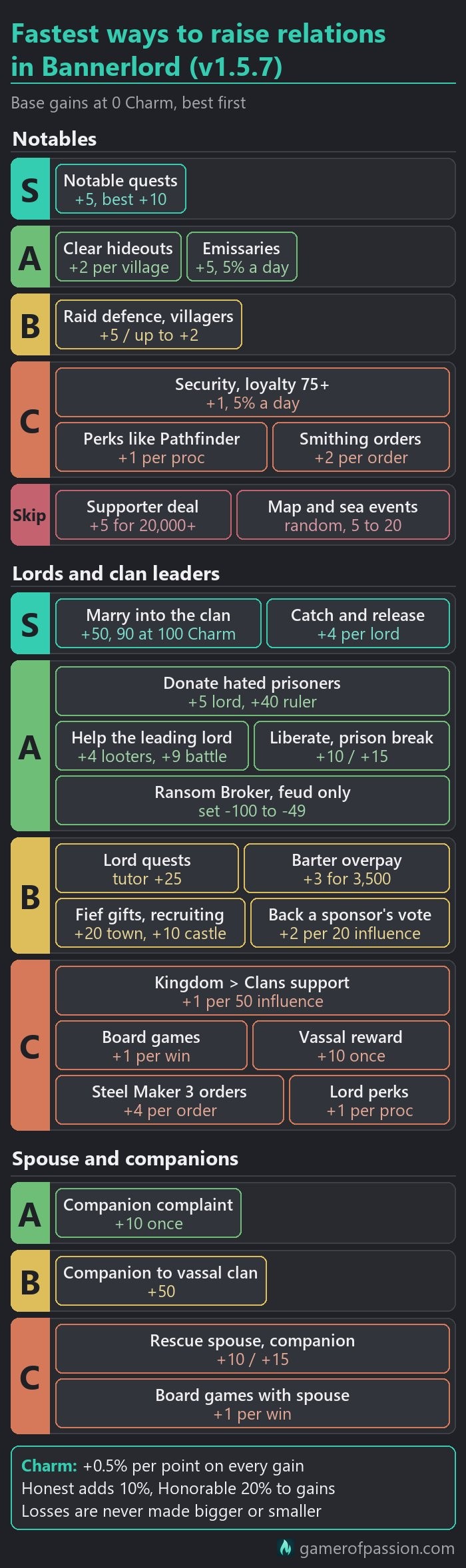
With notables, quests sit alone in S tier. Clearing hideouts and emissaries make up A tier, since one hideout reaches several villages and emissaries work while you do something else, and raid defence and saving villagers are B tier. Fief security, perks like Pathfinder and smithing orders are C-tier background noise, while the supporter deal and map and sea events are skips.
With lords, marrying into the clan and catch and release share S tier, one as the biggest single jump and the other as the one you can repeat after every battle. A tier holds donating hated prisoners, helping the leading lord and liberating captives or prison breaks, plus the Ransom Broker as a Blood Feud exit only. B tier is lord quests, barter overpay, fief gifts and recruiting as a ruler, and backing a sponsor’s vote, while Kingdom > Clans support, board games, the vassal reward, Steel Maker 3 orders and the lord perks make up C tier.
With companions, the promise on a first complaint is A tier, a vassal clan for a companion B tier, and rescuing your spouse or a companion and board games with your spouse C tier. Several entries, mostly in the lower tiers and the spouse and companion list, rest on our reading of the v1.5.7 files alone.
First 30 days
- Take every notable quest in two or three neighbouring towns, and clear a hideout or two a week nearby.
- Park every companion you do not need in those towns, for one +5 every 20 days or so per emissary at 0 Charm.
- Keep an eye on the -10 gate with the ruler you want to serve.
Mercenary or vassal
- Catch and release every lord you beat, and free every lord you find among a beaten party’s prisoners.
- Join battles where an allied lord leads your side, ideally outnumbered, and stay out of his army.
- Donate captured clan leaders and rulers to fiefs whose owners hate them, and collect the vassal reward.
Fief owner
- Keep security and loyalty at 75 or more, and station emissaries in your towns and castles (castles only reach lords).
- Buy supporters once a notable reaches 50 and matches his current clan.
- Marry yourself or a clan member into the clan you need most.
- Switch off raiding for clan parties that roam near clans you need.
Ruler
- Raise a target clan to 20 before the defection talk for the Easy opener, then recruit it by barter for +20.
- Gift fiefs, promote trusted companions to vassal clans and top up clans close to a threshold with Kingdom > Clans support.
- Keep releasing lords you may want later, and do not execute lords of those clans.
What lowers relations
Charm and traits will never change any of the losses below.
| Action | Relation lost | Other costs |
|---|---|---|
| Attack a caravan at peace | Owner 60, ruler 10 as war starts | Crime +60, Honor -150, Mercy -150, war |
| Attack a caravan at war | 12 with the owner | None |
| Bully a caravan at peace (part / all goods) | 10 or 20 with the owner | Crime +10 / +20, Honor and Mercy -25 / -50, no war |
| Rob villagers at peace | 6 with the village owner, 30 with each notable | Crime, Honor, Mercy, war and ruler costs of a caravan |
| Rob villagers at war | 6 with each notable | – |
| Bully villagers at peace | 1 or 2 with the owner, 5 or 10 with each notable | Crime +10 / +20, Honor and Mercy -25 / -50 |
| Force supplies, village does not resist | 4 with the village owner and 4 with every notable | Crime +10, Honor -25, Mercy -25, no war |
| Force volunteers, village does not resist | 8 each (owner, each notable) | Crime +20, Honor -50, Mercy -50, no war |
| Village resists and you attack, or raid at peace | 24 with the owner and every notable | Crime +60, Honor -150, Mercy -150, war |
| Raid completed, your clan’s parties count as you | Up to 6 with the owner, 3 with each notable | Your Mercy -30 per raid you lead |
| Start a siege | 5 with the settlement’s owner | None |
| Siege aftermath | Devastate 30, Pillage 15 with the old owner | Merciful lords -10 on Devastate, Cruel on Show Mercy |
| Vote for another option than a sponsor’s | 1, 3 or 7 with that sponsor (8 if Sturgian) | Influence spent |
| Leave a kingdom | 20 with every clan leader, 40 if you keep your fiefs | Ending a mercenary contract costs nothing |
| Disband another’s army | 4 with its leader, 1 with every other lord in it | 30 influence (15 as ruler) |
| Crime reaches 60 as ruler or independent clan | 10 with its ruler | War |
| War on an ally caused by your own attack | 100 with their ruler | Honor -1,000 |
| Meeting a town notable as Calculating / Cerebral | 3 / 6 once | Puts that notable below 0 for recruiting |
Caravans
In v1.5.7, attacking a caravan of a faction you are at peace with costs 60 relation with its owner and 10 with that faction’s ruler as the war starts, on top of crime, Honor, Mercy and, for a vassal or ruler, 300 influence. A vassal also loses 12 with that ruler, and a mercenary 12 with his own ruler and his contract. At war it is only -12 with the owner, and bullying a caravan into handing over part or all of its goods costs 10 or 20 with no war.
Before 1.5.7 the game applied the attack penalty twice, which made the older numbers a little bit higher. Our money guide weighs up whether caravans are worth it.
Villages
Robbing a villager party at peace (making it surrender and taking its goods) costs 6 with the village owner and 30 with each notable of its home village, plus the same crime, war and ruler costs as a caravan, while robbing one at war costs 6 with each notable. Bullying villagers costs 1 or 2 with the owner and 5 or 10 with each notable.
Since 1.5.0, forcing a village that does not resist no longer starts a war, but in v1.5.7 it still costs relation at peace. Forcing supplies costs 4 with the village owner and 4 with every notable of the village, and forcing recruits 8 each, plus crime, Honor and Mercy in both cases. If the village resists and you attack, or you raid it at peace, it is 24 with the owner and with every notable, a war and -10 with its ruler, and a vassal or ruler pays influence as well.
Against a village of a faction you are at war with, forcing or raiding costs no relation or crime, but a finished raid will still cost up to 6 with the owner and 3 with each notable. Your clan’s other parties raid in your name, which is why you should untick “Allow raiding villages” in the clan party controls of any party that roams near clans or notables you need.
Sieges and politics
Starting a siege costs 5 with the settlement’s owner. After a capture, Devastate costs 30 with the old owner and Pillage 15, while Show Mercy costs nothing.
Leaving a kingdom costs 20 with every clan leader in it, or 40 if you keep your fiefs, while ending a mercenary contract costs nothing. Disbanding someone else’s army costs 4 with its leader and 1 with every other lord in it.
As a ruler you will run into a few more:
- Firing a mercenary clan costs 2, and refusing to pay what he is owed costs more (8 for a 2,500 debt).
- Threatening a lord at peace costs 10 with him and his ruler, plus a war.
- Crime reaching 60 with a faction costs 10 with its ruler and a war, also when you lead an independent clan.
- Refusing an ally’s Call to War costs 50 with its ruler (accepting gives +10).
- A war on an ally caused by your own attack, or declared by your kingdom while you rule it, costs 100 with their ruler and 1,000 Honor (a trade partner 50 and 1,000 Honor).
Devious and Deceitful change none of these.
Executions and Blood Feuds
Executions changed more than anything else in 1.5. A Blood Feud is a state between your clan and another one that an execution starts and that blocks several dealings with that clan until it ends.
| Event | Relation | Other effects |
|---|---|---|
| Executing a lord of another clan, no feud yet | That clan’s leader set to -100 | Honor -1,000, Mercy -500, Blood Feud starts |
| Clans on 50+ with his clan, the rest of his kingdom | -45 / -50 | Only for the feud-starting execution |
| Dishonorable, rebel or minor victim | -30 / -25 | Mercy -1,000, no Honor for a dishonorable victim |
| Further executions of the same clan while the feud runs | – | +50,000 on the broker price |
| AI clan at -50 or lower executes one of your clan members | That clan’s leader set to -100 | Your relative dies, a feud starts |
| Pay a Ransom Broker in a tavern | Set to -49 | 5,000 + 50,000 per surplus execution, 55,000 for one |
| Your relation with their leader is back at 0 or higher | 96-104 stored points from -100 | The feud ends, any gain with any member counts |
| A lord of the feuding clan captures you | Other captors: below -50 plus 10 per Mercy level | He always executes you, relatives certain on day 10 |
In v1.5.7, executing a lord of another clan that is not yet in a feud with you starts a Blood Feud and sets your relation with that clan’s leader straight to -100, however honest the victim was (his heir too, if you executed the leader). Clans whose leader is on 50 or more with the victim’s clan lose 45 with you and the rest of his kingdom 50, or 30 and 25 if the victim was Devious or Deceitful or came from a rebel or minor clan.
That execution also costs 1,000 Honor and 500 Mercy (1,000 Mercy and no Honor for a dishonorable victim), while your own family never minds. Further executions of the same clan while the feud runs should not cost you more relation or Honor, but each one adds 50,000 to the Ransom Broker’s price. Our execution guide has more on what to do with prisoners instead.
How a feud starts
You start one with every execution you order of a clan you are not already feuding with, whatever your relation is. An AI clan whose relation with yours is -50 or lower starts one when it executes one of your clan members.
While it runs, that clan will send you no marriage offers, its lords cannot be asked to join your kingdom and its clans cannot defect to a kingdom you rule. You also cannot bribe its parties for safe passage or ask it to lift a siege, and your relatives it holds will not be released. Mercenary and vassal offers have no feud rule of their own and stop through the usual -10 gate with the ruler.
Two ways out
A feud ends the moment your relation with that clan’s leader is back at 0 or higher, which is about +100 from -100, and any gain with any member of the clan counts.
The quicker way is a Ransom Broker, the man in a town’s tavern who normally buys your prisoners. Tell him “I’m involved in a blood feud, and I would like to end it.” and pay 5,000 denars when they executed as many of your family as you of theirs (or more), plus 50,000 for every extra member of theirs you executed. One executed lord is 55,000, two are 105,000.
Afterwards your relation is set to -49, and you are still going to need about +49 to be neutral again.
Danger to you and your family
A lord of a feuding clan will always execute you if he captures you. Any other captor can only do it when his clan is below -50 plus 10 times his Mercy level with yours (-70 for a Sadistic lord, -50 for a neutral one, -30 for a Compassionate one), and even then it is one roll at capture, for example 18% at -60 with a neutral lord and 40% at -100 with a Sadistic one.
Your companions, spouse and children held by a feuding clan are at 1% risk on day 1, 25% on day 5 and certain on day 10 (8 days after they reach its town or castle). Other clans can execute them only at -50 or worse, which starts a feud.
Your own clan’s party leaders, on the other hand, will execute feud prisoners on their own, usually within a few hours.
Personality traits
Traits started to matter for relation gains with 1.5.0.
| Trait levels | Relation effect | How you get it |
|---|---|---|
| Honest / Honorable | +10% / +20% on every relation gain, never losses | 1,000 / 4,000 hidden Honor, most quests give 30 to 50 |
| Devious / Deceitful | -5% / -10% on gains with clan leaders, losses untouched | -1,000 / -4,000 Honor, hostile act at peace 25 to 150 |
| Calculating / Cerebral | -3 / -6 once with each town notable you meet (you only) | Calculating XP +20 per freed lord or persuaded defection |
| Merciful, Compassionate / Cruel, Sadistic | No direct relation effect (execution odds, siege aftermath) | Show Mercy +20 / +10, Devastate -50 / -30 |
| Personality match (Honor, Valor, Mercy) | +2 / +1 / +1 when your level has the same sign as his | – |
In v1.5.7, Honest and Honorable add 10% and 20% to every relation gain, and the better of the two people counts, which means an Honorable lord gives you the +20% on gains with him too. At 0 Charm an Honorable character turns a +4 release into +5 and a +10 liberation into +12, while losses never change.
Devious and Deceitful cut gains with clan leaders by 5% and 10%. Your own Devious only cuts gains when the person you deal with leads his clan, while a Devious lord, notable or companion cuts your gains with him, because you lead your clan. Despite the 1.5 patch-note wording “amplified relation swings”, losses do not get bigger.
Calculating and Cerebral start you at -3 or -6 with each town notable you meet for the first time. Only you are affected (village notables, lords and companions are left out), but it puts that notable below 0 for recruiting until you raise him.
Honest needs 1,000 hidden Honor points and Honorable 4,000. Most quests give 30 to 50 and honorable map-event choices 100 to 300, while every hostile act at peace costs 25 to 150 and a feud-starting execution 1,000. As such, Honorable is going to take a while.
Apart from its one point in the personality match, Mercy has no direct relation effect and matters through executions and the siege aftermath.
What changed in 1.5
Version 1.5.7 brought the 1.5 changes to the live game on 11 November 2026:
- Personality traits change relation gains (since 1.5.0).
- Blood Feuds arrived, and the AI can execute your family.
- The feud’s -100 and the -45 and -50 hits replaced the old fixed execution losses.
- Villages that do not resist no longer start a war, but still cost relation.
- Since 1.5.4, courtship and defection talks need one success fewer, and a failed one can be retried after one season.
- 1.5.7 fixed caravan and villager penalties hitting twice.
- Camaraderie doubles battle-help relation, where it tripled it before 1.5.7.
- Gains are rounded the same way every time instead of randomly.
Recruit-slot bands, supporters, emissaries, quests, barter, votes, prisoner donation, prison breaks and marriage gains stayed the same.
You will still come across a few old claims. Votes now give +2 per 20 influence, where older numbers said +8, +20 or +60. Pillage does anger someone, as it costs 15 with the old owner. A failed courtship is no longer final, since you can try again after one season. The old rule that the AI only executes you below -30 is gone too, replaced by the feud and Mercy rules above. Supporters also do not appear by chance at 50, since you have to ask through the dialogue and pay.
Odds and ends
Is it a good idea to execute lords?
Usually not. One execution sets that clan to -100, costs 45 or 50 with many other clans, starts a Blood Feud that blocks marriage offers and recruiting and puts your captured family at risk. I would only do it to a clan you never plan to recruit, marry into or serve.
Is there a relation cheat?
Yes, but only with cheat mode enabled. The console command campaign.add_hero_relation [hero name] | [value] will then change your relation with that hero’s clan (Charm still scales positive values), and campaign.show_relation shows it.
How do you raise relations with a whole village?
A village has two sides, its owner (the clan that holds it) and its notables. Clearing a hideout within half a day’s ride gives +2 with one of its notables, saving its villagers up to +2 with each notable and up to +4 with the owner, and its notables’ quests +5 each. Forcing supplies or recruits costs relation with the owner and every notable at once.
How do you get on good terms with your king?
Collect your vassal reward for +10 once, back his proposals in kingdom votes at +2 per 20 influence and join battles where he leads your side without being inside his army. Freeing members of his clan from a beaten party’s prisoners gives +10 each, and donating captured enemy lords to his fiefs pays too when they are at 0 or worse with him.
Conclusion
Relations in Bannerlord are mostly a matter of habit. Take quests and clear hideouts for notables, let every captured lord go through the talk and marry into the clan that matters most, and you will rarely have to worry about the numbers. That being said, v1.5.7 made executions far more expensive, and I would think twice before reaching for the axe.