
Whenever a technology merchant or a blueprint researcher in No Man’s Sky asks you for nanites, you will quickly notice how slowly the game hands them out in your first hours.
They drip in from dozens of small sources, from scanned animals to derelict freighters, and the game never tells you which of them are worth your time. The best one changes as you progress.
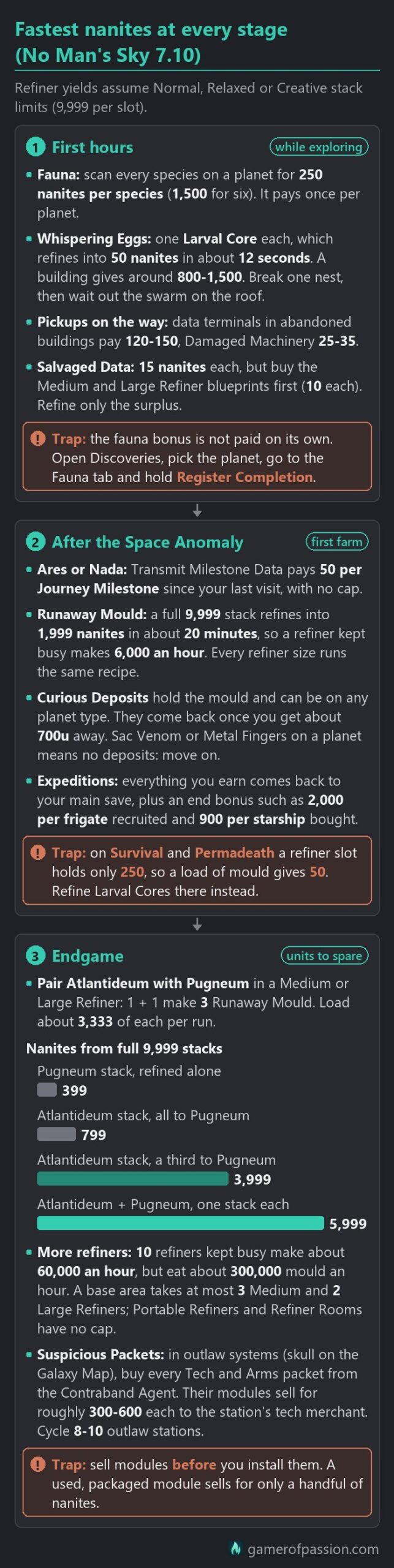
The short answer, by stage of the game:
- In your first hours, scan every animal species on a planet and claim the completion bonus by hand (250 nanites per species), and refine the Larval Cores from Whispering Eggs into 50 nanites each.
- Once you reach the Space Anomaly, hand your milestones to Ares or Nada for 50 nanites each, trade discovery data with Helios, and pick Extract Nanites at the end of a derelict freighter for 400-600.
- As soon as you have a base, build a Runaway Mould farm on Curious Deposits. Every refiner will turn a full stack of 9,999 mould into 1,999 nanites in about 20 minutes.
- When you have plenty of units, buy Suspicious Packets (Tech and Arms) at outlaw stations and sell the X-class modules inside, uninstalled, for roughly 300 to 600 nanites each.
- In dissonant systems, refine Atlantideum together with Pugneum. A full stack of each turns into 5,999 nanites.
- On Survival and Permadeath, a refiner slot only takes 250 of a resource, which makes Larval Cores and Radiant Shards better targets than mould.
Checked for 7.10 Forsaken, which changed no nanite source or cost. Most ratios and rewards below are taken from the game files, and the farm yields are worked out from them.
If you are brand new to the game, the nanite table in our No Man’s Sky beginner guide is the short version of this post. Below, I will go through the main routes in the order you will reach them.
Contents
- Nanites in your first hours
- After the Space Anomaly
- The Runaway Mould farm
- Turning units into nanites
- Which method is fastest?
- Everything that refines into nanites
- What to spend nanites on first
- Mistakes that cost nanites
- Nanite questions
- Conclusion
Nanites in your first hours
Before the Space Anomaly, you will have no base full of refiners and no pile of units to trade. Your first nanites are paid for exploring, and several of these sources will stay useful for the whole game.
Fauna completion bonus
Scanning animals is probably one of the best nanite sources of the early game. Scan every creature species on a planet and you will earn a completion bonus of 250 nanites per species, which makes 1,500 for a planet with six species and 3,000 for one with twelve. It adds up quickly.
The game will not pay this bonus by itself, and the nanites will only arrive once you open the Discoveries page, pick the planet, go to the Fauna tab and hold Register Completion in the box at the top. Uploading the discoveries pays a separate and smaller amount. Do both.
Bear in mind that the bonus pays once per planet. If a discovery glitch wiped your old scans, rescanning a planet you had completed before will pay units but not the bonus, while new planets still pay in full.
Planets with two or more rare underground species will eat the most time. When you are scanning for nanites, simply skip those and move on to the next planet.
Small pickups while exploring
Upload your discoveries whenever you think of it. The upload-all arrow on the Discoveries page does every system and planet in one go for a few free nanites.
A lot of objects on a planet pay small amounts as well:
- Damaged Machinery pays 25-35 nanites most of the time, and sometimes an upgrade module you can sell instead.
- Data terminals in abandoned buildings pay 120-150 nanites, factory terminals 90-120.
- Crashed-ship databanks, Traveller graves and conversations with planet NPCs pay somewhere between 40 and 150, depending on the option you pick.
- Waypoints (the save poles next to planetary buildings) pay 10 nanites and a Navigation Data.
Salvaged Data
Salvaged Data is dug out of buried technology modules, 2 to 4 at a time, and each one refines into 15 nanites. Buy the base blueprints you need first, though. The Medium and Large Refiner cost 10 Salvaged Data each and the Base Teleport Module costs 2, and your mould farm is going to run on exactly those parts later.
Refine whatever is left over. Salvaged Data stacks three times higher than cores and shards (30 per exosuit slot against 10), and one full slot refines into 450 nanites, close to a slot of Larval Cores or Radiant Shards at 500.
Whispering Eggs
Every Whispering Egg holds exactly one Larval Core, and each core refines into 50 nanites in about 12 seconds in any refiner. The eggs sit in nests around abandoned buildings and lie loose on airless planets, and one building will usually give you somewhere around 800-1,500 nanites’ worth. A full exosuit slot of 10 cores is 500 nanites.
Shoot an egg with the mining beam and grab the core straight away, because it rolls off and vanishes. Breaking an egg sets off a timed swarm of Biological Horrors. No more than six are out at once, and the on-screen timer ends with “Swarm subsiding”, which means they will not keep coming forever.
The safe way is to break one nest, jump onto the building’s roof or into your ship until the swarm ends, and then do the next nest. Horrors can still spit at you up there, and a decent shield helps. With a Terrain Manipulator you can also dig a shallow tunnel under a nest and shoot the eggs from below, and the cores will roll down to you.
Underwater, a similar growth holds a Hadal Core worth the same 50 nanites. If you would rather skip the fight, pirate-station traders sometimes sell Larval and Hadal Cores.
Fishing
Fishing starts the moment you reach the Space Anomaly, where you will buy the Fishing Rig blueprint for your Multi-Tool. Releasing a fish pays nanites by its class: roughly 15-30 for a C-class fish, 50-90 for B, 100-120 for A and 160-200 for S. Size does not matter.
In order to release a fish, stand in the water, open your inventory, select the fish and release it, one at a time. Junk such as old boots pays nothing.
Most catches are C-class, and over a long session you will average about 50 nanites per fish, with the A- and B-class fish earning most of the total. Expect somewhere around 1,000-1,500 nanites from a relaxed 15-20 minute session. That is slower than refining. Fish when you enjoy it, and keep C-class fish for bait or cooking if you need them.
After the Space Anomaly
The Space Anomaly opens up a second set of sources. Most pay modest amounts, but you can collect from them again on later visits.
Ares, Nada and Helios
Ares and Nada will take your milestone progress. Choose Transmit Milestone Data and you will get 50 nanites for every milestone reached since your last visit, with no cap. The first visit after a long session will pay a nice stack.
Helios asks for one kind of data each day and pays 5 nanites per new creature, plant or mineral, or 15 per new planet, counted since your last hand-in. Additionally, Helios hands out a free Emergency Signal Scanner each week, which will lead you to a derelict freighter.
Once you have a base, hire a Scientist and finish his quests. He asks for the same data at the same rate, but pays 20 per planet. Both of them draw from the same counter and a discovery only pays once, which makes the Scientist the better place for your planet data. None of this needs a farm. Simply drop by whenever you pass the Anomaly.
Cooking for Cronus
Cronus judges cooked food and pays nanites for it, from nothing for the worst dishes up to about 110 for an outstanding one. You can hand over up to three dishes at a time. Elaborate dishes such as cakes score best. Raw ingredients score badly.
Cronus’ Market also asks for specific dishes that change every day, and supplying them raises your Esteem with him. It is fine if you cook anyway, but slow compared with refining.
Mission rewards
Nanite rewards on missions come up at random. Station board missions pay 100-400 when the reward is nanites, Nexus missions 300-550, and the board in a pirate station 250-400. A guild envoy’s gift is worth 100-500 depending on your standing, and sometimes it is units instead. Check the reward before you accept anything.
Sentinels and Salvaged Glass
Every Sentinel you destroy on a planet pays nanites on the spot: 5 to 10 for a drone, 12 to 24 for a Quad, and up to 90 for a Walker, and drones also drop Salvaged Glass about two times in three, which on average is worth far more than the kill itself once you open it.
Open the Glass from your inventory, and you will find that about two in five hold a Sentinel upgrade module (a Sentinel Weapons Shard or a Sentinel Exosuit Fragment) that a technology merchant will buy for a few hundred nanites. About one in eight holds 10 to 15 nanites, and the rest are crafting components, alloys or a Vy’keen Effigy to sell for units.
To farm Glass, fight on until a summoner drone appears and leave it alive. It will keep calling in more drones for you to shoot. Rinse and repeat. Destroying a Sentinel Pillar pays 100-140 nanites plus some Pugneum, which you will want for the Atlantideum route further down.
In space, Sentinel interceptors pay more per kill. About a third of the time you will get 90 to 160 nanites, and sometimes a Hyaline Brain that refines into 230. Pirate ships now and then drop 100-250 nanites, and they are one more source of Suspicious Packets.
Dissonant systems
Dissonant systems hold several of the big refining items. Radiant Shards grow out of the terrain there, you mine them with the Mining Laser, and each one refines into 50 nanites. Inverted Mirrors are left behind by the corrupted swarm’s Dissonance Resonators and refine into 95 each, and corrupted Sentinels drop the Atlantideum for the pairing route in the mould section.
Derelict freighters
A derelict freighter is well worth the detour. At the end of the wreck, the Engineering Control terminal offers Extract Nanites for 400-600. Pick it when you do not need the tech, bulkhead or corvette modules that Fabricate Items offers instead.
The small cases and lockers on the way hold a few more nanites, and some cases hold Tainted Metal, which refines into 2 nanites per unit. The other detour in space is the Dyson Lens, a large eye-shaped object that pays 500-700 nanites and a recipe when you shoot it apart.
Expeditions
Expeditions are probably one of the biggest nanite paydays in the game. Everything you earn during the run goes back to your main save when it ends, and the summary screen will add a bonus per activity:
- 2,000 nanites per frigate recruited
- 900 per starship bought
- 230 per relic, 210 per companion adopted and 150 per upgrade bought
- 120 per base part learned, 45 per word learned and 25 per Biological Horror killed
- 3-35 per new discovery (15 per creature, 25 per planet and 35 per star system)
Five frigates alone will add 10,000. Start the expedition from your main save at the Expedition terminal on the Space Anomaly, and the rewards will have a save to return to.
After you finish the Atlas Path, Atlas Interfaces also offer a repeatable task where you present a discovery for some nanites and new Atlas words. Treat it as a small top-up.
The Runaway Mould farm
Runaway Mould refines 5:1 into nanites, and the Curious Deposits that hold it come back after you leave the area. Add enough refiners and you will have a nanite income that only stops when you stop loading them.
Finding Curious Deposits
Any planet type can have Curious Deposits, and there is no need to limit your search to toxic or radioactive worlds. Each planet gets only one of three rare surface resources, either Curious Deposits, Sac Venom or Metal Fingers. When you find Sac Venom or Metal Fingers on a planet, move on to the next one.
Each deposit gives 300-500 mould before mining upgrades, which means 20 to 34 deposits per full stack. The Optical Drill raises your mining yield, and it is the first upgrade a mould farmer should buy. As the name suggests, the stuff also does not like to stay put. The deposits will roll away when you start mining them.
Respawning the deposits
Curious Deposits come back once you leave the area. Get about 700u away and return, and go further if they do not reset. Flying up out of the atmosphere or teleporting to another base and back both work, which means two deposit fields linked by teleporters will let you reset one while you mine the other.
Refining the mould
One refiner turns a full 9,999-mould stack into 1,999 nanites in about 20 minutes, and 4 mould stay behind in the input. That makes 6,000 nanites an hour per refiner, as long as you keep reloading it.
Refiner size makes no difference for mould. Portable, Medium and Large Refiners all run the same 5:1 recipe at the same speed. Build whichever refiner you can place the most of, and remember that the Portable Refiner needs Carbon as fuel.
Multiply by your refiner count. Ten refiners give about 60,000 nanites an hour, but they need about 300,000 mould an hour to stay busy. Mining is the quick part. The refiners set the pace.
A base takes at most three Medium and two Large Refiners per area, but Portable Refiners and the Refiner Rooms on a freighter, a space base or a space station you have claimed have no such cap, which is how the big farms reach 20 to 40 refiners. For reference, five refiners with a full stack each will give you 9,995 nanites after one 20-minute run.
On Survival and Permadeath, a refiner slot takes only 250 of a resource, and one load of Runaway Mould gives just 50 nanites. Your exosuit holds 500 per slot there, your ship 1,000 and your freighter 2,000. On Normal, Relaxed and Creative every refiner and inventory slot holds 9,999, and in a custom game the Inventory Stack Limits setting decides (Standard 9,999, Restricted 250 and Harsh 150 per refiner slot). Larval Cores and Radiant Shards still stack to 10 on Restricted, which makes them the better refining targets there.
Setting up the farm
- Claim a base right next to a group of deposits.
- Wall the deposits in to stop them rolling away when you mine them.
- Add a Base Teleport Module (one per base, built from 4 Metal Plating, 2 Carbon Nanotubes and 40 Sodium) and give it power, for example with a Biofuel Reactor.
- Do the same at a second deposit field and bounce between the two bases.
- Place your refiners at the base, or carry the mould to the Refiner Rooms of your freighter.
The blueprints cost Salvaged Data: 10 for each refiner, 2 for the Base Teleport Module and 1 for the Biofuel Reactor. That is why your early Salvaged Data is better spent here than in a refiner.
The Atlantideum route
Atlantideum refines 1:2 into Pugneum, and one Atlantideum plus one Pugneum in a Medium or Large Refiner make 3 Runaway Mould. Pairing them is the route to use. A full stack of Pugneum refined alone gives only 399 nanites (25:1), but 9,999 Atlantideum plus 9,999 Pugneum become 29,997 mould and then 5,999 nanites.
If you only have Atlantideum, refine a third of it into Pugneum and pair that with the rest, and a 9,999 stack will turn into 3,999 nanites instead of the 799 you would get by going through Pugneum alone. A refiner output slot holds 9,999, which is why you should load about 3,333 of each per run.
The Atlantideum drops from corrupted Sentinels, and the Pugneum from Sentinel Pillars and interceptors. The Personal Refiner Mk 2 has two inputs as well, which lets you run the pairing recipe while you explore.
The slow goop chain
Residual Goop, Viscous Fluids and Living Slime each refine 1:1 into the next, from Goop to Fluids to Slime and finally to Runaway Mould. That means 5 of any of them will become 1 nanite. You will pick them up early from robot-camp crates and slime blobs, and a Hypnotic Eye refines into 50 Living Slime.
Run them through a Portable Refiner while you explore, but expect little. From Residual Goop one refiner makes about 375 nanites an hour, against 6,000 an hour on Runaway Mould.
Turning units into nanites
In the mid game, units usually pile up much faster than nanites, and the routes below turn units, or things you could sell for units, into nanites. Packets and ship scrapping are going to need a healthy units balance.
Suspicious Packets
Outlaw stations sell Suspicious Packets, and the X-class modules inside them sell for nanites. The loop:
- Find an outlaw system. These show a skull on the Galaxy Map, and with a Conflict Scanner (or an Economy Scanner) in your starship the system readout will say Pirate Controlled (or Black Market) before you warp. The Conflict Scanner blueprint costs 150 nanites from Hyperion on the Space Anomaly and is built from a Walker Brain and a Wiring Loom.
- In the outlaw station, buy every Suspicious Packet (Tech) and Suspicious Packet (Arms) from the Contraband Agent. The Goods packets hold no modules.
- Open the packets from your inventory. Most contain an X-class upgrade module, and a few contain a recovered or salvaged item instead, which you can dismantle for a few nanites.
- Sell the modules, uninstalled, to the technology merchant in the same station. Expect roughly 300 to 600 nanites per module, with the odd strong roll paying more.
- Teleport to the next outlaw station and do it all again.
Opening the packets is fine. Installing the modules is what costs you. Once a module has been installed, you can only dismantle it for a few materials or package it again, and a used, packaged module sells for only a handful of nanites.
A Contraband Agent restocks a few packets at a time rather than all at once, and how many packets an agent has varies from station to station. Do not wait at one station. Save eight to ten outlaw stations in your teleporter list and cycle through them, and by the time you are back at the first one, some packets will have come back. A full restock takes much longer.
Selling inside the outlaw station keeps you in pirate space. If you are flying to a regular system anyway to sell black-market goods, check that merchant’s offer before you sell, because it can be a little bit higher. Packets cost units, and a loop through ten stations will take a big bite out of your balance. The ones you find in robot-camp crates or loot from pirate ships are free, and you can open and sell those the same way.
The standing discount
Once your standing with a race is at or near its maximum, that race’s technology merchants will sell upgrade modules for up to half price, and the shop shows the Standing Discount next to the prices. They still buy modules back for much more than that. Buying a merchant’s whole stock and selling it straight back will turn a profit of roughly 800 to 1,200 nanites per merchant, or about 2,000 to 6,000 per station across all four merchants. You will need a few thousand nanites to start.
Skip the starship reactors. They cannot be sold back. Only do this when the discount is large, because with a small discount you will lose nanites on every module. It is ordinary buying and selling and does not rely on any glitch, but it is a price gap that Hello Games could rebalance in a later update.
Scrapping starships
Scrapping a starship at a station’s Starship Outfitting terminal gives you scrap items that sell for units, usually a few upgrade modules, and often Storage Augmentations that add starship slots. Choose to extract scrap metals when the game asks. Better ships give more. A- and S-class ships give the most modules, and S-class ships nearly always drop one to three Storage Augmentations.
Sell the modules you do not need to a technology merchant for nanites, and scrap Multi-Tools the same way at the Space Anomaly. Buying ships just to scrap them is a different story. It only pays off if you are sitting on a large pile of units. Count the nanites as a bonus next to the units and Storage Augmentations, and run Suspicious Packets if nanites are your main goal.
Space hulk salvage
Space hulk salvage can be turned into nanites too. Bring the processed salvage (Reactor Cores, Data Packets, Stasis Lockers and the rest) to the Quartermaster at a deep-space outpost and trade it for nanites, or sell the same items for units at a trade terminal. Check both offers, because the nanite price varies from item to item.
On the hulk, pull off the most valuable parts first, since the meltdown destroys whatever is still attached. The Forsaken traders added in 7.10 take mementos and preserved grubs in exchange for corvette modules and the Larva Cannon multi-tool. They do not pay nanites.
Which method is fastest?
The fastest method depends on what you bring. Before the Space Anomaly, the fauna bonus wins, with 3,000 nanites for a sweep of a twelve-species planet against about 800-1,500 for a building full of eggs. After the Anomaly, the big single payouts are the milestone hand-in after a long session, a derelict freighter’s Extract Nanites and the bonus at the end of an expedition.
With a base, the mould farm has the highest ceiling. Each busy refiner adds 6,000 nanites per hour of refining, and the refiners will keep working while you do something else. With a big units balance, Suspicious Packets are the quickest way to turn units into nanites, because the modules pay out the moment you sell them.
I would say the mould farm is the better long-term choice for most players. It costs next to nothing to run once it is built, while every packet loop burns through units.
| Method | Stage | What you need | Nanites | Notes |
|---|---|---|---|---|
| Fauna completion | First hours | Scan every creature species on a planet | 250 per species | Claim by hand on the Fauna tab (Register Completion) |
| Damaged Machinery and terminals | First hours | Nothing, grab them on the way past | 25-35 machinery, 120-150 data terminal | Factory terminals 90-120; machinery can drop a module |
| Whispering Eggs (Larval Cores) | First hours | Abandoned buildings or airless planets | 50 per core, 800-1,500 per building | Grab each core at once; the Horror swarm is timed |
| Milestones (Ares or Nada) | Space Anomaly | Journey Milestones since your last visit | 50 per milestone, no cap | Helios: 5 per new creature, plant or mineral, 15 per planet |
| Fishing | Space Anomaly | Fishing Rig; stand in the water to release | 15-30 (C) to 160-200 (S) per fish | Pays by class, not size; junk pays nothing |
| Cronus cooking | Space Anomaly | Cooked dishes, up to three per hand-in | Up to 110 per dish | Cakes and other elaborate dishes score best |
| Mission board and Nexus | Space Anomaly | Missions that show a nanite reward | 100-400 board, 300-550 Nexus | Guild envoy gift: 100-500 by standing |
| Sentinel kills and Salvaged Glass | Mid game | A weapon; leave the summoner drone alive | 5-10 per drone, up to 90 per Walker | Glass often holds a Sentinel module to sell |
| Derelict freighter | Mid game | Emergency Signal Scanner (free weekly from Helios) | 400-600 from Extract Nanites | Replaces the tech, bulkhead or corvette reward |
| Runaway Mould farm | Mid game | Base at Curious Deposits, refiners, teleporter | 1,999 per stack, 6,000 per refiner-hour | Reset after you go 700u away; go further if not |
| Atlantideum and Pugneum | Mid game | Medium or Large Refiner (two inputs) | 5,999 from 9,999 of each | Pugneum alone gives only 399 per stack |
| Suspicious Packets | Late game | Units, an outlaw station, a Conflict or Economy Scanner | 300-600 per X-class module | Sell the modules before you install any |
| Standing buy-and-resell | Late game | Standing at or near max, a few thousand nanites | 800-1,200 per merchant | 2,000-6,000 per station; only with a big discount |
On Survival and Permadeath the order shifts. At 50 nanites per load of mould, cores, shards and modules will do more for you than a mould refinery.
Everything that refines into nanites
Fifteen refiner recipes turn something straight into nanites, and the goop chain and the Atlantideum pairing reach nanites by way of Runaway Mould.
| Input | Ratio (input : nanites) | Refiner | Time per batch | Notes |
|---|---|---|---|---|
| Hyaline Brain | 1 : 230 | Any refiner | 49 min 4 s | Sentinel interceptor drop |
| Inverted Mirror | 1 : 95 | Any refiner | 13 min 56 s | From corrupted Dissonance Resonators |
| Hadal Core | 1 : 50 | Any refiner | 12 s | Underwater egg plants or pirate-station traders |
| Larval Core | 1 : 50 | Any refiner | 12 s | One per Whispering Egg |
| Vile Spawn | 1 : 50 | Any refiner | 18 s | Embryo sacs, with a Visceral Synthesiser |
| Flesh Rope | 1 : 50 | Any refiner | 18 s | Hungering Tendril remains |
| Radiant Shard | 1 : 50 | Any refiner | 6 min | Stacks 10 per slot, like the cores |
| Salvaged Data | 1 : 15 | Any refiner | 19.2 s | Keep 10 per refiner blueprint first |
| Tainted Metal | 1 : 2 | Any refiner | 0.72 s | Derelict freighter wrecks |
| Faecium and Hexite | 1 + 1 : 1 | Medium or Large | 0.24 s | Both from creature faecal matter |
| Corrupted Ichor | 5 : 1 | Any refiner | 0.36 s | Destroyed swarmer shells |
| Runaway Mould | 5 : 1 | Any refiner | 0.6 s | Full 9,999 stack: 1,999 in 20 min |
| Pugneum | 25 : 1 | Any refiner | 0.12 s | Full stack: only 399; pair it with Atlantideum |
| Platinum | 35 : 1 | Any refiner | 0.24 s | Mined from asteroids |
| Platinum, Gold and Silver | 25 + 15 + 15 : 1 | Large only | 0.36 s | Asteroid metals; needs three input slots |
Per slot, ten Hyaline Brains (2,300 nanites) and a full stack of Runaway Mould (1,999) are the biggest payouts you can realistically fill, while Larval and Hadal Cores finish in about 12 seconds each and never block a refiner for long. Do not bother refining Platinum, the Gold, Silver and Platinum mix or Pugneum by itself. It takes 35 Platinum or 25 Pugneum to make a single nanite, and Pugneum is worth far more paired with Atlantideum. Upgrade modules cannot go into a refiner at all, and you should sell those instead.
What to spend nanites on first
Your first 10,000 nanites will go furthest on cheap blueprints, and after that on S-class modules. You will find the Exosuit blueprints at Iteration: Selene, the starship ones at Hyperion and the Multi-Tool ones at Iteration: Eos, all on the Space Anomaly. A good order to buy them in:
- Cadmium, Emeril and Indium Drive for 80, 120 and 200 nanites, 400 in total. They open red, green and blue star systems.
- Neural Stimulator for 90, which lets you fly and sprint longer. Add Rocket Boots for 200 if you like big jumps.
- Shield Lattice and Oxygen Recycler for 120 each, for longer hazard protection and life support. Add one 160-nanite hazard blueprint (Coolant Network, Thermic Layer, Toxic Suppressor or Radiation Deflector) for the planets you spend the most time on.
- Waveform Recycler for 120. Your scanner recharges faster and reaches further, which means more scans and more discoveries.
- Terrain Manipulator, Advanced Mining Laser and Optical Drill for 50, 75 and 460, or 585 if you own none of them. This is the mining yield your mould farm will run on.
- Haz-Mat Gauntlet and Personal Refiner for 80 and 360. The gauntlet lets you harvest wild plants, and the refiner lets you refine anywhere.
- Efficient Thrusters for 120, which lowers the fuel cost of every take-off.
- S-class upgrade modules with the rest, Scanner or Movement first. You can use three of one type.
The first seven steps add up to 1,995 nanites without the optional extras, or 2,355 with the Rocket Boots and one hazard blueprint, which leaves roughly 7,500 to 8,000 of your first 10,000 for modules. Make sure to buy those from the race you have the highest standing with, for the Standing Discount.
| Buy | Where | Nanites | Why |
|---|---|---|---|
| Cadmium, Emeril and Indium Drive | Hyperion (Starship) | 400 (80 + 120 + 200) | Opens red, green and blue star systems |
| Neural Stimulator | Iteration: Selene (Exosuit) | 90 | Fly and sprint longer |
| Shield Lattice and Oxygen Recycler | Iteration: Selene (Exosuit) | 240 (120 + 120) | Longer between hazard and life support recharges |
| Waveform Recycler | Iteration: Eos (Multi-Tool) | 120 | Scanner recharges faster and reaches further |
| Terrain Manipulator, Advanced Mining Laser, Optical Drill | Iteration: Eos (Multi-Tool) | 585 (50 + 75 + 460) | Mines rare deposits, then raises mining yield |
| Haz-Mat Gauntlet and Personal Refiner | Iteration: Selene (Exosuit) | 440 (80 + 360) | Harvest wild flora, refine from your Exosuit |
| Efficient Thrusters | Hyperion (Starship) | 120 | Cheaper take-offs: less launch fuel |
| S-class upgrade modules | Technology Merchants in stations | The rest of the budget | Scanner or Movement first, max 3 of one type |
| Total for the blueprints | Space Anomaly | 1,995 | Leaves most of the 10,000 for modules |
Do not buy these early
- Class upgrades. Going from C to B alone costs 10,000 nanites, your whole first budget, and C to S is 85,000 per starship or Multi-Tool.
- Freighter recolouring, at 5,000 to unlock plus 5,000 per colour. It is cosmetic and only matters once you own a freighter.
- Squadron pilot slots (800 to 10,000) and pilot upgrades (1,200 to 9,500), which need a freighter before you can recruit at all.
- The Exocraft Summoning Unit for 640, before you have built a geobay.
- The Superior and Advanced Translators for 310 and 580. The 90-nanite Simple Translator covers the start.
- Pulse Engine upgrades such as the Instability Drive and Sub-Light Amplifier at 460 each, which cost as much as several beginner blueprints.
| What | Nanites | Notes |
|---|---|---|
| Starship class upgrade | 10,000 to B, 25,000 to A, 50,000 to S | 85,000 from C to S |
| Multi-tool class upgrade | 10,000 to B, 25,000 to A, 50,000 to S | 85,000 from C to S |
| Corvette class upgrade | 10,000 to B, 25,000 to A, 50,000 to S | Same steps as a starship: 85,000 from C to S |
| Freighter colours | 5,000 unlock, then 5,000 per colour | 10,000 for one colour, 55,000 for all |
| Companion slots | 500 or 1,000 for the first paid slot, up to 3,500 | Two are free; filling all 30 costs 61,000-67,000 |
| Squadron pilot slots | 800, 3,500, 7,500, 10,000 | 21,800 for all four; needs a freighter |
| Squadron pilot upgrades | 1,200 to 9,500 per step | Better ship and abilities for that pilot |
| Ship or multi-tool transfer between saves | 1,000-2,800 ship, 900-2,200 multi-tool | Expedition terminal on the Space Anomaly |
| Conflict or Economy Scanner | 150 each (Economy 300 with Teleport Receiver) | Hyperion; marks outlaw systems before you warp |
| Traveller grave marker | 100 | Pay one Traveller at a time; a second can find nothing |
You get two companion slots for free. The next one costs 500 or 1,000 nanites (the Companion Register shows the price), and later slots climb to 3,500 each, roughly 61,000-67,000 for all 30. Corvettes upgrade class in the same steps as starships, with 10,000 to B, 25,000 to A and 50,000 to S, which is 85,000 from C to S.
Copying a starship or corvette between your main save and an expedition at the Anomaly’s expedition terminal costs 1,000-2,800 nanites depending on the ship, and a Multi-Tool 900-2,200. Some Travellers ask 100 nanites to mark their grave on your map. Pay one at a time, because asking a second Traveller straight after can turn up nothing.
Mistakes that cost nanites
Most lost nanites disappear in a handful of predictable ways:
- Installing modules you meant to sell. An installed X-class module can only be dismantled or packaged again, and a used, packaged module is worth a handful of nanites.
- Forgetting Register Completion. The fauna bonus will wait on the Discoveries page until you hold the button, and after a few dozen planets it is easy to leave thousands of nanites unclaimed.
- Refining Salvaged Data you still need. At 15 nanites each it looks tempting, but the Medium and Large Refiner blueprints cost 10 Salvaged Data each and the Base Teleport Module 2.
- Selling Runaway Mould at a trade terminal. A full stack is worth 1,999 nanites in a refiner.
- Keeping gifted “nanites”. If another player hands you a stack of nanites at the Space Anomaly and it sits in your inventory, it is a save-edited item that cannot be turned into real nanites. Delete it to free the slot. Real nanites never take up a slot, and even nanites you take out of a refiner go straight into your wallet.
- Expecting full stacks on Survival and Permadeath. Refiner slots hold 250 there, which turns a load of mould into 50 nanites.
- Feeding a Traveller’s “Offer nanites” option. It only swaps 15 nanites for units, and it adds up if you are saving nanites.
Nanite questions
What is the best way to get nanites in No Man’s Sky?
For most players it is a Runaway Mould farm on Curious Deposits. Every refiner you keep loaded will turn 9,999 mould into 1,999 nanites in about 20 minutes. Before you have a base, the fauna completion bonus at 250 nanites per species is the best source.
What refines into nanites?
Salvaged Data (15 each), Larval and Hadal Cores (50), Radiant Shards, Flesh Rope and Vile Spawn (50), Inverted Mirrors (95), Hyaline Brains (230), Tainted Metal (2), Runaway Mould and Corrupted Ichor (5 to 1), Pugneum (25 to 1) and Platinum (35 to 1), plus two mixed recipes. Goop, Fluids, Slime and Atlantideum get there by way of Runaway Mould.
What is the fastest way to get nanites in 2026?
Forsaken 7.10 did not change any nanite source, and the fastest routes are still the ones that worked in 7.0 Cosmos. With units to spare, Suspicious Packets from outlaw stations pay out the moment you sell, at roughly 300 to 600 nanites per module. Without them, a mould farm with as many refiners as you can place gives 6,000 nanites per refiner for every hour of refining.
How do I earn 10,000 nanites?
The simplest plan is five refiners with a full stack of Runaway Mould each, which gives 9,995 nanites after one 20-minute run from about 50,000 mould. An expedition where you recruit five frigates also pays 10,000 at the end by itself, and a few planets’ worth of fauna bonuses plus a milestone hand-in will get you there more slowly. Spend the first 10,000 on the blueprint list above before you even think about a class upgrade.
How do I get nanites early in the game?
Scan every animal on each planet and hold Register Completion, upload your discoveries, use the data terminals in abandoned buildings and break the Whispering Eggs around them for Larval Cores. Keep your Salvaged Data for the refiner and teleporter blueprints, and refine only what is left.
Conclusion
Nanites are scarce in the first hours and plentiful once a farm is running. Claim every fauna bonus by hand, keep your Salvaged Data for the refiner blueprints and visit Ares and Helios whenever you pass the Anomaly.
Once you have a base, put as many refiners next to a Curious Deposit field as the game allows. Then keep them loaded. If you are sitting on millions of units, a loop of outlaw stations will turn them into nanites without any refining wait. For most players, though, the mould farm is going to be the route that pays for every class upgrade later on.