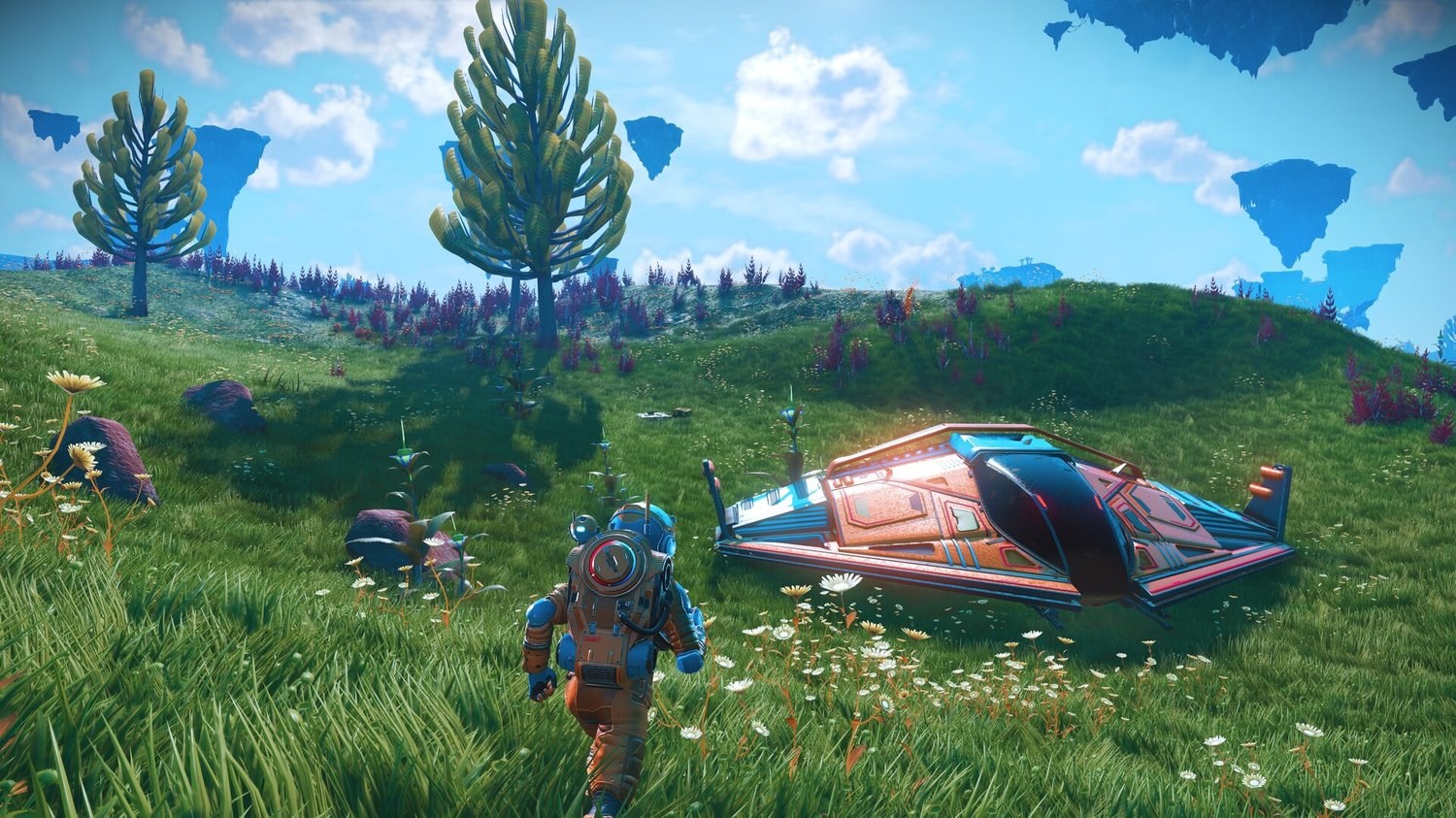
If you plan to put your next base on a Paradise planet in No Man’s Sky, warp to yellow stars with five or six planets and moons, scan every world in the system and keep going until one of them carries the title Paradise Planet, Paradise Moon or Paradise Giant. The game will only hand out that title to a lush world that is not a marsh world, has no storms and no extreme weather, and has its Sentinels at the lowest level for your On-Foot Combat setting.
Around most stars, roughly one lush planet in eight to ten gets the title. In a Normal galaxy like Euclid, where everyone starts, plan on checking 10 to 20 yellow systems before a Paradise planet shows up, while in a Lush galaxy such as Eissentam it will often take only a handful.
Yellow stars are the best place to look, a Lush galaxy will shorten the search, and purple systems are only worth the trip for Paradise Giants. Bear in mind that your On-Foot Combat setting changes which planets get the title as well: on harder combat settings, fewer lush planets qualify.
In this guide, I am going to go through the scan, the best places to look and a search route for every stage of the game. Everything here is based on the Forsaken update, PC version, with the game files read in November 2026. The rule and most of the odds were taken from those files for this guide and set against what players have reported over the last few years.
Contents
- What counts as a Paradise planet
- How to spot one from orbit
- Where to look
- A search route for every stage
- Paradise planet types
- How difficulty changes the title
- Hazards on a Paradise planet
- Paradise planet myths
- Questions about Paradise planets
- Conclusion
What counts as a Paradise planet
A Paradise planet is a lush world that the game itself titles Paradise Planet, Paradise Moon or Paradise Giant. You will see that title when you scan the planet from your ship, and you will also find it on the planet’s entry in the Discoveries page, the menu page that lists every system and planet you have found.
The planet will only get that title when five things are true at once: it has to be lush, it cannot be a marsh world, it needs to have no storms and no extreme weather, and its Sentinels have to sit at the lowest level for your current On-Foot Combat setting.
On-Foot Combat is the difficulty setting that adjusts how often hostile encounters happen while you are on foot, and it is going to come up again further down.
Nothing else counts. Star colour, galaxy, flora, fauna, water and temperature are not part of the rule, which means a Paradise planet can have lakes or no water at all, and it can be full of animals or almost empty.
| Condition | What you see on the scan |
|---|---|
| Title | Paradise Planet, Paradise Moon or Paradise Giant |
| Lush world | Lush names (Rainy, Verdant, Bountiful) before the overwrite |
| Not a marsh world | No marsh name such as Marshy, Boggy or Murky |
| No storms | One of the ten calm words, or an exotic word not in red |
| No extreme weather | Weather line not shown in red |
| Lowest Sentinel level for your On-Foot Combat setting | One of the twelve low Sentinel words |
| Not part of the rule | Star colour, galaxy, flora, fauna, water, temperature |
Sentinels at the lowest level
Paradise planets still have Sentinels. Their Sentinels line will read one of the twelve low words, such as Low, Limited, Sparse or Few, and patrols out in the open are rare there.
Buildings and other sites can still have guards, though, which is why the right way to describe a Paradise planet is that its Sentinels sit at the lowest level.
A planet without aggressive Sentinels does not qualify automatically either. Middle words such as Attentive, Frequent, Regular Patrols or Observant will also block the title, and while a planet with one of those words can still be a nice spot for a base, it will not show up as a Paradise planet on your current setting.
Names that mean nothing
Most lush planets also get a random name from a list of ten: Rainy, Verdant, Tropical, Viridescent, Grassy, Temperate, Humid, Overgrown, Flourishing and Bountiful.
These names say nothing about the weather or the Sentinels. A Verdant or Flourishing planet can be lovely, or it can be stormy, and the only way to tell is to read its Weather and Sentinels lines.
Bountiful is a little bit confusing, because it is also one of the top words on the Flora and Fauna lines, where it simply means that the planet has a lot of life.
Infested Paradise and Abandoned Paradise are names that infested and ruin-covered lush worlds can carry. They sound close, but they are not the Paradise title, and a planet that still shows one of them has most likely failed the rule.
Marsh worlds are the last trap. They will never get the title, even with gentle weather and few Sentinels, and you can spot them by names such as Marshy, Boggy, Foggy, Misty or Murky and by weather words such as Gentle Mist or Warm Fog.
How to spot one from orbit
You can read almost everything you need from space, and that is going to save you a lot of landings. This is the order I would go through:
- On the Galaxy Map, before you jump, pick the star. The map will show you its colour and how many planets and moons the system has, but it has no filter for lush planets, weather or Paradise planets (the only filters are No Filter, Economy, Conflict and Lifeform).
- When you arrive, scan the system. With a freighter, the Scanner Room will do this for you, since it is a freighter room that “probes all celestial bodies in the local solar system”. With only a starship, use the Starship Scanner in space and look at each planet. You are looking for a title that starts with Paradise.
- On the Discoveries page, read three lines for every planet: the title, the Weather line and the Sentinels line. The weather has to be one of the ten calm words (or one of the odd Bubble-world words covered below) and must not be shown in red. The Sentinels have to be one of the twelve low words. Flora and Fauna are down to your own taste.
- Fly to the planet with your starship and check the title again from orbit. This is also a good moment to look at the colour of the atmosphere and whether there is any water.
- Land, confirm the title once more and stay a while before you build anything.
| Calm weather words | Low Sentinel words |
|---|---|
| Temperate | Low |
| Light Showers | Minimal |
| Mild Rain | Low Security |
| Refreshing Breeze | Limited |
| Humid | Infrequent |
| Pleasant | Sparse |
| Balmy | Isolated |
| Mellow | Remote |
| Beautiful | Irregular Patrols |
| Blissful | Spread Thin |
| Intermittent | |
| Few |
Weather words that sound calm
On a normal lush world, the Weather line tells you how stormy the planet is. The ten calm words in the table all mean no storms, and that includes rain words such as Mild Rain and Light Showers.
Every Paradise planet with normal weather will show one of them. A calm word alone is not enough, though, because the Sentinels or a marsh world can still block the title.
Mostly Calm and Usually Mild are the two words that trip people up. They sound safe, but they belong to the stormy list, which means a planet with either of them gets storms and can never be a Paradise planet.
Some lush worlds use odd weather names such as Bilious Storms, Poison Cyclones or Corrupted Blood. Every Bubble world shows them, and some other lush worlds do too. Those names are cosmetic: such a planet can still be calm and can still be a Paradise planet, so trust the title over the weather word.
If the Weather line is shown in red, on the other hand, the planet has extreme weather and cannot be Paradise.
Check again before you build
The Scanner Room and the Discoveries page are great for making a shortlist.
Before you put down a base, fly to the planet and check the title again from orbit, and then once more when you land. It will only take a minute, and it is a lot less work than moving a finished base.
Where to look
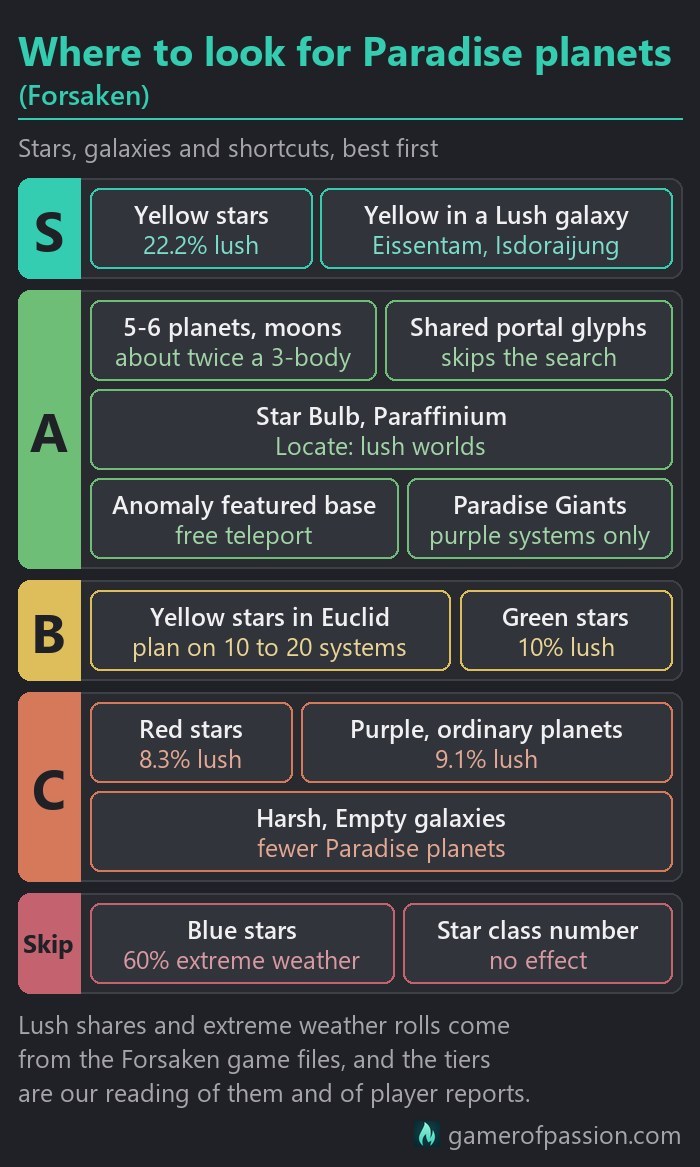
The tier list groups every target from S down to Skip. Yellow stars sit at the top, because about two planets in nine around a yellow star are lush, against about one in ten at the other colours.
Yellow stars in a Lush galaxy such as Eissentam or Isdoraijung are S tier as well, since they are the same stars with even more lush planets around them.
The A tier is a mix of ways to get more out of every jump. Systems with five or six planets and moons will give you more chances per system, shared portal addresses skip the search entirely, Locate on Star Bulb or Paraffinium takes you straight to lush planets, and a featured base in a Lush galaxy is a free teleport into one.
Paradise Giants are in A too. Purple systems, the star class that Worlds Part II added to the game, are the only place to find them.
Yellow stars in Euclid or another Normal galaxy only make B. They are the very same yellow stars as in S, but the search will take longer there, and you should plan on 10 to 20 yellow systems in a Normal galaxy. Green stars are B as well, with fewer than half as many lush planets as yellow stars but the same low chance of extreme weather.
Red stars, purple systems for an ordinary Paradise planet, and Harsh or Empty galaxies make up C.
Blue stars and the star class number end up in Skip. Blue stars have about as many lush planets as red or purple ones, but those planets roll extreme weather far more often, and the class number does not change your odds at all. The order of the colours below yellow is our reading of the game files.
| Star | Lush planets | Extreme weather roll | Lush planets with the title |
|---|---|---|---|
| Yellow (F, G) | 22.2% | 20% | One in eight to ten |
| Green (E) | 10% | 20% | One in eight to ten |
| Red (K, M) | 8.3% | 25% | One in eight to ten |
| Purple (X, Y) | 9.1% | 33% | One in eight to ten |
| Blue (B, O) | 9.1% | 60% | Half as many |
Star colour
Of everything the Galaxy Map shows you, star colour matters the most. Around a yellow star, about 22.2% of planets are lush, while green, red, blue and purple stars all sit at roughly one in ten. Paradise planets exist at every colour, yellow just has the most of them.
Blue stars are the worst choice. Their planets roll extreme weather three times as often as those of yellow and green stars (60% against 20%), and since a planet with extreme weather can never be Paradise, only about half as many lush planets around blue stars will carry the title.
The number after the star’s letter, as in G4 or F7, makes no difference to your odds. Only the colour matters, and F and G are both yellow, so never skip a yellow star because of its number.
Lush galaxies
Every galaxy in No Man’s Sky has a type, and a Lush galaxy is one that puts more lush planets around its yellow stars than a Normal galaxy like Euclid, which means you will usually scan fewer systems there before a Paradise planet turns up. Keep hunting yellow systems in a Lush galaxy too, since the bonus is for yellow stars.
Eissentam (galaxy 10) is the Lush galaxy most hunters use, and Isdoraijung (galaxy 19) comes next. Lush galaxies come two in every twenty: 10, 19, 30, 39, 50, 59 and so on up to 250, which makes 25 in total.
How big the bonus is, nobody can say for sure. The game files have no table for galaxy types, and none of the figures you might come across are backed by them.
Harsh and Empty galaxies still have Paradise planets, though probably fewer of them. I would not make one your hunting ground by choice.
Big systems
Every planet and moon in a system is another chance, which is why systems with five or six bodies are the ones to pick. A six-body system is about twice as likely to hold a Paradise planet as a three-body one.
The Galaxy Map will show you the number of planets and moons before you jump, and that is the second thing to check after the colour.
If you want a lake or a sea, prefer systems whose Galaxy Map entry ends in Water and confirm it on the planet itself. Water creatures in the planet’s Discoveries list are a good sign.
A search route for every stage
How you hunt will depend on how far into the game you are. The route below follows a save from the first hours to the late game, and you can join it at whatever step fits yours:
- Start in Euclid with yellow stars only. Open the Galaxy Map, pick yellow systems with five or six planets and moons, and scan every planet when you arrive. For this, the map is still the better choice, because it lets you check a system’s details before you jump, which warping straight to a star in the sky does not. Skip systems with only one or two bodies when another yellow star is in range, and plan on 10 to 20 yellow systems before your first Paradise planet.
- Read each scan and decide whether to land or move on. Only the title Paradise Planet, Paradise Moon or Paradise Giant counts, and you can expect about one Paradise planet for every eight to ten lush ones.
- Once you have picked up Star Bulb or Paraffinium, use Locate on it in the Catalogue. Every hit will be a lush planet (more on this trick below).
- Once you own a freighter, build the Scanner Room, ideally right next to the bridge to save walking, and warp the freighter instead of your ship. One scan will show every planet in the system on the Discoveries page. If you do not have a freighter yet, the freighter guide goes through the ways to get one. Additionally, the upload-all arrow on the Discoveries page will turn all those new entries into a few free nanites.
- In the mid game, move to a Lush galaxy. The free way is the Space Anomaly teleporter: switch to the Featured filter and look for a base in Eissentam or another Lush galaxy. Teleporting there costs nothing and saves you the long trip through the galaxy core. Otherwise, you are going to have to fly through the cores yourself. Eissentam is galaxy 10, which means nine trips through a galaxy core from Euclid, and Isdoraijung takes 18. Take a spare ship for those trips, because a core trip can damage your technology.
- In the Lush galaxy, keep the same rules: yellow stars, five or six bodies and a freighter scan. It will often take only a handful of systems there.
- Wherever you are, skip blue stars, ignore the class number, use green or red stars only when no yellow star is in range, and stay out of Harsh or Empty galaxies if you have a choice.
- In the late game, go after Paradise Giants once purple systems have opened up for you (see the Paradise Giants section below).
- At any point after A Leap in the Dark, you can take the shortcut and visit someone else’s find.
The Star Bulb trick
Star Bulb is a plant and Paraffinium is a substance, and both belong to lush planets. If you open the Catalogue and use Locate on either of them, the game will send you to a lush world.
Beware that this is not a Paradise finder. Only about one lush planet in eight to ten carries the title, which means you will still have to scan the planet before you land.
A few things can get in the way:
- You need to have picked up the plant or the substance once before you can locate it.
- If the Galaxy Map shows no marker, make the locate mission your active mission.
- If the system you are in already has it, the marker will stay right there. Jump far away first.
Shared coordinates
The fastest route of all is someone else’s find. Coordinate-sharing communities post the portal addresses of Paradise planets, and a portal dialled with the right glyphs will take you straight there, as long as you are in the galaxy the address was posted for.
Portal glyphs are the symbols you enter at a portal to travel to a planet’s address, and you get them through the A Leap in the Dark part of the story.
Use addresses that were posted since the last big update, and check the title yourself when you arrive. If you share a planet of your own, say which mode you play, because a planet that counts as Paradise on your save may not count on someone else’s.
Paradise planet types
Every type of lush world can carry the Paradise title, with one exception: marsh worlds never do. The shares in the table are weights from the game files, and the type names follow the file names rather than labels you will see in the game.
| Type | Share of lush worlds | Paradise title |
|---|---|---|
| Jungle | 19.5% (25.8% in purple systems) | Yes |
| Classic grass and trees | 14.6% | Yes |
| Rocky lush | 5.9% | Yes |
| Floral, giant flowers | 5.1% | Yes |
| Bubble | 2.2% | Yes, the calmest type |
| Ruins | 1.5% (9.0% in purple systems) | Yes |
| Marsh | 11.7% | Never |
| Giant planet | Purple systems only | Yes, as Paradise Giant |
Jungle worlds
Dense jungle worlds came with Worlds Part II, and they are the biggest group, with 19.5% of lush worlds outside purple systems and 25.8% inside them. Next to them, you will find classic grass-and-trees worlds, rocky lush worlds and floral worlds with giant flowers (those are probably the garden planets from Worlds Part I).
Bubble worlds are rare, but their own weather has zero storm chance, which makes them the calmest type. Only the star’s extreme-weather roll can still give them storms.
Ruin-covered worlds are rare too, though they will turn up far more often in purple systems.
Paradise Giants
Giant planets only appear in purple systems, and a lush giant can carry the title Paradise Giant. Look for a purple system built around one huge planet with its moons, where that planet is not labelled Gas Giant. They are rare, and you should plan on a long hunt.
Getting there takes a bit of work. Your starship needs the Atlantid Drive to reach purple stars, and your freighter needs its own upgrade, the Resonance Matrix.
Purple systems come with the In Stellar Multitudes story chain, which you will reach after the Atlas and Artemis paths and the Autophage story. In Abandoned mode, they are open from the start.
Paradise Moons
Moons can carry the title as well, as Paradise Moon, and they can do that around any star. Each moon is one more chance, which is another reason to pick systems with plenty of them.
How difficulty changes the title
Your On-Foot Combat setting changes which planets get the Paradise title. On harder combat settings, fewer lush planets will qualify, while easier settings and Creative let more of them through, and that is one reason why two saves, even in the same galaxy, can turn up very different numbers of Paradise planets.
As far as the game files show, the settings do not change which planets have storms. Turning combat down will not make a stormy planet a Paradise planet, because the storms belong to the planet itself.
Survival and Permadeath still have Paradise planets, but they are rarer there. If you share a Paradise planet, say which mode you play, because a find from Creative may not be Paradise on a Normal save.
The game modes themselves are explained in the beginner guide, and for this hunt the On-Foot Combat setting is the part to keep an eye on.
Hunt on a normal save as well. Expeditions can come with their own weather and Sentinel rules, and a planet can look different there.
On a new save, ignore the weather readings of your starting system while the tutorial runs. The first storms are part of the tutorial and they are scripted, so judge planets once you have built your first base and left the start system.
Hazards on a Paradise planet
A Paradise planet has no storms. As such, you will not see tornadoes or storm lightning there, but that does not mean nothing on the planet can hurt you.
Paradise planets can still get local hazards. Electrical anomalies can hurt your shield, meteor showers can come down at night, and some worlds get gravity inversions, roaming toxic clouds or geysers. Not every Paradise planet gets these events, but make sure to look around for a while before you build.
No storms also means no Storm Crystals. Storm Crystals are only found on planets with extreme weather, which is the opposite of what you want for a Paradise base. You will have to farm them somewhere else, and the money guide has more on that.
If you are picking a planet for a settlement rather than a base, the settlement guide has a few more points to look at, such as fairly flat ground.
Paradise planet myths
A lot of old advice about Paradise planets is still going around, and some of it will cost you hours. These are the claims you will run into most often.
The star class number is a good place to start. The idea is that the number after the star’s letter, as in G4 or F7, decides whether a yellow system is worth the jump. It makes no difference at all. Only the colour counts.
Next is the belief that Viridescent, Bountiful, Verdant or Flourishing planets are the next best thing to a Paradise planet. Those names are random and say nothing about storms or Sentinels, and you will only know whether such a planet is beautiful or stormy by reading its Weather and Sentinels lines.
Some people will tell you that Paradise is just flavour text, one more random name like Verdant. That is true for the other ten names. Paradise is a real title with five conditions behind it, and the game will only hand it out when all of them hold.
Another common belief is that Paradise planets are free of Sentinels. They have the lowest Sentinel level, and that still means a Sentinels line with a word such as Few, plus guards that can still turn up at buildings and sites.
Then there is the idea that any weather line with Calm in it is safe. Calm on its own is not one of the ten no-storm words, and Mostly Calm belongs to the stormy list. A planet with Mostly Calm or Usually Mild weather gets storms and can never be Paradise.
Star Bulb is often treated as the sign of a Paradise planet. It belongs to lush planets in general, and only about one in eight to ten of those carries the title.
Purple systems get recommended as a hunting ground quite often. For an ordinary Paradise planet, they are a poor choice: about one planet in eleven is lush there, the same small share as around blue stars, and that seems to hold even inside a Lush galaxy. Go there for Paradise Giants.
You will also see a fixed multiplier quoted for Paradise planets in Lush galaxies. The bonus in a Lush galaxy is for lush planets around yellow stars, and its size is unknown, because the game files have no table for galaxy types. More lush planets do mean more Paradise planets, but treat any fixed figure with care.
Every now and then, someone claims that the Paradise title has been dropped. It is still in the game in Forsaken, no update has replaced it with Lush or removed it, and Paradise planets, moons and giants still turn up. Since the Origins update in 2020, the game simply no longer calls a planet Paradise when it has hostile conditions.
Another claim is that finishing the purple story gives your freighter the Atlantid Drive for free. The Atlantid Drive is for your starship. Your freighter needs its own upgrade, the Resonance Matrix, before it can warp to purple stars.
Finally, old Paradise addresses do not always lead where they promise. Big updates have changed planets before, which means an address from an old list or video may not be a Paradise planet any more. Check the title when you arrive.
Questions about Paradise planets
How rare is a Paradise planet?
Roughly one lush planet in eight to ten around yellow, green, red or purple stars carries the Paradise title, and about half as many around blue stars. These are estimates from the game files and player counts rather than fixed odds.
If you still cannot find one after a long search, check your On-Foot Combat setting and the colour of the stars you are visiting before you blame bad luck. The setting changes how many lush planets carry the title, and the star colour changes how many lush planets you find at all, with blue stars also cutting the share that qualifies.
Is Euclid worse than a Lush galaxy?
Euclid is a Normal galaxy, and it has Paradise planets too. The search will simply take longer there, because a Lush galaxy puts more lush planets around its yellow stars.
If the Space Anomaly lists a featured base in a Lush galaxy, the move costs you nothing. If it does not, I would say the core trips are only worth it once you are settled in for a long hunt.
What is the Paradise Quotient?
The Paradise Quotient is a separate percentage that sits apart from the planet title. Your best one shows under Planetary Records in the Wonders section of the Catalogue, together with that planet’s portal address.
Can a Paradise planet lose its title?
It can. Your On-Foot Combat setting decides which planets get the title, and a planet that counts as Paradise on an easy setting may not count on a harder one. Big updates have also changed planets before. If your base sits on a Paradise planet, check its entry on the Discoveries page again after a big update or after you change your difficulty settings.
Conclusion
Finding a Paradise planet is mostly about reading the scan correctly and warping to the right stars. Yellow systems with five or six bodies, a freighter with a Scanner Room and, later on, a Lush galaxy will get you there a lot faster than random jumps.
That being said, the title is not everything. If all you want is a quiet place for a base, a lush planet with a calm weather word is probably going to serve you just as well, even if its Sentinels keep it from the title.