
If your energy credits keep running dry in Stellaris 4.5, the fix is nearly always more Technicians working your Generator Districts, a Trade surplus that your Wealth Creation policy can turn into energy, and fleets that sit docked at a starbase while you are at peace.
For a lot of energy fast, fill the Technician jobs you already have before you build anything new. Every 100 Technicians will make 6 energy a month, a full Generator District holds 200 of them, and each Solar Panel Network on an upgraded starbase will add 6 more without any upkeep.
Losing energy usually means that pops left their Technician jobs for new specialist jobs, that new districts and buildings cost upkeep before anyone works them, or that fleets away from dock eat the Trade your policy would have turned into energy.
To fix a deficit, pause your building, dock your fleets and bridge the gap with small market trades. Those trades cost Trade since 4.0 ‘Phoenix’ (May 2025), which made Trade a normal resource you stockpile and removed trade routes. Energy is simply one more good on the market, at about 130 Trade per 100 energy with the starting Market Fee, and that puts most older energy guides and videos out of date.
I am going to stick to the PC version on patch 4.5.4 ‘Cygnus’ here, and every source that needs a DLC is marked. Most figures were looked up in the 4.5.3 script files, since the 4.5.4 hotfix only fixed bugs and multiplayer stability, and a few market numbers are worked out from the rules in those files.
Contents
- Energy sources
- Energy tier list
- Why you are losing energy
- Running out of energy
- Energy by game stage
- How the market works in 4.5
- Lowering the Market Fee
- The Galactic Market
- Outdated energy advice
- Upcoming patch 4.6
- Energy credit questions
- Conclusion
Energy sources
Every regular empire gets a flat +20 energy a month, and a Machine Intelligence gets +40. Everything past that, you will have to build, staff or trade for.
| Source | Energy | How to get it |
|---|---|---|
| Base income | +20 flat (Machine Intelligence +40) | Every regular empire, not Nomadic Purger |
| Technicians (Generator District) | 6 per 100 jobs, 12 per district for 1 energy upkeep | 300 minerals, regular empires |
| Robot bonus | +2 per 100 Technicians (8 total) | Robot or synthetic empires, Machine Intelligence |
| Wealth Creation (Trade Policy) | Half the Trade surplus, 0.5 energy per 1 Trade | Default policy, not for gestalts or Worker Cooperative |
| Solar Panel Network | +6 each, +12 with a galactic studies resolution | Start tech, 50 alloys on a Starport, no module upkeep |
| Orbital energy deposits | +1 to +10 per deposit | Mining station, 100 minerals and 1 energy upkeep |
| Voltaic Production Yard | +200 Technician jobs, 12 energy for 2 energy upkeep | High-Energy Capacitors, 400 minerals, a building slot |
| Energy Generation zone | +100 Technician jobs per district (+6 energy) | Global Energy Management, 1,000 minerals |
| Generator World designation | +15% Technician Job Efficiency, +20% with Adaptability | Any non-capital planet |
| Energy Grid | +0.5 per 100 Technicians for 2 energy upkeep | Global Energy Management, 400 minerals, 1 per planet |
| Capacity Subsidies (edict) | +1.2 per 100 Technicians, +0.5 Trade upkeep per 100 | Edict after Global Energy Management, 30 unity a month |
| Energy techs | +5% Technician output each, repeatable +5% | Field Modulation, then the Quantum techs |
| Technician Automation Building | Automates 25% of Technician jobs, 50% with Optimization | Assembly Patterns, 8 energy + 4 per 100 automated jobs |
| Energy Nexus | +1.0 per 100 Technicians, 1.5 on a ring world | Planetary Power Grid, 2 energy + 1 Rare Crystal (ring 5 + 3) |
| Mutual Aid / Trade League policies | 0.2 / 0.15 energy per Trade | Worker Cooperative (MegaCorp), Trade League (Federations) |
| Dyson Swarm | Star output up to +3,000%, about 30 times | Dyson Swarm tech (The Machine Age), 20 alloys upkeep |
| Dyson Sphere | +1,000 per stage, +4,000 finished | Galactic Wonders, one per empire, final stage 10,000 alloys |
Generator Districts
Technicians make 6 energy per 100 jobs with no job upkeep, which makes them the cheapest energy in the game. Robot empires (a Mechanical main species, synthetic empires and Machine Intelligences) will get 2 more per 100.
A Generator District costs 300 minerals and 1 energy upkeep and holds 200 Technician jobs, which will give you 12 energy once they are filled. How many you can build depends on a planet’s energy deposits, and Desert, Arid and Savanna worlds are 1.5 times as likely to roll each one.
Global Energy Management opens the Energy Generation zone, one of the biggest single steps you can take on a generator world. It will add 100 Technician jobs to every Generator District on the planet, for 300 per district, plus 3 building slots for the Energy Grid and other generator buildings.
The Generator World designation will add +15% Technician Job Efficiency, or +20% once you finish the Adaptability tradition tree. Your capital cannot take it.
For the building slots, you will mostly use these:
- The Voltaic Production Yard adds 200 Technician jobs for 2 energy upkeep, about 10 net energy once they are filled.
- The Energy Grid adds 0.5 energy per 100 Technicians for 2 energy upkeep. Its upgrade, the Energy Nexus, will make 1.0 per 100 for an extra Rare Crystal a month, or 1.5 per 100 on a ring world, where its upkeep rises to 5 energy and 3 Rare Crystals.
- The Conductive Works Complex line, up to the Planetary Nexus, raises the Generator District cap of a capped planet by 2, 4, 6 and finally 8, with Rare Crystal upkeep from the second step on.
- The Technician Automation Building works 25% of the Technician jobs without pops for 8 energy plus 4 per 100 automated jobs, and our automation building guide shows when that pays off.
Additionally, Field Modulation, Quantum Energy States and Quantum Field Manipulation each add +5% energy from Technicians.
Capacity Subsidies, an edict that also needs Global Energy Management, will give Technicians +20% Job Efficiency, about +1.2 energy per 100. It costs 30 unity to enact, 30 unity a month (both scaled by Empire Size) and +0.5 Trade upkeep per 100 Technicians. I would turn it on once you run a few hundred Technicians and your unity can carry it.
Wealth Creation
Trade is the everyday economic resource of 4.x. Your Civilians, Clerks and Traders make it, and you will spend it on ship logistics, colony upkeep and the market.
Your Trade Policy, an empire-wide policy, decides what part of that Trade turns into other resources. The default, Wealth Creation, turns half of it into energy at 1:1, which means 100 spare Trade a month will give you 50 energy and leave the other 50 as Trade.
Beware that it only converts your Trade surplus, which is what is left after ship logistics and Planetary Deficits, and your ships will pay no Trade logistics while they are docked at a starbase, half of it in friendly space and double in hostile space. Planetary Deficits are the Trade a colony pays when it uses more of a resource than it makes, around 12.5 Trade a month for 100 missing energy or food.
A fleet leaving dock or a colony with a local deficit is going to cut your energy as well, even if your energy upkeep stays the same.
Traders make 8 Trade per 100 jobs for 1 consumer goods, which works out to 4 energy plus 4 Trade, and Clerks make 3 Trade, or 1.5 of each. For pure energy, Technicians are clearly better.
Hive Minds and Machine Intelligences only have a Logistics Policy, which keeps their Trade as Trade, and for a gestalt it never turns into energy.
Starbase energy
A Solar Panel Network is a starbase module for 50 alloys that makes 6 energy with no upkeep of its own, and its tech, Orbital Energy Conversion, is one you start with. While you are a Galactic Community member and a galactic studies resolution such as Astral Studies Network is in force, each panel makes 12. You will not be able to build one in a black hole system or next to a Dyson Sphere from its third stage on.
Modules need an upgraded starbase, though, and a Starport costs 250 alloys and 2 energy upkeep and uses Station Capacity, the number of upgraded starbases you can run without a penalty, which starts at 3 and grows a little with every system you own.
Each starbase over the cap will add about +25% Station Upkeep to all of them, while Outposts do not count at all.
Mining stations on orbital energy deposits make 1 to 10 energy each for 100 minerals and 1 energy upkeep. A +1 deposit only pays for its own station, so leave those for later.
Megastructures
The Dyson Swarm (The Machine Age DLC) will raise its star’s output by +500%, +1,500% and finally +3,000%, about 30 times what the star made before. A star with a +3 energy deposit will end near 90 energy a month for 20 alloys of upkeep.
The 500, 1,000 and 1,500 on its stages are alloy build costs. Since the Swarm only multiplies what the star itself produces, you should put it around your best energy star.
The Dyson Sphere is the biggest single source you can build, with +1,000 energy per stage and +4,000 once finished. Its tech comes through the Galactic Wonders ascension perk, and you can have one per empire (a second one with the Isolated Contingency Core relic). With The Machine Age, you build it by upgrading a finished Dyson Swarm.
Energy tier list
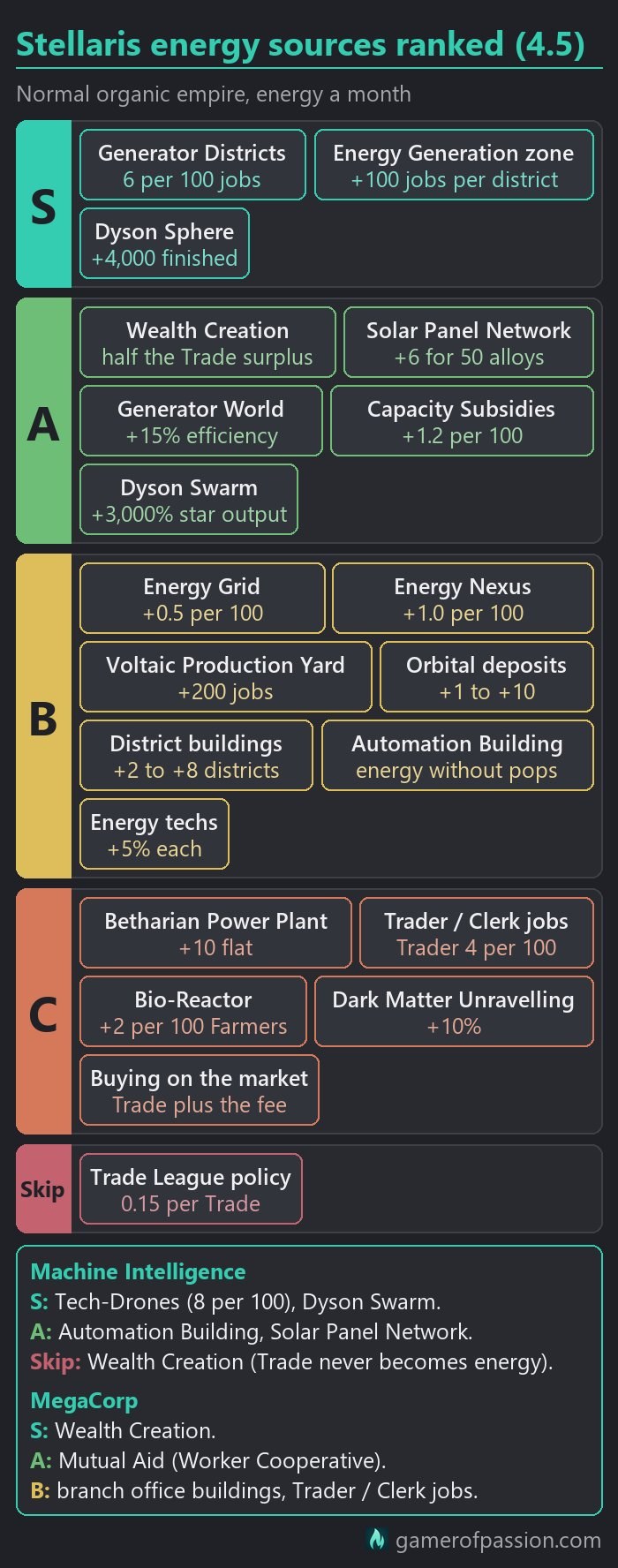
This is how I would rank the sources for a normal organic empire, with Machine Intelligences and MegaCorps at the end.
S tier
Generator Districts, the Energy Generation zone and the Dyson Sphere. The first two are the backbone of every energy economy, and the Sphere makes more than anything else, but it arrives late and costs a fortune.
A tier
Wealth Creation, Solar Panel Networks, the Generator World designation, Capacity Subsidies and the Dyson Swarm. The first three cost you next to nothing. Capacity Subsidies costs unity and a little Trade, and the Swarm needs The Machine Age and a good star, but both pay back well.
B tier
The Energy Grid and Nexus, the Voltaic Production Yard, orbital energy deposits, the Conductive Works Complex line, the Technician Automation Building and the energy techs. Each one needs something first, such as enough Technicians to beat the upkeep, pops for the new jobs or a planet at its district cap.
C tier
The Betharian Power Plant (only with its deposit), Trader and Clerk jobs, the Bio-Reactor, Dark Matter Unravelling and buying energy on the market. These are patches or bridges.
Skip tier
The Trade League policy (Federations DLC), if energy is what you are after. It gives 0.15 energy per Trade against 0.5 under Wealth Creation. The federation can still be worth it for other reasons (see our federation types guide).
Machine Intelligence
Tech-Drones make 8 energy per 100 and the empire starts with +40 base energy, which puts them in S tier. The Dyson Swarm moves up to S too, since machines pay energy for Calculators and their other complex drones, and it boosts research stars as well.
Technician automation climbs to A, as it pays from about 800 jobs, and Solar Panel Networks stay in A (Astro-Mining Drones get the Astro-Mining Bay, +5, instead). Wealth Creation and Trade jobs drop to skip, because a gestalt has no Trade Policy.
MegaCorp
For a MegaCorp (the Corporate authority needs the MegaCorp DLC), Wealth Creation becomes S tier. The authority adds +10% Trade from jobs, the Mercantile diplomatic stance it can pick adds +10% Monthly Trade, and since 4.5 your Branch Office and Commercial Pact Trade runs through the policy as well.
Worker Cooperative empires get Mutual Aid instead, which turns 75% of their Trade into resources, 0.2 energy, 0.2 minerals, 0.2 food and 0.075 unity per Trade. That is A tier, and our civics ranking covers the civic itself. Branch office buildings (+8 to +10 energy each, scaled by Branch Office Value) and Trader or Clerk jobs move up to B.
Why you are losing energy
Hover over your energy income in the top bar first. The tooltip splits it into income and upkeep, and one of these eight causes is almost always behind a sudden drop. I would check them in this order:
- Empty Technician jobs. Pops fill specialist jobs before worker jobs, which means every new lab or factory can pull Technicians off your districts. Hold back on specialist buildings or lower specialist job priority, and every 100 Technicians you get back will be worth 6 energy.
- Buildings and districts built ahead of your pops. They will cost upkeep whether anyone works them or not, 2, 5, 8 or 10 energy for a building depending on its tier, 2 for a City District and 1 for a rural district. Stop building for a while and disable or demolish what stands empty.
- Fleets away from dock. Docked ships pay no Trade logistics, which leaves more Trade for your policy to convert. Their energy upkeep (1 for a corvette up to 8 for a battleship, see our ship design guide for the hulls) stays the same in dock. Crew Quarters on the starbase they orbit, a 50-alloy building, will cut it by 25% for the ships in orbit.
- Too many warships. Going over your Naval Capacity will raise military ship upkeep, and the penalty grows the further over you go. Check the fleet upkeep tooltip before you build past the cap.
- Too many upgraded starbases. Every one above your Station Capacity will raise the upkeep of all of them. Downgrade spare ones back to Outposts (1 energy, outside the cap), and do not copy the AI’s starbase count, because the AI pays no penalty for this.
- Conquered planets and stations. Switch off or demolish the inherited buildings, research stations, Arc Furnaces and starbases you do not need.
- Automation buildings and auto-built defence platforms. Keep Technician automation for big generator worlds, where its 8 energy plus 4 per 100 automated jobs pays off from about 1,600 Technician jobs.
- A smaller Trade surplus. Wealth Creation only converts what is left, and every 100 Trade you lose to logistics or Planetary Deficits will cost you 50 energy. Fix the Trade first.
Running out of energy
A negative energy income only drains your stockpile at first. Once the stockpile hits zero, though, the Energy Shortages situation will open in your Situation Log. It replaced the old flat deficit penalty.
It will start at 15 progress and climb by up to 5 a month while you sit at zero with a negative income. Every month with a positive income will take 5 off again.
| Stage | Effect |
|---|---|
| Start | Zero energy opens Energy Shortages at 15 progress |
| Empty stockpile | Up to +5 progress a month |
| Positive income | Takes 5 progress off every month |
| Up to 25 progress | Ship weapon damage and speed cut by 20% |
| Up to 50 progress | Ship weapon damage and speed cut by 40% |
| Up to 75 progress | Ship weapon damage and speed cut by 60% |
| Up to 100 progress | Ship weapon damage and speed cut by 80%, all jobs -10% |
| Every stage | Also cuts diplomatic weight and pop assembly |
| Bioship empires | Exempt from the ship penalties |
| Bankruptcy! (100) | One-off energy bailout, all buildings downgraded |
| Bankruptcy! (100) | Each warship deleted on a 50% roll, offensive armies removed |
| Empire Defaulted (10 years) | +25% costs, -50% influence and unity, -25% weapon damage |
Its stages will cut your ship weapon damage and speed by 20%, 40%, 60% and 80% and lower your diplomatic weight and pop assembly, and the last one takes another 10% off every job. Since 4.5, bioship empires are exempt from the ship penalties.
With an income of half your expenses, you are going to reach 100 in about 17 months, or 34 on Cadet difficulty.
Do not let it reach 100. At that point the “Bankruptcy!” event fires. You will get a one-off bailout of 1,000 energy, plus 1,000 for every ten years the game has run (up to 15,000), but every building in your empire will be downgraded, each warship will be deleted on a 50% roll, all offensive armies will be removed, and Empire Defaulted stays on you for 10 years with +25% costs, -50% influence and unity and -25% weapon damage.
If you are already deep in stage 3 or 4, switch the situation’s approach from Maintain Current Expenditures to Cut Scientific Investment. It will halve researcher output but cut building energy upkeep by 20%.
Reaching stage 4 will also fire Spiralling Deficits, an event that lets you borrow from your supporters or reallocate resources from one planet at the cost of 50 devastation there.
To get out for good, bridge first and build second. Sell a surplus of minerals, food or a strategic resource for Trade and buy energy in small amounts. Then add income that lasts, such as +12 for a filled Generator District (+18 with the zone), +6 per Solar Panel Network and about +1.2 per 100 Technicians from Capacity Subsidies.
Energy by game stage
Early game
For roughly the first 20 years, keep Wealth Creation. Switching to another Trade Policy before you have spare energy is one of the most common early crashes.
Fill your starting Generator Districts first (a Prosperous Unification capital has three) and add more only as pops free up, since each one needs 200 of them. Put Solar Panel Networks on your home starbase, build mining stations on energy deposits of +3 and better, and research High-Energy Capacitors and then Global Energy Management as soon as they come up. Our beginner guide has the rest of the opening.
Mid game
Make one dry planet with plenty of Generator Districts your generator world, with the Energy Generation zone and the Generator World designation. Add an Energy Grid once it has about 400 Technicians, and turn on Capacity Subsidies.
With The Machine Age, this is the time for a Dyson Swarm on your best energy star (3,000 alloys over three stages). If you have subjects, a Prospectorium (Overlord DLC) will raise its own energy and minerals by 10% to 30% through its specialist perks and make your mining stations cheaper to build, and our vassal guide explains how to get one.
Late game
Upgrade to the Energy Nexus on worlds with about 1,500 Technicians and spare Rare Crystals, and make sure every big generator world has a Technician Automation Building. The Dyson Sphere is the big late project if you took Galactic Wonders (with The Machine Age, you get it by upgrading a finished Dyson Swarm), though its last stage alone costs 10,000 alloys and 5,000 unity.
Generator segments on a Ring World multiply the zone’s jobs by five and get 1.5 energy per 100 Technicians from the Nexus (see our Ring World guide), and habitats have their own Energy Generation zone too. Repeatable energy techs and Dark Matter Unravelling add the last few percent.
How the market works in 4.5
The market is where you swap resources for Trade and back. Energy has a base price of 1 Trade, and every deal pays the Market Fee, the market’s cut of each trade, which starts at 30%.
The fee is already inside the price the market shows you. That is why 100 energy at base will cost you about 130 Trade, or about 105 at the 5% floor, and why a sale pays out less than the base price.
| Rule | Value |
|---|---|
| Market currency | Trade, 1 Trade per energy at base |
| Market Fee | 30% base, 5% floor, each cut subtracts points |
| Buying 100 energy at base | About 130 Trade at the 30% fee, inside the shown price |
| Base prices: energy to alloys | Energy, minerals, food 1, consumer goods 2, alloys 4 |
| Base prices: motes to Dark Matter | Motes, gases, crystals 10, Living Metal, Zro, Dark Matter 20 |
| Price band | 20% to 500% of base price, plus the Market Fee |
| Safe monthly amounts, Internal Market | Buy up to 42, sell up to 64 energy, minerals or food |
| Galactic vs Internal Market | Half the price move, 3x faster recovery, members only |
| Single-trade cap | 20,000 energy (200 market units), 5,000 alloys |
| Monthly trade limit | None, monthly orders start at 10 energy |
| Stockpile caps | Energy 25,000, minerals, food, alloys 15,000, Trade 50,000 |
| Form the Galactic Market | +10,000 storage for every Galactic Community member |
| 4.5.4 fix | Save loads no longer re-count a month of monthly trades |
Prices will move with every trade, anywhere between 20% and 500% of base, and drift back toward base over time. Until the Galactic Market is founded, or while you have no access to it, you will trade on your own Internal Market. There, each trade will move the price twice as much, recovery takes three times as long, and you can probably only trade resources your own empire produces.
Patch 4.5.4 fixed a bug where every save load counted another month of your monthly trades and pushed prices away from base. On the Galactic Market, AI empires will buy a resource once their stockpile covers less than six months, which pushes shared prices up.
Bear in mind that running out of Trade is a deficit of its own, with -25% Job Efficiency and double Empire Size.
Trading tips
- Count what energy really costs in Trade, which comes out of the same stockpile that keeps your ships and colonies supplied.
- Use monthly orders below the safe amounts on the Internal Market. At base price you can buy up to 42 or sell up to 64 energy, minerals or food a month, 21 and 32 consumer goods, 10 and 16 alloys, 4 and 6 motes, gases or crystals, and 2 and 3 Living Metal, Zro or Dark Matter.
- Buy energy to bridge a short deficit or when its price is at or below base, and stop once your income is fixed.
- Sell surplus steadily. Each 100 sold at base will lower the Internal price by only 0.6%, but a 1,000 sale pushes it about 6% down, and it takes about four years to recover.
- Avoid one big buy on the Internal Market. 1,000 energy at once will push the price about 20% up, and it takes over two years to come back. 10,000 triples it, with about twelve years to recover. The Galactic Market moves half as much and recovers about three times faster, but other empires move that price too.
- Never buy and sell the same resource, as you pay the fee both ways.
- Cut the fee before you trade a lot, with Insider Trading first and a Galactic Stock Exchange or Trader Proxy Office after that.
- Sell big surpluses to AI empires in diplomatic trade deals when you can. They cost no Market Fee and leave market prices alone.
- Keep enough in stock to cover every monthly sell order.
- There is no monthly trade limit, and one trade is capped at 20,000 energy (5,000 alloys). The price is your real limit.
Lowering the Market Fee
Each fee cut subtracts its points from the 30%, and no combination goes below 5%. Insider Trading from the Commerce tradition (after Adaptive Economic Policies) will bring you to 20% by itself, and that makes it one of the first picks for any empire that trades a lot. Our tradition tier list rates the rest of Commerce.
Gestalts get the same -10% from Galactic Exchange Efficiencies in their Logistics tree, and a Machine Intelligence can stack it with Adaptive Programming from Versatility.
| Source | Fee | Who can get it |
|---|---|---|
| Insider Trading (Commerce tradition) | -10% | Regular empires |
| Market Nexus (Galactic Market host) | -10% | Owner of the Galactic Market Station system |
| Galactic Exchange Efficiencies (Logistics tradition) | -10% | Gestalts (Hive Minds, Machine Intelligences) |
| Adaptive Programming (Versatility tradition) | -10% | Machine Intelligences only |
| Galactic Stock Exchange (building) | -5% | Regular empires with the rare tech Galactic Markets |
| Trader Proxy Office (Leviathans Story Pack) | -5% | Starport by a Trader enclave (not gestalts), or Nomads |
| Secrets of the Inetian Traders (Cosmic Storms) | -5% | Reward of the Inetian precursor chain |
| Trader Liaison (Leviathans Story Pack) | -1% per councilor level | Leader with a Trader enclave liaison trait |
| Economic Sanctions | +10/20/30% | Members in breach or denounced |
The smaller cuts are a little bit harder to reach. The Galactic Stock Exchange (-5%) needs Galactic Markets, a rare tech gestalts never get. The Trader Proxy Office (-5%) needs a Starport in a system with a Trader enclave, and those enclaves only spawn with the Leviathans Story Pack.
For example, Insider Trading plus Market Nexus (the Galactic Market host’s -10%) will put you at 10%, and one Galactic Stock Exchange more reaches the 5% floor.
The fee can go up as well. Galactic Community sanctions add 10% per level, up to +30%, for empires in breach of a resolution or denounced, and there is no maximum fee.
The Galactic Market
The Galactic Market is one shared market for the members of the Galactic Community, and everyone else keeps their Internal Market. Genocidal civics never get access at all.
It starts with the Galactic Community resolution Form the Galactic Market. Once it passes, every member will get +10,000 resource storage, which lifts your energy cap from 25,000 to 35,000, and a five-year nomination begins. Our influence guide covers the influence you will need for the Galactic Community. This is how the whole process works:
- Join the Galactic Community and meet at least three other regular empires (Fallen Empires and other special countries do not count).
- A member that is neither a gestalt nor genocidal proposes Form the Galactic Market for 100 influence. When it passes, the 1,800-day nomination starts, along with the galactic focus Founding the Galactic Market.
- Nominate one planet with Galactic Market Hub Nomination for 1,000 energy and 150 influence. Your empire needs more than 2,000 pops and must have been a member when the nomination began. Nomadic and Inward Perfection empires cannot nominate, and neither can a Nanotech World. The game will then roll a rating of Weak, Adequate or Strong.
- If you like, use Boost Nomination Bid (2,000 energy and 300 influence) up to twice, one rating step each, up to Exceptional and then Perfect. Revoking costs 10 influence and refunds nothing.
- On day 1,800, one nominated planet is drawn as the host. With no nominee, the attempt fails and the resolution can be proposed again.
- The host will get Market Nexus and the Galactic Market Station, every member will get access and 100 influence from the finished focus, and strategic resources appear once any member produces them.
- A member that later takes the station’s system becomes the new host. If the system goes to no one, a genocidal empire or a non-member, the station will move to a random member’s capital, most likely one in contact with the old host. If the host leaves the Galactic Community, the market will close and a new nomination will start.
- With the Federations and MegaCorp DLCs, any member except the host, gestalts and genocidal empires can propose Relocate Galactic Market (100 influence) once 50 years have passed since the market was founded or last moved. It reopens the nomination, and with no nominee, the market stays where it is.
If the market never forms in your game, then nobody has proposed the resolution yet, it has not passed, or nobody nominated a planet in time.
The host draw
The draw is a weighted lottery among the nominated planets, held on the day the nomination ends. Each nominee’s weight is 1 plus its rating (1 to 5) plus its empire’s monthly Trade income on that day, and the Trade income counts for far more than the rating. Two boosts cost 4,000 energy and 600 influence for the weight of 2 more Trade a month.
For example, a Perfect nominee from an empire making 40 Trade a month will only win about 18% of the time against an AI with a Weak rating and 120 Trade (about 49%) and one with an Adequate rating and 80 Trade (about 33%). I would skip the boosts unless every nominee has a low income, and put those resources into Trader jobs and other Trade income before the draw.
The planet itself only counts for the first rating roll. An Ecumenopolis, or a MegaCorp planet with 120 or more Trade, will roll Strong about 80% of the time, a normal planet under 50 Trade only 2%.
The AI never nominates a planet under 2,000 pops, which can leave you with few rivals in a young galaxy. Reloading to re-roll the draw is not reliable, while raising your Trade income before it will change your odds.
Host benefits
The host will get Market Nexus, a -10% Market Fee for as long as it owns the station’s system, and that is the only host bonus.
Outdated energy advice
A lot of the energy advice you will find online predates 4.0 or the changes since. None of these points hold in 4.5:
- Trade value, trade routes, trade-route piracy and starbases collecting trade were removed in 4.0 ‘Phoenix’.
- Wealth Creation converts half of your Trade surplus, never all of your trade.
- The Energy Grid’s “+20%” is stale in-game concept text, and the building really adds 0.5 energy per 100 Technicians.
- The Technician edict is Capacity Subsidies (there is no Energy Subsidies edict), and its extra upkeep is Trade, whatever its tooltip says.
- There is no Generator support specialization for City Districts in 4.5.
- An energy deficit does more than weaken your ships. Energy Shortages also cuts diplomatic weight and pop assembly, takes 10% off every job in its last stage and ends in Bankruptcy at 100.
- Boosting your nomination will not win you the market, because Trade income counts for far more in the draw and the old “rating times system trade” formula is from before 4.0.
- Job values count per 100 jobs in 4.x, which means per-pop numbers from older guides do not carry over.
Upcoming patch 4.6
The Willpower DLC and the free 4.6 ‘Corona Borealis’ update are planned for 23 November 2026. On the 4.5.3 Experimental branch, Paradox already changed how the AI buys, sells and stockpiles on the market, and it may move those changes into 4.6 (they are not part of 4.5.4). As of 11 November 2026, Paradox had published no release notes for the base-game part of 4.6, and this guide will get an update once 4.6 is live.
Energy credit questions
How much energy income is normal?
A normal start runs a small surplus of a few dozen energy a month, about +35 to +40 on day 1, and every outpost, ship and building you add eats into it. Watch the tooltip whenever you add a colony or a fleet.
What should I do with too much energy?
Sell it in monthly orders before you hit the cap and use the Trade for whatever you are short on, alloys for example. Energy also pays for clearing blockers, for decisions and for the 1,000 energy Galactic Market Hub Nomination.
Is the Energy Nexus worth it?
On a big generator world, yes. The upgrade costs 600 minerals and 50 Rare Crystals and adds another 0.5 energy per 100 Technicians for 1 Rare Crystal a month. It will pay for itself from about 1,500 Technicians if you have spare crystals, or closer to 2,600 if you have to buy them, and it needs Planetary Power Grid and an upgraded capital.
Which Trade Policy is best for energy?
Wealth Creation, by a wide margin. It will turn half your Trade surplus into energy at 1:1, while the Trade League policy gives 0.15 energy per Trade and Mutual Aid 0.2. Consumer Benefits and Marketplace of Ideas need Adaptive Economic Policies from Commerce, and I would only switch to them once your energy income can stand without the policy.
Conclusion
Energy in 4.5 is mostly a question of jobs. Fill your Technician jobs before you build anything new, give one world the Energy Generation zone and keep Wealth Creation running while energy is tight.
The market is a good bridge in small monthly orders, but a long deficit will cost you far more than any trade once Bankruptcy comes into sight. If you only change one thing today, make it the Energy Generation zone on your best generator world.