
What are the best leader traits to take in Stellaris 4.6, where one leader can only carry two basic and three veteran traits? For a Commander, the destiny traits Master Gunner on an Admiral and Genius Armorer on a Strategist sit at the very top, and before level 8 you will want Skirmisher on the council and Aggressive on a fleet.
A council Scientist should take Expertise in the field you are going to research next, Maniacal and Spark of Genius. Officials will do their best work on the council with Charismatic and Politician, while a governor does well with Unifier or Forge Focused. For your ruler, Titan of Industry is the strongest starting pick for an Under One Rule start, and on a normal start Charismatic or a Spark of Genius Scientist ruler are the safe choices.
Most of this is a Galactic Paragons feature. Without the DLC, the game assigns traits as leaders level up, and the tiers below will matter most if you own it. All trait values in this guide match the leader trait files of the 4.6.0 build.
Next to the tiers for each leader class, I will also explain how picks, negative traits and immortal leaders work in 4.6.
Contents
- How leader traits work
- Best traits per class
- Commander traits
- Scientist traits
- Official traits
- Destiny traits by veteran class
- Ruler traits
- What 4.6 changed
- Negative traits
- Immortal leaders
- Playing without Galactic Paragons
- How to choose leader traits
- Conclusion
How leader traits work
Leader traits belong to one Commander, Scientist or Official and work through whatever job that leader holds. Species traits are a separate system, and you’ll find those ranked in the Stellaris species trait tier list.
With Galactic Paragons, every level-up from level 2 to level 10 gives you a trait pick. Each pick shows 2 new traits, and upgrades of traits the leader already has can appear next to them.
Mind that a trait has its own levels, too. An upgrade takes level 1 of Carefree to level 2 of Carefree, which has nothing to do with the leader’s own level.
At level 4, you will pick the leader’s veteran class, a subclass that shapes which veteran traits they are offered later. Commanders choose between Admiral, General, Commissioner and Strategist, Scientists between Explorer, Scholar, Analyst and Statistician, and Officials between Industrialist, Ambassador, Advisor and Delegate (whose Ideology and Envoy bonuses need Willpower). At level 8, the destiny trait comes up with 3 options, and the game will try to make one of them fit your ethics.
A leader holds at most 2 basic and 3 veteran traits, the veteran ones being the stronger traits tied to the veteran classes. Once both groups are full, every pick will only offer level 2 or level 3 of traits the leader already has.
A councilor sits in one of your council seats, and a council trait gives its listed value to the whole empire at its current level, and more once you upgrade it. Governor traits only touch the planet and sector the leader governs, and fleet traits only the fleet a Commander leads.
Offers lean toward that job as well. A trait for the leader’s current post is weighted 5 times higher, one for another post only a quarter as high, and traits of their veteran class count double.
You can get more options per pick from adopting Aptitude, the Vaults of Knowledge civic (or its hive, machine and corporate versions), Meritocracy and the Gifted trait, all of which need Galactic Paragons for this bonus. Without Galactic Paragons, the game assigns traits as your leaders level up, and the base-game section further down explains that version.
Best traits per class
Few rankings exist for leader traits in the 4.x versions, which is why most tiers here lean on the 4.6 trait values, weighed against the few player reports from 4.0 to 4.6. S means a trait you will build a leader around, A is a pick you take whenever it is offered, B is good in the right job, C only fits a narrow plan and D is a trait you would rather skip.
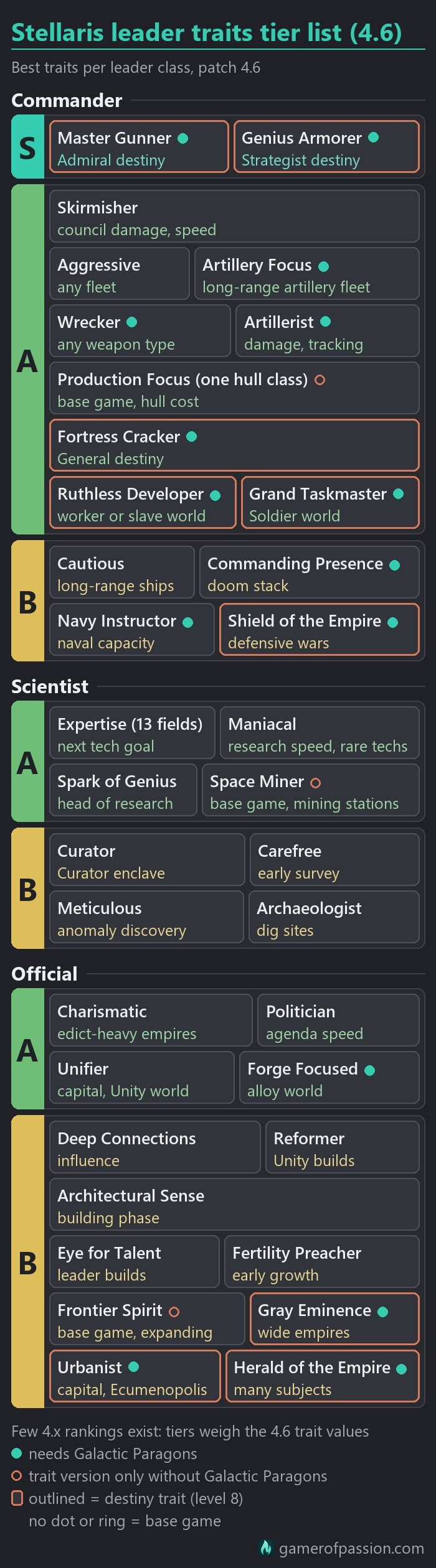
Three picks reach S tier. Master Gunner and Genius Armorer are destiny traits for an Admiral and a Strategist, and Titan of Industry is a Luminary trait that only the ruler of a Materialist empire with the Under One Rule origin can take. Everything else lands in A or below, because most traits give a solid bonus in one job and nothing anywhere else.
On the chart, a chip with the Galactic Paragons marker needs that DLC, a chip marked as base game only is a trait version you only get while you play without it, and a chip with no marker works in the base game (level 3 of a few of those still needs the DLC, which the tables show). Destiny traits keep their own outline inside their class group, since you will only ever see them at level 8.
Commander traits
| Trait | Tier | What it does | Best slot | DLC |
|---|---|---|---|---|
| Skirmisher | A | Council: +5% weapons damage, +15% sublight speed | council | Base game |
| Aggressive | A | Fleet: +5% fire rate, +5% weapons damage | fleet | Base game |
| Artillery Focus | A | +20% / +35% artillery damage, +15% / +35% range | fleet | Galactic Paragons |
| Wrecker | A | +15% / +25% weapons damage, -35% / -50% debris | fleet | Galactic Paragons |
| Artillerist | A | +10% / +15% damage, +7.5% / +10% tracking | fleet | Galactic Paragons |
| Production Focus (one hull class) | A | Council: -30% build cost of one hull class | council | Base game only |
| Cautious | B | Fleet: +20% weapons range, +5% disengage chance | fleet | Base game |
| Commanding Presence | B | +50 / +80 fleet command limit | fleet | Galactic Paragons |
| Navy Instructor | B | +25 / +50 naval capacity, +120 / +200 ship experience | council | Galactic Paragons |
| Intimidator | C | +0.5 / +0.75 influence from Power Projection | council | Galactic Paragons |
| Guardian, Defense Engineer, Fortifier, Border Guard | D | Guardian: +10% / +20% platform damage and hull | council | Guardian, Border Guard: Galactic Paragons |
| Engineer | D | +0.5% hull, +1% armor regen per day | fleet | Base game |
Skirmisher is the cheap, strong pick for an early council Commander. It will give your whole navy +5% weapons damage and +15% sublight speed, and it does all of that from a basic trait with a single level.
On a fleet, Aggressive adds +5% fire rate and +5% weapons damage. It is the opposite of Cautious, which means a Commander will only ever hold one of the two. Aggressive is the better general pick, while Cautious suits long-range ships.
Once your Commander becomes an Admiral, the stronger traits will start to appear. An Admiral draws from a pool of a bit over a dozen veteran traits, and three of them stand out. Artillery Focus gives up to +35% artillery weapon damage and up to +35% weapons range, Wrecker gives +15% and then +25% weapons damage for any weapon type (at the cost of less debris after a fight), and Artillerist adds damage and tracking, with some accuracy at level 2.
I would say Wrecker is the safest of the three, because it does not care what your ships carry. Beware that the four Focus traits (Artillery, Carrier, Guidance System and Gunship) rule each other out, and an Admiral can hold only one of them. Wrecker and Jury-Rigger also exclude each other.
Without Galactic Paragons, a council Commander can get one of the four Production Focus traits instead, which make one hull size 30% cheaper to build. The base-game section has more on those.
Cautious is the quiet pick in B tier. Its +20% weapons range is a big number for a basic trait, and on long-range ships it will often be worth more than the damage of Aggressive. Commanding Presence (up to +80 command limit) lets one Admiral lead a much bigger doom stack, and Navy Instructor, a Strategist trait, adds naval capacity on the council and gives new ships more starting experience.
Intimidator only raises the influence you can get from Power Projection while its Commander is on the council. That is weaker than any trait that simply gives you influence, which is why it sits alone in C tier.
The defense group sits at the bottom. Guardian gives the same two stats as Defense Engineer (defense platform damage and hull), and Fortifier and Border Guard also only boost starbases and platforms. Take them only if you’re going to stay at home and defend. Engineer is weaker still, since a little hull and armor regeneration per day is too small to matter in a fight.
Scientist traits
| Trait | Tier | What it does | Best slot | DLC |
|---|---|---|---|---|
| Expertise (13 fields) | A | +15% / +30% / +50% research speed in one field | council | Base (level 3: Galactic Paragons) |
| Maniacal | A | +5% / +8% / +10% research speed, rare techs | council | Base (level 3: Galactic Paragons) |
| Spark of Genius | A | Council: +3% / +6% research speed | council or ruler | Base game |
| Space Miner | A | Council: +10% mining resources, -25% station cost | council | Base game only |
| Curator | B | +10% research speed, +25% survey speed | council, Curator enclave leader | Base game |
| Carefree | B | +20% / +35% anomaly research speed | science ship | Base game |
| Meticulous | B | +10% / +15% anomaly discovery chance | science ship | Base game |
| Archaeologist | B | +20% / +35% excavation speed | science ship | Base game |
| Cartographer | C | +25% / +33% / +50% terraforming speed | council | Galactic Paragons |
Expertise is the trait every council Scientist should aim for. There are 13 versions, one per research field, and each gives +15%, +30% and finally +50% research speed in its field plus a higher draw chance for the techs of that field.
Make sure to pick the field of your next tech goal, and think about swapping the Scientist on the council when that goal changes. Level 3 needs Galactic Paragons, and with the DLC only a Statistician will get Expertise and Maniacal at all.
Expertise: Psionics is still in the game and raises the draw chance of Psionics techs at least twice as much as the other Expertise traits do. A Scientist only gets it with a psionic trait, or once you have Psionic Theory (or the Shroudwalker Apprentice origin) and a psionic species.
Maniacal gives +5%, +8% and +10% research speed on the council, and it will make rare techs such as the Juggernaut, Synthetic Workers and the planet killers come up more often. Spark of Genius is the smaller version with +3% and +6% research speed, but you can have it from the first day as a ruler trait.
Spark of Genius also raises the odds of some rare techs, among them Selected Lineages, a tech that appears more often with Expertise: Biology, Curator or Spark of Genius on the council and twice as often for Authoritarian empires, while Fanatic Egalitarian empires will never draw it.
Space Miner only exists without Galactic Paragons, and there it is one of the best early picks: +10% resources from mining stations and 25% cheaper mining stations while the Scientist sits on the council.
Curator is a strong council trait with +10% research speed and +25% survey speed, at 10% more researcher upkeep. You won’t ever roll it on a level-up, though. It only comes from the Curator enclave, either on a Scientist you hire there or, for a gestalt empire, on a council node.
Carefree and Meticulous belong on survey ships. Carefree speeds up anomaly research by 20% and then 35%, and Meticulous raises the chance to discover anomalies in the first place, which makes the two a fine pair for your early explorers. Rulers cannot hold Carefree. Archaeologist does the same job for dig sites, with up to +35% excavation speed.
Cartographer is only useful while you terraform. It speeds up terraforming and blocker clearing on the council, and it needs Galactic Paragons.
Official traits
| Trait | Tier | What it does | Best slot | DLC |
|---|---|---|---|---|
| Charismatic | A | -7.5% / -10% edict upkeep, +15 / +35 Edict Fund | council or ruler | Base game |
| Politician | A | +10% council agenda speed | council | Base game |
| Unifier | A | +15% Unity from jobs on the planet, +7.5% in its sector | planet governor | Base game |
| Forge Focused | A | +10% / +20% / +35% alloys from jobs on the planet | planet governor | Galactic Paragons |
| Deep Connections | B | Council: +0.5 / +0.75 / +1 influence | council | Base (level 3: Galactic Paragons) |
| Reformer | B | +5% / +10% / +15% Unity, up to +75% ethics attraction | council | Base (level 3: Galactic Paragons) |
| Architectural Sense | B | -10% / -10% / -15% building cost, +15% / +25% / +33% speed | council | Base (level 3: Galactic Paragons) |
| Eye for Talent | B | +5% / +10% leader experience gain | council or ruler | Base game |
| Fertility Preacher | B | +5% pop growth, +15% food from jobs | council | Base game |
| Frontier Spirit | B | -25% colony ship cost, +15% development speed | council | Base game only |
| Investor | C | +10% / +15% / +20% trade from jobs | council | Base (level 3: Galactic Paragons) |
Charismatic is probably the best basic trait in the game for an empire that runs a lot of edicts. It cuts edict upkeep by 7.5% (10% at level 2) and adds 15 and then 35 Edict Fund while the leader is on the council or ruling. Any class can have it, either as a starting ruler pick or on a level-up.
Politician simply gives +10% council agenda speed with one level, and it will work on a leader of any class who sits on the council.
For governors, Unifier gives +15% Unity from jobs on the governed planet and half of that in its sector. It has a single level, and it is the trait you want on the governor of your capital or a Unity world.
Forge Focused does the same for alloys with +10%, +20% and finally +35% alloys from jobs on the planet. It needs Galactic Paragons and a governor subclass, but any governor subclass will do, and a governor can hold only one Focused trait.
Deep Connections is the influence pick, with +0.5, +0.75 and +1 influence on the council. Reformer (Unity and governing ethics attraction) and Architectural Sense (cheaper and faster buildings) are both solid B picks, the second one mostly during a building phase. Level 3 of all three needs Galactic Paragons.
Eye for Talent gives +5% and +10% leader experience gain on the council or as ruler, which will level every leader in your empire a little bit faster. Fertility Preacher is the quiet one of the group. Its +5% pop growth and +15% food from jobs on the council make a good early-growth package that is easy to overlook.
The base-game version of Frontier Spirit makes colony ships 25% cheaper from a council seat while you expand. With Galactic Paragons, only an Advisor can get Frontier Spirit, as a veteran trait with a smaller colony ship discount and faster colony development. Investor sits in C tier, because its trade bonus is weak unless you run a trade empire.
Two more traits will only turn up on leaders in the recruitment pool. Retired Fleet Officer is a council trait for Officials and Scientists that gives +20% ship build speed and +200 starting experience for new ships. Eager halves the recruitment cost of its leader, and that leader does not use leader capacity below level 4. Neither of them has levels.
Destiny traits by veteran class
| Trait | Tier | What it does | Best slot | DLC |
|---|---|---|---|---|
| Admiral (class) | A | +5% weapons damage, +5% fire rate, +5% disengage | fleet | Galactic Paragons |
| Statistician (class) | A | +5% research speed on the council, not for gestalts | council | Galactic Paragons |
| Advisor (class) | A | -5% pop upkeep, +5% trade from jobs, not for gestalts | council | Galactic Paragons |
| Analyst (class) | A | +10% research on the governed planet, +5% sector | planet governor | Galactic Paragons |
| Strategist (class) | B | +10% military ship build speed, not for gestalts | council | Galactic Paragons |
| Industrialist (class) | B | +5% specialist output, -10% amenities usage | planet governor | Galactic Paragons |
| Commissioner (class) | B | Stability for Soldier jobs on the governed planet | planet governor | Galactic Paragons |
| General (class) | C | +5% vs starbases and bombardment, +5% army damage | fleet or army | Galactic Paragons |
| Master Gunner | S | +30% range, +30% tracking, +30% accuracy | fleet (Admiral) | Galactic Paragons |
| Genius Armorer | S | +20% armor and shield hardening, +100 armor and shields | council (Strategist) | Galactic Paragons |
| Fortress Cracker | A | +30% weapons damage, +50% vs starbases, +40% army damage | fleet or army (General) | Galactic Paragons |
| Ruthless Developer | A | +25% worker output, -35% pop upkeep, -10% happiness | planet governor (Commissioner) | Galactic Paragons |
| Bot Lord | A | +20% job efficiency, -20% upkeep for robots and cyborgs | planet (any governor class) | Galactic Paragons |
| Grand Taskmaster | A | energy, minerals, food from Soldier jobs | planet governor (Commissioner) | Galactic Paragons |
| Gray Eminence | B | -5% empire size effect, +50% ethics attraction | council (Advisor) | Galactic Paragons |
| Shield of the Empire | B | Friendly territory: +45% evasion, fire rate, +300 shields | fleet (Admiral) | Galactic Paragons |
| Urbanist | B | -50% empire size from districts, -50% building upkeep | planet governor (Industrialist) | Galactic Paragons |
| Herald of the Empire | B | +20% diplomatic weight, +1 influence | council (Ambassador) | Galactic Paragons |
| Resilient Commander | C | +25% hull, +2% hull regen | fleet (Admiral) | Galactic Paragons |
| Guerilla Tactician | D | +2 disengage opportunities, -25% command limit | fleet (Admiral) | Galactic Paragons |
With Galactic Paragons, you should choose the veteran class at level 4 by the destiny trait you want at level 8. Admiral leads to Master Gunner, Strategist to Genius Armorer and Advisor to Gray Eminence, while Statistician is the only class that gets the Expertise veteran traits. The level 8 pick only offers 3 options, and the right class is your best way to get the trait you want.
Gestalt empires can’t use the four council classes (Strategist, Ambassador, Advisor and Statistician), and their leaders will grow through the fleet, planet and science classes instead.
Master Gunner gives the fleet its Admiral leads +30% weapons range, +30% tracking and +30% accuracy. It needs Galactic Paragons and the Admiral subclass, and it is the trait I would build a main fleet Commander around.
Genius Armorer works only while its Strategist is on the council, but then every ship in your empire gets +20% armor hardening and +20% shield hardening plus 100 extra armor and shield points. That is a navy-wide bonus from one seat.
Fortress Cracker, the General’s destiny trait, gives +30% fleet weapons damage, +50% against starbases and +40% army damage. A General can lead a fleet as well, and as such it competes directly with Master Gunner for your assault fleet.
For governors, Bot Lord is a destiny trait for any class that gives robot and cyborg pops on the planet +20% job efficiency and -20% upkeep. Ruthless Developer is the Commissioner’s harsher version for worker planets, with more worker output and lower pop upkeep at the price of happiness and growth. Both need Galactic Paragons.
Grand Taskmaster is the Commissioner destiny trait (a Commander governing a planet), and it makes the planet’s Soldiers also produce energy, minerals and food. It is strong on a soldier-heavy world and weak anywhere else, which is why one of my Stellaris best builds aims for it. It needs Galactic Paragons.
Gray Eminence, the Advisor’s destiny trait, cuts the effect of Empire Size by 5% while on the council and adds +50% governing ethics attraction, at -5% happiness. That makes it a decent B pick for wide empires, though weaker than its old reputation.
Shield of the Empire is stronger than it looks, with +45% evasion and fire rate and +300 shields, but only in friendly territory. It is a good trait for a defensive war and little else. Avoid Guerilla Tactician on your main fleet, because it cuts the fleet’s command limit by 25% for a better chance to run away.
With Willpower, eight Ideological Paragons can join you as level 5 leaders. An empire with an Absolute ethic (or a gestalt at 80% Ideological Strength), a Galactic Hall and positive Momentum gets a monthly chance to be offered the Paragon of its Ideology’s ethic, and that chance grows every year it fails and with higher Ideological Strength, while a Recruitment Office roughly doubles it. My Stellaris Willpower guide goes through all eight.
Ruler traits
| Trait | Tier | What it does | Best slot | DLC |
|---|---|---|---|---|
| Titan of Industry | S | +10% / +15% / +30% minerals, +5% / +10% / +15% alloys | ruler or council | Galactic Paragons (Under One Rule), Materialist |
| Enlightened Ruler | A | +2.5 / +3.5 / +5 stability, up to -10% job upkeep | ruler or council | Galactic Paragons (Under One Rule), Pacifist |
| Genome Artist | A | -10% / -15% / -25% pop upkeep, more modification points | ruler or council | Galactic Paragons (Under One Rule), Xenophobe |
| Charismatic | A | -7.5% / -10% edict upkeep, +15 / +35 Edict Fund | ruler or council | Base game |
| Spark of Genius | A | +3% / +6% research speed, rare-tech draws | ruler or council | Base game |
| High King | B | +3 / +5 / +8 stability, up to +30% ruler job efficiency | ruler or council | Galactic Paragons (Under One Rule), Authoritarian |
| Pious Ascetic | B | -10% / -15% / -20% amenities and housing usage | ruler or council | Galactic Paragons (Under One Rule), Spiritualist |
| Eye for Talent | B | +5% / +10% leader experience gain | ruler or council | Base game |
| Fleet Organizer | B | +5% / +15% naval capacity | ruler or council | Base game |
| Wise Mentor | C | +1 leader capacity per class at every level | ruler or council | Galactic Paragons (Under One Rule), Spiritualist |
| Mining Rush | C | +2.5% minerals from jobs, level 2: +7.5% from Miners | ruler or council | Base game |
On a normal start, Charismatic is the safest ruler trait you can pick. Your ruler always counts as sitting on the council, which means the edict upkeep cut and the Edict Fund will work from the first month.
A Spark of Genius Scientist ruler is the other safe start for a tech rush, but the price is one fewer Scientist for your early surveys. Eye for Talent and Fleet Organizer are fine B picks for a leader-heavy start or an early war, while Mining Rush gives too few minerals to be worth a starting pick.
The Under One Rule origin (Galactic Paragons) is a different story. It starts you with a Luminary, a ruler with unique traits, and every Luminary trait is locked to one ethic. Titan of Industry (Materialist) is the best of them, with +10%, +15% and +30% minerals plus +5%, +10% and +15% alloys and consumer goods from jobs. Enlightened Ruler (Pacifist) comes next, with up to +5 stability and up to -10% job upkeep.
Genome Artist (Xenophobe) is better than its reputation. Next to its extra modification points, it will cut pop upkeep by 10% and later by up to 25%, and that part works from day one. High King is a B pick that only pays off with an Authoritarian elite build. Wise Mentor looks good on paper, but its extra leader capacity stays at +1 per class at every level, and that is too little for a ruler trait.
Under One Rule also sends your aging Luminary into The Fall, unless they already carry a Chosen trait (the psionic Chosen One, Shroudshaper or one of the five patron Chosen) or one of the five Luminary ascension traits such as The Passenger or Endless Upgrades. Those traits are also what keep a Luminary alive for good. Ascending by itself won’t do it.
What 4.6 changed
| Trait | Tier | What it does | Who gets it | Gate |
|---|---|---|---|---|
| Golden Generation | A | +3 Effective Leader Skill Level | Golden Generation academy graduates | Golden Generation origin |
| Elite Alumnus | C | +1 Effective Leader Skill Level | later leaders of an Elite Academy | Golden Generation origin |
| Golden Exclusivist | B | +30% agenda speed if the only Golden Generation councilor | Golden Generation event choice | Golden Generation origin |
| Golden Cooperator | C | +5% agenda speed per Golden Generation councilor | Golden Generation event choice | Golden Generation origin |
| Organ Transplant | – | +30 leader lifespan | Golden Generation event | Golden Generation origin |
| Dissident | – | -10 stability on the planet, -10% agenda speed | Momentum event, a random governor or councilor | Willpower |
| Spiritual Prodigy | A | about a third more lifespan, Unity from jobs, happiness | a newborn Spiritualist Official | Path of the Self civic, Willpower |
| Ideologue (8 ethic versions) | B | +50% ethic attraction, +50% Ideological Strength as Advocate | Officials of that ethic with a matching Ideology | needs that ethic and an Ideology |
| Indoctrinator | B | +25 pops converted, council +25% ethics attraction | Official leading a Cultural Envoy fleet | Willpower |
| Zealot | B | +50% envoy speed, council +25% agenda speed | Official leading a Cultural Envoy fleet | Willpower |
| Persuasive Luminary | – | -50% opinion loss, council +10% diplomatic weight | Official leading a Cultural Envoy fleet | Willpower |
| Negotiator | C | -10% envoy cost and upkeep, +10% Trade while converting | Official leading a Cultural Envoy fleet | Willpower |
| Ideological Paragons (8) | – | one leader per ethic, created at level 5 | Absolute ethic, Galactic Hall, positive Momentum | Willpower |
| Camaraderie | C | +0.25 / +0.5 / +1 federation XP, Advocate up to +15% | Delegate or any federated Official | Base (federation), Advocate part: Willpower |
| Greeter | – | helps as Advocate and on a Cultural Envoy | Delegate or any federated Official | Base (federation), Advocate part: Willpower |
| Peacemaker | – | softens the downsides of a strong Ideology | Delegate or any federated Official | Base (federation), Advocate part: Willpower |
| Joint Exercise | – | Cultural Envoy ships up to 30% tougher | Delegate or any federated Official | Base (federation), Advocate part: Willpower |
The 4.6 patch changed where your leaders come from. The species traits in your empire now shape which species new leaders belong to, and your ethics make leaders with a fitting background more likely, while Shared Burdens and Worker Cooperative draw leaders evenly. Starting leaders always share your empire’s ethics, and a starting ruler holds the regular form of a fanatic or Absolute ethic. Every leader’s background species now matches their home colony.
A ruler you assign to a post, like a Philosopher King governing a planet, now gains the experience of that post, and eight game rules let you assign your ruler to the posts it is normally blocked from.
Four Official traits got a second job. Camaraderie, Greeter, Peacemaker and Joint Exercise keep their federation bonuses and add a new one when the Official is your Ideology Advocate or flies a Cultural Envoy. The Ideology Advocate is the Official who speaks for your empire’s Ideology, and a Cultural Envoy is the ship an Official leads to convert pops.
As Advocate, Camaraderie gives +5% to +15% Ideological Strength, Greeter helps both as Advocate and on an Envoy, Peacemaker softens the downsides of a strong Ideology, and Joint Exercise makes your Cultural Envoy ships up to 30% tougher. The Advocate and Envoy parts need Willpower, and the top values (the third level of each trait) also need Galactic Paragons.
When you fill the Advocate post, look for an Official with Ideologue, Camaraderie, Greeter or Peacemaker. An Ideologue of your Ideology’s ethic will be the natural choice, since it adds +50% Ideological Strength as Advocate of that ethic. Officials who lead a Cultural Envoy also pick up one of four envoy traits (Indoctrinator, Zealot, Persuasive Luminary or Negotiator), and Zealot deserves a council seat afterwards for its +25% agenda speed.
The Golden Generation academy trains three students, and an early event lets you pay for a fourth Official, Commander or Scientist. They graduate about 20 years in with the Golden Generation trait, shown in game as +3 Effective Leader Skill Level, which makes them some of the best councilors you will ever have. Elite Alumnus (+1) goes to later leaders from an Elite Academy, Golden Exclusivist suits one star councilor and Golden Cooperator a council full of graduates. My Stellaris origins tier list has more on the origin itself.
Spiritual Prodigy arrives through a Spirit Cultivation event that adds a newborn Spiritualist Official, and it grows into one of the strongest Official traits in the game. It gives about a third more lifespan, Unity from jobs and citizen happiness where the leader governs, plus +3 councilor skill and faster agendas on the council.
Dissident is the new bad one. It costs 10 stability where that leader governs and slows the council, and you should move it off both. The eight Ideological Paragons are in the destiny section above.
Negative traits
| Trait | Who it hits | Level 1 (level 2) | How to get rid of it |
|---|---|---|---|
| Bureaucratic | council | +5% (+15%) Empire Size from pops | Keep the leader off the council, otherwise only rare events |
| Paranoid | council | -5% (-10%) research speed | Keep them off the council |
| Passive | council | -10% (-20%) council agenda speed | Keep them off the council |
| Arrested Development | the leader | -25% (-75%) leader experience gain | Rare events only, replace the leader |
| Fallible | the leader | +1 (+3) maximum negative traits | Rare events only, replace the leader |
| Wasteful | governed planet | +10% (+25%) consumer goods upkeep | Don’t make them a governor |
| Insider Trading | governed planet | -10% (-25%) trade | Don’t make them a governor |
| Slipshod | fleet | -10% (-20%) armor and shields | Move them off your main fleet |
Every new leader secretly rolls how many negative traits they will pick up over their career. With Galactic Paragons that roll is 0 to 4, with 3 in 55% of cases and 4 in 20%, and without it the roll is 0 to 2. Once a leader is due for a negative trait, the yearly chance will be 2% per point of eligibility, and it is never above 10% (1% flat for immortal leaders).
Each point of “Leader Maximum Negative Traits” reduction takes one off that roll. Harmony’s Mind and Body, Aptitude’s Psychological Profiling (Galactic Paragons) and the Talented species trait all do it. Talented alone means close to a third fewer negative traits per leader with Galactic Paragons and more than half fewer without it.
The negative traits that hurt most are the council ones, because they hit your whole empire. Bureaucratic is the worst. It adds 5% to your Empire Size from pops while the leader sits on the council, and 15% at level 2.
Paranoid and Narrow-Minded slow your research, and Narrow-Minded at level 2 also takes away one tech option. Amicable makes ships slower to build and more expensive while its Official is on the council. A flat alloy or energy upkeep trait on a governor is rarely worth replacing a good leader for.
Removing negative traits
No tech, building, edict or policy removes a negative leader trait in 4.6. Your real tool is the job. Keep a Bureaucratic or Paranoid leader off the council, and don’t make a Wasteful leader a governor.
Gestalt empires can run the Correctional Bisection agenda to strip negative traits from their council, at 300 experience per trait, although the traits can come back later. The Golden Generation origin (Willpower) has a one-time Neural Corrections event that pays 500 energy per trait to clean up its graduates. Beyond that, only a few rare one-time leader events will clear them.
Immortal leaders
You can make your leaders immortal in Stellaris, and Eternal Machine, a 4-point species trait for robots and machines, is the cleanest route to it.
| Source | How | DLC |
|---|---|---|
| Eternal Machine (species trait) | every leader of that robot or machine species, 4 points | Base game |
| Gestalt rulers and council nodes | Hive Mind and Machine Intelligence rulers and their nodes | Base game |
| Virtual Leader | Virtual Leaders from the virtual Synthetic path | The Machine Age (Virtuality) |
| Chosen One, Shroudshaper, patron Chosen | psionic Chosen One, or a leader chosen by a Shroud patron | psionic path |
| Luminary ascension traits | the Luminary gains one of five Luminary ascension traits | Under One Rule (Galactic Paragons) |
| Evolutionary Predators councilors | organic councilors of an oligarchic empire, mutation path | BioGenesis |
| Special and event leaders | like the Intemporal explorer or hired mercenary admirals | various |
| Near-immortal, not immortal | Harkaloid Organ 600-year minimum, Entropy Drinkers +50% | Willpower / Shadows of the Shroud |
No organic species trait does the same, and the other routes are tied to your government, an ascension path, an origin or special leaders. Hive Mind and Machine Intelligence rulers never die of old age, and neither do their council nodes, which means a gestalt empire will get an immortal ruler without doing anything.
Virtual Leaders from the virtual Synthetic path (The Machine Age) are immortal, and so is a psionic Chosen One or a leader chosen by one of the Shroud patrons. Both of those routes start with the right ascension perks.
Under One Rule’s Luminary turns immortal if they gain one of the five Luminary ascension traits. Additionally, the game makes some leaders immortal by script: the organic councilors of an oligarchic Evolutionary Predators empire on the mutation path (BioGenesis) and hired mercenary admirals. A few event leaders, like the Intemporal explorer, are immortal too.
Two things come close without getting there. Tahqeq’s Harkaloid Organ (Willpower) sets a minimum lifespan of 600 years, and the Entropy Drinkers civic (Shadows of the Shroud) gives +50% leader lifespan and -50% leader upkeep. Neither of them makes a leader immortal.
Every other leader is mortal. Once they pass their lifespan, they can die of old age, and the risk will climb every year after that, much faster beyond 1.2 times the lifespan. A long-lived species buys you time, but it will not stop the clock, and your best councilors are going to need a successor at some point.
Playing without Galactic Paragons
Without Galactic Paragons, leaders still level to 10 and gain traits as they go, but the game picks them for you. Veteran classes and almost all destiny traits are part of the DLC. Instead, about 60 veteran traits are open to every leader of their class, which means a base-game leader will still pick up stronger traits as they level.
These class-wide traits stop at level 2 without the DLC, and that includes Expertise, Maniacal, Deep Connections, Reformer, Architectural Sense and Investor.
A few traits only exist without Galactic Paragons: Space Miner, Home in the Sky, the four Production Focus traits, Fleet Logistician and the base-game version of Frontier Spirit. Most of them only work while the leader sits on the council, and your ruler always does. Each new leader also rolls only 0 to 2 hidden negative traits, and there is no way to get extra trait options, since Aptitude, the Vaults of Knowledge civics, Meritocracy’s extra option and Gifted all need the DLC.
What you still control is which leaders you keep and where you put them. The leaders worth keeping are a council Scientist with Expertise in your next research field, Maniacal or Space Miner, a council Official with Charismatic, Politician or Deep Connections, and a council Commander with the Production Focus for the ship size you build most. On fleets, Aggressive and Cautious are the best base-game traits, and Unifier is the governor trait for your capital.
Some quiet traits are better than their reputation here. Cautious gives a fleet +20% weapons range, Unyielding gives +20% hull points, and a Production Focus makes one ship size 30% cheaper while its Commander sits on the council. For a first empire without the DLC, the Stellaris beginner guide has the rest of the early game.
How to choose leader traits
To choose leader traits, decide the leader’s job first and then take the traits that work in that job. A great trait in the wrong seat will do nothing for you, while an average trait in the right seat is going to pay off for decades. These are the rules I would follow on every level-up:
- Pick traits for the job the leader will keep. Council traits only work while the leader sits on the council, fleet traits only on a fleet and governor traits only on the planet and sector the leader governs.
- Put a leader in the role you want them to grow into before they level. Offers lean heavily toward the job they hold at the moment of the level-up.
- On the council, take empire-wide traits first (research speed, agenda speed, edict upkeep, influence), because one seat there affects your whole empire.
- A leader holds only 2 basic and 3 veteran traits. When the offer is weak, upgrading a good trait you already have to level 2 is usually the better choice.
- With Galactic Paragons, choose the subclass at level 4 by the destiny trait you want at level 8, for example Admiral for Master Gunner or Strategist for Genius Armorer.
Conclusion
Most leader traits look like small numbers in a tooltip, but a council seat turns each of them into a bonus for your whole empire, and the destiny traits at level 8 are where a leader really starts to pull their weight.
Personally, I would build around an Admiral headed for Master Gunner first, since your main fleet is going to decide every war you fight. Right behind it comes a council Scientist with the Expertise of your next tech goal. That being said, a Charismatic ruler will carry an early game just fine while you wait for those two to level up.