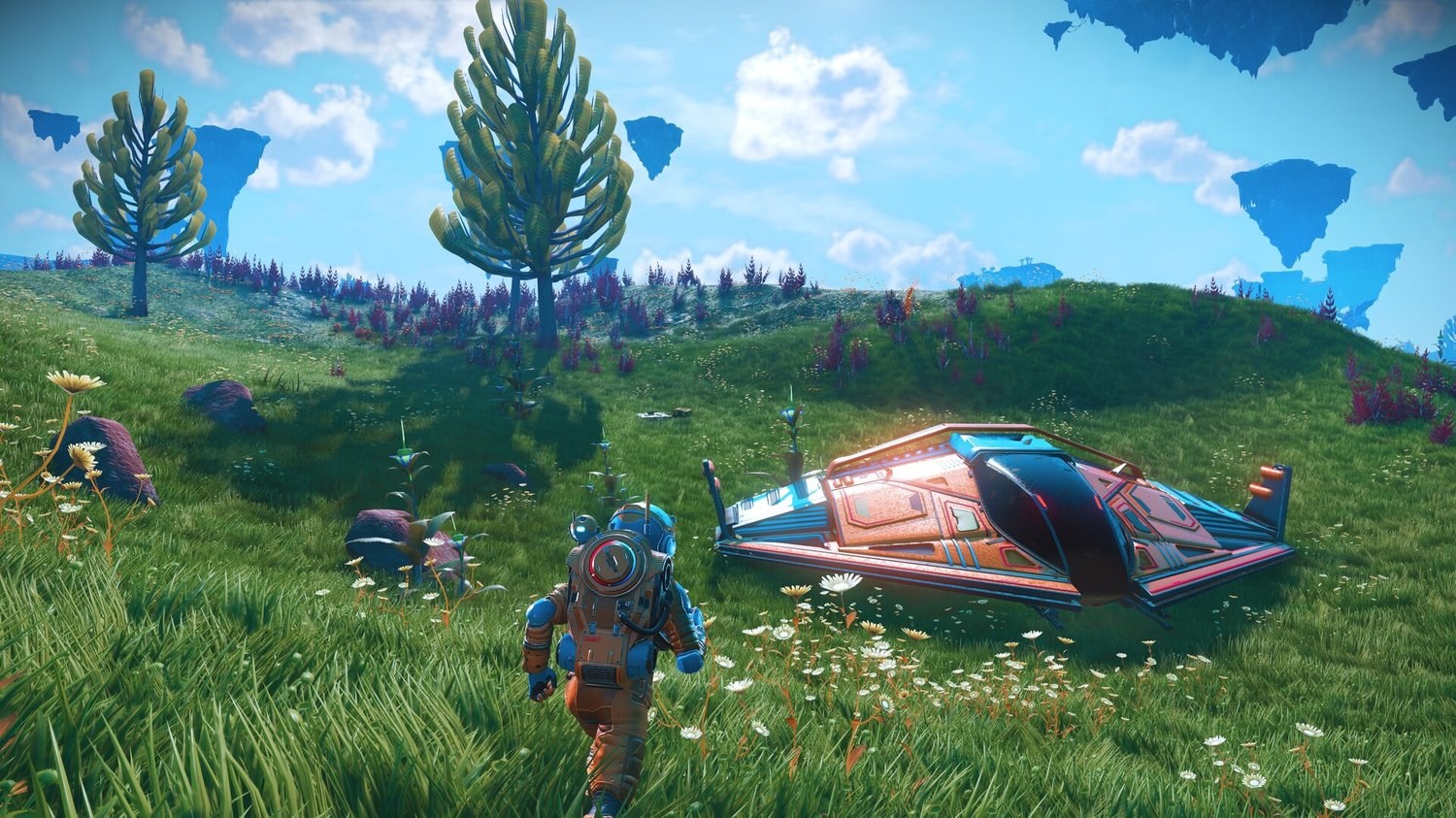
Exocraft are the six vehicles you can build and drive in No Man’s Sky, from the Roamer buggy whose geobay blueprint you get for free early on to the Nautilon submarine and the Minotaur mech. Each of them does one job better than the others, but getting, summoning and upgrading them is spread over several missions and menus.
If you only want one, the Minotaur is the best exocraft overall. Its Environment Control Unit blocks all four hazards from the start, it takes the hardest-hitting exocraft gun, it picks up Storm Crystals straight from the cockpit, and its AI Pilot can walk and fight beside you. The Nomad, an all-round explorer that hovers over water, and the Pilgrim, the fastest exocraft on open ground, are the next best picks.
You are going to start with the Roamer, though. The Base Computer Archives hand you the Roamer Geobay blueprint for free, and the other geobays in the exocraft part of the blueprint tree sit behind it. The Minotaur Geobay is a free reward from A Trace of Metal, or costs 10 Salvaged Data at the Space Anomaly.
A geobay is the pad an exocraft lives on. You build it from a blueprint, and from then on the vehicle will wait in your Quick Menu, ready to be called with Summon Vehicles. Are exocraft worth it? I would say yes for hazardous planets, storms, scanning for buildings and carrying extra cargo, and a little bit less for short hops near your ship. Mind that summoning only works for an exocraft whose geobay you have built at least once.
Most of the speeds, slot counts and Salvaged Data costs below were pulled from the PC version’s Forsaken 7.14 files, while the update history sticks to Hello Games’ own release notes.
Contents
- Exocraft tier list
- How to get exocraft
- Roamer
- Nomad
- Colossus
- Pilgrim
- Nautilon
- Minotaur
- Summoning exocraft
- Exocraft upgrades
- Best exocraft per job
- Exocraft update history
- Exocraft FAQ
Exocraft tier list
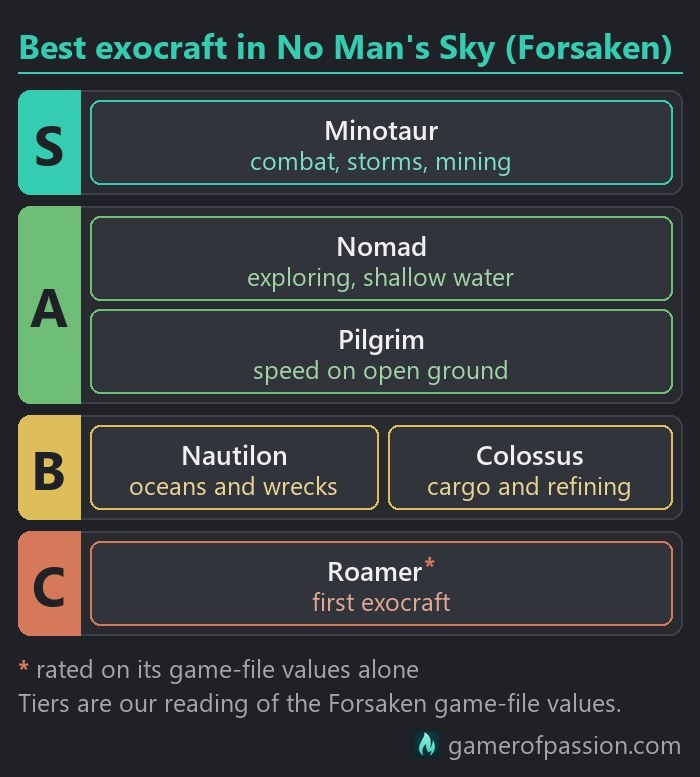
The tiers rank what each exocraft can do once you own it. Of course, every one of them is the best pick for at least one job, and a B-tier exocraft can still be the right call on the right planet.
The Minotaur sits alone in S tier. Its Environment Control Unit is fitted from the start and blocks all four hazards, its Minotaur Cannon hits for 420 against 320 for the Mounted Cannon on the other land exocraft, and it collects Storm Crystals without you leaving the cockpit. Add the Minotaur AI Pilot and it will even walk and fight next to you.
The Nomad and the Pilgrim share A tier. The Nomad hovers over water and takes the whole radar ladder, which makes it the best exocraft for finding buildings. The Pilgrim has the highest top speed and boost cap of the four exocraft that drive, and on flat, open planets it will get you there first.
The Nautilon and the Colossus are B tier, because both are very good at one thing and fairly weak outside it. Underwater the Nautilon is the quickest exocraft there is, and its High-Power Sonar finds drowned starships and sunken buildings for only 10 Nanites. On a dry world, though, it has nothing to do. The Colossus carries the most cargo of all six and is the only one that can fit the Mineral Processing Rig and the Excavation Blade, while also being the slowest of the four exocraft that drive.
The Roamer lands in C tier. It has the cheapest geobay blueprint, Exocraft Boosters fitted and 40 cargo slots, but it has a lower top speed than the Nomad and the Pilgrim and has no way across water, which is why the Nomad will replace it once you have one. This rating is my own reading, and it rests on the Roamer’s cost, speeds and slots in the game files alone. That being said, it is a fine first exocraft, and you are going to build it first anyway.
| Exocraft | Tier | Best for | Why |
|---|---|---|---|
| Minotaur | S | combat, hazards, storms, mining | blocks all four hazards, Minotaur Cannon 420 |
| Nomad | A | exploring and shallow water | top 18 / boost cap 32, hovers over water |
| Pilgrim | A | speed on open ground | top 19, boost cap 35, 1.5 s recharge |
| Nautilon | B | oceans and wrecks | underwater top speed 22 vs 15, High-Power Sonar |
| Colossus | B | cargo, refining, waste hauling | 50 cargo + 30 tech slots, Mineral Processing Rig |
| Roamer | C | first exocraft | cheapest geobay blueprint (4 Salvaged Data), our pick |
The Exo-Skiff is missing from this list on purpose. It is a static fishing platform that you summon onto water from the Quick Menu once its interface is built into your Exosuit, and it does not count as an exocraft.
How to get exocraft
Every exocraft starts as a geobay blueprint. You can buy these with Salvaged Data, the currency you spend on base blueprints, or get several of them for free from missions. Once you build the geobay on a planet, the exocraft is yours, and you can call it from the Quick Menu with Summon Vehicles.
These missions hand out geobay blueprints for free:
- The Base Computer Archives give you the Roamer Geobay blueprint, and so do the main story’s base step and the Exocraft Technician.
- The Exocraft Technician you hire for your base gives you the Nomad Geobay and later the Colossus Geobay. Its first steps ask you to Build an Exocraft Terminal and then Hire an Exocraft Technician from a space station.
- Dreams of the Deep starts on its own as a strange signal your starship picks up in space, once you have warped between enough star systems or moved far enough in the main story. Its second part gives you the Nautilon Chamber blueprint, the Marine Shelter and the Hydrothermal Fuel Cell recipe.
- A Trace of Metal is a settlement story that starts with an urgent message once you run a settlement. It gives you the Minotaur Geobay and Exocraft Summoning Station blueprints for free if you do not own them yet, along with the Hardframe parts and the Minotaur AI Pilot as the story goes on.
The Pilgrim Geobay is the odd one out. It is no mission reward outside expeditions, and you will have to buy it for 10 Salvaged Data. The Roamer Geobay also belongs to the starter blueprints in the first base part of the beginner guide, if you want to see what else to buy with your first Salvaged Data.
If you want every exocraft, this is the cheapest order. The Roamer Geobay is the root of the exocraft part of the blueprint tree, and every other geobay in that part needs it first:
- Roamer Geobay, free from the Base Computer Archives or 4 Salvaged Data.
- Nomad Geobay, free from the Exocraft Technician or 8 Salvaged Data.
- Colossus Geobay, free from the Exocraft Technician or 8 Salvaged Data.
- Pilgrim Geobay, 10 Salvaged Data with no free route outside expeditions.
- Nautilon Chamber, free from Dreams of the Deep or 10 Salvaged Data.
- Minotaur Geobay, free from A Trace of Metal or 10 Salvaged Data.
Bought outright, the six cost 50 Salvaged Data in total. If you use every free route, you only pay 10 for the Pilgrim.
You can build a geobay anywhere on a planet’s surface, and you do not need a base for it. The limits are one of each kind per base, one per region and five per planet. The Nautilon Chamber has to go underwater, while the Nautilon Platform sits on the water’s surface. If you place one in a bad spot, you can simply pick it up again with the deconstruct tool.
| Geobay | Free route | Salvaged Data | Build recipe |
|---|---|---|---|
| Roamer Geobay | Base Computer Archives | 4 | 5 Metal Plating, 2 Ion Battery, 50 Paraffinium |
| Nomad Geobay | Exocraft Technician | 8 | 5 Metal Plating, 2 Ion Battery, 50 Paraffinium |
| Colossus Geobay | Exocraft Technician | 8 | 5 Metal Plating, 4 Ion Battery, 100 Paraffinium |
| Pilgrim Geobay | no free route outside expeditions | 10 | 5 Metal Plating, 100 Silver, 5 Di-hydrogen Jelly |
| Nautilon Chamber | Dreams of the Deep | 10 | 5 Metal Plating, 4 Crystal Sulphide, 100 Salt |
| Minotaur Geobay | A Trace of Metal | 10 | 5 Metal Plating, 4 Ion Battery, 100 Gold |
| Nautilon Platform | no free route outside expeditions | 10 | 90 Magnetised Ferrite, 100 Oxygen, 3 Di-hydrogen Jelly |
| Exocraft Summoning Station | A Trace of Metal | 12 | 80 Uranium, 60 Tritium, 1 Unstable Plasma |
| All six geobays | 10 with every free route | 50 | – |
Roamer
The Roamer is a buggy and the exocraft you are most likely to start with. Its geobay blueprint is free from the Base Computer Archives, and the main story’s base step and the Exocraft Technician give it too. Otherwise it costs 4 Salvaged Data. You build the Roamer Geobay anywhere on a planet’s surface from 5 Metal Plating, 2 Ion Battery and 50 Paraffinium, and then call the Roamer from the Quick Menu with Summon Vehicles.
It comes with a Fusion Engine and Exocraft Boosters already fitted, which means you will be able to boost as soon as it appears. The Nomad is quicker flat out, but the Roamer boosts three times as long, and over a kilometre the two will finish level. Where the Roamer falls behind is water, since it has no way across.
Personally, I would build the Roamer first even if you plan to drive the Nomad later. Every other geobay in the exocraft tree needs its blueprint anyway, and a cheap car with a boost and a decent cargo hold is a fairly solid start on your first planets.
| Stat | Value |
|---|---|
| Best for | first exocraft |
| Top speed / boost cap | 16 / 30 |
| Boost / recharge | 1.5 s / 3 s |
| Cargo / technology slots | 40 / 28, 3 supercharged |
| Comes with | Fusion Engine, Exocraft Boosters |
Once the Roamer is out, these upgrades will help the most:
- The Exocraft Radar, then the Radar Amplifier and the Radar Power Resonator (120, 210 and 320 Nanites). Together they find Depots, then Drop Pods and Abandoned Structures, and finally Trade Outposts, Ruins and Alien Structures.
- The hazard module for the planet you are on (120 Nanites), which stops that hazard from draining you inside.
- An S-class Fusion Engine module, which adds 10-15% top speed.
- The Cyclops Scope (320 Nanites), for scanning from the driver’s seat.
Nomad
The Nomad is probably the best all-round exocraft for exploring. It hovers over water and drives across it once it is there, and a lake or a strip of sea will not end your trip the way it does in the Roamer. It also takes the whole radar ladder, which makes it a great exocraft for hunting down buildings.
The Exocraft Technician you hire for your base will give you the Nomad Geobay for free as part of its mission chain. Otherwise, it costs 8 Salvaged Data, and the recipe is the same as the Roamer’s.
Make sure to summon the Nomad while you stand on solid ground. Once it is out, you can simply drive it onto the water and keep going.
Each geobay also doubles as the paint shop. On the Nomad you can change the Cockpit, Left Panel, Right Panel, Engine Cover, Boost Module and Antigrav Fans.
| Stat | Value |
|---|---|
| Best for | exploring and shallow water |
| Top speed / boost cap | 18 / 32 |
| Boost / recharge | 0.5 s / 2 s |
| Cargo / technology slots | 30 / 26, 3 supercharged |
| Comes with | Fusion Engine, Exocraft Boosters |
For the Nomad, these come first:
- The same radar ladder as on the Roamer, from the Exocraft Radar through the Radar Amplifier to the Radar Power Resonator.
- An S-class Exocraft Boosters module, which adds 55-70% boost speed.
- An S-class Fusion Engine module.
- One hazard module only, because its 26 technology slots fill up faster than on the bigger exocraft.
Colossus
The Colossus is the big truck of the group and one of the more specialised exocraft. It has the most cargo and technology slots of any exocraft, and it is built for hauling, refining and waste sites. With a top speed of 12, it is also the slowest of the four exocraft that drive. It will not win any races.
The Exocraft Technician will give you the Colossus Geobay later in the same chain that gives the Nomad, or you can buy it for 8 Salvaged Data. It takes 5 Metal Plating, 4 Ion Battery and 100 Paraffinium to build.
The Colossus comes with a Fusion Engine and an Exocraft Mining Laser, but without the Exocraft Boosters that the smaller exocraft get. As such, buying the Boosters early makes a big difference. Additionally, only the Colossus can fit the Mineral Processing Rig, a 3-slot refiner with its own fuel, and the Excavation Blade, which pulls a few resources out of rocks and plants you drive through. Since Remnant, its Exocraft Radar also finds Waste Processing Plants and Waste Heaps, and its geobay lets you swap cabins, chassis modules and wheels and keeps up to 6 named setups.
| Stat | Value |
|---|---|
| Best for | cargo, refining, waste hauling |
| Top speed / boost cap | 12 / 30 |
| Boost / recharge | 1.25 s / 5.5 s |
| Cargo / technology slots | 50 / 30, 3 supercharged |
| Comes with | Fusion Engine, Exocraft Mining Laser |
The Colossus gets the most out of these:
- Exocraft Boosters (180 Nanites), because it has none fitted.
- The Mineral Processing Rig (480 Nanites).
- The Advanced Exocraft Laser (210 Nanites), which adds 50 damage to the laser it ships with.
- The Excavation Blade (480 Nanites).
Pilgrim
The Pilgrim is a motorbike and the fastest exocraft on open ground. Its top speed of 19 and boost cap of 35 are the highest of the four exocraft that drive, and its boost recharges quicker than on any of the others. On wide, flat planets, the Nomad and the Roamer come closest, but neither keeps up with it.
For reference, the speed numbers in this guide are game-file values without a unit. The speed readout will show you something else, since it has used kilometres per hour since Worlds Part II.
The Pilgrim is also the only exocraft with no free route outside expeditions. You buy the Pilgrim Geobay for 10 Salvaged Data and build it from 5 Metal Plating, 100 Silver and 5 Di-hydrogen Jelly. It comes with a Fusion Engine and Exocraft Boosters, and the price for all that speed is a small hold of 30 cargo slots.
| Stat | Value |
|---|---|
| Best for | speed on open ground |
| Top speed / boost cap | 19 / 35 |
| Boost / recharge | 0.6 s / 1.5 s |
| Cargo / technology slots | 30 / 26, 3 supercharged |
| Comes with | Fusion Engine, Exocraft Boosters |
On the Pilgrim, these are the upgrades that matter:
- An S-class Exocraft Boosters module, since it already has the highest boost cap.
- An S-class Fusion Engine module.
- The Exocraft Radar (120 Nanites), which finds Depots while you race between them.
- The Icarus Fuel System (120 Nanites), which refills the engine in daylight. Boosting burns fuel much faster than cruising, and the Pilgrim is going to boost a lot.
Nautilon
The Nautilon is the submarine, and on ocean worlds it is the exocraft you will want most. Underwater it is the quickest of the six, with a top speed of 22 in the game files where every other exocraft sits at 15, and since Worlds Part II it can boost without any extra technology. If you have read somewhere that the Nautilon is slow, that view is older than those changes.
It is also no longer stuck in the sea. The Nautilon can climb out onto a beach and keep moving on land, which saves you a summon when an ocean run ends at an island.
Dreams of the Deep gives you the Nautilon Chamber blueprint for free in its second part, together with the Marine Shelter and the Hydrothermal Fuel Cell recipe. Otherwise the Chamber costs 10 Salvaged Data. It has to be built underwater, while the Nautilon Platform, a second blueprint for another 10 Salvaged Data, floats on the water’s surface.
Its engine is the Humboldt Drive, which burns Hydrothermal Fuel Cells. Make sure to check that the Humboldt Drive is fitted after you build the Chamber, and skip the Icarus Fuel System here. There are no hazard modules for the Nautilon either. Summon it while you are in or right above deep enough water, or it will not appear.
| Stat | Value |
|---|---|
| Best for | oceans and wrecks |
| Top speed / boost cap | 22 underwater / 25 |
| Boost / recharge | 2.5 s / 2.5 s |
| Cargo / technology slots | 40 / 28, 3 supercharged |
| Comes with | Humboldt Drive engine, check it is fitted |
| Underwater top speed | 22, others 15 |
The Nautilon’s best upgrades are cheap to start with:
- The High-Power Sonar (10 Nanites), which finds drowned starships, crashed freighters, sunken buildings and submerged ruins.
- The Osmotic Generator (350 Nanites), which cuts fuel use and slowly recharges the Humboldt Drive.
- An S-class Humboldt Drive module, for a little more speed and a stronger boost underwater.
- The Tethys Beam (450 Nanites), which starts at 240 damage, the highest base value of any exocraft mining laser.
Minotaur
The Minotaur is a walking mech, and it is the best exocraft overall. It comes with its Daedalus Engine, the Ariadne’s Flame jetpack and an Environment Control Unit, and that last one blocks all four hazards from the moment you build it, while the other land exocraft only slow hazard drain until you fit a separate module for each of the four hazards.
It can also pick up Storm Crystals and other resources straight from the cockpit, while the Environment Control Unit keeps every hazard off you. That makes it the safest way to farm a storm, and Storm Crystals are one of the better early ways to make money.
On foot the Minotaur is slow, so travel in Ariadne’s Flame jumps, which will carry it far faster than its walk. In a fight, its Minotaur Cannon is the hardest-hitting exocraft gun, and the Minotaur Laser and Minotaur Bore make it a strong miner too.
A Trace of Metal gives you the Minotaur Geobay blueprint for free, together with the Exocraft Summoning Station blueprint. It is a settlement story that starts with an urgent message once you run a settlement, and the settlement guide explains how to get a settlement if you do not have one yet. Otherwise, the Minotaur Geobay costs 10 Salvaged Data at the Space Anomaly and takes 5 Metal Plating, 4 Ion Battery and 100 Gold.
Over its parts, A Trace of Metal also hands out the Hardframe Body, Left Arm, Right Arm and Legs, which you can buy as blueprints for Nanites as well. The Left Arm gives you a combat laser that hits stunned targets five times harder (it needs the Minotaur Laser), the Right Arm a stun gun and the Legs better fuel use and boost tanks. The Liquidator Body, Left Arm, Right Arm and Legs were rewards from the Liquidators expedition in Worlds Part I, and the Liquidator Right Arm is the Minotaur’s flamethrower.
| Stat | Value |
|---|---|
| Best for | combat, hazards, storms, mining |
| Speed | slow on foot, jetpack cap 20, boost 25 |
| Boost / recharge | 2.5 s / 2.5 s |
| Cargo / technology slots | 40 / 28, 3 supercharged |
| Comes with | Daedalus Engine, Ariadne’s Flame, Environment Control Unit |
The Minotaur’s first upgrades should be these:
- The Minotaur AI Pilot (480 Nanites).
- The Minotaur Cannon (210 Nanites), with 420 damage.
- The Minotaur Radar Array (120 Nanites), which finds depots, secure facilities, distress signals and planetary outposts.
- The Minotaur Bore (210 Nanites), which digs through terrain.
Minotaur AI Pilot
Install the Minotaur AI Pilot and the Minotaur will walk beside you without a driver. It costs 480 Nanites as a blueprint, or you get it for free in the later parts of A Trace of Metal. You can set it to one of three directives, which the game calls Autopilot Directive: Mine Resources, Exterminate Sentinels and Protect Traveller. The moment you climb in, it will hand control back to you.
Beware that it is not tough enough to tank Sentinels alone. Expect to repair its technology after a hard fight, and if the HUD shows AI Autopilot Critically Damaged, that is your sign to do it.
Summoning exocraft
Summoning is where most of the confusion around exocraft comes from. The first rule is simple. You can only summon an exocraft whose geobay you have built at least once, anywhere in your save. Without that, the Quick Menu will show “Exocraft Not Owned”, whichever summon method you use.
On the planet you built its geobay on, you can summon that exocraft from anywhere on the planet, but elsewhere it only comes back while you are fairly close to where you left it, which means that for everything beyond that you are going to need one of these three:
- An Exocraft Summoning Station covers its whole star system. You can pick it up again and carry it to the next system, and A Trace of Metal gives you its blueprint for free (otherwise it costs 12 Salvaged Data).
- An Orbital Exocraft Materialiser is a room you add to your freighter, and it does the same job whenever your freighter is in the system.
- The Exocraft Summoning Unit is Exosuit tech for 640 Nanites, built from 140 Activated Quartzite, 3 Quantum Computer and 90 Crystallised Helium. It summons any exocraft you own from anywhere in the galaxy.
The Exocraft Summoning Unit does not replace the geobay, and it will only call exocraft whose geobay you have built once. If you are short on Nanites, the Nanites guide has a list of what to spend them on first.
Beware that the Orbital Exocraft Materialiser only works while your freighter is in the same star system, which means it fails in systems your freighter’s warp drive can’t reach. If you do not own a freighter yet, the freighter guide explains how to get one.
Where you stand matters too. Summon the Nautilon while you are in or right above deep enough water, and summon land exocraft while you stand on solid ground.
| Method | Where it works | What it needs | How to get it |
|---|---|---|---|
| Quick Menu from a geobay | the geobay’s planet, elsewhere only near where you left it | geobay built once | the geobay |
| Exocraft Summoning Station | anywhere in that star system | geobay built once, Station in the system, can be picked up | 12 Salvaged Data or A Trace of Metal |
| Orbital Exocraft Materialiser | anywhere in the system while your freighter is there | geobay built once, freighter in the system | freighter room |
| Exocraft Summoning Unit | anywhere in the galaxy | geobay built once, Unit in the Exosuit | 640 Nanites |
Summon not working
Most failed summons come down to one of these:
- If the Quick Menu shows “Exocraft Not Owned”, you have never built that exocraft’s geobay in this save. Build it once, anywhere.
- If you get “Cannot Summon: No Exocraft Summoning Station in System”, you are too far from the exocraft in a system without a Station. Deploy an Exocraft Summoning Station, bring your freighter with its Orbital Exocraft Materialiser, or install the Exocraft Summoning Unit.
- If the Orbital Exocraft Materialiser does nothing, your freighter is not in this system. Summon the freighter first, or use a Station or the Unit instead.
- If the Nautilon will not appear, you are not in or above water. Get into deep water, or right above it, and try again.
- If every geobay is built and some exocraft still refuse to appear, make a manual save, quit to desktop and reload that save.
Exocraft upgrades
Every exocraft has a fixed inventory that cannot be expanded. The Colossus has 50 cargo slots and 30 technology slots, the Roamer, Nautilon and Minotaur have 40 and 28, and the Nomad and Pilgrim have 30 and 26, with 3 supercharged technology slots on every exocraft. Supercharged slots make whatever technology sits in them stronger.
A plain exocraft only slows hazard drain. On the Roamer, Nomad, Colossus and Pilgrim, the Thermal Buffer, Megawatt Heater, Air Filtration Unit and Neutron Shielding each stop one hazard from draining you inside. The Minotaur already has its Environment Control Unit, and the Nautilon has no hazard modules at all.
The Minotaur Cannon hits harder than the Mounted Cannon of the four land exocraft and the Nautilon Cannon, and the Mounted Flamethrower is a close-range weapon for the Roamer, Nomad, Colossus and Pilgrim only. For scanning, the Cyclops Scope fits every exocraft and gives you the Analysis Visor from the driver’s seat, which lets you tag points of interest and scan plants, animals and minerals without getting out.
C to S class upgrade modules for every exocraft, including the Nautilon and Minotaur, come from the exocraft technology merchant in space stations, and its stock rotates. Minotaur modules come in B, A and S class only, and radars, hazard modules and the drills have no upgrade modules at all. At the top end, an S-class Fusion Engine module adds 10-15% top speed and an S-class Exocraft Boosters module adds 55-70% boost speed.
| Module | Fits | What it does | Nanites |
|---|---|---|---|
| Fusion Engine | Roamer, Nomad, Colossus, Pilgrim | core engine, 300 charge | 120 |
| Exocraft Boosters | Roamer, Nomad, Colossus, Pilgrim | boost (stock on Roamer, Nomad, Pilgrim) | 180 |
| Exocraft Mining Laser | Roamer, Nomad, Colossus, Pilgrim | mining laser, 80 damage (stock on Colossus) | 180 |
| Advanced Exocraft Laser | Roamer, Nomad, Colossus, Pilgrim | +50 laser damage | 210 |
| Mounted Cannon | Roamer, Nomad, Colossus, Pilgrim | 320 damage, rate 0.5 | 210 |
| Mounted Flamethrower | Roamer, Nomad, Colossus, Pilgrim | 3 per tick at 0.08, fire 25 per second for 3 s | 480 |
| Exocraft Radar | Roamer, Nomad, Colossus, Pilgrim | finds Depots | 120 |
| Radar Amplifier | Roamer, Nomad, Colossus, Pilgrim | adds Drop Pods, Abandoned Structures | 210 |
| Radar Power Resonator | Roamer, Nomad, Colossus, Pilgrim | adds Trade Outposts, Ruins, Alien Structures | 320 |
| Thermal Buffer, Megawatt Heater | Roamer, Nomad, Colossus, Pilgrim | blocks heat and cold drain fully | 120 each |
| Air Filtration Unit, Neutron Shielding | Roamer, Nomad, Colossus, Pilgrim | blocks toxic and radiation drain fully | 120 each |
| Cyclops Scope | all six | Analysis Visor from the seat | 320 |
| Icarus Fuel System | all six, skip it on the Nautilon | engine recharge in daylight | 120 |
| Mineral Processing Rig | Colossus | 3-slot refiner, own fuel | 480 |
| Excavation Blade | Colossus | a few resources from rocks and plants it hits | 480 |
| Humboldt Drive | Nautilon | core engine, 400 charge, Hydrothermal Fuel Cells | 120 |
| High-Power Sonar | Nautilon | drowned starships, crashed freighters, sunken buildings | 10 |
| Osmotic Generator | Nautilon | fuel use 0.8, slow Humboldt recharge | 350 |
| Nautilon Cannon | Nautilon | 220 damage, rate 0.5 | 250 |
| Tethys Beam | Nautilon | 240 laser damage | 450 |
| Dredging Laser | Nautilon | underwater terrain digging | 390 |
| Daedalus Engine | Minotaur | core engine, carbon fuel, fuel use 0.5 | 120 |
| Ariadne’s Flame | Minotaur | jetpack boost | 180 |
| Environment Control Unit | Minotaur | blocks all four hazards | 120 |
| Self-Greasing Servos | Minotaur | fuel use 0.8 | 120 |
| Minotaur Radar Array | Minotaur | depots, secure facilities, distress signals | 120 |
| Minotaur Laser | Minotaur | 100 mining damage | 180 |
| Precision Minotaur Laser | Minotaur | +50 laser damage | 210 |
| Minotaur Cannon | Minotaur | 420 damage, rate 0.35 | 210 |
| Minotaur Bore | Minotaur | terrain digging | 210 |
| Minotaur AI Pilot | Minotaur | AI walks, mines, fights, protects | 480 |
| Hardframe Body, Left Arm, Right Arm, Legs | Minotaur | combat laser x5 vs stunned, stun gun, fuel 0.9 | 480 / 500 / 500 / 500 |
| Liquidator Body, Left Arm, Right Arm, Legs | Minotaur | stun gun, flamethrower, fuel 0.9 + boost tanks | expedition reward |
| C to S upgrade modules | matching exocraft | S Fusion Engine +10-15% top speed, damage +5 to +40 | from the exocraft technology merchant |
Best exocraft per job
Here is my pick for each job, with a runner-up for when the first choice is not available yet:
- For mining, take the Minotaur. Its Minotaur Laser and Minotaur Bore work on any planet without hazard worries, and it picks up resources from the cockpit. The Colossus comes second with its stock Exocraft Mining Laser, the Mineral Processing Rig and 50 cargo slots.
- Scanning and exploring is the Nomad’s job, since it hovers over water and takes the whole radar ladder and the Cyclops Scope. The Minotaur is the runner-up, because its Minotaur Radar Array adds secure facilities and distress signals.
- In combat, the Minotaur wins again with the hardest-hitting gun and an AI partner. The Nomad is the runner-up here.
- On water, the Nautilon is the pick for anything below the surface. The Nomad drives across the water at full speed and makes a good second choice.
- For pure speed, the Pilgrim leads with the Nomad close behind.
- For storms and hazards, the Minotaur is the pick, thanks to its Environment Control Unit and the Storm Crystals it collects from the cockpit. The Roamer is the runner-up, because its 28 technology slots leave room for the hazard module of the planet you are on.
- As your first exocraft, the Roamer is a good choice, since its blueprint is free from missions and the cheapest to buy, and it comes with a Fusion Engine and Exocraft Boosters. The Nomad makes a good second geobay.
| Job | Best pick | Runner-up | Why |
|---|---|---|---|
| mining | Minotaur | Colossus | Minotaur Laser 100 and Minotaur Bore, hazard-proof |
| scanning and exploring | Nomad | Minotaur | hovers over water, Exocraft Radar to Radar Power Resonator |
| combat | Minotaur | Nomad | Minotaur Cannon 420 vs Mounted Cannon 320, AI partner |
| water | Nautilon | Nomad | underwater top speed 22 vs 15, High-Power Sonar |
| speed | Pilgrim | Nomad | top speed 19 / boost cap 35 vs 18 / 32 |
| storms and hazards | Minotaur | Roamer | Environment Control Unit blocks all four hazards |
| first exocraft | Roamer | Nomad | cheapest blueprint (4 Salvaged Data), our pick |
Exocraft update history
Exocraft arrived with Path Finder, and quite a few updates have changed them since. Here they are, oldest first:
- Path Finder (Update 1.2) added the Nomad, Roamer and Colossus, summoning from anywhere on the planet they were built on, the Vy’keen Technician missions and Exocraft Races.
- NEXT improved the Colossus speed and its fuel tanks.
- The Pilgrim and the Nautilon followed around the Abyss update, which also brought the Dreams of the Deep mission and a vehicle shop in space stations.
- Exo Mech brought the Minotaur, the Orbital Exocraft Materialiser and the Icarus Fuel System, made the Roamer, Nomad, Pilgrim and Nautilon faster, cut the price of some geobay blueprints and ended the old hazard immunity.
- Fractal brought A Trace of Metal and its Minotaur upgrades to Nintendo Switch.
- Worlds Part I added the Liquidator parts through the Liquidators expedition.
- Worlds Part II (January 2025) brought the Nautilon Platform, the Mineral Processing Rig, the Mounted Flamethrower, the Nautilon boost and the Dredging Laser, and it switched the speed readout to kilometres per hour.
- Voyagers (6.0, August 2025) let you rebind the exocraft boost.
- Remnant (6.2, February 2026) brought Colossus customisation with 6 saved setups, the Cyclops Scope, the Excavation Blade and the Colossus radar for waste sites.
- The Swarm (May 2026) improved how wheeled exocraft perform on Switch, Xbox One and PS4.
COSMOS (7.0, September 2026) only fixed exocraft UI and visuals, and Forsaken (7.10, October 2026) only fixed some Minotaur sounds in AI pilot mode, plus two small exocraft issues on iOS in its 7.13 patch. If you want to see what Forsaken did bring to the game, the Forsaken overview lists it.
Exocraft FAQ
Are exocraft worth it?
Yes, in most saves. Their cargo slots work as extra storage that you can summon, the Minotaur and the hazard modules make dangerous planets and storms much easier, and the radars will find buildings you would otherwise spend a long time looking for. For quick hops between nearby spots, your jetpack and your starship are probably still enough.
Can you summon an exocraft anywhere?
Yes, as long as you have built its geobay at least once. Without extra tech, you can summon it anywhere on the planet you built the geobay on, and elsewhere only near where you left it. An Exocraft Summoning Station or a freighter with an Orbital Exocraft Materialiser stretches that to the whole star system, and the Exocraft Summoning Unit to anywhere in the galaxy.
Which exocraft is fastest?
On open ground, the Pilgrim is the fastest exocraft, with a top speed of 19 and a boost cap of 35. Underwater, the Nautilon takes over with 22 against 15 for every other exocraft. The Nomad and the Roamer finish level with each other over a kilometre.
How do you unlock the Minotaur?
The Minotaur Geobay is a free reward from A Trace of Metal, the settlement story that starts with an urgent message once you run a settlement. If you would rather not wait, it costs 10 Salvaged Data at the Space Anomaly. The same mission also gives you the Exocraft Summoning Station blueprint and, later on, the Minotaur AI Pilot.
How do you get the Nautilon?
Dreams of the Deep gives you the Nautilon Chamber blueprint in its second part, and the mission begins by itself with a signal your starship picks up in space. You can also buy the blueprint for 10 Salvaged Data. Remember that the Nautilon Chamber has to be built underwater, while the Nautilon Platform goes on the water’s surface.
If you are not sure where to start, build the Roamer Geobay as soon as the Base Computer Archives hand it to you, and the Minotaur Geobay as soon as A Trace of Metal reaches you. Those two will cover almost everything until your first ocean world makes the Nautilon worth the trip.