
A vassal is a subject empire in Stellaris that keeps its own planets but pays you what its agreement asks for, joins your wars on the terms you set and can be integrated later, which makes vassalizing a cheaper way to grow than conquest once your empire has more than a handful of colonies.
Between a Vassal and a Tributary, the difference is control. A Tributary pays you 30% of its basic resources from day one, but it keeps its own diplomacy, never joins your wars and cannot be integrated. A Vassal only pays the taxes you set, and in return you decide how it votes, whether it may expand, which holdings go on its planets and whether it gets integrated. A Tributary can usually be renegotiated into a Vassal after 60 months, as long as it still has at least 40% of your technologies.
Conquest mainly costs you Empire Size. Taking a 10-colony empire by force adds around 395 Empire Size, which makes every technology and tradition up to 79% more expensive, while a vassal’s planets should not count toward yours at all. For most empires, the best subject type is the Scholarium, since it sends you at least 30% of its research and adds 10% to your own.
Everything below applies to 4.5.3 ‘Cygnus’, the current PC patch. The Vassal, Tributary and Protectorate come with the base game. The three specialist subjects (Bulwark, Scholarium and Prospectorium) need the Overlord DLC, which our DLC tier list rates with vassal players in mind. Most of the numbers below were read out of the agreement and war goal files of that build.
Contents
- How to vassalize an empire
- Subject types
- Tributary or vassal?
- Conquer or vassalize?
- Agreement terms
- Best subject for each goal
- Integrating a subject
- Common mistakes
- Patch history
- Other vassal questions
- Conclusion
How to vassalize an empire
Subject is the game’s word for any empire that answers to you as its overlord, and Vassal, Tributary and the rest are subject types. You can get one in five main ways: two war goals, a diplomatic offer, releasing a sector or taking over the subjects of an empire you beat.
| Route | You need | You get |
|---|---|---|
| Vassalize war goal | A war (no claims), relative power above Equivalent | A Vassal (a Protectorate at less than 40% of your techs) |
| Make Tributary war goal | A war, as Vassalize, with Inward Perfection allowed | Always a Tributary paying 30% of its basic resources |
| Propose Subjugation | Peace, 50 Trust or Excellent opinion and an embassy | Any subject the AI accepts (-800 if it already has subjects) |
| Release a sector | Your own sector (you lose its planets and pops) | A new subject at 50 loyalty, +1.5 a month for 5 years |
| Inherit subjects | Vassalize or Make Tributary on an empire with subjects | Its subjects, with their type and terms |
Vassalize war goal
Both war goals run on the Subjugation casus belli (the game’s reason for a war). You will get it automatically once your overall relative power against an empire is Superior or Overwhelming, which means being ahead on average across economy, technology and military. Neither of you may be a subject, and you cannot share a federation. Nomads only need the stronger fleet.
When you win a Vassalize war, the loser will become a Vassal with the starting terms of your Subjugation War Terms policy. Balanced Vassalage gives it the standard Vassal agreement and Benevolent Vassalage a friendlier one. Oppressive Vassalage will hand you a vassal that starts with Integration Permitted, but it begins at -100 loyalty, the lowest possible, and its terms drain another 8.9 a month. Balanced Vassalage starts it at -50 and Benevolent at 0, and all three can be renegotiated right away.
If the loser has less than 40% of your technologies, it becomes a Protectorate instead, whatever your policy says.
Additionally, the game will not let you pick Vassalize if you hold claims on every inhabited system of the target, because a victory would annex the whole empire. That rule makes a hybrid war possible. Claim the systems you want to run yourself, such as their capital or a chokepoint, leave at least one inhabited system unclaimed and go for Vassalize. When you win, you will take the claimed systems and the rest becomes your subject.
A freshly beaten empire carries Recently Subjugated for five years, which costs it 1.5 loyalty a month. In a status quo peace, the occupied systems you claimed go to you, and other occupied systems with a planet will break away as a new Vassal.
Make Tributary
Make Tributary uses the same casus belli, but the loser always becomes a Tributary that pays you 30% of its basic resources (energy, minerals and food) by default. The game does not check technology when this war ends, which means it will never hand you a Protectorate, and it also works against Inward Perfection empires, which Vassalize cannot target. A status quo peace releases occupied systems with a planet as a new Tributary.
Mind that this only protects you when the peace is signed. A Tributary that falls far behind you in technology later on can still turn into a Protectorate.
Propose Subjugation
The peaceful route is Propose Subjugation in the diplomacy screen, which only works while both of you are at peace. You will need 50 Trust or an Excellent opinion, plus an embassy with them or the Diplomatic Networking tradition. An envoy set to improve relations (our beginner guide explains envoys) is probably the simplest way to get there. The offer itself does not cost influence.
Meeting the requirements only lets you ask. Whether the AI says yes depends on factors you will see in the tooltip:
- A base of -50, and another -100 (Lack of Trust) while their Trust in you is below 50.
- -800 (Is Overlord) if they already have subjects of their own.
- -50 if a militarist target has an imperialist faction.
- -25 for every 10,000 pops they have, which makes big empires harder to win over.
- About +375 for each step of relative power in your favour, which puts an Inferior empire at +375 and a Pathetic one at +750.
- +25 Subjugation Acceptance from the Feudal Society civic or the Intimidation menace perk.
- The loyalty value of the terms you offer, with generous terms raising acceptance.
The -800 is why an empire with subjects almost never accepts. You are going to need it to be Pathetic next to you, plus terms generous enough to cover the rest. Simply open the offer, read the red and green lines and adjust the terms until the cross turns into a tick.
Feudal Society (Imperial authority only) lets you propose subjugation without the 50 Trust and embassy requirements and exempts one subject from Divided Patronage, but its subjects can never be set to Expansion Prohibited, Limited Diplomacy or Do not join subject wars. Our best civics list has the rest of what it does. The Intimidation menace perk skips the same requirements, and so does the corporate Franchising civic since 4.5.2.
Releasing a sector
You can also make a subject out of your own territory by releasing a sector. The new empire gets your origin and should start on your technology level. It will begin at 50 loyalty, Recently Released Sector adds 1.5 more every month for five years, and its first renegotiation has no cooldown.
That makes a released sector the easiest way to get a specialist: release it, then switch it to a Bulwark, Scholarium or Prospectorium straight away.
Beware that the planets and pops stop being yours unless you integrate the subject later, and the AI will run them its own way. It may wipe the construction queue and tear down buildings it cannot afford. Make sure to check the sector for deficits before you let it go. For a cheap specialist, a single system is enough.
Fanatic Purifiers, Determined Exterminators, Driven Assimilators, Devouring Swarms and genocidal Infernals cannot release sectors, and a hive species can only be released by a Progenitor Hive.
Inheriting subjects
When you subjugate an empire that has subjects of its own, those subjects will become yours as well and keep their type and terms. Each one adds to Divided Patronage, and inherited Bulwarks and Prospectoriums keep contracts that make you pay them. You may not be offered a plain Vassal contract for an inherited specialist either, so look at what the target owns before you declare the war.
Subject types
Every subject runs on an agreement, a set of terms that decides what it pays, which wars it joins and what it may do by itself. A subject type is a preset of those terms. Payments are called contributions, and they are always a share of the subject’s own monthly output. A negative value means that you pay the subject.
| Type | You get | They get | DLC |
|---|---|---|---|
| Vassal | Taxes you set, joins your defensive wars, can integrate | Your protection in its defensive wars | Base game (Overlord for holding slots 2 to 4) |
| Tributary | 30% to 75% of its basic resources, no war help or holdings | Independent Diplomacy, Expansion Permitted, +20 loyalty | Base game |
| Protectorate | +0.25 influence a month, basic tax up to 45% | Tech cost -80% for techs you already have | Base game |
| Bulwark | -20% starbase upgrade cost, up to -75% platform cost | Platform cap +2/+5/+8, you pay it 30% to 75% of its basic | Overlord |
| Scholarium | 30% to 75% of its research, +10% to your research | Research +20/+30/+40%, naval capacity -30/-40/-50% | Overlord |
| Prospectorium | 30% to 75% of its basic, relay -25% building cost | You pay it 30% to 75% of its research, research -30/-40/-50% | Overlord |
| Subsidiary (MegaCorp overlords only) | 30% to 75% of its basic resources, Vassal-style terms | Your defensive help | Base game (corporate authority) |
| Satrapy (Heirs of the Khan or the Khan’s Throne) | 30%+ basic, +30% of its naval capacity, joins all your wars | Independent Diplomacy, Expansion Permitted | Nomads for Heirs of the Khan |
The Vassal is the flexible base-game type. By default it pays no taxes, has Restricted Voting, pays an influence tithe for every outpost it builds (Expansion Regulated), joins your defensive wars while you join its, and lets you build holdings on its planets at Holdings Limit 1. You can tax or subsidise each resource group by up to 45%. It is also the type to pick if you want to integrate it later.
A Tributary pays 30% to 75% of its basic resources (30% by default) and can be asked for up to 75% of the other groups. It keeps Independent Diplomacy and Expansion Permitted, never joins your wars and gives you no holdings, while you still have to help it in its defensive wars. For loyalty, its default terms are the friendliest of the main types, at +20 when the agreement starts and +2 a month.
A Protectorate is what you get when a beaten empire has less than 40% of your technologies. It pays 80% less for every technology you know, cannot sign Research Agreements and earns you 0.25 influence a month. You can tax up to 45% of its basic resources or subsidise its research instead.
Once a Protectorate reaches 50% of your technologies, it should turn into a normal Vassal, but since you keep researching as well, that rarely happens by itself. Vassals and Tributaries that fall far behind you can also turn into Protectorates later.
The three specialists grow strong in one field, give you a smaller bonus in it, pay a price somewhere else and level up over time. All three need Overlord, and each prefers an ethic.
The Bulwark (militarist) costs you resources, because you pay it 30% to 75% of its basic resources, at least 45% at tier 2 and 60% at tier 3. You will get -20% starbase upgrade cost and +20% upgrade speed, and once your Hyper Relay network reaches its capital, Bulwark Watch gives connected planets -10% crime and +2 stability. Its Bulwark Prefabs trade cuts the cost and upkeep of your defense platforms by 25% per tier, and from tier 2 it can trade you commanders with defensive traits. The extra platform slots and tougher starbases stay with the Bulwark itself.
The Scholarium (materialist) must pay you 30% to 75% of its research and gives you +10% research. With your relay network on its capital, Scholarium Tutelage adds +10% researcher output, although two Scholariums will not double that. Its trades can add a technology option and +20% to +40% research station output. The price is its fleet, with up to -50% naval capacity and +50% ship cost and upkeep at tier 3, and you are the one who has to defend it.
The Prospectorium (pacifist) pays you at least 30% of its basic resources and 15% of its alloys and consumer goods, while you pay it at least 30% of its research, rising to 60% at tier 3. Its own research also drops by 30% to 50%. You will get -20% cost and +20% build speed for mining stations, and over the relay network Prospectorium Supply gives +25% building speed and -25% building cost. Its trades add up to +15% output of exotic gases, rare crystals and volatile motes. Since your payment is a share of its research, the best Prospectorium is a subject with little research to begin with.
Turning a subject into a specialist takes a while. A one-system subject converts in a little over a year and bigger ones take longer, the preferred ethic speeds it up and the opposite ethic slows it down, and you pay 3 influence a month until it is done. Shared Destiny cuts the time by 20% and Franchising by 33%.
After that, the specialist earns experience every month equal to a tenth of its loyalty. Tier 2 needs 1,200 experience, which is 10 years at 100 loyalty, tier 3 needs 3,600, and a disloyal specialist will lose experience instead.
A Subsidiary is the subject type of corporate empires (MegaCorp DLC), which get it through their own Make Subsidiary war goal instead of Vassalize and Make Tributary. It pays 30% of its basic resources by default like a Tributary, but it runs on Vassal-style terms with Restricted Voting, help in your defensive wars and Holdings Limit 1, and it cannot be integrated.
The Satrapy is the Great Khan’s subject type. Submit to the Khan, and you become his Satrapy with -30% naval capacity, pay him 30% of your basic resources and join all of his wars, and your own subjects become satrapies as well. With the Heirs of the Khan origin (Nomads DLC) or the Khan’s Throne relic, you can have Satrapies yourself, and they add 30% of their naval capacity to yours. How the Khan rises is in the Great Khan section of our endgame crisis guide.
Fallen and Awakened Empires have their own subject types, the Luminarium comes out of an Astral Planes event, and genocidal nomads turn invaded planets into Planetary Purgers. Nomadic empires can neither have nor be specialist subjects.
Tributary or vassal?
Pick the Tributary when you just want income for little effort. It starts paying 30% of its basic resources on day one, its other terms add loyalty to soften the cost of that tribute, and it will never join your wars, which also means it will never lose its fleet in them.
What you give up is control. A Tributary will vote as it likes, expand where it likes, take no holdings and cannot be integrated while it stays a Tributary.
Pick the Vassal when you want more than money. You can make it vote with you, build holdings on its planets, have it join your defensive wars and integrate it after ten years. A fresh Vassal will pay nothing until you set its taxes, and every tax you add will cost some loyalty.
The choice does not have to be final. Every 60 months you can renegotiate, and a Tributary that still has 40% of your technologies can be offered a switch to a Vassal or a specialist, which it will take if the deal is good enough. Personally, I would take a Tributary early in the game, when its 30% is worth a lot to you, and turn it into a Vassal or a Scholarium at the first renegotiation.
Conquer or vassalize?
Empire Size is the reason vassals work as a strategy. Each colony you own adds 20 to it, each system 1, each district 0.5 and each pop 0.005, and every point above 100 makes your technologies and traditions 0.2% more expensive.
For example, conquering an empire with 10 colonies, 15 systems, 60 districts and 30,000 pops will add 395 Empire Size. If you were already above 100, all of your technologies and traditions now cost 79% more.
You are also going to pay for the claims. A colonised system with an upgraded starbase three jumps away costs 175 influence to claim in peace and 350 if you claim it as the attacker during the war. For ten such systems, that comes to 1,750 or 3,500 influence (20% less against a rival).
Vassalizing the same empire needs no claims at all, and its planets, systems and pops should keep counting toward its own Empire Size instead of yours. You get taxes, holdings, votes and war help through the agreement instead.
Integration closes the gap later if you want the planets after all. With Integration Permitted and ten years as your subject behind it, that same empire costs about 450 influence to integrate over about 7.5 years, and once it is done, all 395 points of Empire Size will land on you at once.
In general, I would conquer what you want to run yourself and vassalize the rest in the same war. An enemy capital full of pops, a chokepoint or a megastructure is worth claiming, since you will usually run those better than the AI. Early on, integrating subjects tends to pay off because you have time to develop their planets. Late in the game, keeping them as subjects spares you an Empire Size jump their colonies are unlikely to pay back.
Agreement terms
Loyalty is a subject’s attitude toward you on a scale from -100 to +100, and it moves every month. A loyal subject will stay quiet and, as a specialist, level up. A disloyal one is more likely to pledge Secret Fealty to a rival or to fight you for its independence.
Most terms in the agreement change loyalty twice: once when the agreement starts, and then every month while it runs.
| Term | Loyalty (once / monthly) | Use it when |
|---|---|---|
| Integration Permitted | -50 / -4 | Only for a subject you will integrate after its 10 years |
| Integration Prohibited | +5 / +0.5 | Every subject you plan to keep |
| Limited Diplomacy | -15 / -1 | When the subject must not make its own deals |
| Restricted Voting | -5 / 0 | The cheap default for Galactic Community control |
| Independent Diplomacy | +5 / +0.5 | Loyalty filler for subjects whose vote you do not need |
| Expansion Prohibited | -15 / -1 | When its outposts would block your own expansion |
| Expansion Regulated | -5 / 0 | Default: it pays you an influence tithe per outpost |
| Expansion Permitted | +5 / +0.5 | Subjects you tax: more territory, bigger tax base |
| Joins Overlord Wars: None / Defensive / Offensive / All | 0 / 0, -10 / -1, -20 / -2, -30 / -3 | Defensive for most, All only for loyal militarists |
| Joins Subject Wars: None / Defensive / Offensive / All | -10 / 0, +5 / +0.5, +10 / +1, +15 / +1.5 | Your duty. Defensive is the cheap loyalty win |
| Holdings Limit: None / 1 / 2 / 3 / 4 | 0 / 0, -5 / -0.4, -15 / -1, -30 / -2, -50 / -4 | 1 is cheap, 3 or 4 only with strong loyalty sources |
| Unified Sensors / Independent Sensors | 0 / +0.25, -5 / 0 | Unified is free loyalty |
The cheapest gains are Integration Prohibited (+5 once, +0.5 a month) on every subject you plan to keep and your promise to join its defensive wars (also +5 and +0.5). Integration Permitted and a Holdings Limit of 4 are the expensive ones, at -50 and -4 a month each. Since 4.4.5, joining a war that is already running counts as offensive for these terms, whichever side your subject joins.
Taxes move loyalty as well, through the economic harm the tooltip shows. Tax a specialist in its specialty and keep basic taxes light on everyone else. A subject that is short of energy, minerals and food will struggle to keep its planets stable, and those planets can revolt and break away.
Divided Patronage
Your first subject is free. From the second one on, Divided Patronage takes 1 loyalty a month from every subject for each subject beyond the first. With five subjects, each one loses 4 loyalty a month.
Shared Destiny, Feudal Society and Franchising each exempt one subject, an Official with the Herald of the Empire trait exempts one more while that leader sits on your council, and the Great Khan’s trait exempts five. Shared Destiny only takes a single subject out of the count, and our ascension perk tier list rates it as a situational pick for vassal empires.
Relations
Relations are one of the cheapest loyalty sources you have, because they feed loyalty every month. Each 100 points of relations with a subject is worth about 1 loyalty a month, and relations add your opinion of the subject to its opinion of you. Keep an envoy improving relations with the subjects you care about.
Beware that a grudge on your side counts as well, for example after a subject has fired a Stellar Cannon at you, and it can drag that subject’s loyalty down for a long time. Shared ethics also help a little bit every month, while opposite ethics cost a little.
Holdings
Holdings are buildings you place on a subject’s planets. The Holdings Limit term gives you holding slots on its colonies, 1 in the base game and up to 4 with Overlord, and each holding can only be built once per planet. Each step costs loyalty, from -5 once and -0.4 a month at 1 up to -50 and -4 a month at 4.
Two holdings that almost every overlord can build pay loyalty back, and neither needs a DLC. The Overlord Garrison gives +0.5 a month and up to +2 when three or more of your armies sit on that planet, although each army also costs 5% happiness there. The Aid Agency gives +0.5 a month, but xenophobe and genocidal overlords cannot build it. Most of the other holdings open to every empire need Overlord. Holdings tied to a civic or origin need no DLC, and a few of them add loyalty too.
Since 4.5.3, an occupied subject colony will stop producing job resources for you, and what its jobs make for you scales with workforce.
Pledge Loyalty
With Overlord, a subject can sign Pledge Loyalty in the trade screen. It gives +1.5 loyalty a month for as long as the deal runs, or +2.5 if its opinion of you is 150 or higher. Ask while the subject is still friendly toward you, and lock the deal in for as many years as it will accept.
A good order is generous terms first, then the pledge, and harsher terms at the next renegotiation.
Renegotiating
You can change a subject’s agreement once every 60 months (5 years) through Negotiate Agreement. It costs 50 influence plus 5 for every point of loyalty the change moves, and the new deal has to leave the subject’s loyalty positive. A released sector and a Vassal fresh from a Vassalize war are the exceptions, as their first renegotiation has no cooldown.
Best subject for each goal
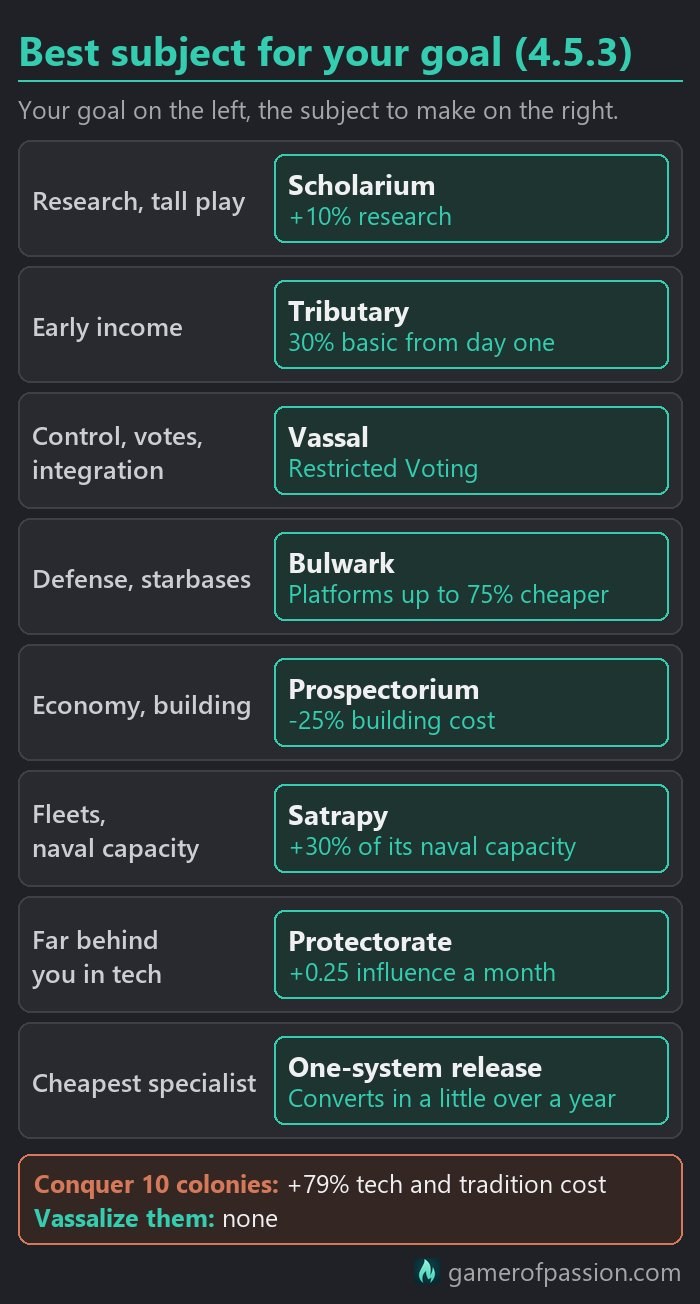
Which subject is best depends on what you want out of it. In most games, I would make a Scholarium my first specialist.
- For research and tall play, take a Scholarium for its research share, +10% research and the relay bonus.
- Early income with little upkeep calls for a Tributary, which pays 30% of its basic resources from the first day. If you want more, offer it a Vassal or specialist deal at the first renegotiation after 60 months.
- A Vassal with your own terms suits control: Restricted Voting for the Galactic Community, help in your defensive wars, holdings and, with Integration Permitted, a later integration.
- For defense and starbases, make a Bulwark out of a small, poor subject, since you pay a share of its basic output. Its Prefabs trade can make your defense platforms up to 75% cheaper at tier 3.
- An economy and building empire wants a Prospectorium made from a subject with little research, because you pay a share of that research.
- Satrapies are the fleet option if you play Heirs of the Khan or hold the Khan’s Throne, with 30% of their naval capacity added to yours and help in all of your wars.
- An empire far behind you in technology usually ends up as a Protectorate, which still earns you 0.25 influence a month.
- The cheapest specialist of all is a one-system subject released from your own sector. It converts in a little over a year, your payments to it stay tiny, and it still gives you every overlord and relay bonus of its type.
Integrating a subject
Integration makes a subject part of your empire, planets and pops included. You need three things for it: the Integration Permitted term, ten years as your subject and no other integration running, because you can only integrate one subject at a time.
The cost is 50 influence plus 10 per planet plus 1 per 100 pops, paid at 5 influence a month, and the subject loses 5 loyalty every month until it is done. The Integrate Subject tooltip will show you the exact total and the number of months.
Integration will stop while the subject is at war with you, and if you cancel it, the influence you have spent is gone.
Tributaries, Subsidiaries, Satrapies and the three specialists can never have Integration Permitted, and you will have to renegotiate them into Vassals first. Oppressive Vassalage will give you a Vassal with Integration Permitted straight out of a war, but that Vassal starts at -100 loyalty, the lowest possible, its terms cost -8.9 a month, and the policy does nothing when the loser is below 40% of your technologies and becomes a Protectorate.
Until you actually plan to integrate a subject, keep it on Integration Prohibited. It adds loyalty every month, and a deal with Integration Permitted also costs more influence to propose because it moves loyalty by a lot more.
Common mistakes
The most expensive mistake is vassalizing an overlord without looking at its subjects first. All of them come along, each one adds to Divided Patronage, and an inherited Bulwark or Prospectorium will make you pay it every month, at least 30% of a Bulwark’s basic resources, and at least 60% once it reaches tier 3.
Over-taxing is probably the most common one. A subject that hands you a big share of its energy, minerals and food will struggle to keep its planets stable, and once they revolt, its payments shrink with them.
Too many subjects at once will hurt as well. Five subjects without exemptions lose 4 loyalty a month each from Divided Patronage alone, which is more than all the friendly terms of an agreement give back.
Then there is the Protectorate trap. Vassalizing an empire with less than 40% of your technologies hands you a Protectorate that cannot become a specialist until it catches up, and Vassals and Tributaries that fall far behind can turn into Protectorates later. Specialists keep their type however far behind they fall, so convert the subjects you want to keep before that happens. Against a far-behind empire, Make Tributary avoids the trap when the war ends.
Patch history
The current subject system with agreements, specialists and holdings arrived with the 3.4 ‘Cepheus’ update and the Overlord DLC in May 2022. The later patches changed the following:
- 4.1: job modifiers now apply to what subject jobs produce for you.
- 4.3: the relay network bonuses of specialists only stack once for each subject type.
- 4.4 and Nomads: nomads only need military superiority for the Subjugation casus belli, and they can neither have nor be specialist subjects.
- 4.4.5: joining a war that is already running counts as offensive for agreement terms.
- 4.5: you can no longer join an ongoing war against your own subject or overlord, and specialists finally give the tier 2 leader traits that let them trade you leaders.
- 4.5.2: Franchising ignores the Opinion, Trust and Embassy requirements of Propose Subjugation.
- 4.5.3: an occupied subject colony stops producing job resources for you, and the resources subject jobs make for you scale with workforce.
4.6 ‘Corona Borealis’ with the Willpower DLC, due on 23 November 2026, changes the Impose Ideology war goal so that a win forces the loser to adopt your Ideology and renames the old effect Overthrow Government, and no changes to subjects have been announced for it so far.
Other vassal questions
Why can’t I vassalize an empire?
Most of the time, you simply lack the Subjugation casus belli, which needs your overall relative power to be Superior or better. It is also missing when the target is already someone else’s subject or sits in your federation. Vassalize is closed when either of you follows Inward Perfection, although Make Tributary still works against an Inward Perfection empire, and MegaCorps use their own subjugation war goal. Claims on all of the target’s inhabited systems remove Vassalize as well.
Will a disloyal vassal declare independence?
A disloyal subject rarely declares independence while your fleet clearly outclasses it. The danger grows when its fleet catches up or another empire backs it, and low loyalty also makes it more willing to pledge Secret Fealty to one of your rivals. If it does fight for independence and wins, every subject that fought on its side will go free with it.
Can vassals join your federation?
Yes, but only yours. A subject can only ever be in its overlord’s federation, and it cannot leave a federation it shares with you. A Hegemony takes subjects in by default, while the other federation types need the Can Subjects Join law. Both the Hegemony and that law need the Federations DLC.
Does any tradition help with vassals?
No tradition tree in 4.5 has a subject bonus. Domination’s picks are about influence, councilors, workers and Empire Size (see our tradition tier list), and old subject picks such as Protection Racket and Fleet Levies are gone. Your tools for subjects are civics like Feudal Society and Franchising, the Shared Destiny ascension perk and leader traits.
Can you play as a vassal?
You can. The Imperial Fiefdom origin (Overlord) makes you the subject of an advanced empire from the first day, and at the start you choose whether you are its Bulwark, Scholarium or Prospectorium, as our best origins list explains. As a subject, you cannot pick the crisis ambitions, and breaking free takes a war of independence unless your overlord agrees to release you.
Conclusion
Vassals are the cheapest way to keep growing in Stellaris once Empire Size starts to bite. Conquer the systems you want to run yourself, vassalize the rest in the same war and keep the number of subjects at a level your loyalty sources can carry.
If you own Overlord and only want one thing from your subjects, turning the first one into a Scholarium will probably pay off the most.