
If you want the best starship in No Man’s Sky, you will not find one that wins at every job, but an S-class Exotic, a Sentinel Interceptor and a Corvette are, in my view, the three strongest picks.
The Interceptor is the odd one in that group, because it does not top the stat card. Its shield and hyperdrive bonuses are close to the bottom of all ship types, and an S-class Exotic beats it on paper. It earns its spot with everything around those numbers: it will cost you no Units, it can hover, it starts with 32 to 40 cargo slots and at S-class it will expand to 120 cargo and 60 technology slots.
Class will also still matter on a fully upgraded ship, because it decides how far the inventory can grow and the range its stat bonuses roll in.
Most stat ranges, slot caps and costs in this post were checked against the game files of the live PC version (Forsaken 7.13) and against Hello Games’ patch notes. The Forsaken patches did not touch ship classes, slot caps, prices or the rules for Interceptors, Exotics and Living Ships, and their ship changes are mostly about corvettes.
Contents
- Starship tier list
- Best ship for each job
- Stats by ship type
- Ship classes
- How to get each ship type
- Inventory slots
- Ship buying mistakes
- Starship FAQ
- Picking your ship
Starship tier list
The tiers rank each ship type by how good it is as your main ship once it is S-class. Four things decide the place: the stat bonus ranges at S-class, how many slots the ship starts with and can grow to, the fixed technology that comes with the type, and how many Nanites it takes to max it. When two types end up close, the one that is easier to get will win.
Looks and the cockpit view are left out on purpose. They matter a lot, of course, but only you can judge them. The tier labels are my own call, while the numbers behind them are the game’s own.
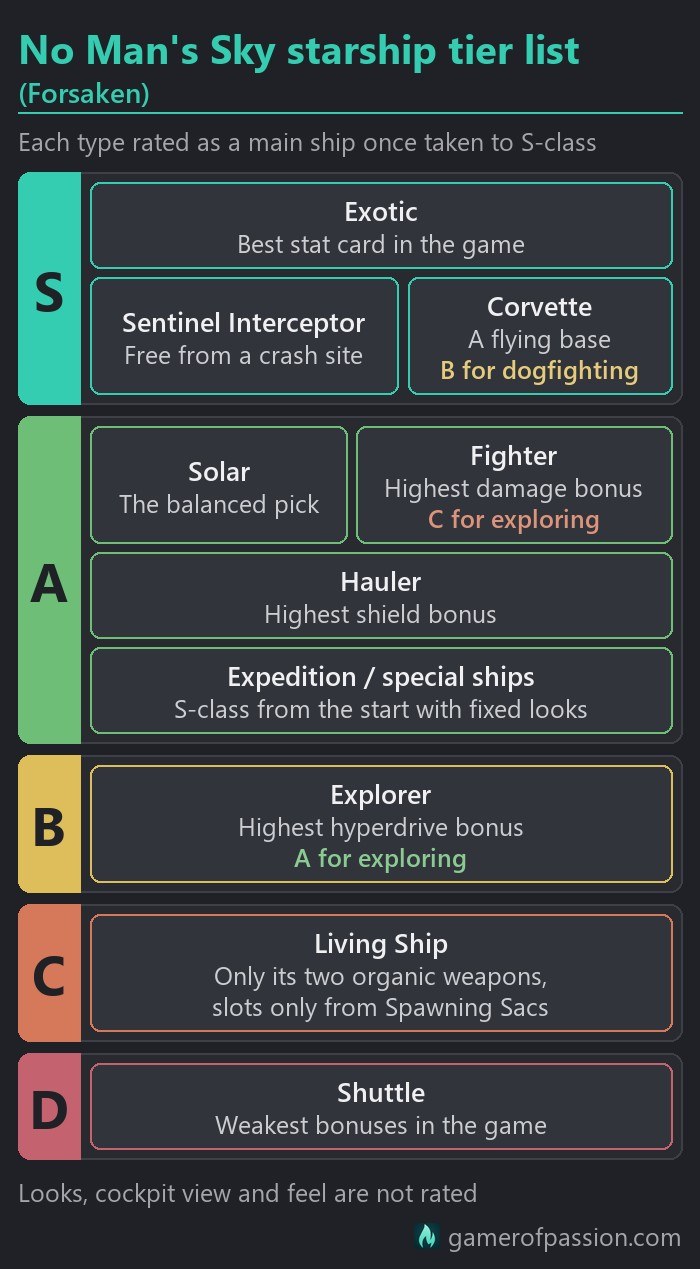
| Tier | Ship type | Best for | Why |
|---|---|---|---|
| S | Exotic | Balanced stats, combat, long warps | Top three on all four stats, always S-class, 105 cargo cap |
| S | Sentinel Interceptor | Planet hopping, combat, a free start | Free, 32-40 slot start, 120 cap, hovers, weak shield |
| S | Corvette | Daily driver, flying base (B tier for dogfights) | Hauler-grade shield, 120 + 60 slots, separate 160-slot hold |
| A | Solar | Daily driver, planet hopping | Bonus to all four stats at every class, 80% less pulse fuel |
| A | Fighter | Combat (C tier for exploring) | Top damage 70-90%, zero hyperdrive bonus, 100 cargo cap |
| A | Hauler | Cargo and trading | Top shield 95-125%, starts with up to 48 slots, 120 cap |
| A | Expedition and special ships | Collecting fixed-look ships | Already S-class; mostly via their expedition or its Redux |
| B | Explorer | Exploring and long warps (A tier there) | Top hyperdrive 90-120%, cheapest take-off, zero damage |
| C | Living Ship | Looks, long warps | Lowest manoeuvrability, two organic weapons, multi-day quest |
| D | Shuttle | A cheap stopgap | Weakest bonuses; C-class has none and 25 tech slots max |
S tier
I would say three ship types belong at the top, each for a different reason.
The Exotic has the best stat card in the game. It is the only type in the top three on all four stats (at S-class it rolls 50 to 75% damage, 70 to 90% shield, 75 to 95% hyperdrive and 40 to 50% manoeuvrability), and it always comes as S-class, which means it will never need a Nanite upgrade. Its weak points are that it is rare and expensive and that it will stop at 105 cargo slots.
The Sentinel Interceptor gets its place from value. You will get it for free from a crash site, and it starts with 32 to 40 cargo slots, grows to 120 and hovers. Its Sentinel technology halves the launch cost and gets two jumps out of every Warp Cell. The price for all that is a weak shield and almost no hyperdrive bonus.
The Corvette is more of a flying base than a ship. It has the same shield bonus as a Hauler (95 to 125% at S-class), 120 cargo and 60 tech slots plus a separate storage hold of 160 slots, and it can hover over rough ground while you beam down to the surface. As a daily driver and mobile base, you will have a hard time finding anything better.
As a dogfighter I would rate it B tier, though, because its damage and manoeuvrability bonuses are Hauler-grade and the way it handles depends on the parts you build into it. Putting one together will also cost you quite a bit.
A tier
Solar ships are the balanced pick among the ships you can buy. They are the only bought type with a bonus in all four stats at every class, their sail cuts pulse engine fuel use by 80% and recharges the launch thruster by itself, and they expand to 110 cargo and 60 tech slots. As of Forsaken, the bug that could stop them from animating correctly after several take-offs and landings in one session is fixed as well.
Fighters and Haulers are A tier for their own job. A Fighter has the highest damage bonus of any type (70 to 90% at S-class) and good manoeuvrability, but no hyperdrive bonus at any class and the smallest cargo cap at S-class with 100 slots. For exploring, that drops it to C tier. A Hauler has the highest shield bonus (95 to 125%), the biggest starting inventory of the ships you can buy (up to 48 slots) and a 120-slot cap, with little damage or agility to go with it.
Expedition and other special ships sit in A tier as a group. The ones named here come as S-class with fixed looks, and each one follows the rules of its base type. The Starborn Runner and Starborn Phoenix are hovering Exotics, the Utopia Speeder and Golden Vector are Fighters, the Iron Vulture is a Hauler, the Boundary Herald an Explorer, The Wraith a Living Ship and the Vintage Interceptor an Interceptor. Most of them are only available during their expedition or its Redux.
B tier
The Explorer has the highest hyperdrive bonus of all types (90 to 120% at S-class) and the cheapest take-off of the ships you can buy, with a cap of 110 cargo and 60 tech slots. It has no damage bonus at any class, which keeps it in B tier overall. If most of your time will go into warping from system to system, you can treat it as an A-tier ship.
C tier
The Living Ship is always S-class, rolls a good damage (50 to 75%) and hyperdrive (75 to 95%) bonus and expands to 120 cargo and 60 tech slots. Everything else works against it. Its manoeuvrability range is tied for the lowest in the game, and it has only its two organic weapons, slots that grow only with Spawning Sacs and a quest that takes several real days. In the end, it is going to be a ship you get for the looks.
D tier
Shuttles have the weakest bonuses in the game. A C-class Shuttle has no stat bonus at all and stops at 25 tech slots, the lowest tech cap of any ship. It will do as a cheap stopgap, although an S-class Shuttle still reaches 110 cargo and 60 tech slots.
Best ship for each job
The tier list looks at ships as all-rounders, but most types are built for one job. If you already know what you will spend most of your time on, simply pick the ship for that job.
For combat, an S-class Fighter rolls the highest damage bonus in the game, 70 to 90%. The Sentinel Interceptor follows at 60 to 80% and makes up for it with a higher manoeuvrability range, which ties the Exotic for the best of any type.
Both have thin shields. If you get into long fights with pirates or Sentinel ships, the Exotic will be the safer choice, as its shield bonus of 70 to 90% is far above what either of them can roll.
For exploring and long warps, the Explorer has the highest hyperdrive bonus at 90 to 120%, followed by the Exotic and the Living Ship at 75 to 95%. The Interceptor plays by its own rules here. Its stat card has almost no hyperdrive bonus, but its own hyperdrive, the Crimson Core, gets two jumps out of every Warp Cell. How far each of those jumps reaches next to an Explorer is hard to pin down, which is why range alone is not a reason to pick an Interceptor.
For cargo and trading, the Hauler starts with the most slots of any ship you can buy (up to 48) and expands to 120 at S-class. The Corvette matches that cap and adds its separate 160-slot storage hold on top. The Interceptor and the Living Ship will also reach 120 cargo slots, which makes a maxed Interceptor a good trader as well.
As a daily driver for hopping between planets, the Interceptor is hard to beat. It hovers, and its launch thruster costs half as much per take-off as a normal one and refuels itself over time.
Solar ships will come close, because the Vesper Sail recharges the launch thruster too and cuts pulse engine fuel use by 80%. Explorers have cheaper take-offs than the other types you can buy. If you would rather bring your base along, the Corvette is the other option, since it can hover over rough ground while you beam down.
For looks, any type will do, because most types can be raised to S-class with Nanites and slots can be added later, while the shape of a normal ship never changes. The squid-shaped Exotic is a good example of a pure looks pick. It has the same stat ranges and the same 105-slot cargo cap as every other Exotic and is only much rarer.
Stats by ship type
Each ship type rolls four stat bonuses (damage, shield, hyperdrive and manoeuvrability) inside fixed ranges that depend on its type and class. The S-class ranges set the ceiling for every type, and the type also decides the slot caps and the fixed technology that comes with it.
| Ship type | Damage | Shield | Hyperdrive | Manoeuvrability |
|---|---|---|---|---|
| Fighter | 70-90% | 24-38% | 0% | 35-45% |
| Hauler | 15-30% | 95-125% | 45-58% | 10-15% |
| Explorer | 0% | 30-40% | 90-120% | 25-32% |
| Shuttle | 25-30% | 25-30% | 25-30% | 15-35% |
| Exotic | 50-75% | 70-90% | 75-95% | 40-50% |
| Solar | 60-75% | 23-50% | 38-50% | 35-40% |
| Living Ship | 50-75% | 15-38% | 75-95% | 10-15% |
| Sentinel Interceptor | 60-80% | 20-35% | 5-10% | 40-50% |
| Corvette | 15-30% | 95-125% | 45-58% | 10-15% |
| Ship type | Max cargo + tech | Fixed perk or core tech |
|---|---|---|
| Fighter | 100 + 60 | Standard core tech; zero hyperdrive bonus at every class |
| Hauler | 120 + 60 | Standard core tech; starts with up to 48 slots |
| Explorer | 110 + 60 | Standard core tech; cheapest take-off of the bought types |
| Shuttle | 110 + 60 | Standard core tech; no stat bonuses at C-class |
| Exotic | 105 + 60 | Standard core tech; always S-class |
| Solar | 110 + 60 | Vesper Sail: pulse fuel x0.2, self-charging launch |
| Living Ship | 120 + 60 | Organ tech, pulse fuel x0.5; slots only from Spawning Sacs |
| Sentinel Interceptor | 120 + 60 | Sentinel tech: half-cost launch, two jumps per Warp Cell |
| Corvette | 120 + 60 | Separate 160-slot storage; stats from built parts |
No type leads everything. Fighters roll the most damage, then Interceptors, then Solar ships, Exotics and Living Ships.
Haulers and Corvettes have the strongest shield bonus, with the Exotic in second place. The Explorer leads hyperdrive ahead of the Exotic and the Living Ship, and the Exotic and the Interceptor share the top manoeuvrability range. That makes the Exotic the only type in the top three on all four stats, which is why it is the all-rounder on paper.
At S-class every ship type will expand to 60 technology slots. Cargo caps differ by type: Fighter 100, Exotic 105, Explorer, Shuttle and Solar 110, and Hauler, Sentinel Interceptor, Living Ship and Corvette 120. The Corvette’s 160-slot storage hold is a separate inventory on top of those 120.
The fixed technology is where the types really differ. A Solar ship’s Vesper Sail is a core part that cuts pulse fuel use to a fifth and recharges the launch thruster by itself. A Living Ship’s Pulsing Heart halves pulse fuel use, and its organs run on things like Oxygen, Carbon, Chromatic Metal and Living Slime instead of normal ship fuel. An Explorer will take off for about half the usual launch fuel and a Shuttle for about two thirds of it.
Bear in mind that the big stat numbers on the ship screen also count your installed technology, and you cannot compare them with these percentage ranges.
Interceptor strengths
On paper the Sentinel Interceptor is no all-rounder. An S-class one rolls 60 to 80% damage and 40 to 50% manoeuvrability, but only 20 to 35% shield and 5 to 10% hyperdrive, and the Exotic beats it on the stat card overall. What makes the Interceptor so popular is everything around those numbers.
It is free, it will start with 32 to 40 cargo and 22 to 28 tech slots at every size (an Exotic starts with 24 to 32 cargo slots), and at S-class it will expand to 120 and 60. Since the Interceptor update (4.2), player-owned Interceptors also have their own flight model with the ability to hover.
Its fixed Sentinel technology is the real perk. The Anti-Gravity Well launch thruster costs half as much per take-off as a normal Launch Thruster and refuels itself like a Launch Auto-Charger.
The Crimson Core hyperdrive gets two jumps per Warp Cell, and the Luminance Engine gives a stronger boost than a normal Pulse Engine. Every one of these core parts also accepts Radiant Shards, which you will farm on dissonant planets anyway. Besides the shards, the Anti-Gravity Well takes Pugneum, the Luminance Engine Tritium, the Crimson Core Warp Cells or Warp Hypercores, and the Aeron Shield Sodium or Sodium Nitrate.
Interceptor weaknesses
The weak spots are the shield and the hyperdrive bonus. Interceptors have one of the lowest shield bonuses of any ship type, about level with the Shuttle’s, and only the Fighter has a lower hyperdrive bonus. An Interceptor’s warp range depends on the Crimson Core instead of the stat card, and how that stacks up against a good Explorer is still an open question.
The Sentinel parts also need Sentinel materials. Whenever a core part breaks or you install one at the crash site, you will need Radiant Shards, Inverted Mirrors or Crystallised Hearts, which you collect on dissonant planets. The Pilot Interface is a core part as well and takes up one of your tech slots.
Ship classes
Once every slot is bought, two ships of the same type can still differ a lot, because the class sets the cap those slots can reach and the range the bonuses roll in. An S-class Hauler will expand to 120 cargo and 60 tech slots, for example, while a C-class one will stop at 60 and 30.
| Ship type | C | B | A | S |
|---|---|---|---|---|
| Fighter | 50 + 30 | 70 + 40 | 80 + 50 | 100 + 60 |
| Hauler | 60 + 30 | 80 + 40 | 100 + 50 | 120 + 60 |
| Explorer | 60 + 30 | 80 + 40 | 90 + 50 | 110 + 60 |
| Shuttle | 50 + 25 | 80 + 40 | 90 + 50 | 110 + 60 |
| Solar | 50 + 30 | 70 + 40 | 90 + 50 | 110 + 60 |
| Sentinel Interceptor | 60 + 30 | 80 + 40 | 100 + 50 | 120 + 60 |
| Corvette | 60 + 30 | 80 + 40 | 100 + 50 | 120 + 60 |
| Exotic | – | – | – | 105 + 60 |
| Living Ship | – | – | – | 120 + 60 |
| Nanites to reach this class | – | 10,000 | 25,000 | 50,000 |
The Exotic and the Living Ship are the two exceptions. They always come as S-class, and their caps (105 and 60 for the Exotic, 120 and 60 for the Living Ship) are the same at every class anyway.
The stat ranges climb with each class as well. An Explorer’s hyperdrive bonus is 15 to 25% at C-class and 90 to 120% at S-class, and a Fighter’s damage goes from 8 to 15% up to 70 to 90%.
Neighbouring classes overlap on some stats, though. An A-class Fighter rolls 50 to 75% damage and an S-class one 70 to 90%, which means a lucky A-class can beat an unlucky S-class on that one stat. A class upgrade should roll the bonuses again inside the new range.
Nanite upgrades
Raising a ship one class at the Starship Outfitting terminal of a space station will cost you 10,000 Nanites from C to B, 25,000 from B to A and 50,000 from A to S, or 85,000 Nanites for the full climb from C to S. If you are short on them, my Nanites guide lists the faster ways to farm them. Exotics and Living Ships are already S-class and have nothing to upgrade.
Supercharged tech slots
Every ship type can have up to four supercharged slots, and they sit near the top of the tech grid. A supercharged slot will boost whatever technology you put into it by 25%, which makes it the place for your best hyperdrive, weapon or pulse upgrades. Check where they are in the tech grid before you buy a ship.
Class odds by system
A ship’s class is rolled from the system’s economy. In a poor (1-star) system no normal ship rolls S-class, in an average system about 1 in 100 is S-class and in a wealthy (3-star) system about 1 in 50. Pirate (outlaw) systems beat both at roughly 1 in 20, which is why S-class hunters camp outlaw trading posts. Wealthy systems are still the best place for A-class ships, with a little bit more than one in four landing as A.
How to get each ship type
Every type has its own route. Fighters, Haulers, Explorers, Shuttles, Solar ships and Exotics land at space stations and trading posts and can be bought from their pilots, while Interceptors and Living Ships need a loop of missions and Corvettes are built from parts.
Sentinel Interceptor
Crashed Interceptors wait on dissonant planets, and the way to them runs through a Harmonic Camp. Once you have done the loop, you can repeat the last steps as often as you like until you get the class you want.
- Open the Galaxy Map, travel to a dissonant system and scan its planets from space to find the dissonant world.
- Destroy Dissonance Resonators for Inverted Mirrors, with a 1 in 5 chance of an Echo Locator instead, and shoot Sentinel crystals for Radiant Shards.
- Use the Echo Locator to mark a Harmonic Camp, then pick “Locate Dissonance Spikes” at its terminal to mark a crashed Interceptor.
- Follow the repair mission at the crash site. The Pilot Interface takes 6 Radiant Shards, 1 Inverted Mirror and a Harmonic Brain. For the brain, shoot down Sentinel Interceptors in space until one drops a Hyaline Brain, then probe it in your inventory and take it to the ancient site it marks to cleanse it.
- Check the class. If it is not the one you want, claim it anyway, scrap it at a station for Units and ask the terminal for the next one.
Which parts arrive broken is random. As such, it is a good idea to bring a few spares of everything.
For reference, the other core parts take these materials to install:
- Anti-Gravity Well: 1 Inverted Mirror, 1 Crystallised Heart and 170 Pugneum
- Crimson Core: 1 Crystallised Heart and 3 Radiant Shards
- Luminance Engine: 1 Salvaged Glass, 3 Radiant Shards and 210 Pugneum
- Aeron Shield: 3 Radiant Shards and 4 Inverted Mirrors
Repairing a damaged part will cost about half of that, and Crystallised Hearts drop from corrupted spiders. The same Harmonic Camps also give you a Sentinel Multi-Tool, which I go through in my best Multi-Tool guide.
A base computer next to the Harmonic Camp will let you teleport back whenever you want another try, and a message marker at each crash site with its class on it helps you find the good ones again. Players report that all crashed Interceptors in one star system share the same design. If you dislike the look, move to another dissonant system instead of farming the same one.
Crashed Interceptors seem to follow the same class table as every other ship. You can expect about one S-class in 20 crash sites in a pirate (outlaw) system, plenty of A-class ones in wealthy systems and no S-class at all in poor ones.
If you do not mind a bigger fight with the Sentinels in space, there is also a second route. Destroying a Sentinel capital ship at the top wanted level will give you a Carrier AI Fragment, and its “Search Archive” option points you to the last known location of an Interceptor.
Exotic
Exotics are bought from their pilots like any other ship, but they are rare. They can turn up in any system, and the usual method is to wait at a space station or trading post and check every ship that lands. The squid-shaped Exotic is the rarest ship of all, and you can play for hundreds of hours without ever seeing one land.
An Exotic always comes as S-class, and you should expect it to cost a good deal more than most other S-class ships. Nanites will not improve it later either, since there is no class to raise.
Solar
Solar ships are bought like other ships, and the best place to look is an outlaw (pirate) system, where they tend to turn up far more often than anywhere else. Those systems also have the best odds for an S-class ship, which makes a Solar hunt and an S-class hunt the same trip. If the one you like is lower than S-class, you will still be able to raise it with Nanites.
Living Ship
A Living Ship will cost you a Void Egg and several days of real time.
- Buy a Void Egg at the Quicksilver shop on the Space Anomaly. It usually costs 3,200 Quicksilver.
- Keep it in your inventory and use the pulse engine in space until a living ship hails you, then answer it.
- Follow the Starbirth quest. Craft the parts it asks for, collect the souls at the marked sites and sit out four 22-hour waits.
- Follow the final signal and claim your Living Ship.
- For another one, buy a new egg. Every later egg will lead you to a fallen Living Ship that costs 10,000 Nanites to claim.
The crafted parts are the Consciousness Bridge (250 Hexite, 80 Pugneum and a Korvax Casing), the Pulsating Core (250 Liquid Sun, 100 Gold and 80 Mordite), the Impossible Membrane (100 Chromatic Metal, a Hypnotic Eye and 150 Living Water) and the Seeds of Glass (100 Magnetised Ferrite and 100 Fragmented Qualia). Hexite and Faecium are two separate items, and only Hexite goes into the Consciousness Bridge.
Starbirth runs over five stages, and four of them end with a 22-hour real-time wait while part of the ship matures. That means the first Living Ship will take close to four days at the very least.
Changing your system clock to skip the waits can break your save, and it is better to just sit them out. Forsaken (7.10) also fixed a bug that stopped the Void Egg from attracting more living ships after Starbirth, which was the reason a second Living Ship sometimes never showed up.
Corvette
Corvettes arrived with the Voyagers update (6.0) in August 2025. You build them from modules at the Corvette Workshop in a space station, where basic modules are sold for Units and the advanced ones are bartered. COSMOS (7.0) gave them their salvage job with the Tractor Beam and the Gravitino Coil, and Forsaken (7.10) added biomechanical parts from the forsaken traders, which I list in my Forsaken guide.
A basic flyable corvette (cockpit, hab, two landing gear, one engine, reactor, weapon and landing bay) comes to about 8.6 million Units in modules at the Corvette Workshop, or much less if you dig up parts on Salvageable Scrap planets. Without a landing bay or another accessway, the game will not let you finalise the build. The accessway is also what makes the hover possible, as a corvette with one can hover over rough ground while you beam down to the surface.
Functional corvette parts work like built-in upgrade modules. A shield generator adds a shield upgrade, an engine a pulse upgrade, and a reactor such as the Zenith-Class a hyperdrive upgrade. Players report that only three parts of the same kind add stats, and any extra ones are just for looks.
Regular ships
You will find Fighters, Haulers, Explorers and Shuttles at almost every space station and trading post, and their class follows the economy odds above. Ship prices scale mostly with slot count and class, and players report most S-class ships at somewhere between about 5 and 40 million Units.
Crashed ships are the cheap way in, and my beginner guide explains how to find one, repair it and fly it to a station. Every new save outside expeditions also starts in the same crashed ship, the Radiant Pillar BC1, a C-class Fighter built from one fixed seed, and every player’s copy looks the same. Players report it hides a good supercharged layout, which makes it worth upgrading with Nanites if you are fond of how it looks.
Inventory slots
Extra starship slots start at 100,000 Units each and will stay at that price for a long time. After that the price climbs in steps to 25 million and finally 75 million Units per slot, which is why the last rows of a big S-class ship take the longest to fill.
A Storage Augmentation adds one slot for free. Save them for the ship you are going to keep instead of spending them on a stopgap.
Scrapping an S-class Fighter, Hauler, Explorer or Shuttle should give you at least one Storage Augmentation. Living Ships work differently again. They only take Spawning Sacs, one per slot, and you cannot buy their slots with Units at all.
You can keep 12 starships in your active fleet, and with a freighter you can archive 18 more at its fleet management terminal. Archived ships will keep their technology but lose any cargo, which is why you should empty them first. Additionally, corvettes cannot be archived, which means a corvette always sits in your active fleet.
Ship buying mistakes
- Buying a fully expanded C-class or B-class ship and expecting it to grow like an S-class one. A C-class Fighter will stop at 50 cargo and 30 tech slots until you raise its class.
- Picking an Exotic as a cargo ship. It stops at 105 cargo slots, while a Hauler, an Interceptor, a Living Ship or a Corvette reaches 120.
- Leaving cargo in a ship you trade in or archive, as you will lose it.
- Spending Storage Augmentations on a ship you are going to replace soon.
- Scrapping an Exotic, a Living Ship or an Interceptor in the hope of salvaged ship parts. These three cannot be broken down into parts.
- Hunting for an S-class ship in a poor system, where only a rare Exotic can turn up as S-class.
- Planning normal upgrades for a Living Ship. It cannot fit the Phase Beam, the Positron Ejector, the Infra-Knife Accelerator, the Rocket Launcher or a Launch Auto-Charger and uses its own organ versions instead.
Starship FAQ
What is the best ship in No Man’s Sky?
There is no single best ship for every job. An S-class Exotic has the best stat card, a Sentinel Interceptor is the best value because it is free, hovers and expands to 120 cargo slots, and a Corvette is the best mobile base. For one specific job, a Fighter is the pick for combat, an Explorer for warping and a Hauler for cargo.
Is the Sentinel Interceptor worth it?
Yes, I would say it is the best value in the game. It will cost you nothing but some time on dissonant planets and a Sentinel dogfight or two, starts with more cargo slots than most ships and comes with cheaper take-offs, two jumps per Warp Cell and the ability to hover. In return you get a weak shield and almost no hyperdrive bonus, and its Sentinel parts need Radiant Shards, Inverted Mirrors and Crystallised Hearts to repair.
How many ships can you have?
You can keep 12 starships in your active fleet. With a freighter, you can archive 18 more at its fleet management terminal, for 30 in total, and corvettes can never go into the archive. If you do not own a freighter yet, my best freighter guide will help you pick one.
Are Exotic ships always S-class?
Yes. Exotics always come as S-class, and their slot caps of 105 cargo and 60 tech slots do not depend on class anyway. That also means there is no class upgrade to spend Nanites on, and a better Exotic is simply one with better stat rolls or more starting slots.
Is a Living Ship worth it?
Only if you love the look. It is always S-class with a good damage and hyperdrive card and a 120-slot cargo cap, but it has one of the lowest manoeuvrability ranges, uses only its two organic weapons, grows only with Spawning Sacs and takes close to four days of real time for the first one. As a main ship, an Exotic, an Interceptor or a Corvette will serve you better.
Picking your ship
If you just want one strong ship without spending a fortune, then farming an S-class Sentinel Interceptor is probably your best bet. Once you have the Units, an Exotic will give you the best stat card and a Corvette the best base on the move, and after that it comes down to the look you like. Just make sure whatever you fly ends up at S-class, because that is what decides how far it can grow.