In this guide, I want to go through how smithing in Bannerlord really works, from the way new parts unlock to what decides the price of the weapons you sell. A lot of the smithing advice out there was written for older versions, and some of it no longer holds after War Sails and the smelting changes of the 1.4 patches. The rules and numbers below were read straight out of the code and data files of v1.4.8 with the War Sails DLC.
The short answer is to craft the most valuable weapon you can and then smelt it again, since crafting earns about five times the unlock progress of smelting the same weapon and the smelt gives most of the metal back. Early on, refine Charcoal with Efficient Charcoal Maker for XP, and later level on crafting orders. Stamina only refills while a hero is inside a settlement, so use your companions as extra smiths.
Smithing basics
The smithy offers four actions. All of them cost stamina, and all of them will give Smithing XP to the hero who does the work.
- Refining turns raw materials into better ones. Two Hardwood make one Charcoal, Iron Ore and Charcoal make Crude Iron, and from there the metal goes up through Wrought Iron and Iron to Steel, Fine Steel and Thamaskene Steel. The three steel steps need the Steel Maker perks.
- Smelting breaks a weapon down into the materials of its parts. Every smelt costs 1 Charcoal.
- Crafting, or free build, lets you design a weapon from the parts you have unlocked.
- Crafting orders are requests from notables and lords for a weapon with certain stats. They pay gold and a lot of XP.
Smithing is an Endurance skill, and that is going to matter later for the learning limit.
Stamina
Stamina is the real limit on how much smithing you can do, and each hero has their own bar. It starts at 100 and grows by half a point for every point of Smithing skill, so a smith at 300 skill will have 250 stamina. Refining costs 6 stamina and smelting costs 10. Crafting costs 10 for a tier 1 weapon and 5 more for every tier above that, so a tier 5 weapon will cost you 30 stamina and a tier 6 weapon 35. Practical Refiner, Practical Smelter and Practical Smith halve the cost of their own action, which brings refining down to 3, smelting to 5 and a tier 5 craft to 15.
Stamina only comes back while that hero is inside a town, castle or village. Travelling does not count. A smith regains 5 stamina per hour at 0 skill and 13 per hour at 300, and the Athletics perk Stamina adds another 50%, which makes 19 per hour at 300.
This is why companions and family members are so useful at the anvil. When your main smith runs dry, simply switch to another hero in the smithy.
How to unlock smithing parts
Part unlocks are probably the most confusing side of smithing. Unlock progress belongs to the weapon type, not to the hero. Every weapon type in the smithy, such as One Handed Sword, Two Handed Polearm or Throwing Axe, has its own unlock progress. Your companions’ crafting and smelting will add to the same pool as your own, and every part that opens can be used by any hero who works at your anvil.
The progress needed for the next part depends on how many parts the weapon type has and how many you have opened so far. Every part you open makes the next one cost more. Types with lots of parts have a lower cost per part, but they will still take far longer to finish. When your progress passes the cost, a part opens and the leftover progress carries over, so one valuable craft can open several parts in one go.
Which part you get is random. The game picks one of the locked parts from the lowest tier that is still unfinished in that weapon type, so you will never get a tier 3 part while any tier 2 part of that type is still locked. No part slot is favoured either. If you keep getting pommels and guards while the blades stay locked, it is only because there are more of them.
Crafting vs smelting
Crafting a weapon earns about five times as much unlock progress as smelting a weapon of the same value. Smelting still helps, though. It is how you put progress into a weapon type you can’t craft well yet, and it gives the metal back.
For example, crafting a weapon worth 10,000 denars earns 1,101 progress, or 2,101 with Curious Smith. Smelting a weapon of the same value earns 201, or 402 with Curious Smelter. The chart shows the same comparison for weapons worth 1,000, 5,000, 10,000 and 20,000 denars.
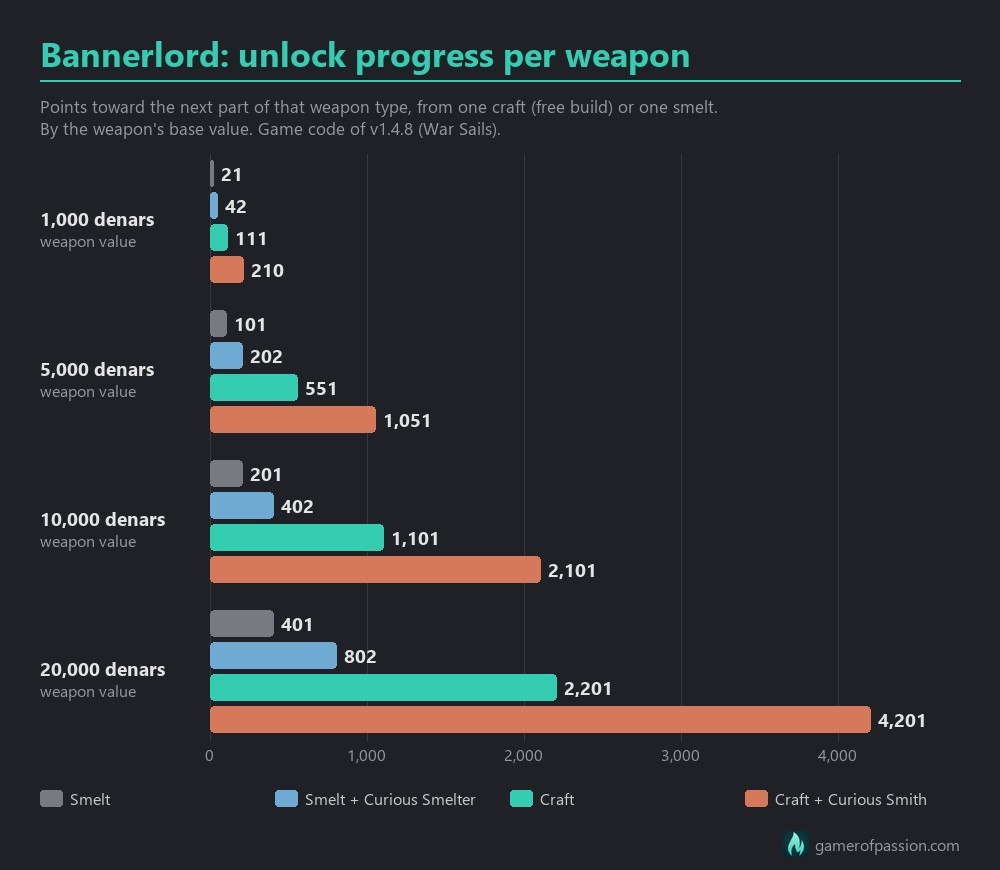
Unlock progress depends only on the weapon’s value, so the most valuable item you can craft is also the fastest way to unlock parts. Damage, speed and part tiers only count because they raise that value. The quality roll does not count at all. A poor-quality weapon will give exactly as much progress as a Fine one, because the game uses the weapon’s base value. The quality only changes the shop price and a few points of damage and speed.
That makes the best loop fairly obvious. Craft the most valuable weapon you can make, then smelt it again. You collect the crafting progress, then the smelting progress on top, and most of the metal comes back for the next craft.
Parts per weapon type
How long a weapon type takes depends mostly on how many parts it has. The last column shows how many crafts of a 10,000-denar weapon with Curious Smith it takes to open all of them.
| Weapon type | Parts (War Sails) | Parts (base game) | Progress for all parts | 10k crafts with Curious Smith |
|---|---|---|---|---|
| Throwing Axe | 11 | 4 | 2,073 | 1 |
| Javelin | 26 | 19 | 7,174 | 4 |
| Pike | 47 | 35 | 16,651 | 8 |
| Two Handed Mace | 82 | 82 | 36,298 | 18 |
| Two Handed Axe | 98 | 88 | 46,136 | 22 |
| Throwing Knife | 99 | 99 | 47,277 | 23 |
| Mace | 137 | 134 | 75,917 | 37 |
| One Handed Axe | 138 | 106 | 76,430 | 37 |
| Two Handed Polearm | 147 | 116 | 81,979 | 40 |
| Dagger | 176 | 168 | 110,182 | 53 |
| Two Handed Sword | 283 | 249 | 216,305 | 103 |
| One Handed Sword | 450 | 398 | 431,730 | 206 |
Throwing axes and javelins fill up quickly because they have so few parts, 11 and 26 with War Sails. A single 10,000-denar craft with Curious Smith covers the progress for every throwing axe part, and four of them cover all the javelin parts. One-handed swords sit at the other end with 450 parts, 52 of them added by War Sails (mostly Nord parts), and that adds up to 206 crafts of the same weapon. War Sails added new parts to ten of the twelve weapon types this way. Throwing knives and two-handed maces are the only ones that got none.
Parts not unlocking?
If a weapon type does not seem to get any new parts, one of these is usually the reason.
- You are working on the wrong weapon type. Progress only goes to the type of the weapon you craft or smelt, so smelting two-handed swords will do nothing for your one-handed swords.
- A lower tier is still incomplete. Every part of the lowest unfinished tier has to open before the next tier starts, and a tier with lots of pommels and guards can take a while.
- Your items are worth too little. A 1,000-denar craft earns 111 progress and smelting a 1,000-denar weapon only 21, while a 20,000-denar craft earns 2,201.
- Your Smithing skill does not open parts. Parts have no skill requirement at all. Skill affects quality and stamina, but never which parts you can use.
- You are missing the Curious perks. Curious Smelter doubles unlock progress from smelting, and Curious Smith nearly doubles it for crafting.
- If you simply want everything open, the console command
campaign.unlock_all_crafting_piecesexists, but it needs cheat mode.
Leveling smithing
Smithing XP follows the value of what you make, while stamina limits how much you can make. Leveling is therefore mostly about getting the most XP out of each point of stamina.
Charcoal and refining
At the very start, refining Charcoal is the best XP per stamina you are going to get. With Efficient Charcoal Maker, one refine turns 2 Hardwood into 3 Charcoal and gives 45 XP for 6 stamina. That is 7.5 XP per stamina point, or 15 once you add Practical Refiner. Without the perk, the same refine makes only 1 Charcoal and gives 15 XP. As such, Efficient Charcoal Maker is the first perk you will want, and the Charcoal will not go to waste either, since every smelt and many refines need it.
Refining metal gives XP based on the value of what comes out, at the same 6 stamina per refine. Iron Ore into 2 Crude Iron gives 12 XP, Wrought Iron 9, Iron 18, Steel 30, Fine Steel 48 and Thamaskene Steel 78, so the steel steps are decent work for a companion with the Steel Maker perks.
Free crafting
Free crafting gives 2% of the weapon’s value as XP. A 1,000-denar weapon gives 20 XP, a 10,000-denar weapon 200 and a 50,000-denar weapon 1,000. Without any Practical perk, a 10,000-denar tier 5 weapon gives about 6.7 XP per stamina point, which is still a little below the 7.5 of Charcoal. Once your crafts are worth more than about 11,000 to 13,000 denars, crafting overtakes Charcoal, and every craft will also bring unlock progress and a weapon you can sell or smelt.
Difficulty itself gives no XP. Harder designs only pay off because they use higher-tier parts, which makes the weapon worth more and, as a result, gives you more XP, more unlock progress and a better price if the roll goes well. Going far above your skill mostly buys you poor-quality results (Bent and Cracked on polearms, Dull and Rusty on swords) that sell for 30 to 60% of the price. In free build, the XP and the unlock progress stay the same with a bad roll, but you will lose money on every one of them. On orders it is riskier, because a bad roll also lowers the damage and speed the client checks.
XP from orders
Later on, most of your XP is going to come from crafting orders. Orders pay at least five times the skill XP of crafting the same weapon in free build, plus a bonus based on the order. A 10,000-denar weapon gives 200 XP in free build and 1,000 XP as an order, before the bonus. The bonus is a quarter of the ordered weapon’s maximum market price (1.3 times its value), so about a third of the ordered weapon’s value, and orders for valuable weapons will move your skill the most. Missing the stats halves that bonus but does not remove it.
Learning limit
The learning limit is the reason a smith can suddenly stop gaining XP. It depends on Endurance and on the focus points in Smithing. Each point of Endurance raises the limit by 10 and each focus point by 30, so focus counts three times as much. Once a hero’s skill goes above the limit, the XP rate takes a big cut straight away, then keeps falling with every further point until it reaches zero.
This is also why companions stall. A companion with 5 Endurance and no focus in Smithing has a learning limit of 40, so their XP rate drops by over a third at 41, keeps falling and reaches zero at 60, which is why players regularly report companion smiths getting stuck in the 50s. If you want a companion to keep improving, give them focus points in Smithing, and the same goes for your main smith.
Leveling route
- Before you start, put focus points into Smithing and, if you can spare them, some points into Endurance.
- Buy Hardwood, take Efficient Charcoal Maker in the first tier and refine Charcoal while your crafts are still cheap.
- Take Curious Smelter and Curious Smith, then craft the most valuable weapons you can and smelt them again. Rinse and repeat.
- Once you have good parts and better metal, do every crafting order your smiths can take.
- Let companions refine and smelt with their own stamina, while your main smith spends theirs on crafts and orders.
The Curious and Practical perks only count for the hero who does the work. Smelt your own crafts with the hero who has Curious Smelter, and give companions the refining jobs.
What to smelt in v1.4.8
If you have read older guides, you will probably know the Pugio and the Tribesman Throwing Daggers as the classic source of Fine Steel. That loop is gone. In v1.4.8 Tribesman Throwing Daggers smelt into 1 Wrought Iron and 3 Iron, and the Pugio into 2 Wrought Iron and 3 Iron. Neither gives Steel or Fine Steel any more. The 1.4.5 patch notes list reduced smelting outputs, and the hammers and the Pitchfork will only give you one or two Hardwood back.
| Weapon | Smelts into |
|---|---|
| Pugio | 3 Iron, 2 Wrought Iron |
| Tribesman Throwing Daggers | 3 Iron, 1 Wrought Iron |
| Wooden Hammer | 1 Crude Iron, 2 Hardwood |
| Pitchfork | 2 Hardwood |
| Blacksmith Hammer | 1 Wrought Iron, 1 Crude Iron, 1 Hardwood |
| Lowland Throwing Knife | 1 Steel, 3 Wrought Iron |
The Lowland Throwing Knife is the only one of them that gives any Steel. For Fine Steel and Thamaskene Steel, you are now going to have to refine them yourself with the Steel Maker perks or smelt expensive weapons.
Your own crafts will give most of their metal back. Smelting one of your weapons returns the materials of all its parts, except that one piece of the best metal comes back one grade lower (one Thamaskene Steel turns into Fine Steel, for example), and it costs 1 Charcoal like any smelt.
Fine Steel and Thamaskene Steel
The shop weapons that smelt into the most Fine Steel and Thamaskene Steel are mostly one-handed and two-handed swords.
| Weapon | Type | Culture | Smelts into |
|---|---|---|---|
| Thamaskene Steel Kaskara | One Handed Sword | Aserai | 3 Thamaskene Steel, 6 Fine Steel |
| Thamaskene Steel Spathion | One Handed Sword | Empire | 3 Thamaskene Steel, 5 Fine Steel |
| Fullered Long Warsword | One Handed Sword | Sturgia | 2 Thamaskene Steel, 6 Fine Steel |
| Wide Fullered Broad Arming Sword | One Handed Sword | Vlandia | 3 Thamaskene Steel, 3 Fine Steel, 2 Steel |
| Thamaskene Steel Two Hander | Two Handed Sword | Vlandia | 3 Thamaskene Steel, 3 Fine Steel, 1 Steel, 1 Wrought Iron |
| Wide Fullered Broad Two Hander | Two Handed Sword | Vlandia | 3 Thamaskene Steel, 3 Fine Steel, 3 Iron |
| Huscarl Runed Sword | One Handed Sword | Nord (War Sails) | 2 Thamaskene Steel, 4 Fine Steel |
| Highland Broad Blade | One Handed Sword | Battania | 1 Thamaskene Steel, 5 Fine Steel |
| Northern Reinforced Two Handed Mace | Two Handed Mace | Sturgia | 2 Thamaskene Steel, 1 Fine Steel, 3 Steel, 2 Hardwood |
| Broad Kaskara | Two Handed Sword | Aserai | 4 Fine Steel, 5 Steel, 1 Iron |
| Battanian Mountain Blade | Two Handed Sword | Battania | 1 Thamaskene Steel, 2 Fine Steel, 1 Steel, 2 Wrought Iron |
| Southern Two Handed Mace | Two Handed Mace | Aserai | 4 Fine Steel, 1 Steel, 1 Hardwood |
| Swift Wing Axe | Two Handed Axe | Nord (War Sails) | 4 Fine Steel, 1 Steel, 1 Hardwood |
| Barghasts Great Axe | Two Handed Axe | – (War Sails) | 1 Thamaskene Steel, 2 Fine Steel, 2 Hardwood |
| Noble Cavalry Lance | Two Handed Polearm | Khuzait | 4 Fine Steel, 1 Hardwood |
The Thamaskene Steel Kaskara tops the list with 3 Thamaskene Steel and 6 Fine Steel, and the War Sails Huscarl Runed Sword gives 2 Thamaskene Steel and 4 Fine Steel. Bear in mind that these are expensive weapons, and shops sell them for a little under their base value in any town. Before you buy one, compare the shop price with what that metal is worth to you, or with the time and stamina it would take to refine it yourself.
Hardwood
Hardwood is the other bottleneck, since every piece of Charcoal starts with it. Two spears give back the most Hardwood of any shop weapon, 4 each, plus a little iron.
| Weapon | Type | Smelts into |
|---|---|---|
| Drilled Leaf Short Spear | Two Handed Polearm | 1 Wrought Iron, 1 Crude Iron, 4 Hardwood |
| Narrow Long Headed Spear | Two Handed Polearm | 1 Wrought Iron, 4 Hardwood |
Compare their price with plain Hardwood in the same town before you buy a stack of spears, and remember that each smelt also costs 1 Charcoal. On the plus side, every smelt will add a little unlock progress to the Two Handed Polearm type.
Making money with smithing
Selling crafted weapons is the classic way to make money with smithing. How much you get will depend on the weapon’s value, the quality it rolls and the trade penalty when you sell it.
Weapon price
Price follows a tier score built from your best attack (damage and speed), the weapon’s length, and the tier and metal of its parts. Because price grows exponentially with that score, a few points of damage or speed can add thousands. Every full point of that score multiplies the price by 2.75.
- 60% of the score depends on the weapon’s best attack. The game takes the stronger of the swing and the thrust, where speed counts heavily, and raises the result further the longer the weapon is.
- Damage types are weighted. Blunt damage counts 1.45 times, pierce 1.15 times and cut once. Weapons that can only be used with two hands get a 0.8 factor, throwing knives and throwing axes 1.2, and javelins only 0.6.
- The other 40% is based on the parts. A smaller share of it is the average tier of your parts, and the larger share is the grade of the metal, from Crude Iron at the bottom to Thamaskene Steel at the top. Wood does not count, and neither do handling or weight, except where they change the speed.
Length raises the price directly, but a longer part can also make the weapon slower, and speed counts more. Check the price in the designer after every slider change, because maxing everything will not always give you the highest number.
Quality
The quality roll changes the selling price. A Legendary weapon will sell for 1.8 times its value, a Masterwork for 1.5 times and a Fine one for 1.2 times. At the bottom, Inferior and Poor results (Bent and Cracked on polearms, Dull and Rusty on swords) only fetch 0.6 and 0.3 times the value. In the game the Fine result shows up under the weapon’s own prefix, for example Balanced on swords or Quality on axes. On javelins, Fine is called Large Bag and Masterwork is called Balanced, while throwing axes have it the other way round.
Your odds depend on your skill compared with the difficulty of the design. Difficulty is the weighted average tier of the parts times 50, with the blade weighted at 100, the handle at 60 and the guard and pommel at 20 each. Just below the difficulty you still get mostly Common weapons, but once the design is about 40 points above your skill, most results are poor-quality. Above it, the gap decides how many Fine, Masterwork and Legendary results you will get. Experienced Smith adds 10% to the Fine chance, Master Smith 7.5% to Masterwork and Legendary Smith 5% to Legendary, plus 1% for every 5 skill points above 275.
Besides the odds, there is also a cap based on the plain average tier of all parts. With an average of 4.5 or more, every quality is possible. Between 3.5 and 4.5, a Legendary roll turns into Masterwork, and below 3.5, Masterwork and Legendary both drop to Fine.
Javelins cannot reach Legendary in v1.4.8, no matter how high your skill is. Their best shaft is tier 3, which keeps the average part tier below the 4.5 a Legendary needs, so they top out at Balanced (Masterwork). Throwing knives also stop at an average of 4.25, so they cannot go Legendary either. Throwing axes can, but only with War Sails parts: you need the tier 5 Nord Decorated Throwing Axehead and a tier 4 or 5 handle.
A low-tier pommel can block a Legendary result, since the quality cap uses the plain average of all part tiers. The pommel has only a small weight in the difficulty, but for the cap it counts just as much as the blade.
Selling
Selling a weapon in a town comes with a hefty trade penalty that grows with the weapon’s tier. The table shows what share of a crafted weapon’s value you will actually get in a town.
| Weapon tier | No perks, Trade 0 | Artisan Smith | Artisan + Trade 150 | Artisan + Trade 300 + Appraiser + Arms Dealer |
|---|---|---|---|---|
| Tier 3 | 26% | 39% | 44% | 56% |
| Tier 4 | 24% | 37% | 42% | 54% |
| Tier 5 | 22% | 35% | 40% | 52% |
| Tier 6 | 21% | 33% | 38% | 51% |
Artisan Smith only counts if your party leader (you) has it. On a companion smith it does nothing for your sales, so give companions Practical Smith. Trade skill does matter as well. At 300 Trade, with Artisan, Appraiser and Arms Dealer, you keep about half of a tier 5 weapon’s value instead of about a fifth. Additionally, Appraiser is a Trade perk and Arms Dealer a Roguery perk, so even without Artisan, 300 Trade with both of them will get a tier 5 weapon to 39%.
Cheap weapons can sell for a bit more in rich towns, but anything worth more than a few thousand denars sells at the same lowest town price factor everywhere, so pick the town by how much gold its merchants have, not by price. Avoid selling in villages, where the penalty is much higher.
The other limit is gold. Town merchants only have so much money, and players report that town traders have had even less of it since War Sails. Selling one or two big weapons per town and then moving on is usually the easier way.
For early money with little metal, the usual pick among players after War Sails is a throwing axe with the tier 3 Nord head and a tier 5 handle. In 1.4.6, players report these axes selling for roughly 5,000 to 15,000 denars. With the tier 3 head they top out at Masterwork (Large Bag), and a Legendary throwing axe needs the tier 5 head.
Crafting orders
Every town has six order slots. Five of them have fixed difficulty ranges, 40-79, 80-119, 120-159, 160-199 and 200-240, and the sixth is set to your main hero’s Smithing skill at the time the order appears. Each slot also goes up with the town’s prosperity, so richer towns will ask for harder weapons.
You can take an order if your smith’s skill is no more than 50 below its difficulty. The game checks this for the hero you have selected, so a companion with more Smithing than your main hero can take orders that are greyed out for your main hero.
- If your weapon’s stats add up to at least the ordered ones, you will get the full reward. One stat can be a bit low if the others are higher.
- If they add up to more, you will get a bit extra, 10% for every 100% of surplus.
- If its stats add up to less or it has the wrong damage type, you will still get half of the reward, and less than that if your weapon is worth less than the one that was ordered.
As mentioned above, a missed order still pays half of the XP bonus, or less if your weapon’s tier is below the order’s. Beyond meeting the stats, how pleased the client is makes no difference. Orders give slightly less unlock progress than a free craft of the same value, 1,001 instead of 1,101 for a 10,000-denar weapon, but the extra XP and the gold more than make up for that.
Two perks add relation as well. If the hero who crafts the weapon has Experienced Smith, every successful order from a notable gives about +2 relation, and with Steel Maker 3, every successful order from a lord gives about +4. A failed order gives no relation. It is worth checking the orders in every town you pass through, since looking costs you nothing.
Best smithing perks
Smithing has 11 perk tiers. In nine of them you pick one of two perks, while Master Smith and Legendary Smith have no alternative. The right pick depends on whether the hero is your main smith, who crafts and sells, or a companion who mostly refines and smelts.
| Tier | Options | Main smith | Companion smith | Why |
|---|---|---|---|---|
| 1 | Efficient Iron Maker or Efficient Charcoal Maker | Efficient Charcoal Maker | Efficient Charcoal Maker | 3 Charcoal from 2 Hardwood and 45 XP per refine |
| 2 | Steel Maker or Curious Smelter | Curious Smelter | Steel Maker | Double unlock progress from smelting, or Iron into Steel |
| 3 | Steel Maker 2 or Curious Smith | Curious Smith | Steel Maker 2 | Nearly double unlock progress from crafting, or Steel into Fine Steel |
| 4 | Experienced Smith or Steel Maker 3 | Experienced Smith | Steel Maker 3 | +10% Fine chance, or Fine Steel into Thamaskene Steel |
| 5 | Practical Refiner or Practical Smelter | Practical Smelter | Practical Refiner | Half the stamina for smelting or for refining |
| 6 | Vigorous Smith or Controlled Smith | Your choice | Your choice | +1 Vigor or +1 Control |
| 7 | Practical Smith or Artisan Smith | Artisan Smith | Practical Smith | Artisan only works on the party leader |
| 8 | Master Smith | Master Smith | Master Smith | +7.5% Masterwork chance |
| 9 | Fencer Smith or Enduring Smith | Your choice | Enduring Smith | +1 focus in One Handed and Two Handed, or +1 Endurance |
| 10 | Sharpened Edge or Sharpened Tip | Your choice | Your choice | +2% swing or thrust damage on crafted weapons |
| 11 | Legendary Smith | Legendary Smith | Legendary Smith | +5% Legendary chance |
I would say the two Curious perks are the most important picks for your main smith. Curious Smelter doubles unlock progress from smelting, and Curious Smith raises the free build multiplier from 1.1 to 2.1, which nearly doubles it for crafting. That is why your main smith can leave Steel Maker and Steel Maker 2 to a companion. Efficient Charcoal Maker is the obvious first pick for everyone, since Efficient Iron Maker only turns one Iron Ore into 3 Crude Iron instead of 2.
Tier 7 is the big decision. Artisan Smith halves the main part of the trade penalty on weapons you crafted, but only if the party leader has it, so it belongs on your main hero. Practical Smith halves the stamina cost of crafting, which makes it the right pick for every companion smith.
The attribute perks are the other reason to level smithing at all. Vigorous Smith gives +1 Vigor and Controlled Smith +1 Control, so pick Vigor if you fight in melee and Control if you prefer bows, crossbows or throwing weapons. In tier 9, Fencer Smith gives +1 focus in both One Handed and Two Handed, while Enduring Smith (+1 Endurance) will also raise the Smithing learning limit, which makes it the safer pick on a companion who mainly smiths. The picks for every other skill are in our Bannerlord best perks guide.
Is smithing worth it?
For most campaigns, I would say yes, at least until you have the attribute perks. Vigorous Smith or Controlled Smith gives you a free attribute point, and Enduring Smith or Fencer Smith later adds either another attribute point or a focus point in both One Handed and Two Handed. Then there is the steady income from crafted weapons and the option to design weapons for yourself and your companions with exactly the stats you want.
The downside is the grind. Stamina only refills while you sit in a settlement, the cheap Fine Steel loops of older versions are gone, town merchants run out of gold, and one-handed swords alone take 206 crafts of a 10,000-denar weapon to open fully, even with Curious Smith. If you do not enjoy town menus, smithing is probably going to feel like a chore after a while. In that case, a fairly solid middle ground is to level it until Vigorous Smith or Controlled Smith and then decide whether to keep going.
Conclusion
Smithing in v1.4.8 comes down to value. The more a weapon is worth, the more unlock progress, XP and gold it will bring, so craft the most valuable weapon you can, smelt or sell it, and move on to crafting orders once your parts allow it. Keep your companions busy at the anvil as well, since every one of them is another stamina bar that refills in town.