
When you research Assembly Patterns in Stellaris 4.5, three new buildings will appear for your energy, mining and farming specializations, and their description says little more than “It automates.” In plain terms, the Automation Building fills 25% of one basic job on the whole planet with automated workforce, so no pops are needed for that share. There are three of them, one each for Technicians, Miners and Farmers, and each planet can have at most one of each. Later on, each one upgrades to an Optimization Building that automates 50%, and both versions cost energy upkeep for the building itself and for every job they automate.
Game version: Stellaris 4.5.2 (Cygnus), with every number taken from the game files.
Many of the forum answers that come up in search still describe the 4.0 version of these buildings, which worked quite differently.
What the Automation Building Does in 4.5
Normally your pops fill a planet’s job slots with their workforce. An automation building takes a share of one job’s slots and fills it with automated workforce instead. If your planet has 1,000 Technician jobs and you build the Automation Building for Technicians, 250 of those jobs will be worked automatically and your pops will only have to fill the other 750.
The 4.5.2 files have six of them, two tiers for each job:
| Building | Job automated | Share | Unlock tech | Cost and base build time | Upkeep |
|---|---|---|---|---|---|
| Automation Building: Technician | Technician, Tech-Drone | 25% | Assembly Patterns (Engineering tier 2, 3,000) | 600 minerals, 360 days | 8 energy |
| Optimization Building: Technician | Technician, Tech-Drone | 50% | Construction Templates (Engineering tier 4, rare, 10,000) | 800 minerals, 480 days (upgrade) | 10 energy |
| Automation Building: Miner | Miner, Mining Drone | 25% | Assembly Patterns | 600 minerals, 360 days | 8 energy |
| Optimization Building: Miner | Miner, Mining Drone | 50% | Construction Templates | 800 minerals, 480 days (upgrade) | 10 energy |
| Automation Building: Farmer | Farmer, Agri-Drone | 25% | Assembly Patterns | 600 minerals, 360 days | 8 energy |
| Optimization Building: Farmer | Farmer, Agri-Drone | 50% | Construction Templates | 800 minerals, 480 days (upgrade) | 10 energy |
The research costs are base values before your empire size raises them. The build times are base values too, because Assembly Patterns itself speeds up building construction by 25% and Construction Templates by another 50%. Construction Templates needs Assembly Patterns first, and since it is a rare tech, it can take a while before it shows up among your options. You cannot build an Optimization Building directly. It only exists as an upgrade of the Automation Building, and it replaces it, so you will end up with 50% automation and never 75%.
Each building also covers the drone version of its job. As such, hive minds and machine intelligences can use them for their Tech-Drones, Mining Drones and Agri-Drones in exactly the same way.
Planet-wide, one of each per planet
Since 4.3, the automation applies to every job of that type on the planet. The 4.3.0 patch notes put it plainly: Technician automation “will apply to all technician jobs on a planet instead of only jobs granted from the Generator District.” Technician jobs from buildings count just as much as the ones from districts.
A planet can have at most one Technician, one Miner and one Farmer building, and only for the specializations it actually has, so three automation buildings at most.
Where you can place them
The buildings need a free building slot in a matching district specialization. You cannot place them in a planet’s Government Zone or in the Urban Expansion specialization, because both explicitly exclude them.
- Technician building: Energy Generation or Volatile Motes Harvesting, plus their habitat, ring world, hive and nexus versions, the habitat Solar Farming Bays and the Nomad arkship reactor specializations
- Miner building: Mineral Extraction, Rare Crystal Extraction, Betharian Processing and Gravitonic Mines, plus Subterranean Urbanization for Subterranean empires
- Farmer building: Agricultural Focus, Aquaculture and Exotic Gas Capture, plus Agrarian Villages and Coastal Hamlets for Agrarian Idyll and Anglers empires
A specialization costs 1,000 minerals, takes 360 days and gives three building slots. Mind that the specialization also adds 100 jobs to each of those districts, so a specialized generator district holds 300 Technician jobs instead of 200. Since you can only place the building in such a specialization anyway, that is the number to plan with on a normal planet.
What happens to the pops it replaces
Automation takes its share of the slots first, and your pops fill the rest. Since 4.4, pops that lose their job this way will drop straight into their stratum’s fallback, which is usually Civilian for regular empires and Maintenance Drone for gestalts. A Civilian only makes 1 trade per 100 pops, or slightly more with some ethics. Civilians will move to planets with open jobs, so the freed pops are only worth something if there is other work for them somewhere in your empire.
Upkeep and When It Pays Off
The running cost has two parts. The building itself costs a flat 8 energy (Automation Building) or 10 energy (Optimization Building) per month. Additionally, every 100 automated worker or simple drone jobs costs 4 energy, no matter which tier did the automating. Specialist and complex drone jobs cost 8 per 100 and elite jobs 12, but the regular buildings never automate those.
For example, a planet with five specialized generator districts has 1,500 Technician jobs. The Automation Building will automate 375 of them, so you will pay 8 + 15 = 23 energy and those 375 automated Technicians make 22.5 energy before any bonuses. With the Optimization Building you would pay 10 + 30 = 40 energy for 45 energy of output. The upgrade is far more efficient, because the flat part of the cost barely grows while the automated share doubles.
If you read older guides, you will see “upkeep per automated district”. That was the 4.0 system, and 4.3 removed it. The Assembly Patterns tech card shows a generic “Automation Building” placeholder that only exists for the tooltip, and its “for this District” wording is left over from 4.0. The buildings you can actually place work planet-wide and have the flat upkeep shown above.
The break-even point
A base Technician makes 6 energy per 100 jobs, and automating 100 of them costs 4, which leaves 2 energy per 100 automated jobs to pay off the building. That is a small margin, so the Technician building needs a fairly large number of jobs on the planet before it covers its own upkeep. The numbers below assume that the automated jobs would otherwise be empty:
| Technician output per 100 jobs | Automation Building (25%) pays off from | Optimization Building (50%) pays off from |
|---|---|---|
| 6 energy (no bonuses) | 1,600 Technician jobs | 1,000 Technician jobs |
| 6.5 energy (Energy Grid only) | 1,280 jobs | 800 jobs |
| 6.9 energy (+15% output) | about 1,100 jobs | about 690 jobs |
| 8 energy (robot or machine empire) | 800 jobs | 500 jobs |
| 9 energy (+50% output) | 640 jobs | 400 jobs |
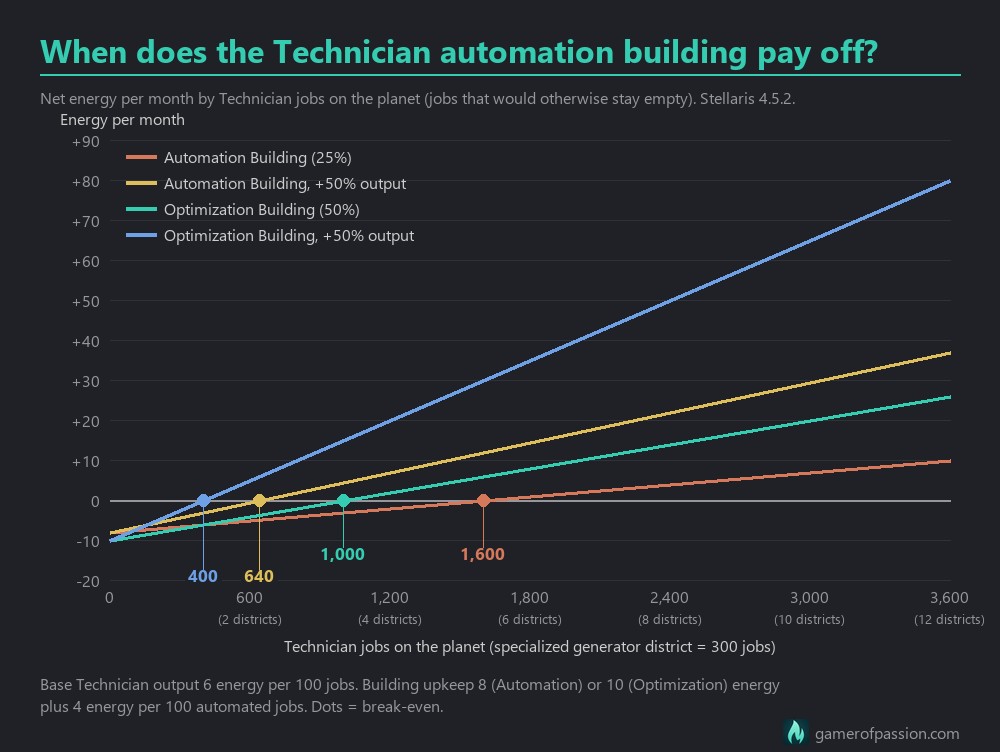
With no bonuses, the Automation Building starts to pay for itself at 1,600 Technician jobs, which is the sixth specialized generator district. The Optimization Building gets there at 1,000 jobs, so the fourth district. Every output bonus pulls that point down quickly. With the three +5% energy techs and an Energy Grid, the Automation Building already pays off from a little over 900 Technician jobs (the fourth specialized district) and the Optimization Building from just under 600 (the second).
If you built the districts only to have them automated, also count their own upkeep of 1 energy each. A tier 1 building with no bonuses then needs 16 specialized generator districts to break even, which is a very large energy world, while the Optimization Building needs 5. That is why the Automation Building on a fresh, empty colony usually looks like a loss in the first years.
All of these numbers are for Energy Generation. Volatile Motes Harvesting is one of the specializations where they do not apply, because every Technician on that planet makes only 3 energy plus 0.75 volatile motes per 100 jobs. That is less than the 4 energy it costs to automate them, so without a robotic empire or big output bonuses, the Technician building there is never going to pay its energy back and simply trades energy for motes.
On normal mining and farming specializations, the Miner and Farmer buildings are not going to pay their upkeep back in energy, since they produce minerals and food. Every 100 automated Miners trade 4 energy for 4 minerals, and every 100 automated Farmers trade 4 energy for 6 food, or 5 food in a robotic empire. Rare Crystal Extraction and Exotic Gas Capture work the same way, but you get fewer minerals or less food plus a little of the strategic resource. The flat 8 or 10 energy matters less and less as the planet grows. Below roughly 800 jobs of that type at tier 1 (or 500 at tier 2), you are mostly paying for the building itself.
The exception is Betharian Processing. There, every Miner on the planet makes 6 energy and 2 minerals per 100 jobs, which gives the Miner building the same margin as a base Technician. It pays for itself in energy from 1,600 Miner jobs at tier 1 and 1,000 at tier 2, and you get the minerals as a bonus.
The game files do not show whether the engine rounds automated jobs to whole hundreds, so take these break-even points as accurate to about one district.
Automation or Pops: When to Build It
The most important thing to understand is that automation replaces pops in those jobs, and the job keeps the same number of slots. Your pops get Job Efficiency from traits, the planet designation and many other sources, while automated workforce does not. If your pops could have worked those jobs at normal or better efficiency, the planet will usually produce less after you build the building, and the freed pops become civilians unless there is other open work on the planet. This is the usual reason an economy gets worse right after the building goes up.
The building is a real gain when the jobs would otherwise stay empty, or when the pops it frees can go to better jobs elsewhere. In general, it is worth building in these cases:
- New colonies that have far more jobs than pops, especially generator worlds with lots of Technician jobs
- Wide empires where every planet is short on pops and the specialist jobs on other worlds are waiting
- Worlds with low habitability, because the habitability penalty is a Job Efficiency malus on pops and automated workforce simply ignores it
- Species with negative traits for that job, for the same reason
- Planets with a lot of that one job, since the flat upkeep matters less the more jobs you automate
It is usually not worth it on a fully staffed capital, on planets where all jobs are filled and no other planet needs workers, or early on when you have few districts of that type.
Your energy income matters as well. Above the break-even point, the Technician building pays for itself, so even an energy-poor empire can use it on its generator worlds. On most planets, Miner and Farmer automation costs energy, so automated mining and farming worlds are going to push you a little bit closer to a deficit. If your energy is tight, automate Technicians first.
Turning automation down with the slider
Since 4.4, every job with automated workforce has an Automated Workforce Limit Slider. In the patch notes’ words, it lets “you directly cap how many of a job’s slots are filled by automation.” You will find it in the job’s expanded entry on the planet screen, next to the normal workforce slider.
Once a planet’s pops catch up with its jobs, slide automation down instead of demolishing the building right away, so you can raise it again when you build new districts or move pops off the planet. Of course, the building will still cost its flat 8 or 10 energy while the slider sits at zero, so demolishing it is the cheaper choice if you will never need it on that planet again. Make sure to check the slider after you add new districts, since every new district brings new jobs for automation to fill.
Which Bonuses Apply to Automated Jobs
This is probably one of the most confusing parts of the system. As a rule, bonuses to a job’s output apply to automated jobs, and Job Efficiency does not.
Output bonuses sit on the job itself, so it does not matter who works it. For example, Field Modulation, Quantum Energy States and Quantum Field Manipulation each give +5% energy from Technicians, and the Energy Grid adds 0.5 energy per 100 Technicians. All of these will raise what your automated Technicians make. Bonuses to resources from jobs in general work the same way.
Job Efficiency is tied to pops. Automated workforce does not get it from any of these sources:
- Species traits for that job
- The planet designation. Generator World, Mining World and Agri-World give +15% Job Efficiency to their jobs, which automation does not get
- The Capacity, Mining and Farming Subsidies edicts (+20% Job Efficiency)
- High or low habitability
The tooltip wording helps here. For the most part, anything that says “Job Efficiency” only affects pops.
The subsidy edicts deserve a separate warning. They also add 0.5 trade upkeep per 100 jobs of that type, and according to an experienced player, who says it has been reported as a bug, automated jobs pay that part as well. On a heavily automated planet, you will get the extra cost without the efficiency. Since the edicts are empire-wide and your pops on other planets still get the +20%, you are probably better off without them only if most of those jobs in your empire are automated.
Automated workforce has its own separate stat, Automated Workforce Efficiency. Normal empires barely ever see it. It comes from Tankbound-only techs and councilors (more on that below), the Production Overseer job, and the built-in bonuses of Fallen and Awakened Empires. It makes each automated job produce more, while the share of automated slots stays the same.
Some details happen inside the engine and are not visible in the script files, such as the exact rounding and whether the rare output bonuses tied to pops (instead of the job) reach automated workers. If a specific bonus matters for your build, compare the job’s production tooltip before and after.
Fallen Empire Buildings and 100% Automation
Fallen Empire buildings are the stronger version of automation, and since 4.3 they are also the only way to automate specialist jobs. Their worker versions automate 75% at tier 1 and 100% at tier 2:
| Tier 1 (75%) | Tier 2 (100%) | Jobs automated |
|---|---|---|
| Class-3 Singularity | Class-4 Singularity | Technician, Tech-Drone |
| Quantum Drilling Plant | Quantum Drilling Hub | Miner, Mining Drone |
| Nourishment Complex | Nourishment Center | Farmer, Agri-Drone |
The specialist versions automate 25% at tier 1 and 50% at tier 2. That includes the Hyper-Forge and Auto-Forge for Metallurgists, the Affluence Emporium and Affluence Center for Artisans, the Aspis Bastion and Aegis Complex for Soldiers, plus research, trade, bureaucrat, entertainer and healthcare versions. Automated specialist jobs cost 8 energy per 100, twice as much as worker jobs.
You can draw Fallen Empire technologies with the Enigmatic Engineering perk or by reaching the second level of the Cosmogenesis ambition (both are mentioned in my Stellaris ascension perks guide). Enigmatic Engineering alone stops after four of these technologies unless you also take the Cosmogenesis perk. Additionally, a few events and the Reverse-Engineer Arcane Technology minor artifact action can grant a single building. That action costs 500 Minor Artifacts and needs the Arcane Deciphering technology. A tier 1 worker building costs 1,500 alloys plus 300 rare crystals, volatile motes or exotic gases, depending on the building, and takes 600 days. Its monthly upkeep is 3 alloys and 2 of that same resource, and the Quantum Drilling Plant and Nourishment Complex cost another 15 energy. The Class-3 Singularity also adds 600 Technician jobs and produces 75 energy on its own.
Automation from different buildings adds up, but the game caps it at 100% of a job’s slots. A Class-3 Singularity (75%) plus a regular Automation Building (25%) gives you exactly 100%. An Optimization Building next to the Class-3 Singularity would add up to 125%, so half of its share is wasted. You get the same 100% as with the Automation Building, but you pay 10 energy instead of 8. With a Class-4 Singularity, the regular building does nothing at all.
Since 4.5.2, Fallen Empire buildings no longer automate any jobs for Virtual empires. The buildings themselves still work otherwise, but the automation part is gone.
For reference, Fallen Empires get +100% Automated Workforce Efficiency, and Awakened Empires another +500% on top.
Automation by Empire Type
Tankbound and Corporate Thinktank
The Tankbound civic (Corporate Thinktank for megacorps) needs the Shadows of the Shroud DLC and is built around automation. All Farmer, Miner and Technician jobs are automated at 100%, and automated jobs cost 25% less upkeep. In return, Tankbound pops cannot work worker jobs at all, and you start with 2K fewer pops. The civic requires an Aquatic, Necroid, Toxoid or Thermophile species and cannot be gestalt. Thermophile species need the Infernals DLC.
Tankbound empires cannot build the regular automation buildings, which would add nothing on top of 100% anyway. Instead, Assembly Patterns and Construction Templates give them +10% Automated Workforce Efficiency each. The Grand Vessel councilor (Executive Vessel for Corporate Thinktank) adds more that grows with the leader’s level, and Production Overseer jobs, which replace Clerks, raise it on their planet. That makes Tankbound the one empire type where automated jobs can really compete with pops.
Machine intelligences and hive minds
Gestalt empires get no automation of their own, but the regular buildings cover their drone jobs. Machine empires have a small edge here, because their Technicians and Tech-Drones make 8 energy per 100 jobs instead of 6. That halves the break-even point of the Technician building to 800 jobs at tier 1 and 500 at tier 2. The same +2 applies to regular empires whose main species is robotic, for example after synthetic ascension.
Wilderness, Nomads and Virtual
Wilderness empires cannot build the automation buildings at all, and they cannot build the Energy Generation specialization either. Nomadic empires can build them, but they pay 60 rare crystals for the Automation Building and 80 for the upgrade instead of minerals. The upkeep stays in energy. Virtual empires can still use the regular buildings normally. Only the Fallen Empire building automation was taken away from them in 4.5.2.
Automation Building or Planet Automation?
The Automation Building is easy to mix up with Planetary Automation, the toggle in the planet view that lets the game construct districts and buildings for you. One is a building you place, and the other is the AI managing your planet on your behalf.
Do not count on Planetary Automation to place an Automation Building for you either. The designation build lists do not include them, so plan on building them yourself.
If Planetary Automation does not build anything, check these points:
- Prevent Deficit Construction is on. The setting blocks anything that would create or increase a deficit, either through its own upkeep or through the jobs it creates. The 4.3.3 patch notes say a planet that does nothing is “often due to the Prevent Deficit Construction setting”, and the developers recommend turning it off.
- The designation was not picked by hand. The developers recommend setting it manually, since automation builds around it.
- The planet still has free jobs. The designation toggle only adds new job buildings and districts when there are no free jobs left or when there are pops without a job who could work them.
- The Designation toggle itself is switched off in the automation panel. Each category (designation, housing, amenities and so on) has its own toggle.
- It is your capital or a special world. The 4.3.3 notes say automation is “generally recommended for colonies focused on a single resource and not critical planets like your capital or special worlds.”
The same 4.3.3 notes also lowered the number of civilians needed to trigger the automation checks to 50.
What Changed Since 4.0
Because the building was rebuilt in 4.3, a lot of advice from 2025 is simply wrong today. The changes that matter, taken from the official patch notes, are listed below.
| Patch | Change |
|---|---|
| 4.0 (May 2025) | Automation buildings tied to Assembly Patterns and Construction Templates. Upkeep scaled with the districts they automated, 8/10 for rural districts and 10/12 for city districts. City automation buildings still existed. |
| 4.0.10 | Bio-Trophies and some other jobs can no longer be automated. |
| 4.1 (September 2025) | Telepath jobs can no longer be automated. Tankbound and Corporate Thinktank added with Shadows of the Shroud. |
| 4.3 Cetus (March 2026) | Assembly Patterns and Construction Templates moved to tiers 2 and 4. Buildings became job specific and planet limit 1. Upkeep no longer scales with districts, and automated jobs cost 4/8/12 energy per 100 instead. Automation became planet-wide. Fallen Empire buildings became the only source of specialist automation. Tankbound lost its old 30% penalty. |
| 4.4 Pegasus (June 2026) | Automated Workforce Limit Slider added. Pops that lose their job now drop straight to Civilian or Maintenance Drone. |
| 4.5.2 Cygnus (October 2026) | Fallen Empire buildings no longer provide automation for Virtual empires. |
The 4.5.0 and 4.5.1 patches did not touch automation. The city and urban automation buildings from 4.0 are gone, although the old “per automated district” upkeep text is still sitting unused in the game’s text files. Apart from the Fallen Empire buildings, there is no automation building for alloys, consumer goods or research in 4.5.2, and nothing at all automates Clerks.
Conclusion
The automation building in 4.5 is a tool for planets that have more jobs than pops, and it is a weak one when your pops could have done the work. The Technician version pays for itself once a planet has enough Technician jobs, about six specialized generator districts without bonuses and far fewer with them, while the Miner and Farmer versions usually trade energy for their resource. I would say it is worth getting Assembly Patterns in any wide empire and putting the Technician building on every growing generator world. Once the pops catch up, turn the slider down instead of letting automation push them out of their jobs.