
A Ring World is a Stellaris megastructure that turns a star system without habitable planets into four habitable Ring Segments, at a base cost of 55,000 alloys and 300 influence. To get one, you are going to need the Mega-Engineering tech, then the Galactic Wonders ascension perk, which only becomes available once you have finished or repaired one megastructure, and then the Ring Segment tech that the perk adds to your research options. It is worth it in a long game with alloys to spare, since each segment holds about as many jobs as a size-17 Ecumenopolis. Converting big planets you already own will get you similar jobs decades sooner, though, and if you find a ruined ring, repairing it is the best deal of all.
Every cost, build time and job count below was read from the Stellaris 4.5.2 game files, and all of them are base values before traits, civics and techs.
How to unlock a Ring World
There are four steps before your construction ship can place the first piece:
- Research Mega-Engineering.
- Finish or repair one megastructure.
- Take the Galactic Wonders ascension perk.
- Research the Ring Segment tech.
Mega-Engineering
Mega-Engineering is a rare tier-5 Engineering tech that costs 24,000 research at base. It will only be offered once you have Citadel, Zero Point Power and Battleships. Bio-ship empires need Stingers instead of Battleships, and nomads need Arkship Mastery instead of Citadel.
You do not need to own a megastructure to research it. Having one inside your borders, even a ruined one that you have not repaired yet, multiplies the tech’s draw weight by 20, and the Shattered Ring origin does the same. More Starholds and Citadels, an Orbital Habitat, a Curator or Maniacal councillor and a neighbour who already has the tech will raise the weight further. Dyson Swarms, Arc Furnaces, Gateways, Hyper Relays and habitats do not count toward that x20.
Additionally, the final Development focus reward adds Mega-Engineering to your research options, and so does the Cybrex project described below.
Galactic Wonders
Galactic Wonders has exactly two requirements: the Mega-Engineering tech, and having finished or repaired at least one real megastructure. Any fully upgraded Dyson Sphere, Science Nexus, Sentry Array, Matter Decompressor, Strategic Coordination Center, Mega Art Installation, Interstellar Assembly, Mega Shipyard, Quantum Catapult or Stellar Cannon counts. So does one repaired Ruined Ring Section, or a Shattered Ring segment you restore with the Repair the Shattered Ring decision.
Gateways, Hyper Relays, habitats, Orbital Rings, Dyson Swarms, Arc Furnaces, the Grand Archive and anything still under construction do not count. If the perk is greyed out with “Requires having repaired or fully upgraded any Megastructure.” even though you have Mega-Engineering, this is the reason.
The perk also takes up one of your slots, so plan it together with the rest of your ascension perks.
The Ring Segment tech
The perk itself only adds the Ring Segment tech, which is the Ring World tech’s in-game name, and the Dyson Sphere tech to your research options (with Megacorp also the Matter Decompressor). You will still have to research each one at 24,000 base research.
Galactic Wonders is the only way to get the Ring Segment tech. It never appears as a normal research card, and nomadic and Wilderness empires cannot research it at all.
DLC requirements
You do not need the Utopia DLC any more. Paradox rolled Utopia, with its megastructures, habitats and ascension perks, into the base game on PC in patch 4.3.6 (May 11, 2026), and nothing in the 4.5.2 Ring World, Mega-Engineering or Galactic Wonders rules checks for a DLC.
Without other DLCs, your first megastructure for Galactic Wonders can be a Science Nexus or a Sentry Array, both normal rare research cards after Mega-Engineering, or a ruined megastructure that you repair. The Megacorp megastructures, the Mega Shipyard (Federations), the Quantum Catapult (Overlord) and the Stellar Cannon (Nomads) still need their DLCs.
Ring World cost and build time
A construction ship places the Ring World Site on a star, and you upgrade it into the Ring World Frame. The finished Frame will split into four Ring World Frame Sections, and each of those is upgraded on its own into a Completed Ring World Section with one habitable Ring Segment.
| Stage | Cost | Bio-ship empires | Base build time |
|---|---|---|---|
| Ring World Site | 5,000 alloys + 300 influence | 2,500 alloys + 8,750 food + 300 influence | 5 years |
| Ring World Frame | 10,000 alloys | 5,000 alloys + 17,500 food | 13 years and 4 months |
| Completed Ring World Section, 4 times | 10,000 alloys each | 5,000 alloys + 17,500 food each | 10 years each |
| Full ring | 55,000 alloys + 300 influence | 27,500 alloys + 96,250 food + 300 influence | 58 years and 4 months, one stage after another |
You pay for the Site and the Frame once, and only the section stage repeats four times, so any figure of 25,000 alloys per section is wrong. None of the stages cost energy to build. The Site has an upkeep of 5 energy a month, and the finished sections have no megastructure upkeep at all.
Build capacity
By default you can only build or upgrade one megastructure at a time, and the Site, the Frame and each section upgrade is a separate order, so the stages will run one after another. Each of these adds +1 Megastructure Build Capacity:
- The Master Builders ascension perk, which also gives +50% megastructure build speed
- Decree: Architectural Renaissance, also with +50% megastructure build speed
- The Strategic Construction Initiative perk, for the president of a level-5 Research Cooperative federation
- The Starlit Citadel and Arc Welders origins
- Radiant Ambitions on the Hyperthermia crisis path
Whether extra capacity lets two sections of one ring build at the same time is not confirmed, so I would not plan around it.
Where you can build it
The Ring World Site goes on the star itself. You will need an outpost in the system, a check that fails without any message, and when another rule fails, the Site will grey out with one of these lines:
| Rule | In-game message | What to do |
|---|---|---|
| Outside your borders | “Cannot build outside Empire borders.” | Claim the system. |
| Any body not surveyed by you | “Cannot build in systems that have not been surveyed.” | Survey everything. |
| Any habitable-class planet or habitat, colonised or not | “Cannot build in systems with habitable planets.” | Pick another system. An empty Tomb World blocks too. |
| Black hole | “Cannot build Ring Worlds around Black Holes.” | Pick another star. |
| Binary or trinary system | “Cannot build this in Binary or Trinary systems.” | Use a single star. |
| Another megastructure there | “Cannot build due to existing Megastructure.” | Pick another system. |
| Protostar or planet selected | “Cannot build around Protostars.” / “Must build around a star.” | Select the star. |
| Unresearched anomaly on the star | “Cannot build on planets that have unresearched anomalies discovered by us or any other Empire.” | Research the anomaly. |
| Nothing but the star | “Cannot build in systems without planetary bodies for material.” | Use a system with at least one planet, moon or asteroid. |
| Consecrated World in the system, Frame stage | “Cannot destroy one of our Consecrated Worlds.” | The Frame cannot start while it stands. |
| Build capacity in use | “Due to the immense requirements in qualified technical personnel, we can only build or upgrade [N] Megastructure(s) at a time.” | Wait or raise your capacity. |
Barren, molten, frozen and toxic planets, gas giants and asteroids do not block the ring, and neither do neutron stars or pulsars. A single star surrounded by dead rocks is exactly what you are looking for. The Consecrated World rule will mostly come up if you have taken the perk of the same name (the Consecrated Worlds guide explains how it works).
What gets deleted
Nothing disappears when you place the Ring World Site. The planets go when the Frame finishes, about 18 years after you place the Site: every planet, moon and asteroid in the system is removed, along with the asteroid belt and any deposits on those bodies. The star itself stays, with its own deposit, and so does your starbase.
Because the game checks the system only when you give the order, use the planets’ resources while the Site and Frame are under construction. They will be gone the day the Frame completes.
Repairing a ruined Ring World
Repairing a Ruined Ring Section needs only Mega-Engineering and a fully surveyed system. You do not need Galactic Wonders or the Ring Segment tech. Each section costs 10,000 alloys and takes 10 years (bio-ship empires pay 5,000 alloys + 17,500 food), counts as a megastructure upgrade and turns into one habitable Ring Segment. Claim the system first, because players report that the repair option only shows up once the system is yours.
All four sections of a ruined ring will cost you 40,000 alloys and take 40 years at base, one after another at the default build capacity, which makes it much cheaper than building one from scratch. The first finished section already counts as your megastructure for Galactic Wonders. You will find Ruined Ring Sections in these places:
- A ruined ring landmark system with four sections, at most one per galaxy
- Cybrex Alpha, where the Cybrex precursor chain ends, with four sections
- The machine fallen empire’s Alpha, Beta and Gamma Refuge systems
- A pre-FTL Shattered Ring system
- The Shattered Ring origin’s home system, if Guaranteed Habitable Worlds is set below the default of two
The Cybrex ring is also a shortcut to Mega-Engineering. Once you find it, the minor artifact action Secrets of the Cybrex (750 minor artifacts, Ancient Relics DLC) leads to a 6,000-research engineering project that adds Mega-Engineering as a research option if you lack it, plus a permanent +10% megastructure build speed.
Mind that, apart from the Shattered Ring segments covered below, only Ruined Ring Sections can be repaired. A ring that has been destroyed leaves only damaged pieces that cannot be colonised or repaired.
Ring segment districts and zones
A ring segment has 10 districts at base, because that is its planet size. You can only build two kinds of district there: the City Segment, which is the Hive or Nexus Segment for gestalts, and three Unspecialized Segment types. Each of them costs 1,000 minerals and 5 energy a month.
- The City Segment gives 2,500 housing plus 100 Enforcer and 300 Clerk jobs, and it holds the Government Zone and two city specialization slots. The second slot needs an upgraded capital building.
- The Hive Segment gives 3,000 housing and 100 Coordinators, and the Nexus Segment 2,500 housing and 100 Tech-Drones.
- An Unspecialized Segment gives 2,500 housing, no jobs of its own and one ring specialization slot.
The Research, Generator, Commercial and Agricultural Segments from older guides cannot be built any more. The names you still see are just labels for a segment’s dominant specialization. Segments also cannot host mining, so your minerals will have to come from somewhere else.
The x5 multiplier
Every district specialization on a ring segment (industry, research, unity, trade, soldiers, food or energy) has its jobs multiplied by five, while an Ecumenopolis, Hive World or Machine World multiplies them by three. District housing, the City Segment’s own Enforcer and Clerk jobs and building jobs are not multiplied.
That works out to 1,000 specialist jobs per ring district at base, against 600 on an Ecumenopolis, Hive or Machine World and 200 on a normal planet, so a fully built segment will hold 10,000 of them.
The City Segment’s slots take industry, research, unity, trade and soldier zones, while energy and food zones only fit into the Unspecialized Segments. A segment with one City Segment and nine Unspecialized Segments on energy will top out at 9,000 Technician jobs. Ring zones also eat into housing, so that kind of segment has 15,600 housing, against 21,000 for a segment built only from City Segments.
Buildings and designations
An Ecumenopolis gets +20% resources from jobs and Hive and Machine Worlds +10%, while a ring segment gets no planet-wide bonus at all. Its extras sit in a few buildings that pay out more on a ring: the Energy Nexus with +0.5 more energy per Technician, Food Processing Centers with +0.5 more food per Farmer, and the unity buildings with +0.1 to +0.5 more unity per Bureaucrat. Each of these also costs more to build and maintain on a ring, while the Metallurgical Research Lab and the Distributed Design Center only cost more there and give no extra bonus.
Ring designations are ordinary Job Efficiency bonuses. Research, Agriculture, Commercial and Generator Ring World each give +15% Job Efficiency to their job, +5% more once Adaptability is finished. Gestalts cannot use the Commercial one, but the Generator Ring World is open to every empire type. A segment can also be a Forge, Factory or Industrial World or a Unification Center.
Keep an eye on the auto-pick, though. An energy, food or trade specialization only weighs 10 toward its ring designation, while one industry or administrative specialization in the City Segment weighs 100, so make sure to set Generator or Agriculture Ring World by hand.
Are Ring Worlds worth it?
A ring segment is about as strong as a mid-sized Ecumenopolis, and a full ring is four of them in a system that would otherwise give you nothing. The comparison below counts specialist jobs, meaning the jobs that zones create, in base values before traits, civics and techs.
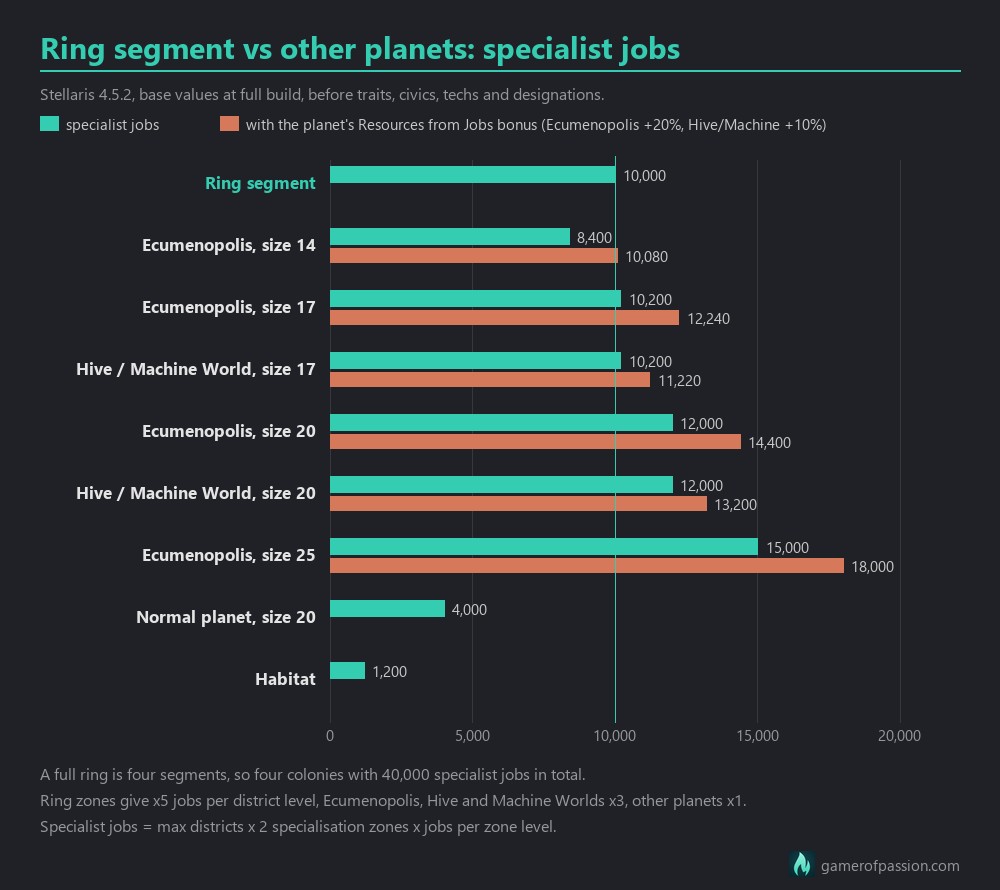
One ring segment holds 10,000 specialist jobs at base, while a size-17 Ecumenopolis, Hive World or Machine World holds 10,200. Count the Ecumenopolis’ +20% resources from jobs and a size-14 one already matches a segment’s output (Hive and Machine Worlds need size 16).
| Colony | Zone jobs | Specialist jobs | With resources from jobs bonus | Empire size before pops |
|---|---|---|---|---|
| Ring segment, 10 districts | x5 | 10,000 | 10,000 | 25.0 |
| Full ring, 4 segments | x5 | 40,000 | 40,000 | 100.0 |
| Ecumenopolis, size 14 | x3 | 8,400 | 10,080 | 27.0 |
| Ecumenopolis, size 17 | x3 | 10,200 | 12,240 | 28.5 |
| Ecumenopolis, size 25 | x3 | 15,000 | 18,000 | 32.5 |
| Hive or Machine World, size 17 | x3 | 10,200 | 11,220 | 28.5 |
| Hive or Machine World, size 25 | x3 | 15,000 | 16,500 | 32.5 |
| Normal planet, size 20 | x1 | 4,000 | 4,000 | 30.0 |
| Habitat, 6 districts | x1 | 1,200 | 1,200 | 23.0 |
This is the math behind the “ring worlds are useless now” threads. A popular Reddit post from the 4.3 era made the same comparison and concluded that any size-17 Ecumenopolis, Hive or Machine World beats a segment. The most upvoted reply answered that a ring gives you four very good worlds out of a system that was useless before, and both sides are right about their part.
Size boosts
The gap grows with district boosts. An Ecumenopolis, Hive or Machine World can get +2 from the Subterranean origin, +2 from Mastery of Nature, +4 from a tier-3 Orbital Ring with four Habitation Modules, and +1 each from the Expansion finisher, Adaptive Ecology and Alien Topography. With all of them, a regular empire’s size-25 Ecumenopolis reaches a theoretical 36 districts and 21,600 specialist jobs, a little bit over two segments.
None of those boosts will reach a ring segment, because it counts as an artificial world (only Void Dwellers get their versions of Adaptive Ecology and Alien Topography there), and you cannot build an Orbital Ring on a segment at all. What does work is any bonus that is not limited to natural planets, such as a Fractal Seed from Astral Planes, which takes a segment to 11 districts and 11,000 jobs. Machine empires can also use Virtuality’s Advanced Server Maintenance, which gives +1 at planetary ascension 1, 5 and 10 for a total of 13,000 jobs.
Empire size and alloys
Each segment is its own colony at 25 empire size before pops, so a full ring adds 100 against 28.5 for a size-17 Ecumenopolis, or 97.5 for three size-25 Ecumenopolises.
In alloys per 1,000 specialist jobs, a ring built from scratch (1,375) costs about the same as a size-17 Ecumenopolis (1,373, counting the 10,000-alloy Arcology Project and rebuilding the half of its districts the conversion removes). Bigger Ecumenopolises are cheaper, down to 1,067 at size 25, and a repaired ruined ring beats all of them at 1,000. Hive and Machine World terraforming costs 10,000 energy instead of alloys. Time matters too: a terraform takes 20 years and the Arcology Project 10, against 58 years and 4 months for a full ring.
When a ring pays off
I would say a full ring is worth building in a long game where alloys are no longer your bottleneck and you have a single-star system with only dead rocks in it. It adds four new colonies instead of converting one of your existing planets, it can run energy and food, which an Ecumenopolis has no specialization for, and each segment gets its own designation.
It is probably not worth it when you own large planets and have the Arcology Project, Hive Worlds or Machine Worlds perk, because converting those will give you comparable jobs much sooner. The same goes for a game that is close to its end, since a ring started late will barely finish.
Best uses for each segment
Each segment is its own colony with its own designation, so the four can do different jobs:
- Energy is probably one of the best uses. A segment holds up to 9,000 Technician jobs, the Generator Ring World adds +15% Technician Job Efficiency, and the Energy Nexus pays out more on a ring. If your pops cannot fill all those jobs, the Technician Automation Building also fits into a ring Energy specialization.
- Food works the same way with Farmers, the Agriculture Ring World and Food Processing Centers. It is a natural pick for bio-ship empires, which pay their megastructures partly in food.
- Research zones fit into both the City Segment and the Unspecialized Segments, and the Research Ring World adds +15% Researcher Job Efficiency.
- Trade works on a Commercial Ring World, where trade zones fill the segment with Traders.
- Unity works with a Unification Center designation, and the unity buildings will pay out a little bit more per Bureaucrat on a ring.
Alloys and consumer goods belong on an Ecumenopolis, which has +20% resources from jobs where a segment has nothing, although a segment can still be a Forge or Factory World if you do not have one yet.
As a starting point for a regular empire, I would advise two Generator Ring Worlds, one Research Ring World, and either an Agriculture Ring World if you use bio-ships or run short on food, or a Commercial Ring World if you do not. A hive mind or machine empire is better off with a second research or a unity segment in place of the Commercial one. If your energy income is already healthy, simply swap one Generator segment for research.
Shattered Ring origin
The Shattered Ring origin (Federations DLC, one empire per galaxy) starts you on a size-25 Shattered Ring Segment that every species lives on at 100% habitability. With the default two Guaranteed Habitable Worlds, the system also holds two more size-25 Shattered segments, but they are buried under blockers until you clear them. With fewer guaranteed worlds you will get Ruined Ring Sections to repair instead.
Shattered segments use ordinary planet districts, except that Generator, Mining and Agriculture Districts have no cap, and every Miner there becomes a Scrap Miner who digs 2 minerals and 1 alloy instead of 4 minerals.
The downside is the Ring World Preference trait, which gives your species no habitability on ordinary planets, so outside rings you are limited to worlds such as Gaia worlds, Ecumenopolises and Relic Worlds. You cannot combine the origin with Agrarian Idyll, Anglers or Planetscapers.
Clearing the blockers
Each extra Shattered Ring segment starts with 12 blockers that take all 25 of its districts. Your capital has none.
| Blocker | Count | Districts | Max habitability | Cost to clear | Tech needed |
|---|---|---|---|---|---|
| Ancient Rubble | 2 | -1 each | -5% to -10% each | 250 energy | none |
| Faulty Diurnal Regulator | 1 | -2 | -20% | 300 energy + 150 alloys | Ion Thrusters |
| Unstable Vacuum Fields | 1 | -2 | -20% | 300 energy + 150 alloys | Improved Deflectors |
| Unaligned Ring Gyros | 1 | -2 | -20% | 300 energy + 150 alloys | Starhold |
| Shorting Power Grid | 1 | -2 | -20% | 300 energy + 150 alloys | Global Energy Management |
| Decrepit Tunnels | 5 | -2 each | none | 1,000 energy each, refunds 200 minerals + 100 alloys | none |
| Malfunctioning Reactor | 1 | -5 | none | 2,000 energy + 1,000 alloys, two years | Zero Point Power |
Until the Malfunctioning Reactor is gone, it also doubles the energy upkeep of the segment’s districts and buildings. Clearing everything will cost you 8,700 energy and 1,600 alloys at base.
The habitability problem is caused by the rubble and the four tech blockers. Together they cut the segment’s maximum habitability by 90-100%, so most species show 0% to 10% there, while machines and robots show 50% because they have a +50% minimum habitability. Two of those four techs are tier 1 and the other two tier 2, so they can go early, while the reactor will have to wait for Zero Point Power.
Repair the Shattered Ring
Once every blocker on a Shattered Ring Segment is cleared and you have Mega-Engineering, the Repair the Shattered Ring decision on that planet becomes available. It costs 7,500 alloys and takes 7.5 years, and you do not need Galactic Wonders for it. The repaired planet becomes a normal size-10 Ring Segment with ring districts and the same x5 zone jobs as a segment you build yourself.
The price is the old layout. The segment drops from 25 to 10 districts, every Generator, Mining and Agriculture District is lost, including all Scrap Miners, and only about a fifth of the city districts (rounded up) survive. Some players report losing all of them, so plan on rebuilding almost from scratch.
Mineral Purification buildings are removed and most other deposits on the planet are lost as well. Your pops stay, which means you are going to see a wave of unemployment and homelessness right after the repair.
The Interloper
The Interloper is the small shattered planet that wrecked your ring. Once you have Mega-Engineering, any of your colonised segments in that system, repaired or not, offers the Remove the Interloper decision for 10,000 alloys and 10 years. When it finishes, the Interloper and its mineral deposit are gone, and the Catastrophic Damage piece next to it turns into a brand-new, empty size-10 Ring Segment you can colonise. A fully repaired Shattered Ring will end up with four habitable segments that way. You do not even need the origin, since any empire that owns a segment there, for example after conquering the system or invading the pre-FTL ring, gets the same decision.
Shattered vs repaired segments
A Shattered Ring Segment has 25 districts but only normal-planet zone jobs, so it tops out at about 5,000 specialist jobs. Repaired, the same segment has 10 districts at five times the jobs each, 10,000 in total at base. For energy or food the gap is smaller: 24 uncapped Generator Districts give 7,200 Technician jobs and a repaired segment 9,000, and the repaired one houses far more pops, with 15,600 housing against 5,400 in that layout. Its empire size also drops from 32.5 to 25.
The one thing a repaired segment cannot do is mine. So repair every segment you want for research, industry, unity or trade, keep one segment Shattered as long as it is your mineral supply, and repair one segment at a time, because each repair wipes most of that segment’s districts when it completes.
Common questions
How many Ring Worlds can you build?
You can build as many as you have valid systems and alloys for. The Ring World has no per-empire cap, unlike the Dyson Sphere, which has its own “Cannot build more than one Dyson Sphere.” check. You are limited to one ring per system and, by default, to one megastructure build or upgrade at a time.
Can you build a Ring World around a pulsar or neutron star?
Yes. Only black holes, protostars and binary or trinary systems are ruled out by star type. Neutron stars and pulsars are allowed, even though the Dyson Sphere and the Mega Shipyard cannot be built around them.
Why can’t I build a Ring World here?
Compare the red line on the greyed-out Site with the table in the building rules above. If the Site is missing from your construction ship’s options entirely, you still need the Ring Segment tech from Galactic Wonders.
Do I need the Utopia DLC?
No. Utopia has been part of the base game on PC since patch 4.3.6, and the Ring World itself needs no DLC. The Shattered Ring origin still needs Federations, though.
Does a Shattered Ring count as a megastructure?
Shattered Ring segments are planets, and repairing them does not create a megastructure. In the standard setup with two Guaranteed Habitable Worlds, the home system holds no megastructure at all, so you can put one system-exclusive megastructure such as a Dyson Sphere or a Mega Shipyard around your home star, repaired segments or not. With the Machine Age DLC, you will build a Dyson Swarm there and upgrade it into the Sphere.
If you started with fewer guaranteed worlds, the leftover Ruined Ring Sections do count as megastructures and block this until you restore them, except for the Machine Age Dyson Swarm, which does not check for other megastructures. Habitats, Orbital Rings and a new Ring World can never go into this system. For Galactic Wonders, the damaged segments you start with count for nothing until Repair the Shattered Ring or Remove the Interloper completes once.
Conclusion
If you come across a ruined ring, repair it as soon as you have Mega-Engineering, because it costs 40,000 alloys instead of 55,000 and qualifies you for Galactic Wonders on the way. If you want to build one from scratch, pick a single-star system full of dead rocks, start early enough that the 58 years still matter, and put the segments on energy, food and research while your Ecumenopolises take care of the alloys.