On 26 September 2026, more than half of the 12,320 Early Access games on Steam carried Steam’s no-update note, and among those in Early Access for a year or more it was three in four. Games that reach full release leave the Early Access list and most of the ones that stall stay on it, which is why the list looks worse than the outcomes.
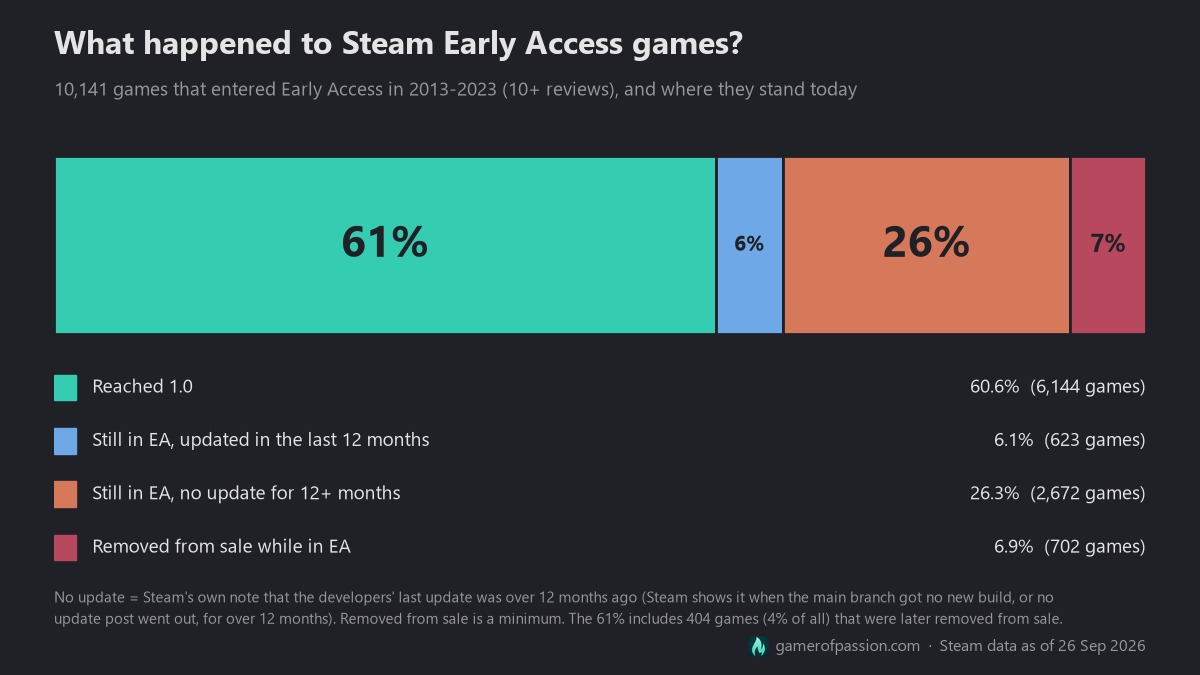
Of the 10,141 Steam games with at least ten reviews that entered Early Access between 2013 and 2023, 6,144 (61%) had reached full release by 26 September 2026. Counting every game this study found that entered in those years, however few reviews it has, the share is 51%. The 61% describes games that at least ten players reviewed. The floor is needed because Steam only shows older graduates through their reviews, and it also leaves out the smallest games, which reach full release least often. A third of the 10,141 games were still in Early Access without an update for a year that day, or had been removed from sale before a full release.
Ask about Early Access on Reddit and you will often hear that it is a cash grab or that games stay in Early Access forever. In 2020, a post on r/pcgaming asking Steam for an automatic “abandoned” tag for Early Access games got more than 14,000 upvotes. In February 2025, Valve started showing a note on Early Access store pages when the developers’ last update was over a year ago. In September 2026, John Buckley, communications and publishing lead at Palworld studio Pocketpair, told GamesRadar that Early Access “has lost its meaning” because players now treat it like a normal game. He also said that the biggest way it is abused now is “We’ll release it now because we need money”, while adding that his studio remains a fan of the program.
Early Access has always come with mixed feelings. On the one hand, some games can essentially be financed this way, and it is the only way we got some truly great titles. On the other hand, it has had some negative impact on the gaming industry, as some of the numbers show. This study checks whether these feelings are true, starting from the expectation that a lot of Early Access games never get finished.
This data cannot see sales or motives, so it cannot tell you whether a game was meant as a cash grab. The other common complaint, that games launch into Early Access far too unfinished, is out of its reach as well, because the data shows how a game ended up and nothing about how complete it was on day one. This study shows how many games reached full release, how many stopped updating or were removed from sale, how long that took and when the odds start to drop.
Where the 10,141 Steam games with at least ten reviews that entered Early Access in 2013-2023 stood on 26 September 2026.
About this study
The gamerofpassion.com Early Access study follows 23,247 games that have been in Steam Early Access, including games that were later removed from sale (the few left out are listed in the method). It uses only public Steam data as of 26 September 2026 and no sales estimates. The full method is at the bottom of this page, every game is in a free CSV there, and corrections go to [email protected]. The site is an independent gaming blog with no ties to Valve, developers, publishers or data companies.
How this study was made
The data was collected between 26 September and 3 October 2026, at a fixed, slow pace (one request every two seconds for store pages, about one per second for Steam’s news feed) to keep the load on Steam’s servers low. Every Early Access store page in the store snapshot was read for Steam’s note, and about 64,000 candidate games were checked through their reviews to find older graduates. Seven archived copies of Steam’s app list were searched for removed games, and 690,585 Steam news posts were collected for 23,490 games and sorted by their type or title, plus Valve’s own update types for 7,319 games.
The results were checked against 37 well-known games with known histories, all of which matched, and against 300 known graduates, 286 of which the method found. Figures from ten other sources, Valve’s own among them, were rebuilt from the data.
Key findings
- Of 10,141 Steam games with at least ten reviews that entered Early Access between 2013 and 2023, 61% had reached full release by 26 September 2026. Counting every game this study found that entered in those years, however few reviews it has, the share is 51%.
- A third of these 10,141 games (33%) were still in Early Access without an update for a year on 26 September 2026, or had been removed from sale while in Early Access.
- On 26 September 2026, nearly 7,000 of all 12,320 Early Access games on Steam, whatever their review count, carried Steam’s note that the developers’ last update was over a year ago. Among the Early Access games on Steam with at least ten reviews, more than half (53%) carried it.
- For the 5,294 Early Access games with at least ten reviews whose store page gives a readable time estimate, about seven in ten say it will take a year or less, although games that kept their estimate have already left and no longer show one. Of the games with at least ten reviews that entered Early Access at least a year before 26 September 2026, 31% reached full release within a year.
- Games that reach full release typically spend a little under a year in Early Access. Of the 3,547 games with at least ten reviews that entered in 2013-2020 and reached full release within five years, half took 315 days or less.
- About one in five (21%) of the 1,533 games with at least ten reviews that entered Early Access between 2013 and September 2018 and had no full release after three years got there within the next five years.
- The often-quoted figure that only 25% of Early Access games reach full release goes back to an EEDAR count published in November 2014, when Steam Early Access was about 20 months old. When EEDAR checked again in March 2016, almost 70% of the 2013 Early Access games had been released.
The gap between what developers promise and the results leaves mixed feelings. Developers should keep their promises, but rushed games are also the bane of the industry, so studios should be careful with what they announce. With the nearly 7,000 games that carry Steam’s note, it may well be that the people behind them simply do not care anymore, and many projects are given up in every field, whether games, art or anything else. The drop after three years is to be expected as well. There has to be some sort of continuity in the process, or the project will fail, and many of the games that stall like this are what truly feels like a cash grab. As for the 25% figure, the number was right for its time, and these numbers are simply more current.
How this study counts an update
A game counts as not updating when its Steam store page says that the developers’ last update was over 12 months ago. The note counts from the last update, so a game can show a note of many years although Steam only introduced it in 2025. Under Valve’s rule, Steam shows it when no build has gone to the game’s main branch for more than a year, or when the developers have not posted an update (patch notes, a regular update or a major update) on Steam for more than a year. Builds that only go to a beta branch do not count, so a game that is developed on a beta branch can carry the note while work continues. In the other direction, one small build and one update post a year keep the note away, so it will also miss some games that have stalled in practice. It errs in both directions, and this study takes it as Steam set it. In this data, 184 Early Access games on Steam with the note also have a Steam post from the last 12 months that looks like an update. When this study says a game stopped updating, it means this note, apart from 7 games whose page had already left Early Access when it was read (see the method).
Full release means the game left Early Access on Steam. It says nothing about whether the 1.0 had everything the roadmap promised.
“Removed” means no longer for sale on Steam, and the count is a minimum, because games that came and went between two of the archived snapshots cannot be seen, nor can removed games that never got a review.
How many Early Access games reach full release?
By 26 September 2026, 6,144 of the 10,141 games (61%) had reached full release, including Subnautica, Slay the Spire, Baldur’s Gate 3 and, in September 2026, Valheim. The graduates include 404 games that were later removed from sale, which is 4% of all 10,141 games.
The gap between the 61% and the 51% is down to games with fewer than ten reviews. Steam only stores an Early Access start date for games that left it after about September 2017, and the review check that finds the older graduates only runs on games with ten or more reviews. Without the floor, old graduates would be under-counted by about five to six points for the 2013-2016 classes. Over all 14,597 games and every class, that under-count is worth about two points, so most of the gap is real: games that almost nobody reviewed reach full release far less often.
Games with more reviews reached full release more often. This only describes the pattern, since a 1.0 launch brings in new reviews by itself.
| Steam reviews | Games | Reached full release | In EA, updated in the last 12 months | In EA, no update for 12+ months | Removed from sale while in EA |
|---|---|---|---|---|---|
| Under 10 | 4,456 | 30.8% | 3.7% | 59.0% | 6.5% |
| 10-99 | 5,540 | 51.7% | 4.2% | 36.2% | 7.9% |
| 100-999 | 2,977 | 67.1% | 7.1% | 18.8% | 7.0% |
| 1,000 or more | 1,624 | 78.8% | 11.1% | 6.4% | 3.6% |
Among all 14,597 games that entered Early Access in 2013-2023, 79% of those with 1,000 or more reviews reached full release, against 31% of those with fewer than ten reviews.
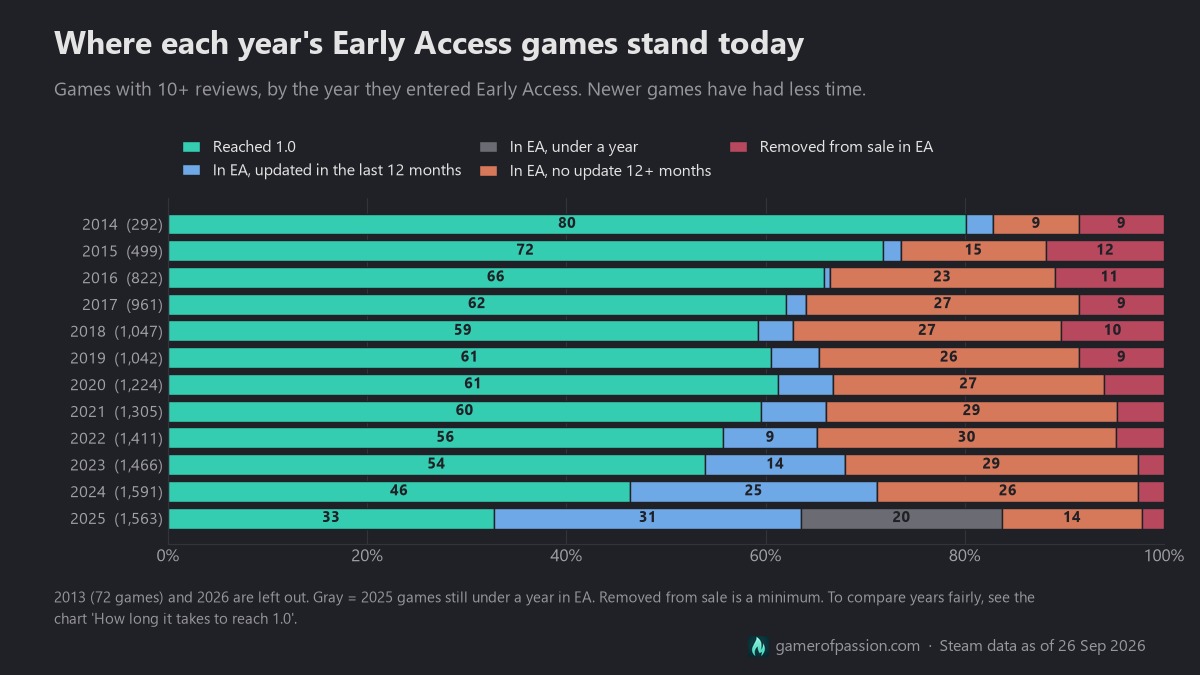
The younger classes are also still catching up. The older ones gained roughly another four to six points after their fifth year in Early Access, so the share for the 2019-2023 games will probably still rise. Removed games that the data cannot see pull the other way, because adding them would lower it. For the 1,591 games with at least ten reviews that entered Early Access in 2024, the share was 46% by 26 September 2026.
How many Early Access games are abandoned?
Steam cannot tell you why a game stopped updating, and neither can this data, so this study never calls a single game abandoned. It counts Steam’s note instead, a test Valve defined itself: on 26 September 2026, 6,989 (nearly 7,000) of the 12,320 Early Access games on Steam said the developers’ last update was over a year ago. Of the 9,063 games on that list that had been in Early Access for a year or more, and so were old enough for the note, 6,977 (77%) carried it.
More than half (3,310 of 6,187, or 53%) of the Early Access games on Steam with at least ten reviews carried the note that day. For those with 1,000 or more reviews, it was 20%. In the 2013-2023 group of 10,141 games, 2,672 (26%) were still in Early Access without an update for a year. For most of them (2,393, or 90%), the note said two years or more.
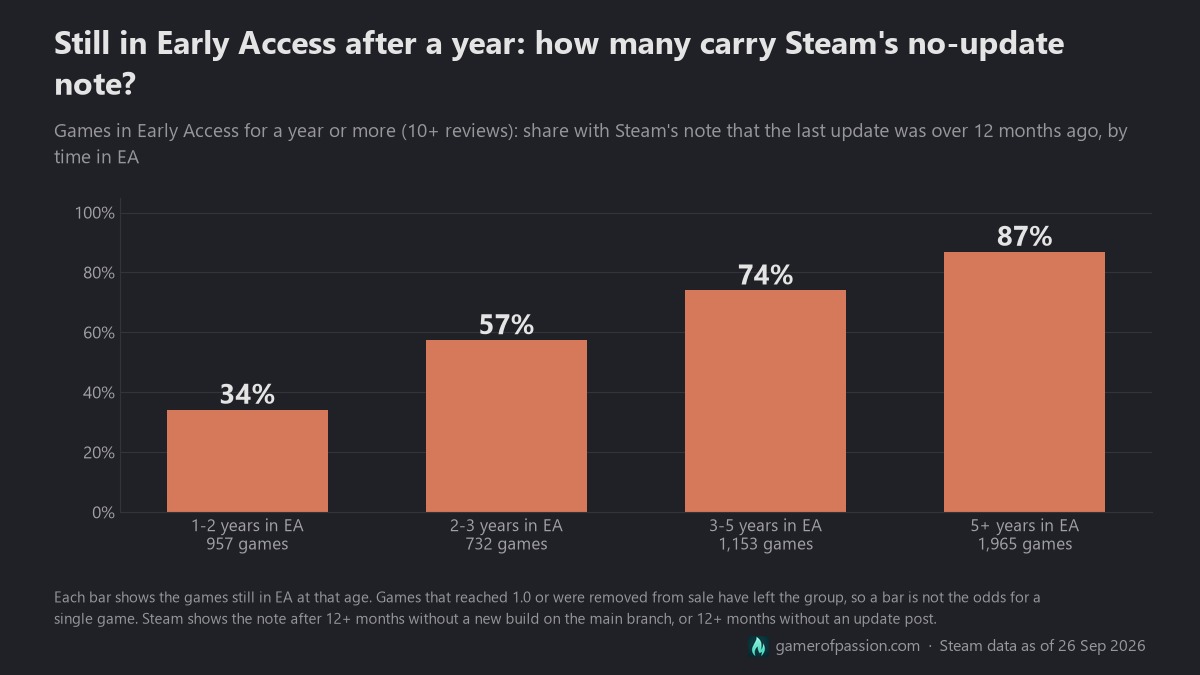
The note gets more common the longer a game stays in Early Access. It was on 87% of the 1,965 listed games with at least ten reviews that had spent five years or more in Early Access, and on 34% of those one to two years in. These shares only describe the games still left at each point. The ones that reached full release or were removed from sale have dropped out of these groups, so the shares do not tell you a game’s chance of getting the note.
It is mostly a small-game pattern: 59% of all 2013-2023 entrants with under ten reviews are still in Early Access without an update for a year, against 6% of those with 1,000 reviews or more. Some bigger games carry the note too. On Kerbal Space Program 2 it says over two years, and its last Steam post of any kind is from June 2024. ATLAS shows over three years, with a last post from June 2023, and BLOCKADE 3D over five. Steam’s note does not count every kind of post, though, and 148 of the 2,672 games did post something on Steam in the past 12 months.
Removed from sale
At least 702 of the 10,141 games (7%) were removed from sale while still in Early Access, although most of their store pages can still be reached by direct link. They include Godus and Survarium, whose developers announced the end on Steam themselves, and The Day Before. With the games removed after their 1.0, at least 1,106 of the 10,141 (11%) are no longer for sale on Steam.
Thirty of the 702 posted something on Steam in the past year. Those posts include shutdown announcements and, in at least one case, a relaunch under a new store page.
How games leave Early Access
Of the 6,846 games with at least ten reviews that entered Early Access in 2013-2023 and had left it by 26 September 2026, 6,144 (about nine in ten) left with a full release and 702 were removed from sale while still in Early Access. Removed games are under-counted, so the true share of full releases among these exits is probably somewhat lower. A game that reaches full release leaves Steam’s Early Access list, while a game that stops updating usually stays on it. Most of the 2013-2023 games without a full release are still listed, next to newer games that have stalled since.
How long do games stay in Early Access?
Steam games that reach full release typically spend a little under a year in Early Access. Of the 3,547 games with at least ten reviews that entered in 2013-2020 and reached full release within five years, half took 315 days or less, and the middle half took between 140 and 642 days. The figures here are medians, because a few games that stay in Early Access for many years would drag an average up a long way.
Most games that reach full release get there early. Of all the graduates among those 2013-2020 entrants, including the ones that took longer than five years, 84% got there within three years. Every game in that group has had at least five years to do so.
Bigger games seem to take longer. The median for all 1,347 games of any review count that reached full release in 2025 was 332 days. GameDiscoverCo found a median of 437 days for the 225 games that left Early Access in 2025 after selling 5,000 or more copies early on. The closest match in this data, the 227 graduates of 2025 with the strongest first month of reviews, comes out at 438 days.
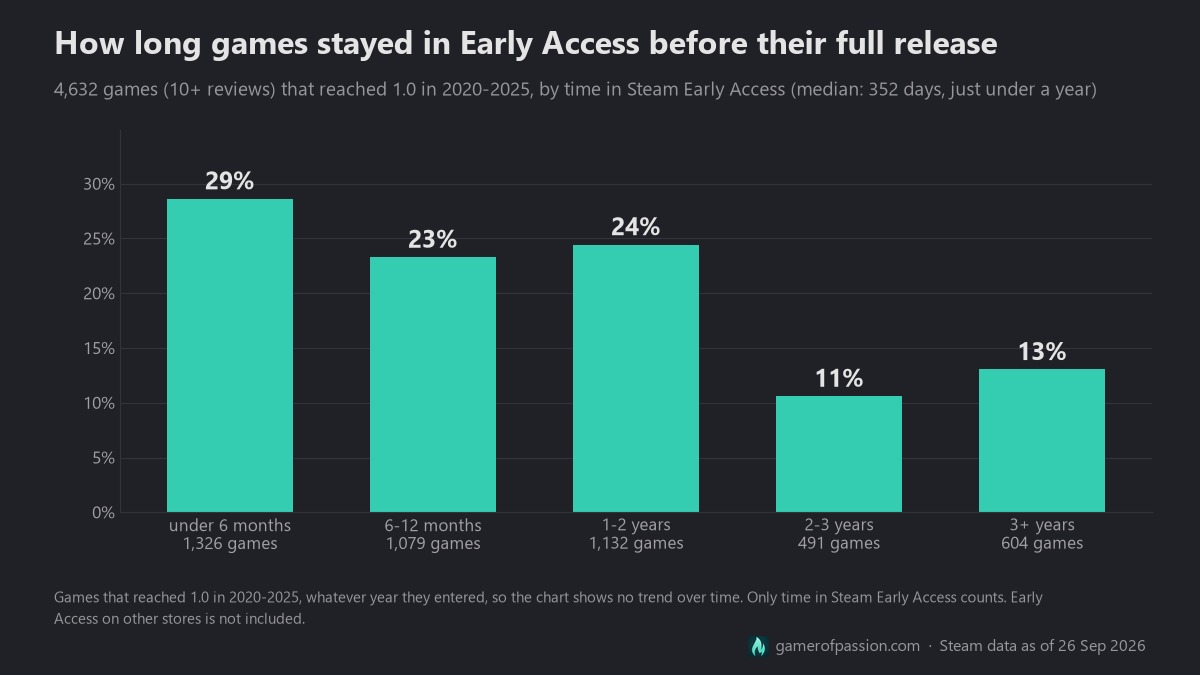
The 4,632 games with at least ten reviews that reached full release between 2020 and 2025 show a wide spread: 29% left Early Access within six months, and about one in four (24%) took two years or more. Bear in mind that these are only the games that reached full release.
Pace by entry year
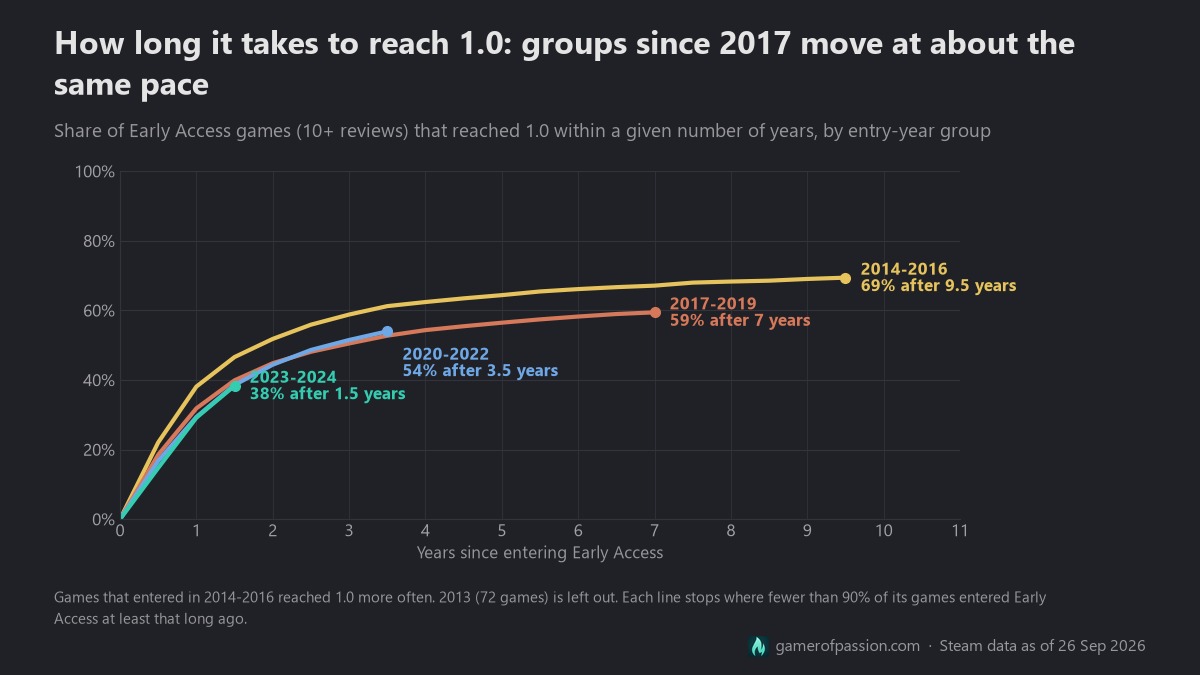
Entry years are only comparable when every class has had the same amount of time, so the comparison uses the share that reached full release within the same number of years. Within two years of entering Early Access, the classes of 2017 to 2023 all landed between 44 and 46%. The 2014-2016 classes did better, between 49 and 58%, and the data does not show why. Part of that gap may come from the data itself, because removed games from those early years are probably the most under-counted, and the 2014 class is incomplete.
Games without a 1.0 after three years
About one in five (318 games, 21%) of the 1,533 games with at least ten reviews that entered Early Access between 2013 and September 2018 and had not reached full release after three years got there within the next five years. Leaving out the 343 of them that were removed from sale while still in Early Access, it is 27%, although it is not known when they were removed, so some may have been gone before year three. The longer a game goes without a 1.0, the lower that share gets:
| No 1.0 after | Games | Reached 1.0 by year eight | Share |
|---|---|---|---|
| 1 year | 2,229 | 1,014 | 45.5% |
| 2 years | 1,751 | 536 | 30.6% |
| 3 years | 1,533 | 318 | 20.7% |
| 4 years | 1,404 | 189 | 13.5% |
| 5 years | 1,339 | 124 | 9.3% |
Store-page time estimates
Most Early Access store pages answer how long the game will stay in Early Access. Among the 5,294 games with at least ten reviews still in Early Access on Steam whose answer could be read, about seven in ten say a year or less. That counts answers given as a length of time, such as “six months”, as well as deadlines such as “until Q4 2018”. By 26 September 2026, 71% of the same 5,294 games were already past their own estimate.
Across all games with at least ten reviews, 31% reached full release within a year of entering Early Access and 46% within two years, counting only games that entered at least that long before the snapshot. Games that kept their estimate have already left and no longer show one, and developers can edit the text at any time.
Updates after full release
Half (51%) of the 4,399 Steam games with at least ten reviews that left Early Access between August 2019 and July 2025 posted no patch notes or update post on Steam between three and fifteen months after their full release. For games with 100 or more reviews it was 37%, and for games with 1,000 or more it was 20%. Because this study only sees posts, all three shares are upper bounds.
The first three months count as the launch window and are left out, so a game that was only patched in that window counts as no update here. Some games need no more updates, and a small single-player game with a complete 1.0 has no reason to keep patching, so the lookup table gives no per-game verdict on this.
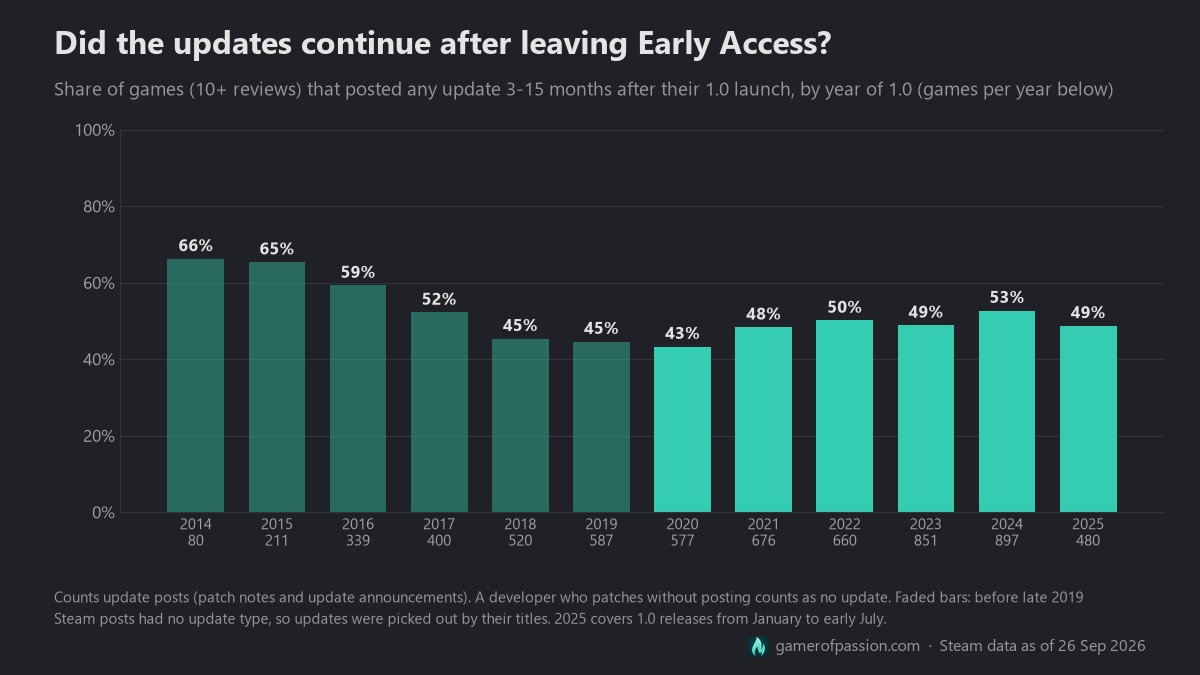
Since 2020, the share of games that did post an update in that window has stayed between 43% and 53% every year.
Games still updating after ten years
A small group of 623 games, 6% of the 10,141, were still in Early Access on 26 September 2026 and had been updated in the previous 12 months, most of them after three years or more. Among the 241 games with at least ten reviews that have spent over ten years in Early Access and are still listed there, 21 are still being updated. They include Project Zomboid (since November 2013), BeamNG.drive (May 2015), Universe Sandbox (August 2015), Exanima and Automation. Phasmophobia and ULTRAKILL, both in Early Access since September 2020, are still updating as well.
Is Early Access a cash grab?
If the worry is that most Early Access games never get finished, the numbers say otherwise for games that enough players reviewed. Six in ten of the 10,141 games with at least ten reviews reached full release, and almost eight in ten among games with 1,000 or more reviews.
That being said, some of the numbers do support the worry. A third of these games stopped updating or were removed from sale before a full release. Once a game had gone three years without a full release, about one in five got there within the next five years.
Most of the stalled games are small, and they stay on the store. More than eight in ten of the nearly 7,000 Early Access games carrying Steam’s note on 26 September 2026 were paid games. That is the store price on the day and says nothing about how many copies any of them sold.
Whether any single game was a cash grab depends on what its developers intended and what they earned, and this data shows neither.
Look up a game
The table below lists all 23,247 games in the study with their dates and Steam’s note or last update post, and you can search it, filter it by status or limit it to the headline games. In the table, games still in Early Access that were updated in the last 12 months show as “In EA, updated recently” or “In EA, last update 6-12 months ago”. Games removed from sale before a full release show as “Removed from sale in EA”. Steam does not count builds that only go to a beta branch, so a game developed on a beta branch can carry the note while work continues. The statuses are neutral labels built from public Steam data as of 26 September 2026 and say nothing about the quality of a game or what its developers intended. If you made one of these games and your row is wrong, write to [email protected] and I will check it and correct it where needed.
23,247 games that entered Steam Early Access. Status as of 26 Sep 2026. Click a column heading to sort.
| Game | Status | Years |
|---|
Spotted a wrong row? Write to [email protected] and I will check it. Download the full data: CSV (column definitions: data dictionary).
The "only 25%" figure
The "only 25%" figure started with Patrick Walker of the research firm EEDAR, who wrote on GamesIndustry.biz in November 2014 that "only 25% of the Early Access titles released have been released as full games". Steam Early Access had opened in March 2013, and most of the games in that count had come out in 2014 (255 against 103 in 2013), so a lot of them had not had the time to reach full release.
EEDAR checked again in March 2016 and found that almost 70% of the 2013 titles had been released. Even so, the 25% still gets quoted in 2026. Nearly all of the 14,513 games with at least ten reviews in this study (98%) entered Early Access after the 25% was published.
Both old figures were rebuilt as of their dates, counting only games still listed on Steam today, which is the closest this data gets to what those studies could see, since removed games drop out of Steam's lists. For the 2013 class in March 2016, the rebuild gives 71%. For EEDAR's 2014 count it gives 21% for games still listed today, or 19% counting every game. Adding back 26 of the estimated 26 to 66 games that left Early Access before about May 2014, a group the review-based method cannot see, brings that full count to 25%, so the 25% fits the data at the low end of that estimate.
Most of the 310 games with at least ten reviews in the study that entered Early Access before EEDAR's figure came out have since reached full release, although that group is incomplete for the same reason.
How the numbers compare with earlier studies
Every earlier Early Access figure that could be found was rebuilt from this data, as of the same date and for the same kind of games. Rebuilt on the same basis, the six sources in the first rows land close to this study, with shares within about two points and counts within 6%. The two that do not are EEDAR's 2014 count and How To Market A Game's 2023 count.
| Source | Their figure | This study |
|---|---|---|
| EEDAR, March 2016 | "Almost 70 percent" of the 2013 class released | 71% (games still listed today) |
| Lin, Bezemer and Hassan, data from March 2016 | 34% of 1,182 Early Access games had left it. Median gap between update posts: 11 days in Early Access, 15 days after | 36% (games still listed today). 12 and 15 days |
| MMO Fallout, June 2020 | 1,925 paid games from 2013-2018 still in Early Access and for sale, 28.8% of them updated since June 2019 | 1,948 games, 27.1% |
| Valve, GDC 2025 | 2,897 new Early Access games in 2024 | 2,723 that this study can trace (every year from 2015 to 2024 within -6% to +4% of Valve's count) |
| Valve, GDC 2025 | 62% of games that left Early Access spent under a year in it | 61% (games that had left Early Access by March 2025) |
| GameDiscoverCo, December 2025 | Median of 437 days in Early Access for the 225 games that left it in 2025 after selling 5,000+ copies early on | 438 days for the 227 graduates of 2025 with the strongest first month of reviews |
| SteamPeaks Promise Clock, October 2026 | 68.6% of the games both track are past their own time estimate | 69.5%, with the same verdict for 97.6% of the 5,394 games where both could read an estimate |
| EEDAR, November 2014 | 25% released | 21% (games still listed today). 19% counting every game, 25% with the lowest estimate of the graduates this method cannot see from before about May 2014 added back |
| How To Market A Game, August 2023 | 3,857 games with a 1.0 among 8,910 since 2014 (43%) | 5,498 of 13,640 (40%), close for different reasons, see below |
Where the basis matches, the rebuilds land within a couple of points of the earlier figures. Where they differ, they point to where this data is thinnest, which is the games that left Early Access before about May 2014 and the games removed from sale in those early years.
The most recent completion count before this one is Chris Zukowski's on How To Market A Game, based on VG Insights data. His August 2023 post counted 3,857 games with a 1.0 among 8,910 that entered Early Access since 2014, or 43%, close to the 40% in this data. The counts behind the two shares differ, though, so the match does not count as support here.
His July 2023 chart by entry year matches this data within about a point from the 2019 class on. For the 2014 to 2018 classes, though, it shows roughly 7 to 21% reaching 1.0, and his post says 90% of the 2016 class never released, while this data shows 47 to 76%.
| Entry year | How To Market A Game (read off the chart) | This study |
|---|---|---|
| 2014 | ~12% | 76.2% |
| 2015 | ~7% | 64.4% |
| 2016 | ~7% | 55.0% |
| 2017 | ~9% | 51.7% |
| 2018 | ~21% | 47.3% |
| 2019 | ~47% | 46.1% |
| 2020 | ~46% | 46.1% |
| 2021 | ~38% | 38.1% |
| 2022 | ~25% | 25.0% |
The gap closes almost completely if only 1.0 launches from about mid-2019 on are counted. That is consistent with a dataset that only began recording a game's switch to 1.0 around then, though VG Insights' data cannot be checked from the outside. If Zukowski or VG Insights see it differently, I would like to hear from them.
Limits of the data
The update data only covers Steam, so builds on a beta branch and news on Discord or a developer's own site do not count, and some games in the no-update group are still being worked on somewhere. Early Access on other stores is not counted either.
The data cannot tell you why a game stopped, whether a studio closed, the team moved on or the game was done. Every removed share is a minimum, and for the earliest years probably a long way below the real one. Lin, Bezemer and Hassan found 100 of the 366 games on EEDAR's 2014 list gone from Steam by March 2016. Of the 305 games in this data that entered Early Access before 31 October 2014, only 8 are removed games whose last review came before that March 2016 snapshot, which is the closest sign here of a game that was already gone.
Steam only began marking reviews as written during Early Access in about May 2014, so games that left Early Access before then are invisible to this method. An estimated 26 to 66 games are missing for that reason, Arma 3 among them. That moves the headline share by 0.1 to 0.3 points, but it leaves the 2013 and 2014 classes incomplete.
Use these charts
All six charts on this page are free to use and embed with a link back to this page. Please credit them as "gamerofpassion.com Early Access study" and cite the figures the same way, with "Steam data as of 26 September 2026". Questions about the data go to [email protected].
Method
All numbers in this study are built from public, logged-out Steam endpoints for the store, reviews, news and events, plus archived copies of Steam's public app list from the Internet Archive, with no SteamDB data, no API key and no sales estimates. The store snapshot is from 26 September 2026. News posts were read between 26 September and 3 October and counted up to 1 October, Valve's update types were read on 3 October, Steam's notes on 1 and 2 October, and removed games were checked between 30 September and 3 October.
Which games are in the study
A game is in the study if it was ever in Steam Early Access and its entry could be dated. The games were found in four ways, with counts before the exclusions below:
- Games in Early Access and listed in Steam's store on 26 September 2026, from a snapshot of all 188,657 apps listed there that day (12,322 games).
- Games that left Early Access after about September 2017, for which Steam stores both dates (7,604 games).
- Older graduates without a stored Early Access date, checked only for games with ten or more reviews. They count if at least three of their reviews were written before release and at least half of those are marked as written during Early Access (1,940 games). This found 286 of 300 known graduates in a test.
- Removed games from archived copies of Steam's app list from 2015 to 2025, checked in a similar way through their reviews (1,634 games).
After the exclusions, 23,247 games remain, 14,513 of them with ten or more reviews, and the headline numbers use the 10,141 of those that entered in 2013-2023, so that every game in the headline group had at least two years and eight months to reach full release by the snapshot. The 2013 class, with 72 games against the 103 that EEDAR counted at the time, is part of the 10,141, but it is left out of the two charts by entry year because it is incomplete. For removed games, the review count covers all languages and purchase types.
Counting every game this study found, 51% of the 2013-2023 entrants reached full release, and Steam's own launch counts for those years suggest the true all-games share is close to half. The headline figure uses games with ten or more reviews so that every route into the data has the same floor.
Valve said at GDC 2025 that over 14,000 games were in Early Access, while this data has at most 10,423 released Early Access games for mid-March 2025, a count that includes 1,097 games no longer for sale today, some of them removed well before then. The gap is consistent with Valve also counting Early Access pages that were announced but not yet released, though the talk does not say how Valve counted.
Dates and statuses
Where Steam stores no Early Access date, it is estimated from the first reviews, which landed within seven days of the real date for 15 of 15 known games. For removed games that reached 1.0, the 1.0 date is the day their reviews stop being marked as written during Early Access, which was within a day for 27 of 27 known games. A test set of 37 well-known games passed in full. The CSV column reached_1_0_basis says for each game whether its 1.0 date is a Steam store date or estimated from reviews. Time spans are measured from exact timestamps, so a rebuild from the day-level dates in the CSV can differ by a few games.
Each game gets one of the statuses above as of 26 September 2026. Games that entered Early Access less than a year before that date are "in Early Access for under a year", which applies to none of the 2013-2023 games. Steam's note was read from every Early Access store page in the snapshot, and the 39 games that left Early Access before that reading keep their snapshot status. The note could no longer be read on their pages, so for those in Early Access for a year or more their Steam posts decide, and 7 of them are listed in the CSV as "In Early Access, no update post for 12+ months".
Update posts are the types developers pick on Steam (patch notes, regular update and major update, the same three Valve's note counts). For older posts and games without event data, a title rule decides, and it matched Valve's own types in 85% of cases. The after-1.0 window runs from 91 to 455 days after launch and only counts where all of it can be seen, so a few very busy games, whose oldest posts are beyond what Steam returns, get no verdict.
Exclusions and missing data
Left out are games that spent under a day in Early Access, games that could not be dated, games on Steam before Early Access existed, and DLC and beta app ids. Also left out are 11 removed games that still get new reviews, since they are most likely still sold outside the US. Seven games in the study have no news data because of permanent Steam errors, and for 15 games Steam's event data kept returning server errors (HTTP 500), so the title rule decides for those.
The review check misses about 5% of older graduates, mostly small games from before 2017, so older classes are slightly under-counted. For 2013 and 2014, the study counts 40% and 81% of the new Early Access games that Valve showed for those years at GDC 2025, against 94 to 104% for every year from 2015 to 2024. Removed games from those early years are probably under-counted the most.
Counting ten reviews today, instead of ten reviews early in a game's life, slightly overstates the no-update share, by less than two points. Finally, 14 games whose store page was re-dated years after launch and 13 removed games whose page no longer says Early Access are counted as their data shows.
The CSV has one row for each of the 23,247 games, and the data dictionary that comes with it explains every column, including the after-1.0 update flag and the data_caveat column, which marks rows with a known gap such as an unknown removal date. The price flag and the store-page time estimates are not in the CSV, so the paid-games share and the two estimate figures cannot be rebuilt from it.
Download the data: the CSV of all 23,247 games (4.6 MB) and the data dictionary that explains every column.
Earlier work
Thanks go to everyone behind the earlier counts this study builds on:
- EEDAR's 2014 analysis and its 2016 follow-up
- Lin, Bezemer and Hassan's 2017 paper in Empirical Software Engineering
- MMO Fallout's 2020 catalog of 1,925 paid games still in Early Access
- Chris Zukowski's 2023 analysis on How To Market A Game
- Valve's GDC 2025 talk on Early Access, with the slides as reported by App2top, and Valve's own recording of the talk as "2025 Steam Dev Talks: Early Access"
- Sergey Galyonkin's 2015 post on Early Access games, written while he ran Steam Spy
- Jamie Allen's 2016 check of the first 50 Early Access games
- u/Six_Foot_Turkey_64's 2017 r/pcgaming list of the oldest Early Access games
- GameDiscoverCo's 2025 look at Early Access graduates
- The SteamPeaks Early Access Promise Clock
Conclusion
For most of the games that players reviewed, Early Access did not mean they would never be finished. Six in ten of the 2013-2023 entrants with at least ten reviews reached full release, most of them within three years. At the same time, a third stopped updating or were removed from sale first, and a game without a full release after three years got there within the next five years about one time in five.
Is Early Access a cash grab? No. But it can be. That many games never get there is not extremely surprising, but the majority actually getting finished was not expected. Before you buy, make sure to check how far the game is and when it was last updated (the table above shows this for every game). Sometimes Early Access is actually Open Alpha 0.01.