If your gear in Divinity: Original Sin 2 has started to show empty rune slots, you will quickly notice that the same rune does three different jobs depending on where you put it. A Flame rune, for example, adds Fire damage in a weapon, Fire resistance in chest armour and Critical Chance in an amulet. Every rune works like that, with damage in a weapon, a resistance in chest armour (Physical Armour for Masterwork) and a utility stat in an amulet.
On top of that, you can put a rune into a frame for an extra attribute or ability. A framed rune can never be upgraded again, though, which is why you will only want to frame Large or Giant runes. For most characters the setup is fairly simple. A Giant Masterwork Rune Of Power goes into the weapon of any Strength build, and Rune Of Power frames that match your main attribute are the best default for your armour and amulet.
Most numbers in this guide were read from the game files of the current Definitive Edition. Everything here is for the game without Gift Bag mods unless a Gift Bag is named.
How runes work
Runes go into rune slots on your gear, and a rune’s bonus will count for as long as you wear the item. Any character can put runes in or take them out, and you won’t need an ability, a tool or gold for it. Right-click the item and pick Manage Runes to put one in.
Rune slots
Not every item has a rune slot. On random loot, only weapons, chest armour and amulets can roll an empty slot, and only from item level 5 on. The higher the rarity, the better your odds, and Legendary and Divine weapons, chest pieces and amulets from level 9 on will always come with at least one empty slot.
Unique items are a different story. About 90 uniques in the base game have a fixed rune slot, and every one of them has exactly one. Most of them are weapons, but you will also find a few chest pieces, amulets and shields with a slot, plus one helmet, one pair of gloves and one ring. Think twice before you sell that unique ring, because no other ring in the game is going to hold a rune. Belts never take runes at all.
The Armor Sets Gift Bag breaks the one-slot rule. Its Devourer chest piece has three slots, the Contamination gloves and leggings have two each, and some set pieces will only gain their slots once you upgrade the set.
Slot effects
In a weapon, a rune adds extra damage of its element, or Physical damage for Masterwork, worth 9% of the weapon’s damage on a Small rune and 15% on a Giant one. That bonus only applies to the weapon’s basic attacks and weapon skills. Spells won’t get any of it. A Flame rune in your staff is not going to make your Fireball hit any harder.
In chest armour, a rune gives a resistance or armour, and in an amulet it gives a utility stat. If a unique or Gift Bag item has its slot somewhere else, a rune in a ring should work like in an amulet, and in a shield, a helmet or any other armour piece like in chest armour.
Source Orbs
A Source Orb also fits into a rune slot. Instead of stats, it will give you a skill that depends on the slot: Venomous Aura in a weapon, Mass Cleanse Wounds in chest armour and Evasive Aura in an amulet. Source Orbs cannot be framed.
Scaling
A rune’s numbers depend on its size and not on the item you put it in. Weapon damage and Masterwork armour are percentages of the item they sit in, though, and a Giant rune on a high-level two-hander is going to add a lot more raw damage than the same rune on an early dagger. Two bonuses also grow with level, namely the Vitality of a Rock rune in an amulet and the attribute from a Rune Frame Of Power or a Mystical Masterwork rune.
Rune effects
There are six rune types in the game: Masterwork, Flame, Frost, Thunder, Rock and Venom. Each of them comes in four sizes, Small, Medium, Large and Giant, and you will find them as loot, buy them from traders or craft them yourself.
The five elemental runes all behave alike in weapons and chest armour. Flame deals Fire damage in a weapon and gives Fire resistance in armour, and Frost does the same for Water, Thunder for Air, Rock for Earth and Venom for Poison. Masterwork is the physical rune. Its armour bonus is a percentage of the chest piece it sits in and not of your total armour, which makes it worth a lot more on heavy armour than on a light robe.
Amulets are where the runes really split up:
- Flame gives Critical Chance, up to +6% on a Giant rune, which makes it a fine pick for almost any damage dealer.
- Frost adds Movement, up to one extra metre.
- Thunder raises your Dodging.
- Rock adds Vitality that grows with level, about +111 on a Giant rune around level 16.
- Venom improves your Accuracy.
- Masterwork should add a percentage of the amulet’s own Magic Armour. Amulets carry far less armour than chest pieces, which means this stays a small bonus.
For weapons, the element matters more than it seems. Undead heal from Poison, and the Poison part of every hit from a Venom rune on your sword should heal skeletons a little while the rest of the hit damages them. Masterwork avoids that problem, which is one of the reasons why it is the default pick for physical weapons.
Older guides from 2017 often show higher numbers, for example for the Flame rune’s Critical Chance, or claim that framed Frost and Thunder runes give the wrong resistance. Both describe the original release. In the Definitive Edition, framed Frost runes give Water resistance and framed Thunder runes give Air resistance, just like the plain ones.
| Rune | In a weapon | In chest armour | In an amulet |
|---|---|---|---|
| Masterwork | +9/11/13/15% Physical damage | +9/13/17/21% Physical Armour on that piece | Magic Armour +9/13/17/21% of the amulet’s own |
| Flame | +9/11/13/15% Fire damage | +5/7/9/11% Fire resistance | +3/4/5/6% Critical Chance |
| Frost | +9/11/13/15% Water damage | +5/7/9/11% Water resistance | +0.25/0.5/0.75/1 m Movement |
| Thunder | +9/11/13/15% Air damage | +5/7/9/11% Air resistance | +3/4/5/6% Dodging |
| Rock | +9/11/13/15% Earth damage | +5/7/9/11% Earth resistance | Vitality, grows with level |
| Venom | +9/11/13/15% Poison damage | +5/7/9/11% Poison resistance | +5/8/12/16% Accuracy |
Rune frames
There are two rune frames, the Rune Frame Of Power and the Mystical Rune Frame, and neither of them turns up in loot or at traders before level 13. You combine the frame with a rune in your inventory, the frame is used up, and the framed rune keeps the plain rune’s effect with the frame’s bonus on top. A framed Giant rune will still add 15% damage in a weapon.
Beware that framing is final. No recipe accepts a framed rune, and you can never upgrade it to the next size or give it a second frame. Only frame a Large or Giant rune that you plan to keep for the rest of the game.
Rune Frame Of Power
The Rune Frame Of Power adds the same attribute in every slot. Masterwork and Rock runes give Strength, Flame and Frost runes give Intelligence, and Thunder and Venom runes give Finesse. The bonus grows with the rune’s size, from +1 on a Small rune and +2 on Medium and Large ones up to +3 on a Giant rune.
Since your damage scales with Strength, Finesse or Intelligence, this is the frame most builds are going to use. I would say it is the better of the two frames for most characters, and the one to grab whenever a trader has it.
Mystical Rune Frame
The Mystical Rune Frame adds +1 to an ability, and the ability depends on the slot. A Mystical Rock rune will give Two-Handed in a weapon, Warfare in chest armour and Geomancer in an amulet. That +1 stays the same at every size, which makes this frame less exciting on a Giant rune than a Rune Of Power with its +3.
Masterwork works differently. A Mystical Masterwork rune gives Wits in a weapon, Constitution in chest armour and Memory in an amulet, from +1 on a Small rune up to +3 on a Giant one. Mystical frames are at their best when you need one ability that is hard to raise elsewhere. Summoning is the classic example, since a Mystical Venom rune in chest armour is the only rune that gives it.
| Rune | Rune Of Power (all slots) | Mystical: weapon / chest / amulet |
|---|---|---|
| Masterwork | +1 to +3 Strength | Wits / Constitution / Memory, +1 to +3 |
| Flame | +1 to +3 Intelligence | +1 Ranged / +1 Huntsman / +1 Pyrokinetic |
| Frost | +1 to +3 Intelligence | +1 Single-Handed / +1 Leadership / +1 Hydrosophist |
| Thunder | +1 to +3 Finesse | +1 Dual Wielding / +1 Scoundrel / +1 Aerotheurge |
| Rock | +1 to +3 Strength | +1 Two-Handed / +1 Warfare / +1 Geomancer |
| Venom | +1 to +3 Finesse | +1 Perseverance / +1 Summoning / +1 Necromancer |
Best runes for each build
Which rune is best depends mostly on your damage attribute and on the slot. The picks below assume the late game with Giant runes and frames. If you still need a build to go with them, our Divinity: Original Sin 2 builds tier list goes through the attributes and abilities for each one.
Strength warriors
For a two-handed warrior, the Giant Masterwork Rune Of Power goes into the weapon. It will add +15% of the weapon’s damage as Physical damage, which Warfare boosts like the rest of your physical damage, plus +3 Strength. A Mystical Rock rune with +1 Two-Handed is the alternative, but I would say the Masterwork rune is the better choice for almost every Strength build.
In chest armour, a Giant Rock Rune Of Power gives Strength and Earth resistance, and a Giant Masterwork Rune Of Power gives Strength and +21% Physical Armour on that piece. The amulet gets a Giant Rock Rune Of Power for Strength and Vitality, or a plain Giant Flame rune if you would rather have the crit. Warriors with a one-handed weapon and a shield will use the same runes, with Masterwork in the chest as the default and a Mystical Frost rune for Single-Handed as their weapon alternative.
Warfare runes
The big question for every physical build is whether the chest should hold a Rune Of Power for your attribute or a Mystical Rock rune for +1 Warfare. Since Warfare should multiply with your attribute bonus, a single point of it is worth more than a single point of Strength. That being said, a Giant Rune Of Power gives you three points.
At a typical endgame spread, with your main attribute around 40, Warfare at 10 and no points in Two-Handed or another weapon ability, the +3 attribute will add roughly +6% damage (about +4% from the +2 on a Medium or Large rune), while the extra Warfare point only adds about +3%. Every point in a weapon ability shrinks that lead, and the Mystical Rock rune pulls ahead once your damage attribute plus your weapon ability points go past 50 against a +2 rune or past 80 against a +3 one.
Of course, this assumes that Warfare is already at 10. Put your ability points into Warfare first, as the builds guide does for every physical build, and pick the chest rune once you get there.
Finesse builds
Rangers and rogues are a little bit trickier, because only Thunder and Venom frames give Finesse. For the weapon, the Mystical Giant Masterwork Rune is a good pick for both, with +15% Physical damage and +3 Wits for Critical Chance and Initiative. Rangers can use a Thunder or Venom Rune Of Power there instead, and rogues will want the same rune in both daggers.
Chest armour gets a Giant Thunder or Venom Rune Of Power for Finesse plus Air or Poison resistance. In the amulet, rangers will want the Giant Venom Rune Of Power for Finesse and Accuracy, and rogues the Giant Thunder Rune Of Power for Finesse and Dodging.
Intelligence casters
Only Flame and Frost frames give Intelligence. That makes casters easy to plan. Use a Flame or Frost Rune Of Power in the weapon, the chest and the amulet. Bear in mind that the weapon rune’s Fire or Water damage only adds to your staff or wand hits, and for a caster that rune is mostly there for its Intelligence.
The Giant Flame Rune Of Power is the amulet pick for almost every mage, because it adds Intelligence and +6% Critical Chance, and that crit is going to matter a lot more once you take Savage Sortilege. A Pyrokinetic can simply use Flame everywhere, while a Hydrosophist will put Frost in the weapon and chest and Flame in the amulet. A Mystical Flame rune in the amulet would give +1 Pyrokinetic, but with Intelligence around 40 and the school at 10, the Rune Of Power still adds more damage.
Necromancers follow the same plan, since most of their spells deal Physical damage and scale with Intelligence and Warfare. While their Warfare is still well below 10, a Mystical Rock rune in the chest can be worth it for a while.
Summoners
Summoners play by different rules. Their summons do not use your Intelligence at all, and the rune that matters is a Mystical Venom rune in chest armour, which will add +1 Summoning plus Poison resistance. Since the +1 is the same at every size, you do not have to wait for a Giant rune here, and a Large one is worth framing as soon as you get your hands on a Mystical Rune Frame. In an amulet, the same rune gives Necromancer, which a summoner has no use for.
A Mystical Venom rune in any other armour piece with a slot should add Summoning as well, and every point past 10 still counts. For the weapon, a Mystical Giant Masterwork Rune will add Wits for Initiative, and in the amulet the same rune gives Memory.
Tanks
A tank will want the Mystical Giant Masterwork Rune in chest armour. It adds +21% to that piece’s Physical Armour plus +3 Constitution, and it is worth the most on heavy armour. Additionally, you can swap in an elemental rune with +11% resistance before a fight with a lot of fire or poison, since taking runes out costs nothing.
In the amulet, the Giant Rock Rune Of Power adds Vitality and Strength, while a Masterwork rune there should only add a share of the amulet’s own Magic Armour. For the weapon, a Strength tank will use the same Masterwork Rune Of Power as a warrior, and a Mystical Venom rune with +1 Perseverance is the defensive option.
Runes before level 13
Until the first frames appear at level 13, you are going to use plain runes. In general, a plain Masterwork rune in the weapon is the safe choice for every physical build, and casters will put a plain rune of their element on the staff or wand. Chest armour should get a resistance rune against the damage type you face most in the current act. The amulet is a good spot for a Flame rune and its crit, though rogues can try Thunder for Dodging, rangers Venom for Accuracy and summoners Frost for Movement.
| Build | Weapon | Chest armour | Amulet |
|---|---|---|---|
| Two-handed warrior | Masterwork Rune Of Power | Rock or Masterwork Rune Of Power | Rock Rune Of Power |
| One-handed warrior with shield | Masterwork Rune Of Power | Masterwork Rune Of Power | Rock Rune Of Power |
| Ranger | Mystical Masterwork Rune | Thunder or Venom Rune Of Power | Venom Rune Of Power |
| Rogue | Mystical Masterwork Rune | Thunder or Venom Rune Of Power | Thunder Rune Of Power |
| Mage | Flame or Frost Rune Of Power | Flame or Frost Rune Of Power | Flame Rune Of Power |
| Necromancer | Flame or Frost Rune Of Power | Flame or Frost Rune Of Power | Flame Rune Of Power |
| Summoner | Mystical Masterwork Rune | Mystical Venom Rune | Mystical Masterwork Rune |
| Tank | Masterwork Rune Of Power | Mystical Masterwork Rune | Rock Rune Of Power |
How to craft runes
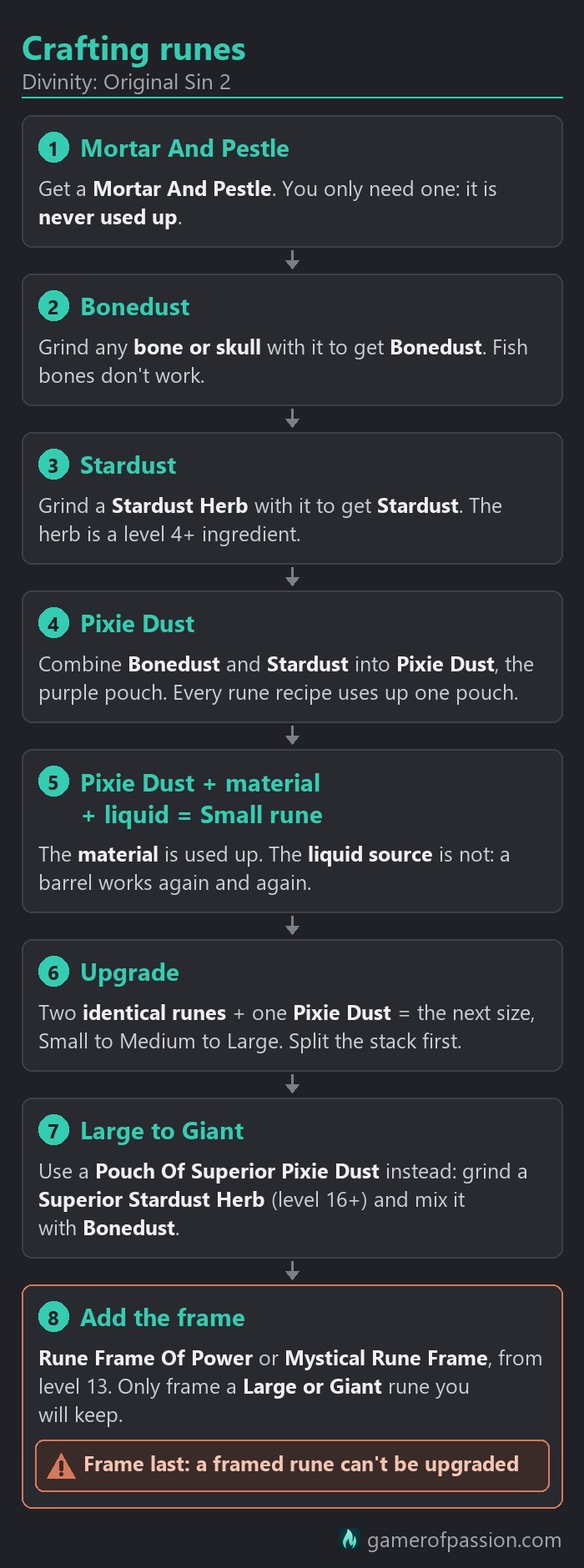
Crafting runes is not hard, but it takes a few steps. You don’t need a crafting ability for it, only a Mortar And Pestle and the right ingredients.
- Get a Mortar And Pestle. It is never used up, and one will last you the whole game.
- Grind any bone or skull with it to get Bonedust. Fish bones do not work.
- Grind a Stardust Herb with it to get Stardust.
- Combine the Bonedust and the Stardust into Pixie Dust, the purple pouch. Every rune recipe will use up one pouch.
- Combine Pixie Dust, the rune’s material and a liquid source to get a Small rune. The material is used up, but the liquid source is not, which means a barrel will work again and again.
- A Small Flame Rune takes a wooden item like a stick, a branch or a log, and oil from a Cup of Oil, an oil bottle or an oil barrel. Oil flasks, the grenades, will not work.
- A Small Thunder Rune takes a gold item like a Gold Cup or a gold Plate, and water from a bottle, mug, cup, barrel or bucket. A well works too.
- A Small Frost Rune takes a metal item like ore, bars, metal scraps or a Silver Cup, and water or a well.
- A Small Rock Rune takes a rock and beer from a bottle, a mug or a Beer Barrel.
- A Small Venom Rune takes a bone or skull and a poison potion or an ooze barrel.
- A Small Masterwork Rune takes a Livewood Log and wine from a bottle, a mug, a glass or a Wine Barrel. It does not need a Source Orb.
- Combine two identical runes with one Pixie Dust to get the next size, from Small to Medium and from Medium to Large. Split the stack first, so that the two runes are separate items. Both runes and the dust are used up.
- To turn two Large runes into a Giant one, you will need a Pouch Of Superior Pixie Dust instead. Grind a Superior Stardust Herb with the Mortar And Pestle and mix it with Bonedust to make one.
- Add the frame last, once the rune has the size you want to keep.
The Superior Stardust Herb only shows up in loot and at traders from level 16, which is why Giant runes are a late-game thing. You won’t have to craft them, though, because Giant runes also drop and appear at traders from that level on.
If a combination fails, check that you are using Pixie Dust and that the two runes sit in separate stacks. A framed rune will never work as an ingredient.
| Small rune | Material | Liquid |
|---|---|---|
| Small Flame Rune | A wooden item (stick, branch, log, arrow shaft) | Cup of Oil or an oil barrel (not oil flasks) |
| Small Thunder Rune | A gold item (Gold Cup, gold spoon, gold Plate) | Water (Bottle of Water, Water Barrel) or a well |
| Small Frost Rune | Ore, bars, metal scraps or a Silver Cup | Water (Bottle of Water, Water Barrel) or a well |
| Small Rock Rune | A rock | Beer (Bottle of Beer, Mug of Beer, Beer Barrel) |
| Small Venom Rune | A bone or skull | A poison potion or an ooze barrel |
| Small Masterwork Rune | A Livewood Log (no Source Orb needed) | Wine (Bottle of Wine, Glass of Wine, Wine Barrel) |
Where to buy runes
Rune traders stock what fits your level. Small runes will be on sale from level 5, Medium runes from 9, Large runes from 13 and Giant runes from 16, and both frames appear from level 13. It is worth checking these traders again after a level-up.
- In Fort Joy in Act 1, Kerban sells runes, but only from level 5 on, when Small runes start to appear.
- On Reaper’s Coast in Act 2, you will find The Advocate, who should be on Bloodmoon Island, and the dwarf Stranded Merchant.
- From the end of Act 1, Tarquin aboard the Lady Vengeance sells runes. He does not trade while he waits at the Stonegarden gate in Act 2, and in Arx you will only find his shop once he has moved to the Hall of Echoes.
- On the Nameless Isle in Act 3, Trayde the Merchant sells them, and so does a Lizard Dreamer trader at the Black Ring camp.
- In Arx in Act 4, you can buy them from Lord Arhu, Lord Omyt upstairs in Kemm’s Mansion, Big Tomorrah of the Thieves’ Guild in the sewers, The Doctor and the elf merchant in the Cathedral district.
Runes and frames also drop from mini-bosses and big bosses, from some quest rewards and from legendary loot.
How to remove a rune
Taking a rune out is free, and you can do it as often as you like. Open Manage Runes on the item, or the Runes tab in the crafting window, pick the rune and choose Extract Rune. You will keep both the rune and the item, and a framed rune keeps its frame.
You can move your best rune from weapon to weapon as you find better gear. Make sure to pull your runes before you sell or scrap a piece of gear, because otherwise they will leave together with the item.
Some pieces from the Armor Sets Gift Bag, namely the Devourer, Contamination and Vulture sets, get upgraded by a quest step. To be safe, take your runes out before you upgrade the set and put them back in afterwards.
FAQ
How do you activate runes?
There is nothing to activate. Once a rune sits in the slot of an item you have equipped, its bonus will work. Right-click the item and choose Manage Runes to put it in.
Can runes be removed?
Yes. Extracting a rune is free, you keep both the rune and the item, and framed runes keep their frame.
Do runes scale with level?
Mostly not. A rune’s numbers depend on its size, but weapon damage and Masterwork armour are percentages of the item and will add more on better gear. The Vitality of a Rock rune in an amulet and the attributes from a Rune Frame Of Power or a Mystical Masterwork rune are the only bonuses that grow with level and size.
Can you upgrade a framed rune?
No. No recipe accepts a framed rune, which means you should upgrade the rune to Large or Giant first and add the frame last.
What are the best runes in Divinity: Original Sin 2?
For Strength builds, the Giant Masterwork Rune Of Power in the weapon. For armour and amulets, a Giant Rune Of Power that matches your main attribute, which means Masterwork or Rock for Strength, Thunder or Venom for Finesse and Flame or Frost for Intelligence. Summoners are the big exception and will want a Mystical Venom rune in their chest armour for Summoning.
Conclusion
Runes look complicated at first, but most of the system boils down to one rule per slot and one rule for frames. Put plain runes into every slot early on and keep your frames for Large and Giant runes. If you are not sure where to start, Rune Of Power frames that match your main attribute are probably the way to go, with a Giant Masterwork Rune Of Power in the weapon of a Strength build.