
Species traits are the strengths and flaws you give your founding species on the Stellaris empire creation screen, and in 4.5 many of them decide how well a whole group of jobs will work for the rest of the game. For most organic empires, the best positive traits right now are Intelligent, Natural Engineers and Rapid Breeders, and the cheapest negative traits to pay for them are Sedentary and Solitary.
You will not fit all five onto the 2 points you start with, though. Intelligent and Rapid Breeders, paid for with Sedentary and Solitary, is the simple setup that works in almost any game. If you also want Natural Engineers, you will have to swap Solitary for a -2 trait such as Psychological Infertility.
Machine Intelligences play by their own rules, and for them Adaptive Frames plus Mass-Produced is the start to aim for.
This tier list only looks at species traits, the ones you pick for a species on the creation screen and later change through gene modding or robomodding, while leader traits belong to individual leaders and are a separate system that is not part of it. Organic, lithoid, machine, robot and hive empires each get their own section further down, because a trait that is great for one of them can be close to worthless for another.
The trait numbers below come from the live 4.5.2 ‘Cygnus’ game files and the official patch notes. As of 1 November 2026, the dev diaries for the 4.6 update and the Willpower DLC, scheduled for 23 November 2026, announce no species-trait rework, only one new negative trait called Redundant Module for the Lost Makers origin.
Contents
- How species traits work in 4.5
- Stellaris trait tier list (4.5)
- Best negative traits
- Lithoid, plantoid and DLC species traits
- Machine and robot traits
- Traits for Hive Minds
- Best trait combinations
- Traits to skip
- Changing traits later
- Trait questions
- Conclusion
How species traits work in 4.5
Organic and Lithoid species get 2 trait points and 5 trait picks. A Machine Intelligence gets 1 point and 5 picks, and the robots an organic empire builds get 0 points and 4 picks.
Negative traits give their cost back as points, but each of them still uses up a pick, while traits that cost 0 do not use a pick at all. Once all five slots are taken, you simply cannot add anything else, no matter how many points your negatives freed up.
Since 4.0, every job trait works through Job Efficiency on one group of jobs. Intelligent, for example, gives +10% Job Efficiency to all researcher jobs, which means 100 Intelligent researchers will work like 110 normal ones. The bonus adds output even when a job is already fully staffed. Additionally, a pop with a job trait is more likely to be placed in the matching job.
Bear in mind that Job Efficiency raises a job’s upkeep as well, since the game simply treats it as extra workers. Intelligent will therefore also raise the consumer goods upkeep of your researcher jobs by 10%. The gain is still bigger than the extra cost, with +0.3 research for +0.15 consumer goods per 100 researcher jobs, and the farmer, technician and miner traits have no upkeep to grow at all, because those basic worker jobs do not have any.
This is also why a lot of trait lists online are going to steer you wrong. Many of them were written before 4.0, when a trait added a percentage bonus to one resource from every job, and their numbers no longer match the game. Charismatic and Repugnant have covered every elite job since 4.0.22 in August 2025, Strong and Very Strong have boosted Soldier jobs since 4.3, and 4.3 also halved the Empire Size that pops generate, which made Unruly and Docile matter less than they used to.
Stellaris trait tier list (4.5)
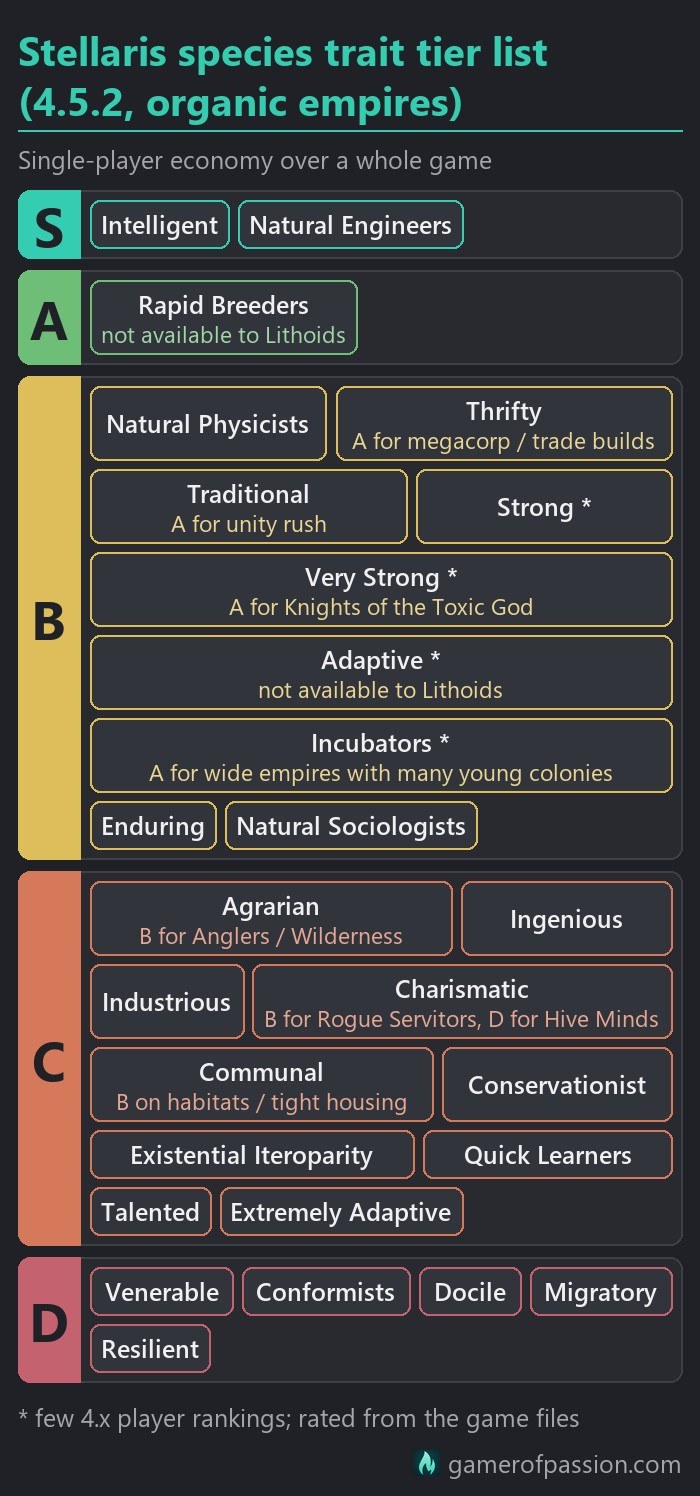
The tiers below judge each trait by what it does for a single-player economy over a whole game, and they assume a normal organic empire unless the text says otherwise. S means you will want it in most games, A is a strong pick, B is solid when it fits your plan, C is situational and D is a trait you will rarely want.
A few traits are new or changed recently enough that there is little 4.x play experience with them yet. Those carry an asterisk, and their rating rests on what the game files say they do.
| Trait | Tier | Cost | What it does |
|---|---|---|---|
| Intelligent | S | 2 | +10% Job Efficiency for Researcher jobs |
| Natural Engineers | S | 1 | +15% Job Efficiency for Engineer jobs |
| Rapid Breeders | A (not for Lithoids) | 2 | +10% Pop Growth Speed |
| Natural Physicists | B | 1 | +15% Job Efficiency for Physicist jobs |
| Thrifty | B (A for trade builds) | 2 | +25% Job Efficiency for Trader jobs |
| Traditional | B (A for unity rush) | 1 | +10% Job Efficiency for Administrative jobs |
| Strong* | B | 1 | +2.5% worker and +10% soldier efficiency, +20% army damage |
| Very Strong* | B (A for Knights) | 3 | +5% worker and +15% soldier efficiency, +40% army damage |
| Adaptive* | B (not for Lithoids) | 2 | +10% Habitability |
| Incubators* | B (A for wide empires) | 2 | +30% Pop Growth Speed at 700 pops or fewer, -10% from 4,700 |
| Enduring | B | 1 | +20 Leader Lifespan |
| Natural Sociologists | B | 1 | +15% Job Efficiency for Biologist jobs |
| Agrarian | C (B for Anglers / Wilderness) | 2 | +15% Job Efficiency for Farmer jobs |
| Ingenious | C | 2 | +15% Job Efficiency for Technician jobs |
| Industrious | C | 2 | +15% Job Efficiency for Miner jobs |
| Charismatic | C (B for Rogue Servitors, D for Hive Minds) | 2 | +20% Influential Job Efficiency (elites, Entertainers) |
| Communal | C (B on habitats) | 1 | -10% Pop Housing Usage |
| Conservationist | C | 1 | -10% Pop Consumer Goods Upkeep |
| Existential Iteroparity | C | 2 | +20% Pop Growth during war and crisis |
| Quick Learners | C | 1 | +10% Leader Experience Gain |
| Talented | C | 1 | -1 Leader Maximum Negative Traits, -10% Leader Upkeep |
| Extremely Adaptive | C | 4 | +20% Habitability |
| Venerable | D | 4 | +80 Leader Lifespan |
| Conformists | D | 2 | +30% Governing Ethics Attraction |
| Docile | D | 2 | -10% Empire Size from Pops |
| Migratory | D | 1 | -35% Resettlement Cost |
| Resilient | D | 1 | +50% Defense Army Damage |
S tier
Intelligent costs 2 points and gives +10% Job Efficiency to every researcher job. It is the only starting trait open to every organic and Lithoid species that boosts all three research branches at once. Every 100 researcher jobs will make an extra 0.3 research for 0.15 more consumer goods, and with thousands of researchers at work that adds up quickly. The only real downside is the price.
Natural Engineers gives +15% Job Efficiency to engineer jobs for just 1 point. If your research is split evenly between the three branches, a Natural trait gives about the same research per point as Intelligent and leaves you a point for something else. That is why it sits in S. Of the three Natural traits, I would pick Engineers first, because engineering research feeds both your fleet and a good part of your economy.
A tier
Rapid Breeders costs 2 points for a flat +10% Pop Growth Speed on every planet you own. More pops means more workers for every job, which is why a growth trait is still one of the safest picks for a long game. Beware that Lithoids cannot take it. It is also an opposite of the other growth traits such as Budding, Crystallization, Incubators and Egg Laying, and you will have to settle on one of them.
B tier
Natural Physicists works exactly like Natural Engineers, only for physicist jobs. Beware that it blocks the other two Natural traits as well as Camouflage and Chromalogs.
Thrifty gives +25% Job Efficiency to trader jobs for 2 points, which works out to +2 trade for every 100 filled Trader jobs. That is the biggest number among the basic traits, but it will only pay off if you actually run a lot of Traders. For a megacorp or any other trade build, Thrifty is an A-tier pick. For everyone else it is a B.
Traditional costs 1 point for +10% Job Efficiency on administrative jobs, or +0.3 unity per 100 Bureaucrats. Unity buys your traditions, and every finished tradition tree gives you an ascension perk slot. That makes Traditional an A-tier trait for a unity rush and a solid way to spend a spare point anywhere else. It is an opposite of Quarrelsome.
Strong costs only 1 point and gives +2.5% Job Efficiency to every worker job, +10% to Soldier jobs and +20% army damage. Per point, that is more worker efficiency than Very Strong offers, 2.5% against about 1.7%. Since the Soldier bonus only arrived in 4.3, this rating is based on the numbers alone, and on paper Strong is probably a decent filler for an empire with plenty of workers.
Very Strong costs 3 points for +5% on all worker jobs, +15% on Soldier jobs and +40% army damage. That is a lot of points for a normal empire, but Knights and Lord Commanders count as Soldier jobs, which makes Very Strong an A-tier trait for Knights of the Toxic God. Squires are worker jobs, though, and they will only get the worker part. Like Strong, it is rated on its 4.3 numbers rather than on its old reputation.
Adaptive costs 2 points for +10% habitability, and Lithoids cannot take it. In 4.x, at 0% habitability, pops will lose 50% Job Efficiency and 50% Pop Growth Speed and pay twice the upkeep and use twice the amenities, which means Adaptive acts like a small economy bonus on every world that is not ideal for you, while it does nothing on planets that are already at 100%. Judged on those numbers, it is a solid B for any empire that settles a lot of mediocre planets.
Incubators costs 2 points and gives up to +30% Pop Growth Speed on planets with 700 pops or fewer, a bonus that will shrink to +10% at 2,700 pops, 0% at 3,700 and -10% from 4,700 pops on. Judged on that curve, it beats Rapid Breeders on any planet below 2,700 pops, which makes it an A-tier pick for wide empires with many young colonies. A crowded capital can actually grow slower with it, though, and for a normal empire it stays at B. Lithoids can take it even though Rapid Breeders is closed to them, but it is an opposite of Crystallization.
Enduring adds 20 years to your leaders’ lifespan for 1 point. Keeping a levelled-up scientist or governor around for 20 more years is good value for a single point.
Natural Sociologists is the third Natural trait, with +15% on biologist jobs for 1 point. I would probably only take it over Natural Engineers in a game built around society research.
C tier
Agrarian gives +15% Job Efficiency to farmer jobs, or +0.9 food per 100 jobs with no extra upkeep, for 2 points. Food is rarely what you are short of, but Agrarian climbs to B for Anglers and Wilderness builds, and Lithoids can take it even though it will only feed your other species, since they eat minerals.
Ingenious gives +15% to technician jobs, which is +0.9 energy per 100 jobs for 2 points. That is fine, but 2 points for a single worker job is a lot next to what Intelligent does for the same price.
Industrious is the mineral version, with +15% on miner jobs and +0.6 minerals per 100 jobs for 2 points. Minerals are worth a little bit more to Lithoids than to other species, because their pops pay their upkeep in minerals.
Charismatic costs 2 points and gives +20% Job Efficiency to influential jobs, which are Entertainers, every elite job such as Politicians at 5 unity per 100 jobs, and Bio-Trophies. That makes it a B on the organic species of a Rogue Servitor with a lot of Bio-Trophies, but a Hive Mind only has Maintenance Drones and Evaluators in that group, which drops it to D there.
Communal cuts each pop’s housing use by 10% for 1 point, which lets roughly 11% more pops fit into the same housing. Housing is rarely what holds a normal planet back, but on habitats and in other builds with tight housing it moves up to B.
Conservationist lowers your pops’ consumer goods upkeep by 10% for 1 point. It is probably a reasonable filler for an empire that burns through consumer goods, but Hive Minds cannot take it.
Existential Iteroparity gives +20% Pop Growth Speed, but only while you are at war or a crisis is running, after 4.3 cut it down from 30%. It only makes sense for an empire that plans to fight for most of the game.
Quick Learners gives your leaders 10% more experience for 1 point. Enduring will usually do more for your leaders at the same price.
Talented costs 1 point for a limit of one fewer negative trait on your leaders and 10% lower leader upkeep, which will rarely change how a game goes.
Extremely Adaptive doubles Adaptive’s bonus to +20% habitability for 4 points. Per point that is the same deal as Adaptive, except that it eats your whole starting budget plus 2 more points.
D tier
Venerable adds 80 years of leader lifespan. At 4 points, it costs as much as Intelligent and Rapid Breeders together.
Conformists costs 2 points for +30% governing ethics attraction. That only nudges which ethics your pops drift towards, and Hive Minds cannot take it.
Docile lowers the Empire Size your species’ pops generate by 10%. At 0.005 Empire Size per pop, 10,000 Docile pops will save you about 5 Empire Size, or roughly 1% tech and tradition cost once you are over 100, which is too little for 2 points.
Migratory only makes resettling pops by hand 35% cheaper. Your pops already move to new colonies on their own, which leaves it with very little to do.
Resilient gives your defensive armies +50% damage for 1 point, and it only matters when someone actually lands troops on your planets.
Best negative traits
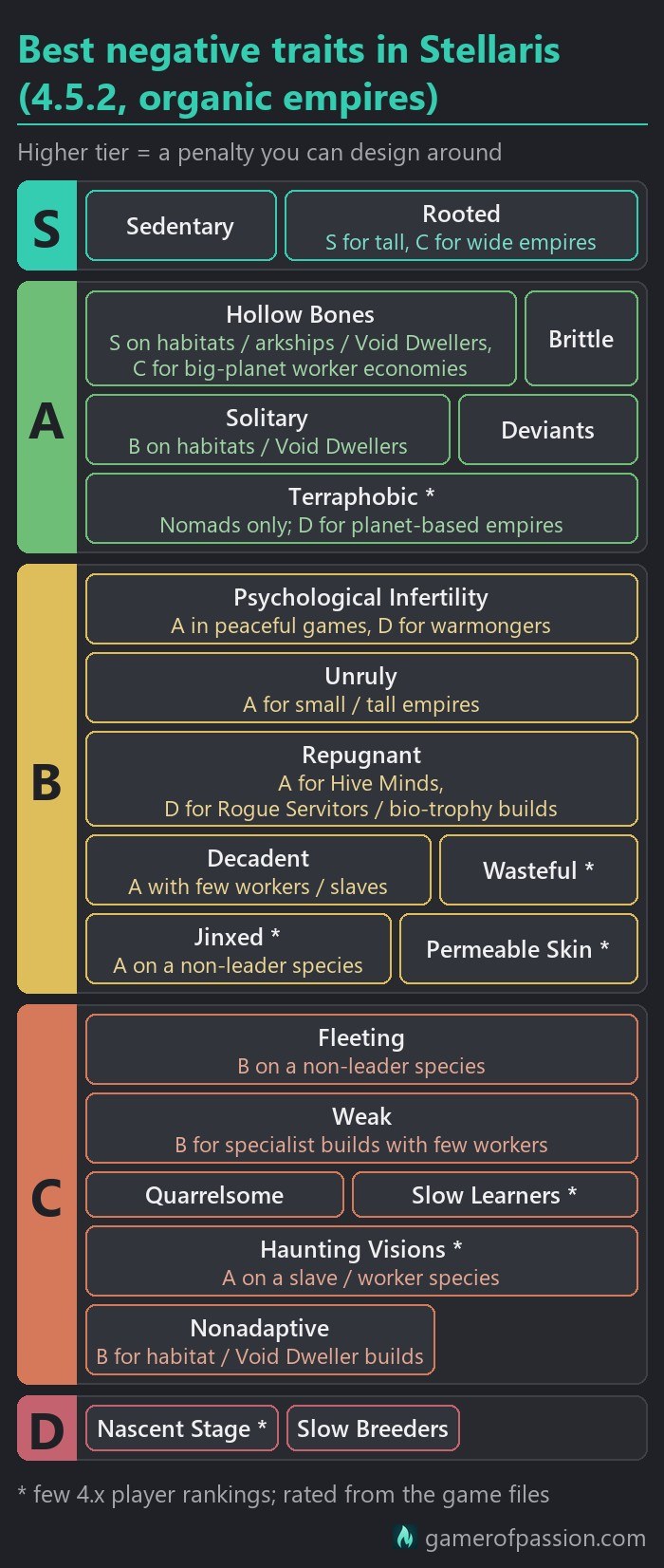
A negative trait is cheap when its penalty hits something you can plan around. The best ones touch a part of the game you were not going to use much anyway, like resettling pops by hand, spare housing or ethics attraction, while the bad ones tax growth or jobs on every planet you own.
The refund matters too, because every negative uses one of your 5 picks, and a -3 trait like Rooted or Brittle will pay for a whole extra positive trait with a single slot.
| Trait | Tier | Points back | Penalty |
|---|---|---|---|
| Sedentary | S | 1 | +35% Resettlement Cost |
| Rooted | S (C for wide empires) | 3 | +200% Resettlement Cost, no automatic resettling |
| Hollow Bones | A (S on habitats, C on big worker planets) | 3 | -0.67% worker and soldier efficiency per planet size |
| Brittle | A | 3 | +0.5 Pop Amenities Usage (from 1 to 1.5 per pop) |
| Solitary | A (B on habitats) | 1 | +10% Pop Housing Usage |
| Deviants | A | 1 | -15% Governing Ethics Attraction |
| Terraphobic* | A (Nomads only; D for planet empires) | 1 | Non-artificial colonies: -15% efficiency, +15% amenity usage |
| Psychological Infertility | B (A in peaceful games, D for warmongers) | 2 | -30% Pop Growth during war and crisis |
| Unruly | B (A for tall empires) | 2 | +10% Empire Size from Pops |
| Repugnant | B (A for Hive Minds, D for Rogue Servitors) | 2 | -20% Influential Job Efficiency (elites, Entertainers) |
| Decadent | B (A with few workers / slaves) | 1 | -10% Worker and Slave Happiness |
| Wasteful* | B | 1 | +10% Pop Consumer Goods Upkeep |
| Jinxed* | B (A on a non-leader species) | 1 | +1 Leader Maximum Negative Traits |
| Permeable Skin* | B | 1 | -20% Habitability on worlds of a different climate category |
| Fleeting | C (B on a non-leader species) | 1 | -10 Leader Lifespan |
| Weak | C (B for specialist builds) | 1 | -2.5% worker and -10% soldier efficiency, -20% army damage |
| Quarrelsome | C | 1 | -10% Job Efficiency for Administrative jobs |
| Slow Learners* | C | 1 | -10% leader experience |
| Haunting Visions* | C (A on a worker species) | 2 | -10% specialist, complex drone and elite efficiency |
| Nonadaptive | C (B for habitat builds) | 2 | -10% Habitability |
| Nascent Stage* | D | 2 | Part of every new generation turns pre-sapient |
| Slow Breeders | D | 2 | -10% Pop Growth Speed |
S tier negatives
Sedentary only makes resettling pops by hand 35% more expensive. Your pops will still move to new colonies on their own. Since most empires rarely resettle anyone by hand, that makes it the best -1 pick in the game. It cannot be combined with Rooted, Migratory, Wilderness or an Arkship species, and the Voidfarers, The Sacred Path, Heirs of the Khan and Forever Cruise origins block it.
Rooted gives back 3 points, but its pops will never move to another planet on their own, and resettling them by hand will cost three times as much. New colonies then grow only from births and from the pops you pay to move, which makes Rooted close to free for tall empires, Wilderness and anyone with few planets and earns it its S. A wide empire should treat it as C. It is a Plantoid and Fungoid trait that a few other portraits can also take.
A tier negatives
Hollow Bones costs your workers, menial drones and soldiers 0.67% Job Efficiency per planet size. That will be -4% on a size 6 habitat, -6% on a size 9 arkship and -13% on a size 20 world. For empires that live on habitats or arkships, for Void Dwellers and for builds with very few workers, it is close to free and an S-tier pick, while a big-planet worker economy should treat it as C. It is a Toxoid and Avian trait.
Brittle raises each pop’s amenity use from 1 to 1.5, which means a Brittle species needs 50% more amenities. You will feel that. Still, it is a manageable cost for 3 points, and it is the biggest refund a Lithoid or Necroid species can get.
Solitary makes each pop use 10% more housing. Most planets will probably have some housing to spare, which makes it one of the easiest -1 picks, but on habitats and with Void Dwellers, where housing is tight, it drops to B.
Deviants lowers the attraction of your governing ethics by 15%. Unless you depend on keeping every pop on your main ethics, you will hardly notice it.
Terraphobic is a Nomads trait for species with an arkship or habitat homeworld. On any colony that is not an artificial one, its pops will lose 15% Job Efficiency and use 15% more amenities, and its armies always have 35% less health. For a nomad empire that stays on its arkships that is close to free and worth an A, but any empire that plans to settle normal planets should see it as D. It only arrived with Nomads in 4.4, and this rating rests on its numbers.
B tier negatives
Psychological Infertility does nothing in peace and cuts Pop Growth Speed by 30% while you are at war or a crisis is running. Any war counts, including one somebody else declared on you. For a peaceful single-player empire that makes it one of the cheapest -2 picks and an A, while a warmonger is going to pay for it all game long and should treat it as D.
Unruly makes every pop of that species count 10% more towards Empire Size. At 0.005 Empire Size per pop, 10,000 Unruly pops will add about 5 Empire Size, which is roughly +1% tech and tradition cost once you are over 100, and since Unruly works on the pop side, civic and ethic reductions to pop sprawl should shrink it as well. For small and tall empires it is an A, but it is never completely free, which keeps it at B.
Repugnant gives back 2 points for -20% Job Efficiency on influential jobs, which include Entertainers, every elite job such as Politicians, and Bio-Trophies. A Politician job makes 5 unity, so Repugnant will cost you more in an empire with many elites than in one that gets its amenities from buildings. In a Hive Mind it only touches Maintenance Drones and Evaluators, which makes it an A there, while Rogue Servitors and other bio-trophy builds should rate it D.
Decadent lowers the happiness of your worker and slave pops by 10%. With few workers or slaves it is close to an A, but a worker-heavy empire is going to feel it.
Wasteful raises the consumer goods your pops use for their living standard by 10%, while the upkeep of their jobs stays the same. It costs little under low living standards and more under the most generous ones, which on paper makes it a fair -1.
Jinxed lets your leaders carry one more negative trait. That only touches leaders, and since 4.5 traits that hurt leaders also make a species less likely to supply them. Judged on paper, it is a B for your main species and close to an A on a worker species in a multi-species empire.
Permeable Skin cuts habitability by 20% on worlds whose climate category differs from your species’ preference. If you mostly settle planets of your own climate, you will rarely feel it, which on paper makes it a decent -1 for Molluscoid and Aquatic portraits.
C and D tier negatives
Fleeting takes 10 years off leader lifespan for organics and 25 for Lithoids, who still come out 25 years ahead thanks to their base trait, and it becomes a B on a species that does not supply your leaders. Weak costs -20% army damage, -10% on Soldier jobs and -2.5% on every worker job, which only specialist builds with few workers can shrug off (B). Quarrelsome takes 10% off administrative jobs and will hurt any unity plan, and Slow Learners gives leaders 10% less experience. Haunting Visions gives back 2 points for -10% on specialist, complex drone and elite jobs, which makes it a great fit for a slave or worker species (A) and a bad one for your main species. Nonadaptive cuts habitability by 10% everywhere and only reaches B for habitat and Void Dweller builds. Slow Learners and Haunting Visions are rated on their numbers, since there is little 4.x play experience with either.
Two negatives are best avoided. Nascent Stage turns part of every new generation into pre-sapients who can only work pre-sapient jobs, and they mature at roughly 1/60 per month, only on colonies that are at least 5 years old. Young colonies will feel that the most, and since the trait was reworked for 4.4 and fixed again in 4.5, its D rests on how the 4.5.2 files handle it. Slow Breeders is the worst of the lot. It takes 10% off Pop Growth Speed on every planet for the whole game.
A few opposites also break popular negative stacks. Make sure to check them before you plan a species around them:
- Seasonal Dormancy and Wasteful cannot be taken together.
- Nascent Stage blocks Slow Breeders, Psychological Infertility and the Wilderness trait.
- Psychological Infertility and Slow Breeders exclude each other.
- Hollow Bones cannot sit next to Weak, Strong or Very Strong.
- Sedentary is an opposite of Rooted, which matters for every Plantoid build.
Lithoid, plantoid and DLC species traits
A lot of traits are tied to a portrait class or a DLC, and you will only be able to pick them if your species qualifies.
| Trait | Tier | Who / DLC | What it does |
|---|---|---|---|
| Recursive Learners* | A (Nomads only) | Arkship Preference; Nomads | +1.25% Job Efficiency per arkship district, up to +25% |
| Budding | B (A for hives / wide) | Plantoid, Fungoid; Plantoids | 0.02 Monthly Organic Pop Growth per 100 pops |
| Crystallization* | B | Lithoid; Plantoids, Lithoids | +0.02 growth per 100 pops |
| Aquatic | B (A for Ocean Paradise / Anglers) | Ocean Preference; Aquatics | +20% Ocean Habitability; -10% housing on ocean worlds |
| Shelled | B | Molluscoid, Necroid; BioGenesis | -30% Pop Housing Usage, +10% Habitability |
| Chromalogs | B (A for unity builds) | Aquatic, Arthropoid, Reptilian; BioGenesis | +20% Physicist and Administrative jobs, +40% Army Health |
| Cranial Hypertrophy | B | Psionic; Shadows of the Shroud | +15% researcher and -10% worker Job Efficiency |
| Radiotrophic | C | Plantoid, Fungoid, Lithoid, Thermophile; Plantoids | Replaces 50% of Food Upkeep with Energy Credits |
| Phototrophic | C | Plantoid, Fungoid; Plantoids | Replaces 50% of Food Upkeep with Energy Credits |
| Camouflage | C | Aquatic, Arthropoid, Reptilian; BioGenesis | +10% Physicist Job Efficiency, +20% Army Health |
| Egg Laying | C | Reptilian, Avian, Aquatic; BioGenesis | +15% Pop Growth Speed with a local Food surplus |
| Familial | C | Humanoid, Mammalian, Avian, not gestalt; BioGenesis | 0.1% Happiness per 100 pops on a planet, max +20% |
| Genetic Memory | C | Humanoid, Mammalian, Necroid; BioGenesis | +0.5% Habitability per colony year, max +25% |
| Spare Organs | C (B for livestock builds) | Molluscoid, Necroid, Toxoid; BioGenesis | +50% Livestock jobs; leaders survive their first death |
| Uncanny Intuition | C | Psionic; Shadows of the Shroud | +2 Effective Councilor Skill |
| Photoadaptive* | C | Any species; Nomads | Workers -15% to +15% by star; +10 Leader Lifespan |
| Unbreakable Resolve* | C | Any species; Infernals | +0.2 Stability per 100 pops, max +15 |
| Scintillating Skin | D (C on a side species) | Lithoid; Lithoids | 0.01 Rare Crystals per month per 100 working pops |
| Gaseous Byproducts | D (C on a side species) | Lithoid; Lithoids | 0.01 Exotic Gases per month per 100 working pops |
| Volatile Excretions | D (C on a side species) | Lithoid; Lithoids | 0.01 Volatile Motes per month per 100 working pops |
| Flight | D | Avian, Arthropoid; BioGenesis | +1 commander skill, -30% Army Damage Taken |
| Spatial Mastery | D | Avian, Arthropoid; BioGenesis | +1 leader skill, -50% Army Damage Taken, -10% housing |
| Reaver* | D | Any species, not gestalt; Nomads | +5% Trader jobs; Commanders start with Plunderer |
Lithoid traits
Lithoids work with a different creation pool. They cannot take Rapid Breeders, Adaptive, Extremely Adaptive, Slow Breeders, Nonadaptive or the organic Fleeting, and their base trait cuts both Pop Growth Speed and flat pop growth by 25%, although in return they get +50% habitability, +50% army health, +50 years of leader lifespan, with mineral upkeep instead of food. Brittle, from BioGenesis, is their big -3 refund.
Crystallization is the Lithoid growth trait. It adds a flat +0.02 monthly pop growth for every 100 Lithoid pops, or +0.03 on the Massive Crater homeworld of the Calamitous Birth origin, and the base Lithoid trait cuts that by 25%, which will work out to about 0.015 per 100 pops on normal worlds. It is an opposite of Incubators, which means a Lithoid is going to have to pick one growth trait or the other. Its B rests on these numbers alone.
Scintillating Skin, Gaseous Byproducts and Volatile Excretions make every 100 working Lithoid pops produce 0.01 Rare Crystals, Exotic Gases or Volatile Motes per month. That is far too little for 2 points on your main species (D), but on a small side species they are a C-tier way to get a trickle of a strategic resource early on.
Plantoid traits
Budding adds a flat +0.02 monthly pop growth per 100 pops, and it stacks with other flat sources such as Clone Vats and Spawning Drones. Its growth scales with the number of pops on a planet, which makes it a B for a normal empire and an A for Hive Minds and wide empires. It is an opposite of Rapid Breeders.
Phototrophic for 1 point and Radiotrophic for 2 both turn half of your pops’ food upkeep into energy upkeep. Radiotrophic also gives +10% growth and +10% habitability on Tomb Worlds, where that energy upkeep disappears, and Lithoids and Infernals can take it too, where it swaps half of their mineral or alloy upkeep instead of food. Both are C.
Invasive Species gives +5% habitability and +5% Pop Growth Speed for each negative trait, counted by trait rather than by points. With 5 picks that means 4 negatives for +20%, or 5 negatives for +25% with the extra pick from Evolutionary Predators. In exchange it blocks nearly every positive trait, including Erudite, Fertile and Robust later on, until you gene-mod it away, and at creation it leaves little more than Aquatic, Phototrophic, Radiotrophic and Budding. It gets no tier here, because it turns your whole species into a negative-trait build.
BioGenesis phenotype traits
Shelled costs 3 points, cuts housing use by 30% and adds 10% habitability. It is the big housing trait if you have a Molluscoid or Necroid portrait, and a solid B for habitat builds and crowded planets.
Chromalogs costs 4 points for +20% on physicist jobs, +20% on administrative jobs, 40% more army health and 15% more governing ethics attraction. That is a stronger Natural Physicists and Traditional in one trait. It is a B for most empires, and for a unity or priest build it moves up to A. At 4 points it is going to eat most of a normal budget, though.
Seasonal Dormancy costs 2 points and cuts a pop’s own upkeep by 15%, or by 75% while the pop is unemployed or a Denizen. It does not touch the upkeep of the jobs they work. It gets no tier either, because its value depends almost entirely on how many unemployed pops and Denizens your build keeps around. It blocks Wasteful and Conservationist.
Most of the other phenotype traits are niche picks in C. Camouflage gives +10% on physicist jobs and +20% army health for 1 point. Egg Laying adds +15% Pop Growth Speed on planets with a local food surplus, Familial gives +0.1% happiness per 100 pops of the species on the same planet up to +20%, and Genetic Memory adds 0.5% habitability per year of colony age up to +25%. Spare Organs gives +50% on livestock jobs and lets your leaders survive their first death, which makes it a B for livestock builds. Flight and Spatial Mastery are D, because most of what they give goes to ground armies, and Spatial Mastery costs 4 points.
Other DLC traits
Aquatic needs an ocean homeworld and gives +20% habitability on ocean worlds, 10% less housing use on ocean worlds and flooded habitats and +10% worker and menial drone efficiency on ocean worlds. On worlds that are not wet, it will cost you 30% more housing and 20% habitability. That makes it a B for a normal empire and an A for Ocean Paradise or Anglers, where you will spend most of the game on ocean planets.
Cranial Hypertrophy is a psionic portrait trait with +15% on all researcher jobs and -10% on worker and menial drone jobs for 2 points. For a specialist-heavy empire it beats Intelligent at the same price, but the two are opposites and the worker penalty hurts anyone with many workers, which keeps it at B.
Uncanny Intuition gives +2 councilor skill for 3 points and is a C. Unbreakable Resolve adds +0.2 stability per 100 pops on the planet, up to +15, and it also works for drones. It only arrived with the Infernals pack in 4.2, and its C rests on those numbers.
Recursive Learners costs 1 point and is only for species with an arkship homeworld. It gives +1.25% Job Efficiency per district on the arkship, up to +25%, for the jobs that arkship class runs: Metallurgists, Artisans and Astro-Harvesters on civilian arkships, researchers on science arkships and engineers and soldiers on military ones. It is among the very few ways to boost Metallurgists and Artisans at all, which earns it an A, although its rating rests on the numbers alone.
The other Nomads traits are weaker, and like Recursive Learners they are rated on their numbers. Photoadaptive swings worker and menial drone efficiency between -15% and +15% depending on your star, with +15% on physicists in black hole systems and +15% on engineers at M-class stars, and it is a C. Reaver only gives +5% on trader jobs and makes your commanders start with the Plunderer trait unless they are Xenophile or Pacifist, which is a D for 2 points.
Overtuned traits
The Overtuned origin has its own set of traits, which are not in the tiers because only that origin can use them. The origin gives +2 trait points and +1 pick, but its free Gene Tailoring does not add the usual +2 points, which means it lands at the same total later on.
Every Overtuned trait will shorten your leaders’ lives: -10 years for the 1-point traits, -20 for Fleeting Excellence and -30 for Pre-Planned Growth, Elevated Synapses and Excessive Endurance. The Damn the Consequences edict doubles their bonuses for at least 5 years, but it also doubles your organic pops’ upkeep.
Machine and robot traits
Machine traits come in two flavours. A Machine Intelligence picks traits for its own species on the creation screen, while the traits an organic empire’s robots can take depend on your robot technology.
Artificial Workforce opens the basic pool with Adaptive Frames, Efficient Processors, Mass-Produced and the worker traits. Artificial Specialists adds Logic Engines, Trading Algorithms, Propaganda Machines, Integrated Weaponry and the three Cores, and Artificial Administration adds Eternal Machine, Enhanced Memory, Loyalty Circuits and Learning Algorithms. A Machine Intelligence can take every starting robot trait except Loyalty Circuits and Domestic Protocols, and it cannot take the robot versions of Quarrelsome, Deviants, Decadent and Wasteful either.
| Trait | Tier | Cost | Who |
|---|---|---|---|
| Adaptive Frames | S | 3 | MI and robots |
| Mass-Produced | A | 1 | MI and robots |
| Logic Engines | A | 2 | MI; robots with Artificial Specialists |
| Engineering Core | A | 1 | MI; robots with Artificial Specialists; Machine Age |
| Physics Core | B | 1 | MI; robots with Artificial Specialists; Machine Age |
| Efficient Processors | B (A for robots once techs add points) | 3 | MI and robots |
| Power Drills | B | 2 | MI and robots |
| Superconductive | B | 2 | MI and robots |
| Propaganda Machines | B | 1 | MI; robots with Artificial Specialists |
| Recycled | B | 2 | MI and robots |
| Durable | B | 1 | MI and robots |
| Enhanced Memory | B | 2 | MI; robots with Artificial Administration |
| Eternal Machine | B (A in long games) | 4 | MI; robots with Artificial Administration |
| Sociology Core | C | 1 | MI; robots with Artificial Specialists; Machine Age |
| Trading Algorithms | C | 2 | MI; robots with Artificial Specialists |
| Emotion Emulators | C (D for Machine Intelligences) | 1 | MI and robots |
| Double-Jointed | C | 1 | MI and robots |
| Streamlined Protocols | C | 2 | MI and robots |
| Integrated Weaponry | C (B for war builds) | 2 | MI; robots with Artificial Specialists; Machine Age |
| Learning Algorithms | C | 1 | MI; robots with Artificial Administration |
| Loyalty Circuits | C (robots only) | 2 | Robots with Artificial Administration; not MI |
| Harvesters | D | 2 | MI and robots |
Best machine traits
Adaptive Frames is the machine auto-mod trait, at 3 points or 2 for Mechanists. It copies the matching job trait for whatever job each pop works, which means one trait will cover researchers, traders, administrators, miners, technicians, farmers and influential jobs. That makes it the S-tier pick for a Machine Intelligence, even though it does nothing for Metallurgists, Artisans, Soldiers or Enforcers.
Mass-Produced gives +15% Mechanical Pop Assembly Speed for 1 point. Machine pops are only ever assembled, which makes this the machine answer to Rapid Breeders and an easy A. Logic Engines, the machine Intelligent with +10% on researcher jobs for 2 points, is an A too, and so is Engineering Core, which gives +15% on engineer jobs for 1 point just like Natural Engineers. Physics Core does the same for physicists and is a B, and the three Cores are opposites of each other.
Efficient Processors gives +5% Job Efficiency on every job, but 3 points is a lot for a Machine Intelligence with 1, which keeps it at B. For an organic empire’s robots it climbs to A once techs have added trait points to your templates.
Power Drills and Superconductive give +15% on miner and technician jobs for 2 points each, and they are solid B picks for robots you put into mining and energy jobs. Propaganda Machines gives +15% on administrative jobs for 1 point, which for a Machine Intelligence means its Coordinators, and it is a B as well.
Recycled gives +20% on Roboticist-group jobs, Replicators included, Durable cuts robot upkeep by 10%, and Enhanced Memory gives your leaders a limit of one fewer negative trait and 25% lower upkeep. All three are B. Eternal Machine costs 4 points and makes your machine leaders immortal, which is a B for most games and an A in long ones.
The C-tier machine traits, such as Sociology Core, Trading Algorithms, Double-Jointed, Streamlined Protocols and Learning Algorithms, are narrow. Emotion Emulators drops to D for a Machine Intelligence, where its +20% only reaches Maintenance Drones and Evaluators, Integrated Weaponry becomes a B for war builds, and Loyalty Circuits is only open to robots of non-gestalt empires. Harvesters is a D, because Adaptive Frames already covers farmers along with six other jobs.
Machine negatives
Few machine negatives have a settled reputation in 4.x, and these ratings rest on what the 4.5.2 files say they do. For a Machine Intelligence, High Bandwidth is the standard -2 refund. It makes your pops count 10% more towards Empire Size, the same effect as Unruly, which is cheap enough for an A. Bulky, which adds 10% housing use, is an A-tier -1 pick as well, and so is Uncanny, since a gestalt empire’s influential jobs are only its Maintenance Drones and Evaluators.
Delicate Chassis costs -50% army damage, -5% on worker and menial drone jobs and -15% on Soldier jobs, High Maintenance raises robot upkeep by 10%, and Scarcity Subroutines takes 25% off your Logistic Drones. All three are B, and Delicate Chassis and Scarcity Subroutines need The Machine Age. Luxurious takes 20% off Roboticist-group jobs, Replicators included, which is a B, and I would move it up to A after the Virtual ascension. Repurposed Hardware, with 10% less leader experience, is a C, and Custom-Made is a D, because its -15% assembly speed hits the only way a machine empire grows.
Robots of an organic empire are a different story, because they mostly work worker jobs. Uncanny and Luxurious should rarely matter for them, because worker robots do not staff those jobs. Uncanny hits influential jobs and Luxurious hits Roboticist jobs. As long as organic pops fill those, both can be close to free, which puts them at S and A for robots. Bulky, High Maintenance and High Bandwidth are B, Delicate Chassis is C because its -5% worker efficiency hits exactly what robots do, and Custom-Made is D.
Traits for Hive Minds
A Hive Mind uses the normal organic pool with the same 2 points and 5 picks, but a few traits are closed to it: Conformists, Deviants, Decadent, Conservationist, Wasteful, Familial and Reaver.
Job traits work for hives exactly as they do for everyone else. Brain Drones make 3 research per 100 jobs and count as researchers, which means Intelligent and the Natural traits apply to them, while Synapse Drones make 3 unity and count as administrators, which is what Traditional boosts, and Thrifty, Industrious, Agrarian and Ingenious cover Logistic Drones, Mining Drones, Agri-Drones and Tech-Drones.
The happiness part of a trait, such as Radiotrophic’s happiness bonus on worlds with Wasteland Radiation, should do nothing for drones. Amenity traits still count, though. Gestalt amenities feed planet stability instead of happiness, which makes Brittle’s +0.5 amenity use a real cost for a lithoid hive.
Charismatic is a trap for hives, because its +20% only reaches Maintenance Drones and Evaluators there. Repugnant works the other way round: in a hive it only touches Maintenance Drones and Evaluators, which makes it an A-tier refund, although it still costs you a little bit of the trade and unity those drones make.
Best trait combinations
Every combination below fits its empire’s starting points and picks. If you want a whole empire around them, with ethics, civics and origin, the best Stellaris builds list the complete trait setup for each build.
| Setup | Traits | Points | DLC |
|---|---|---|---|
| Beginner / generalist organic | Intelligent, Rapid Breeders | 4 – 1 (Sedentary) – 1 (Solitary) = 2 | base game |
| Peaceful tech rush | Intelligent, Natural Engineers, Rapid Breeders | 5 – 2 (Psychological Infertility) – 1 (Sedentary) = 2 | base game |
| Lithoid | Intelligent, Industrious, Natural Engineers | 5 – 3 (Brittle) = 2 | BioGenesis, Lithoids |
| Tall plantoid / fungoid | Intelligent, Natural Engineers, Budding | 5 – 3 (Rooted) = 2 | Plantoids, BioGenesis |
| Knights of the Toxic God | Very Strong, Enduring | 4 – 1 (Solitary) – 1 (Jinxed) = 2 | Toxoids |
| Hive Mind | Rapid Breeders, Intelligent, Natural Engineers | 5 – 2 (Repugnant) – 1 (Sedentary) = 2 | base game |
| Machine Intelligence | Adaptive Frames, Mass-Produced | 4 – 2 (High Bandwidth) – 1 (Delicate Chassis) = 1 | Machine Age |
| Machine Intelligence without The Machine Age | Adaptive Frames, Mass-Produced | 4 – 2 (High Bandwidth) – 1 (Bulky) = 1 | base game |
| Robots of an organic empire (first template) | Power Drills, Mass-Produced | 3 – 1 (Uncanny) – 2 (Luxurious) = 0 | base game |
For a beginner or any generalist organic empire, Intelligent and Rapid Breeders paid for with Sedentary and Solitary is hard to beat. The two positives cost 4 points, the two negatives give 2 back, and you will land at exactly your 2 points with one pick unused.
For a peaceful tech rush, add Natural Engineers and swap Solitary for Psychological Infertility. Intelligent, Natural Engineers and Rapid Breeders cost 5 points, and Psychological Infertility plus Sedentary give 3 of them back while using all 5 picks. I would take Psychological Infertility over Unruly here, because Unruly raises the tech costs you are trying to keep low, while Infertility will do nothing as long as you stay at peace and no crisis is running.
A Lithoid cannot take Rapid Breeders, which is why the Lithoid setup goes for research and minerals instead. Intelligent, Industrious and Natural Engineers cost 5 points, and Brittle alone pays 3 of them back with one pick left over. Make sure you own BioGenesis, since Brittle needs it.
A tall Plantoid or Fungoid empire can run Intelligent, Natural Engineers and Budding on the back of Rooted, again 5 points minus 3. Rooted costs you little when you only settle a few planets. You will need the Plantoids Species Pack and BioGenesis for it.
For Knights of the Toxic God, Very Strong and Enduring cost 4 points, and Solitary and Jinxed pay back 2 of them. Knights and Lord Commanders get the Soldier bonus, and Jinxed only touches leaders.
A Hive Mind can take the whole research package of Rapid Breeders, Intelligent and Natural Engineers, paid for by Repugnant and Sedentary. It needs no DLC at all.
A Machine Intelligence should open with Adaptive Frames and Mass-Produced for 4 points, with High Bandwidth and Delicate Chassis giving 3 back to land on its single point. Delicate Chassis needs The Machine Age, and without it you can simply take Bulky instead.
For the first robot template of an organic empire, Power Drills and Mass-Produced cost 3 points, and Uncanny and Luxurious give exactly 3 back for all 4 picks. You will need Artificial Workforce and Machine Template System for it, and the two negatives should rarely matter, because worker robots do not staff influential or Roboticist jobs.
Traits to skip
Some traits look tempting on the creation screen but will rarely pay you back. These are the ones I would leave alone in most games:
- Extremely Adaptive gives the same habitability per point as Adaptive, but at 4 points it eats your whole budget and 2 more.
- Venerable spends 4 points on leader lifespan alone.
- Docile only saves about 1% tech and tradition cost per 10,000 pops, for 2 points.
- Migratory makes manual resettling cheaper, and your pops already move on their own.
- Slow Breeders takes 10% off growth on every planet for the whole game.
- Nascent Stage slows down exactly the young colonies you most need to grow.
- Charismatic is a waste of 2 points in a Hive Mind.
- Harvesters gives robots +15% on farmer jobs, which Adaptive Frames already covers.
- Custom-Made cuts assembly speed by 15%, and assembly is how machines grow.
Changing traits later
Your starting traits are not final. Genome Mapping, a tier 1 tech with +10% Pop Growth Speed, will lead to Gene Tailoring at tier 3, which gives you genetic modification and +2 trait points. From then on you can add the basic positive traits to a species, and Glandular Acclimation, also tier 3, lets you change its climate preference. Each modification is a project whose cost has a fixed base part and then grows with the number of pops and the trait points you change, which makes modding a species cheaper while it is still small.
Targeted Gene Expressions is a rare tech that makes Vocational Genomics available and lets you remove job traits like Intelligent to make room for it. Vocational Genomics costs 3 points and works like Adaptive Frames, copying the matching job trait for whatever job each pop works, which covers researchers, traders, bureaucrats, farmers, miners, technicians, entertainers and elites, while Metallurgists, Artisans, Soldiers and Enforcers get nothing from it.
You cannot pick it at creation, which is the only reason it is missing from the tier list. Once you have it, it is an S-tier trait. Wilderness species cannot take it, and different auto-mod traits, such as Fleeting Excellence from Overtuned, can sit on the same species.
Adding negative traits after creation needs Genetic Resequencing, Genotype Regeneration or Unnatural Selection, and advanced traits like Erudite, Fertile, Robust and Natural Machinist need one of the genetic ascension traditions. Erudite gives +20% researcher efficiency and -10% leader upkeep for 4 points and replaces Intelligent, while Natural Machinist finally gives Metallurgists and Artisans +25%. Exemplary Genetics is meant to make advanced traits 1 point cheaper, and the 4.5.3 open beta fixes that so it actually works, but in 4.5.2 you should plan with the normal cost. The paths themselves are covered in the Stellaris ascension perks guide, and since 4.5 the Cybernetic trait gives +10% Job Efficiency, up from 5%.
Most extra trait points will come from those ascension traditions, with +4 to +6 points and +2 to +4 picks, and from Gene Tailoring. The Natural Design civic, or Innate Design for a Hive Mind, gives +2 trait points and +2 trait picks, but such an empire cannot research Gene Tailoring or Targeted Gene Expressions.
Robots and machines follow their own track. Machine Template System at tier 1 gives you robomodding, and four techs add trait points: Cross-Model Standardization (+3) and Fungible Circuitry (+1) for an organic empire’s robots, Binary Motivators (+3) and Nanite Assemblers (+1) for machine empires. Robot modding has a lower base cost than gene modding, but it costs more per pop and per trait point.
Trait questions
What are the best traits to pick in Stellaris?
For an organic empire, Intelligent, Natural Engineers and Rapid Breeders are the best positive traits, and Sedentary and Solitary are the cheapest negatives. Once you research Targeted Gene Expressions, Vocational Genomics is worth swapping in.
Is there an immortal trait in Stellaris?
Yes, but only for machines. Eternal Machine costs 4 points and makes the leaders of a machine or robot species immortal. A Machine Intelligence can pick it at creation, while an organic empire’s robots will need Artificial Administration first, and Artificial Personality Matrix before they can lead at all. No organic species trait makes leaders immortal, and the closest you will get is Venerable with +80 years, or a Lithoid’s +50 years from its base trait.
What are the best traits for humans?
Humans use the normal organic trait pool, which means the best traits for a human empire are the same as for any other organic species, and the beginner setup below works just as well for them.
What are the best starting traits for beginners?
I would start with Intelligent and Rapid Breeders, paid for with Sedentary and Solitary. Both positives help in every game no matter what you plan, and both negatives touch things a new player will rarely use, namely resettling pops by hand and spare housing.
Can you change species traits later?
Yes, through gene modding for organic species and robomodding for robots and machines, as the section above explains.
Are leader traits the same as species traits?
No. Leader traits belong to individual leaders and are a separate system that this list does not cover.
Conclusion
In the end, a good starting species is mostly research, growth and two negatives you will barely feel, and the rest depends on which job your empire leans on. If you are unsure, start simple and let Vocational Genomics do the fine-tuning once you have it.