
Where you put a habitat in Stellaris decides most of what it will ever be worth. Since the 4.0 rework, every star, planet and gas giant in its system adds to its district count, and the deposits around them set how many of those districts can be Reactor Districts, Astro-Mining Bays or Research Districts.
Building one takes the Orbital Habitats technology, a construction ship, 200 influence and 1,500 alloys, and the Habitat Central Complex will then need 5 years to finish. Empires with the bio-ship shipset pay 750 alloys and 2,625 food instead of the 1,500 alloys. You can only have one habitat per system, but there is no limit on how many systems get one.
Habitats are worth it in systems with many bodies and deposits, as Fortress habitats on chokepoints, in Arc Furnace systems and in empires that have run out of good planets. In a poor system, even a fully upgraded habitat is going to hold fewer jobs than a normal size-16 planet at base values, and early on the alloys will probably do more for you as warships.
The numbers on this page match the patch 4.5.2 game files and leave out traits, civics and traditions unless a sentence names one of them.
How to build a habitat
A habitat starts as a megastructure that your construction ship orders, and once it is finished, it turns into an empty habitat with its own districts that you colonise, a bit like a small planet.
The habitat techs
Orbital Habitats is a tier 3 Engineering tech that costs 5,000 research and needs Starhold. It is not rare, but its draw weight is cut to a tenth during the first 50 years, so you will rarely see it early. Owning three or more Starholds, a neighbour who already has it and the Expansion traditions all raise its chances.
Two rare techs build on it:
- Habitat Expansion costs 10,000 research and also needs Star Fortress. It adds +1 max districts to every habitat, opens the second city specialization slot and unlocks Habitat Central Control.
- Advanced Space Habitation costs 20,000 research and also needs Citadel. It adds another +1 max districts and unlocks Habitat System Control.
Bear in mind that neither of them can be drawn before you own a colonised habitat. An empty one does not count, so it makes sense to settle your first habitat as soon as it is done. Void dweller empires, meaning the Void Dwellers and Voidforged origins or anyone with the Voidborne perk, get ten times the draw weight for both techs.
Utopia, the DLC that habitats used to belong to, has been part of the base game on PC since patch 4.3.6, so habitats need no DLC. The Void Dwellers and Voidforged origins still need Federations, though.
Cost and build time
Every empire pays 200 influence for the Habitat Central Complex, plus 1,500 alloys, or 750 alloys and 2,625 food with the bio-ship shipset, and it takes 5 years to build at base. The megastructure has no upkeep of its own, since that only starts with the colony’s capital building and districts.
Voidborne lowers the Habitat Build Cost by 20%, the Void Dwellers and Voidforged origins by 25%, and the Void Hive civic takes 5% off every megastructure. Voidborne does not make the five years any shorter, though.
Building it step by step
- Research Orbital Habitats.
- Make sure the target system is inside your borders and has your starbase. An outpost is enough.
- Select a construction ship and open its megastructure menu. Hovering a system will show its “Habitat Potential”, a forecast of the maximum districts a habitat there would get, and since patch 4.4 the menu also lists the “Systems with highest Habitat potential”.
- Pick the Habitat Central Complex and click the star, planet or gas giant it should orbit.
- Once the “Habitat Complex Built” message arrives, colonise the habitat like any other planet.
The list shows scores of 10 or less in red and 16 or more in green, which is a fair first filter. A new habitat starts with one Habitation District, the Habitat Administration building, 40% base habitability and +200% Colony Development Speed.
Where to build a habitat
The build menu only says “Must be built in orbit of a major planetary body.” In 4.5.2, that means any star, black holes, neutron stars and pulsars included, and any planet or gas giant, even a habitable or colonised one. The megastructure’s description still mentions uninhabitable planets, but nothing checks for that anymore. These are the rules that do apply:
| Rule | What the game says | What to do |
|---|---|---|
| The system needs your starbase | no message | Build an outpost first |
| Inside your borders | “Cannot build outside Empire borders.” | Claim the system |
| One habitat per system, any owner, ruins included | “Cannot build due to existing Habitat Central Complex in the system” | Pick another system or repair the ruin |
| No Ring World (from the finished Site on) or ruined ring in the system | “Cannot build due to existing Megastructure.” | Pick another system |
| No orbital debris | “Cannot build due to orbital debris.” | Payback origin only: it clears at the end of the origin’s project chain |
| Body must be surveyed | “Cannot build on an unsurveyed planet.” | Survey it |
| No unresearched anomaly on the body | “Cannot build on planets that have unresearched anomalies discovered by us or any other Empire.” | Research it or pick another body |
| No moons or asteroids | “Cannot build on a minor planetary body (asteroid or moon).” | Pick a planet, gas giant or star |
| No astral scars | “Cannot build around an astral scar.” | Pick another body |
| No megastructure already on the body, such as an Orbital Ring, Dyson Swarm, Arc Furnace or Science Nexus | “Cannot build due to existing Megastructure.” | Pick another body in the system |
| One special First Contact system | “…because of strange hyperlane activity.” | Pick another system |
Which body you choose does not change the district count, because the habitat will count the whole system. It only matters for other megastructures.
Deposits and stations
Building the Habitat Central Complex does not touch the planet or star it orbits. Its deposit and any mining or research station on it will keep working. Stations will only go away later, one at a time, when a new Reactor District, Astro-Mining Bay or Research District puts an orbital on a body with a matching deposit. That orbital will replace the station and collect the deposit itself.
Volatile Motes, Exotic Gases, Rare Crystals and Living Metal never get an orbital, so their stations stay. Once every eligible body has its orbital, new districts simply spawn none.
Other megastructures
A habitat and a Ring World never share a system. Any habitat, even an empty one, blocks the Ring World Site (“Cannot build in systems with habitable planets.”), and once a Ring World Site is finished or a ruined ring sits in the system, you cannot start a habitat there. A habitat started while the Site is still being built gets deleted when the Ring World Frame completes. Additionally, a habitat rules out a Matter Decompressor at that black hole.
Dyson Spheres, Dyson Swarms, Arc Furnaces and the other megastructures can share a system with a finished habitat. A planet or star that already carries an Orbital Ring, Dyson Swarm, Arc Furnace or Science Nexus cannot host the habitat, though, and players report that a planet with a habitat cannot take an Orbital Ring afterwards either. Keep habitats off planets you want to ring, and if you plan a Dyson Sphere or Swarm, put the habitat around a planet rather than the star to be safe.
Habitat size and max districts
A habitat is always size 6 (the unique Payback and Ithome’s Gate habitats are 10), and it never grows. Everything above those 6 districts comes from bonuses, so guides that talk about habitats going from 4 to 8 districts describe a system that no longer exists.
Total max districts
The total is 6, plus a bonus for each star, planet and gas giant in the system, plus your empire’s Habitat Max Districts bonuses. The body bonus is paid by the habitat’s capital building: +0.5 per body with Habitat Administration, +0.75 with Habitat Central Control and +1 with Habitat System Control.
Each star of a binary or trinary system counts separately, black holes, neutron stars and pulsars count like any star, and colonised planets count too. Moons and asteroids add nothing unless you are a void dweller empire, and then only +0.25 each, at every tier.
The 0.25 per body for the first tier that some sources give is the build-menu forecast of an empire with only Orbital Habitats. The finished habitat counts 0.5, and the building’s tooltip says so: “Max District Slots from Major Celestial Bodies: +0.50”.
The empire bonuses are Habitat Expansion and Advanced Space Habitation (+1 each), Ceramo-Metal and Durasteel Infrastructure (+1 each), Voidborne (+2) and the Void Dwellers or Voidforged origin, which gives +2 and four more origin-only bonuses described further down. For every other empire, the Expansion finisher only adds its district to natural planets, and Master Builders adds no habitat districts in 4.5.2.
Resource district caps
How many of those districts may be Reactor Districts, Astro-Mining Bays or Research Districts depends on the deposits in the same system, on any body. Each deposit adds its own fixed number of districts of its type, 1 plus half its size rounded down, and these simply add up. A size-3 and a size-5 Minerals deposit will give you 2 + 3 = 5 Astro-Mining Bays. Counting 1 per deposit plus half the combined size would give 2 + 4 = 6, but the game rounds every deposit separately.
| Deposit in the system | District | How many |
|---|---|---|
| Energy | Reactor District | 1 + half the size, rounded down |
| Volatile Motes, Exotic Gases | Reactor District | 1, whatever the size |
| Minerals, Rare Crystals | Astro-Mining Bay | 1 + half the size, rounded down |
| Arc Furnace deposits | Astro-Mining Bay | 1 per body, 2 from the furnace’s second stage |
| Physics, Society, Engineering, Zro, Dark Matter | Research District | 1 + half the size, rounded down |
| Living Metal, mining Minor Artifacts | Research District | 1 |
| Food, trade, alloys | none | 0 |
Output bonuses such as Zero-G Refineries or a Dyson Swarm never add districts, since the caps only count which deposits exist. The Arc Furnace is the big exception, because it creates deposits: every planet, moon and asteroid in its system that has no research deposit and is not habitable gets one, worth +1 Astro-Mining Bay and +2 from the furnace’s second stage. Those deposits will stay for your habitat, so Arc Furnace systems often show mining caps far above what the habitat’s total lets you build.
Resource districts and Habitation Districts share the same total, and the habitat starts with one Habitation District already in place.
The build-menu forecast
The “Habitat Potential” number in the build menu is a forecast based on which habitat techs you have, rounded down. The finished habitat counts its capital building instead, so the two can be a little bit apart, by a quarter district per star or planet. A new habitat always starts with Habitat Administration, which counts each body as half a district. That beats the forecast before you have Habitat Expansion, matches it once you do, and falls short of it after Advanced Space Habitation, until that habitat upgrades to Habitat Central Control.
In a system with four stars and planets, both habitat techs and no other district bonuses, for example, the forecast says 11, while a brand-new habitat there will have 10. The forecast also shows only the total, never the split by district type.
A worked example
Take a binary system with a frozen world, a molten world, a gas giant, a toxic world, two moons and three asteroids. The habitat goes around the gas giant. That leaves six major bodies, both stars and the four planets:
| Body | Deposit | Adds |
|---|---|---|
| Star A | Energy 5 | 3 Reactor Districts |
| Star B | none | nothing |
| Frozen world | Engineering 4 | 3 Research Districts |
| Molten world | Minerals 5 | 3 Astro-Mining Bays |
| Gas giant | Exotic Gases 2 | 1 Reactor District |
| Toxic world | Society 2 | 2 Research Districts |
| Moon 1 | Minerals 3 | 2 Astro-Mining Bays |
| Moon 2 | Food 3 | nothing |
| Asteroid 1 | Rare Crystals 1 | 1 Astro-Mining Bay |
| Asteroid 2 | Volatile Motes 1 | 1 Reactor District |
| Asteroid 3 | Alloys 2 | nothing |
That makes caps of 5 Reactor Districts, 6 Astro-Mining Bays and 5 Research Districts. A normal empire with only the tech each tier needs will get 9 max districts with Habitat Administration, 11.5 on paper with Habitat Central Control (the files do not say how the game rounds the half) and 14 with Habitat System Control. With Ceramo-Metal and Durasteel Infrastructure, that becomes 11, 13.5 and 16, while the forecast with Orbital Habitats alone would have shown 7 (9 with the two Infrastructure techs).
Together, the caps ask for more districts than even the fully upgraded habitat can hold, which is normal for a good system. The orbitals can go on the energy star, the frozen world, the molten world, the mineral moon, the alloy asteroid and the toxic world, while the gas, mote and crystal stations stay.
Habitat tiers and upgrades
The Habitat Central Complex has no upgrade stages. Every habitat upgrade is an upgrade of the colony’s capital building, and each one needs a tech and enough pops:
| Habitat Administration | Habitat Central Control | Habitat System Control | |
|---|---|---|---|
| Tech | Orbital Habitats | Habitat Expansion | Advanced Space Habitation |
| Pops needed | none | 1,000 | 2,500 |
| Upgrade cost | comes with the colony | 600 minerals, 480 days | 800 minerals, 600 days |
| Habitability | 40% | 50% | 60% |
| Max districts per star or planet | +0.5 | +0.75 | +1 |
| Housing and amenities | 500 | 750 | 1,000 |
| Branch office slots | 1 | 2 | 4 |
| Defense armies | 4 | 8 | 16 |
| Jobs | 200 Politicians | 200 Politicians, 100 Enforcers | 200 Politicians, 200 Enforcers |
| Upkeep per month | 3 energy, 5 alloys | 3 energy, 5 alloys | 5 energy, 5 alloys |
The habitability bonuses replace each other, so the tiers read 40%, 50% and 60% before species traits. With the Expansion traditions adopted, the upkeep of each capital building drops by 1 alloy.
Habitat Administration already counts as an upgraded capital, so buildings that need one, such as the Fortress, can go on a habitat from day one, while a normal planet of a regular empire first has to reach 1,000 pops. The “Habitat Level” in the outliner is only a counter, since no script reads it.
Districts, zones and designations
Habitats have their own four districts. Each of them costs 150 alloys, takes 360 days and costs 2 energy plus 0.25 alloys a month.
The Habitation District gives 1,000 housing and no jobs, and it holds the Government Zone plus two city specialization slots. It has no cap, so it fills whatever the total leaves free. The Reactor District, Astro-Mining Bay and Research District each come with one specialization slot and their own cap, and they bring 100 Technicians, 100 Miners or 30 Physicists, 30 Biologists and 30 Engineers.
The resource districts add a few hundred housing each. The district files say 300, but the Reactor District lists its 300 twice, so check your tooltip.
Specializations
The specialist jobs of a Habitation District come from its two city specialization slots, the second of which needs Habitat Expansion, and a specialization’s jobs are multiplied by your number of Habitation Districts. Heavy Industry will give you 100 Metallurgists per Habitation District, for example. The usual city choices are available, along with Archives for researchers and Bureaucrats, and each specialization costs 1,000 minerals and 360 days.
The resource districts have one slot each, which needs Global Energy Management, Mineral Purification or Zero-G Laboratories first. Reactor Districts take Energy Generation or Solar Farming Bays with 100 Farmers, Astro-Mining Bays take Mineral Extraction, and Research Districts take a Research Enclave, Archives or a single-field research specialization. Among the habitat district specializations, only Solar Farming Bays and Exotic Gas Capture bring Farmers. The Technician Automation Building fits into the habitat version of Energy Generation and into Solar Farming Bays as well.
Rare resource specializations
Since patch 4.3, Rare Crystal Extraction can go into an Astro-Mining Bay, and Volatile Motes Harvesting or Exotic Gas Capture into a Reactor District. Each needs one deposit of that resource anywhere in the habitat’s system, with no station needed and nothing used up, plus Rare Crystal Mining, Mote Stabilization or Exotic Gas Extraction. They take one of the normal Astro-Mining or Reactor districts and do not add districts of their own.
Beware that the swap is going to affect the whole habitat. Every Technician will become a Mote Harvester making 3 energy plus 0.75 motes instead of 6 energy, Miners drop from 4 to 2 minerals plus 0.75 crystals, and Farmers from 6 to 3 food plus 0.75 gas, all before other bonuses.
Mineral Purification Plants and the Energy Grid need a system that gives the habitat Astro-Mining or Reactor districts, and the Surface Quarry Depot cannot be built on habitats at all.
Designations
Habitat designations raise Job Efficiency for one job type by 15%, or 20% with the Adaptability traditions finished, while Industrial Station splits it into 10% for Artisans and 10% for Metallurgists (12.5% each with Adaptability). None of them adds or swaps jobs, apart from a federation perk that adds Bureaucrats to the Unification and Ecclesiastical Stations.
- Generator, Mining and Research Station only appear when the system gives that district type a cap, so Research Station normally needs a research deposit.
- Industrial and Factory Station only show up for empires that use consumer goods, so Hive Minds and most Machine Intelligences do not get them. Foundry Station is open to everyone, and Trade Station is not available to gestalt empires.
- Fortress Station adds +25% army build speed, -10% bombardment damage, +20% army defense damage and +15% Soldier Job Efficiency.
- The game will pick the designation automatically from your districts and specializations, but it never picks Hydroponics Station by itself, so you will have to set that one by hand.
Buildings and housing
Building slots on a habitat come from the Government Zone (6) and from district specializations (up to 3 each), and the capital upgrades add none. Archives is the only research specialization that fits the city slots, while Research Enclave and the single-field ones only go into a Research District. With two Archives plus a research specialization, the specializations give you up to 9 slots for research buildings, against up to 6 for foundries and factories from two industry specializations, and the Government Zone takes either kind.
Regular empires can build Luxury Residences, Paradise Domes and Communal Housing on habitats only with the Void Dwellers or Voidforged origin or the Voidborne perk. Machine and Hive Mind housing, such as Drone Storage and the Hive Warren, has no habitat restriction.
Are habitats worth it?
Counted in jobs at base values, a fully upgraded habitat in a rich system beats a size-16 planet, and a habitat in a poor system falls short of one. The chart compares both for a regular empire with the four techs that add habitat districts.
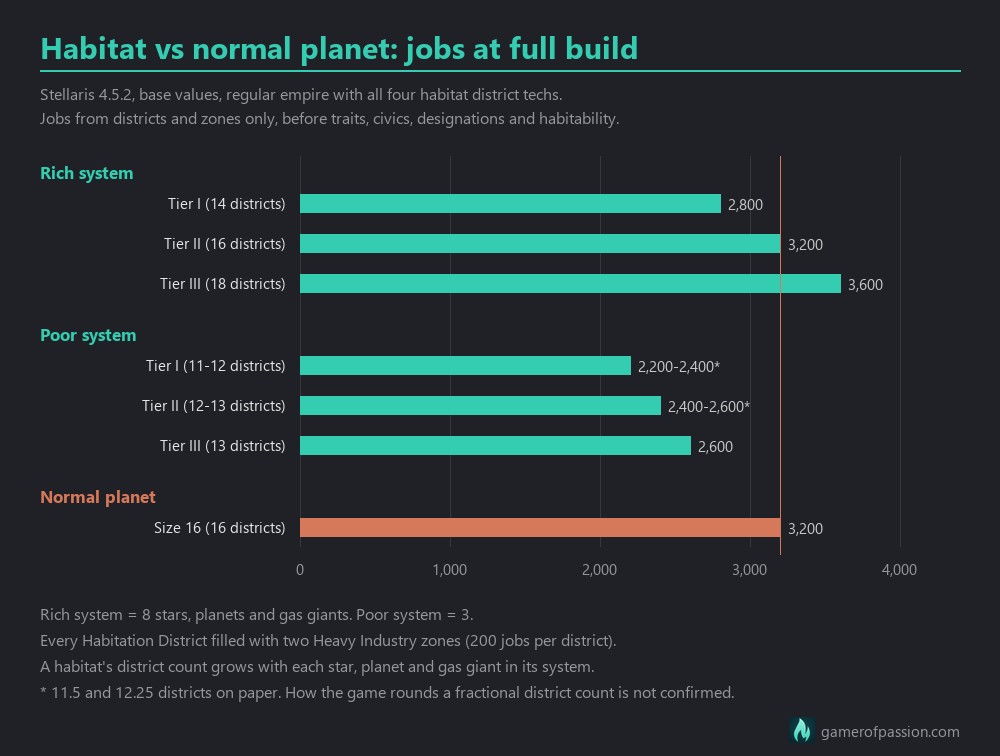
The rich system has one star, seven planets (two of them gas giants), three moons and an asteroid, with nine deposits that give caps of 5 Reactor, 6 Astro-Mining and 6 Research Districts. The poor one has a star, two planets, a moon and two small deposits. Both habitats are filled with Habitation Districts with Heavy Industry in both city slots, the same layout as a planet full of City Districts.
The rich habitat reaches 14, 16 and 18 districts over the three tiers, which comes to 2,800, 3,200 and 3,600 jobs. The poor one ends at 13 districts and 2,600 jobs. Its first two tiers land on 11.5 and 12.25 districts on paper, so the chart rounds them down to 11 and 12, since the files do not say how the game rounds.
| Colony (estimated at base values, jobs from districts and zones) | Districts | Jobs | Housing | Empire size |
|---|---|---|---|---|
| Habitat, rich system, Habitat System Control | 18 | 3,600 | 10,800 | 29 |
| Habitat, poor system, Habitat System Control | 13 | 2,600 | 7,800 | 27 |
| Normal planet, size 16 | 16 | 3,200 | 9,600 | 28 |
| Ring World segment | 10 | 14,000 | 21,000 | 25 |
A single Ring World segment holds almost four times the jobs of the rich habitat, but it needs Mega-Engineering and an ascension perk, and habitats arrive much earlier.
Filling the resource caps instead does not raise the job count. The rich habitat with every resource district it can take holds 3,480 jobs. A Reactor District or Astro-Mining Bay with its specialization gives the same 200 jobs as a Habitation District, and a Research District only 180 or 190, depending on its specialization, while a planet’s Generator or Mining District with its specialization gives 300. On city jobs a habitat keeps up with a planet, while on basic resources it falls behind.
Empire size
A colonised habitat counts as one colony: +20 empire size, plus 0.5 for each district and the usual amount per pop. The orbitals add nothing, since they are megastructures and not districts or colonies. For Virtuality, the habitat is one more colony, so it takes 10 points off the +75% Job Efficiency of digital pops like any other planet.
When to build one
- On a chokepoint, as a Fortress habitat. This is probably the one use of habitats that nobody in the community argues about.
- In an Arc Furnace system, where the mining cap can get so high that only the habitat’s total will limit you.
- In systems with many stars, planets and gas giants and plenty of deposits. Binary and trinary systems are good candidates, since each star counts.
- When your empire is boxed in and has no good planets left.
A system with only a few bodies and hardly any deposits will give you a habitat that never catches up with a decent planet, for the same +20 empire size per colony. In the early game, the 200 influence also competes with your claims.
Wide empires simply have more systems to choose from, but every habitat is one more colony for empire size. That is why a few fully upgraded habitats in your best systems usually beat many small ones, whether you play wide or tall.
Fortress habitats and the FTL inhibitor
A habitat can sit in any system with your starbase and a star, planet or gas giant, which makes it the easiest way to put a planetary FTL inhibitor on a chokepoint without a colonisable planet.
One Fortress is enough. Research FTL Inhibition and Global Defense Grid, build a Stronghold on the habitat for 400 minerals and upgrade it to a Fortress (600 minerals and 50 Volatile Motes, 360 days, then 1 energy and 1 Volatile Mote per month). A Stronghold alone gives no inhibitor. Habitat Administration already counts as an upgraded capital, so even a brand-new habitat can take the Fortress, and it will fit into the Government Zone without a Military Defenses specialization. Extra Fortresses will only add Soldiers, since the inhibitor has no strength value.
The Planetary Shield Generator does not create an inhibitor either. It halves orbital bombardment damage on the planet, and Cosmic Storm devastation if you own that DLC, which will keep a fortress habitat under the 50% devastation mark for longer.
The Fortress inhibitor sits on the habitat rather than the starbase, so it keeps holding the system after the starbase falls. Bombardment is what breaks it: once devastation goes past 50%, it will stop working until the habitat repairs back under that line.
Orbitals cannot be attacked. Since the 4.0 rework they are megastructures, so an enemy fleet cannot shoot or disable them, and they add no devastation. The enemy has to bombard or invade the habitat itself.
Soldiers and naval capacity
Every 100 Soldiers give 4 naval capacity (5 with Ground Defense Planning), 1 defense army and 0.15 stability, and cost 1 alloy a month. A Stronghold has 200 Soldiers for 8 naval capacity, a Fortress 400 for 16, and each Military Defenses specialization adds 100 per Habitation District, or 150 for void dweller empires. The doubled fortress specializations of Ecumenopolis, Ring World and Hive or Machine worlds do not exist on habitats.
The capital building adds 4, 8 or 16 defense armies on top, depending on its tier. The Military Academy (one per empire, needs Centralized Command and Habitat Central Control) brings 200 more Soldiers, and both it and Fortress Station raise Soldier Job Efficiency.
Void Dwellers and Voidborne
The game treats three things as a void dweller empire: the Void Dwellers origin, its machine version Voidforged, and the Voidborne ascension perk. All three get the same package on habitats:
- 1.5 times the jobs from habitat districts and their specializations, so a Reactor District will give you 150 Technicians instead of 100. Jobs from buildings, such as the capital, Stronghold and Fortress, and housing are not multiplied.
- +2 max districts on every habitat.
- +0.25 max districts for each moon or asteroid in the habitat’s system.
- Housing buildings such as Luxury Residences on habitats.
The origins
The Void Dweller trait gives +15% Job Efficiency on habitats, and -15% Job Efficiency plus -30% happiness on any non-artificial world, which includes the Ecumenopolis. On ring worlds and other artificial worlds it does nothing. Habitability is a separate trait, Habitat Preference, which sets 80% on habitats. Voidforged machines get Zero-G Optimized instead, which swaps the happiness penalty for +15% robot upkeep. Both traits and Habitat Preference only come with the origins.
The origins also cut habitat and district costs by 25% and get four district bonuses no other empire can use on a habitat: Expansion Traditions Finished (+1), Modular Superstructures (+1 and 100 housing per Habitation District), Adaptive Architecture (+1) and the Alien Topography insight tech (+1). With the four techs, the origin and the two tradition bonuses, the rich system from the comparison above reaches 23 districts and 6,900 jobs with Habitat System Control, at base values.
Voidborne
The Voidborne ascension perk needs Orbital Habitats, and the two Void Dweller origins cannot take it. It gives +2 max districts on every habitat, lowers the Habitat Build Cost and habitat district cost by 20% (a district costs 120 alloys instead of 150) and turns on the void dweller bonuses above. It also offers Habitat Expansion as a research option, or Advanced Space Habitation if you already have Habitat Expansion. It does not speed up construction and gives no species trait or habitability.
One line of its tooltip does not do what it suggests. The waiver of technology requirements for district specializations only works on a habitat that is your capital, so with a planet capital you will still need Habitat Expansion, Global Energy Management, Mineral Purification and Zero-G Laboratories for those slots. The Functional Architecture and Constructobot civics waive them on every habitat.
Habitat FAQ
Can you build more than one habitat per system?
No. Each system can hold one habitat, and that counts other empires’ habitats and ruined ones too. There is no limit on how many systems you put one in, and only AI empires have a habitat cap.
Can you build a habitat around a star or black hole?
Yes. Any star works, black holes, neutron stars and pulsars included, and so does any planet or gas giant. Only moons, asteroids, astral scars and artificial worlds such as Ring World segments are refused.
Why can’t I build a habitat in this system?
A reason that is easy to miss is a missing starbase, since the game shows no message for that one. Others are another habitat or a ruin in the system, a moon or asteroid as the target, an unresearched anomaly on the body or a Ring World in the system. The placement table above lists every rule.
Can habitats be destroyed?
A World Cracker can destroy a habitat. Every pop dies, the buildings go and a Ruined Habitat Central Complex is left behind. You can repair it with Orbital Habitats for the same 200 influence, 1,500 alloys and 5 years as a new one, and it will come back as an empty habitat with one free Major Orbital. A Global Pacifier only shields the habitat permanently.
Do habitats count toward megastructure limits?
Habitats do not count toward the Arc Furnace or Dyson Swarm limits, and a habitat order does not compete with Ring World or Dyson Sphere stages for construction. They also do not count as the finished megastructure that Galactic Wonders asks for.
Conclusion
Habitats in 4.5 are the colonies you build where no good planet exists, and the system you put them in matters more than anything else about them. Personally, I would place the first one in the best system the ranking shows soon after Orbital Habitats arrives and settle it at once, because Habitat Expansion and Advanced Space Habitation will not be drawn before that. After that, a Fortress habitat on each chokepoint and a few big habitats in rich or Arc Furnace systems are going to pay off, while the poor systems can wait.