
Stellaris is probably one of the deepest and most wonderous 4X games out there. And while there is undeniably a focus on exploring, expanding, and exploiting, if you want to do some exterminating, you are going to need a proper fleet.
This guide gives you outlines and tips for the best fleet composition in Stellaris, updated for the 4.5 “Cygnus” update. As is often the case, there is no single best answer, but there are some rules of thumb that can be applied in almost any situation. Since Stellaris updates tend to be quite impactful, this guide will try to stay up to date.
Mind that some of these tips can be considered an opinion, as there are many different approaches to fleet composition in the Stellaris community. While the ideal composition is a matter of debate, the concepts here will be at the very least viable choices for beginners.
Quick Recommendation for 4.5
If you just want something that works, here is the short version based on community testing from the 4.3 and 4.4 patches (4.5 did not touch weapon or hull stats, see further below):
| Game stage | Composition | Main weakness |
|---|---|---|
| Early game | Corvettes with 1 autocannon and 2 plasma throwers, armor and shields | Falls off once the enemy has cruisers with hangars or a titan |
| Mid game | Cruisers, either the carrier/missile kiting cruiser or the kinetic artillery + neutron launcher cruiser (see below) | Corvette swarms that get in close |
| Late game | Kinetic artillery + neutron launcher cruisers or artillery battleships, plus as many titans as you are allowed to build | Still corvette swarms, which is what the titans are for |
The rest of this guide explains why, and when you should do something different.
The Rock-Paper-Scissors Triangle
As is the case with many games with multiple types of ships, there is usually a kind of rock-paper-scissors meta in which one kind of ship beats the second one, but then gets beaten by the third one and so on. In Stellaris, it is kinda similar, although this is a very simplified approach that should only be used as a rule of thumb.
- Cruisers/Battleships (with small and medium weapons or hangars) beat Corvettes
- Corvettes beat Artillery Battleships
- Artillery Battleships beat Cruisers/Battleship mixes
While it is simplified, it still affects the way compositions are built and as such, should be memorized to be able to effectively deal with the enemy.
Also, you should keep in mind that “beat” means in this case that there is a significant advantage. It does not mean it is an absolute one. Raw firepower can defeat you even if you have the “right” counter, so ship quality and raw numbers are still key in warfare.
Why the triangle works
The triangle comes from evasion and tracking. Every hull has a base evasion, and every weapon has a tracking value that cancels out some or all of that evasion. Big weapons hit hard but have very low tracking, small weapons hit softly but rarely miss. For reference, these are the base values of the mechanical hulls in 4.4/4.5:
| Hull | Naval capacity | Base hull | Base evasion |
|---|---|---|---|
| Corvette | 5 | 200 | 60% |
| Frigate | 8 | 600 | 20% |
| Destroyer | 10 | 1200 | 35% |
| Cruiser | 20 | 2400 | 10% |
| Battleship | 40 | 4800 | 5% |
| Titan | 80 | 20000 | 5% |
Two mechanics make corvettes annoying for big ships. Evasion is capped at 90%, so a corvette built for evasion can get very close to that cap with thrusters and a combat computer. And battleships, titans and juggernauts actively avoid firing at targets with more than 70% evasion if anything less evasive is around. That is why a pure battleship fleet struggles against a corvette swarm even when it has far more firepower on paper.
Corvettes
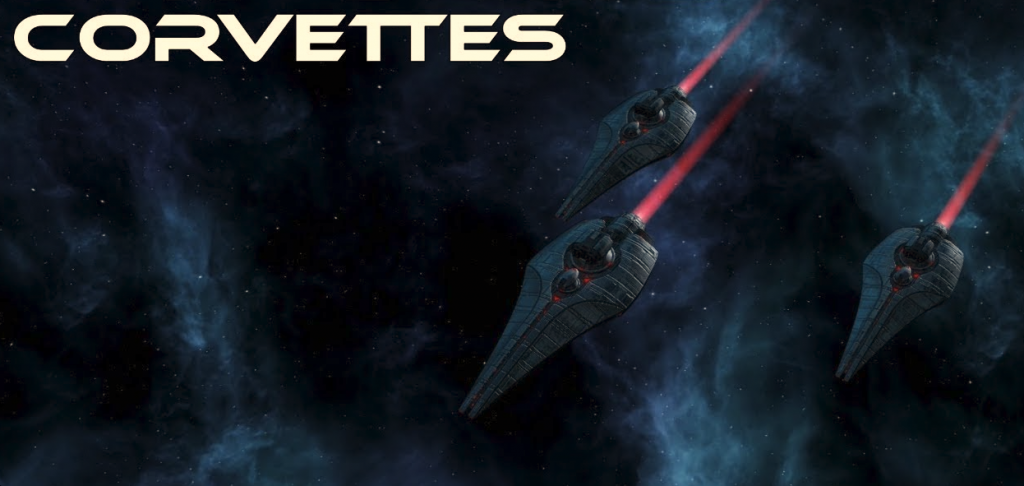
The first fleet composition we will discuss is a Corvette-based composition. Corvette-based means a big fleet of corvettes that should be built towards having as much evasion as possible. There is an old rule from the beginnings of Stellaris of having 50+ corvettes with 90% evasion.
The idea here is that 90% evasion makes it very hard for high firepower weapons to hit you, especially if they have weak tracking.
What has changed is the loadout. Torpedo and missile corvettes used to be the go-to choice, but community testing in 4.3 showed that the corvette with 1 autocannon and 2 plasma throwers (with both armor and shields) beats every other corvette design at equal tech. Missiles in particular have lost a lot of their appeal, because most ship designs now come with a fair amount of shield hardening, which weakens the shield penetration that made missiles good in the first place. Disruptor corvettes also tested poorly.
Another big factor for corvettes is that they are the earliest ship that is available and also very cheap. So going for this composition is naturally a given in the early game and the follow-up question is only how long you want to stay on Corvettes and when (if) you want to transition. Once the enemy starts fielding cruisers with hangars and point defense, or a titan with its area damage, corvettes start losing a lot of value.
Cruisers (the current mid and late game workhorse)
Cruisers are probably the biggest change since this guide was first written. In 2021 they were mostly a support ship in a mixed fleet. Since the 4.3 patch, a cruiser with a kinetic artillery in the bow, neutron launchers in the middle, and small plasma and autocannons in the stern has become one of the strongest designs in the game. Community testers pitting equal fleets against each other found it reliably beats every type of battleship design.
The popular version of this build looks like this:
- Bow: kinetic artillery (large slot), which strips shields at long range
- Core: neutron launchers (G slots), which deal multiplied damage against big ships
- Stern: small plasma and autocannons, which help against smaller ships
- Line or artillery combat computer
- Auxiliary slots: fire control
- Utility: as many shields as your reactor supports, fill the rest with armor
Launchers only work well if something takes the enemy shields down first, since they deal reduced damage against shields. That is the job of the kinetic artillery. They also have a minimum range of 45, so you want these cruisers sitting at long range, not charging in.
That being said, there is a real caveat. This build is at its best against Fallen Empires and endgame crises, because those fleets have a larger average ship size (which is exactly what neutron launchers punish). Against a regular AI empire running mixed fleets it still wins, but it is not necessarily the strongest option. Before you have neutron launchers, a kiting cruiser with a hangar, missiles and flak was the stronger pick in the same community testing, and it does fine against AI empires that rarely bring enough point defense. Pairing the artillery/neutron cruiser with some kind of frontline ship also helps a lot against normal empires.
The weakness of cruisers is still the same as always: corvette swarms that manage to get close. In the late game, titans handle that job (see below).
Cruisers/Battleship Mixed fleet
Unlike the other options in this guide, this one is more of a spectrum composition. The ratio of cruisers to battleships in this fleet is not fixed and depends on the enemy you are facing. The more corvettes you intend (or expect) to fight, the more cruisers you should have in this composition. As mentioned above, the cruisers are what’s effective against the corvettes. A good starting ratio is 50:50 until you can scout the enemy composition.
The more corvettes you face, the more you should also change your loadout to suit your needs. Consider picking some medium slot weapons and hangar bays. Be careful with hangar bays though, as strike craft have suffered from the same shield hardening changes as missiles and are not particularly useful against big, tanky targets.
Artillery Battleships
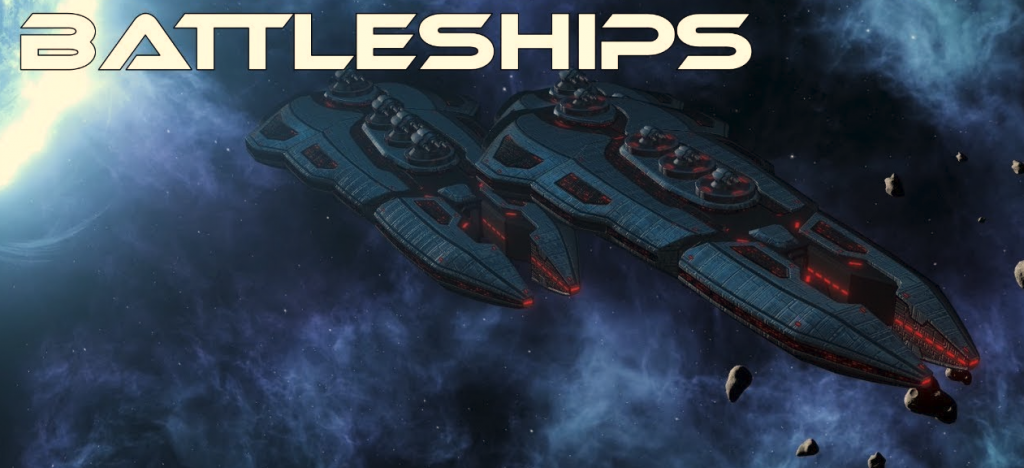
This kind of fleet composition is a pure battleship/titan fleet with the biggest guns you can possibly get on them. The idea here is to have so much firepower and range that you can obliterate anything before it even can touch you. You can throw a titan with a tracking aura or shield dampener aura in the mix to round it out and you should be fine against pretty much everything except for pure Corvette.
Good weapon picks are a Tachyon Lance (or Focused Arc Emitter) in the extra-large slot and Kinetic Artillery in the large slots, with an Artillery combat computer. The Tachyon Lance has a range of 150 and no minimum range, which makes it one of the best alpha-strike weapons in the game.
For Single Player this fleet is still very advisable, since Battleship artillery counters Destroyers and Cruisers with small weapons (the AI’s favorite choice) extremely hard. Against the AI, range is still king.
Additionally, while it is true that corvettes “counter” Artillery Battleship compositions, it is only barely a counter as Corvettes users do more damage in terms of resource cost, but are in danger of losing a lot of ships themselves.
Mind that artillery battleships are no longer the “absolute best and utterly unbeatable” late-game answer they were when this guide was first written. In community testing for 4.3, the kinetic artillery + neutron cruiser beat every battleship design at equal naval capacity. Battleships are still a great choice, especially mixed with those cruisers, but they are not the automatic endgame pick anymore.
Titans
Titans got a lot more important in 4.3, when their weapons started dealing area damage. You are hard capped on how many you can own, so the advice is very simple: always build as many as you are allowed.
Their area damage is what solves the corvette problem of the cruiser and battleship compositions above. One or two titans per doomstack means you no longer need to build specific anti-corvette ships in the late game. Their auras (tracking, shield dampener, etc.) are a nice bonus for the whole fleet on top of that.
Fleet Ratios
A lot of people search for an exact fleet ratio. There is no official one, but these are the ratios that come up in community testing and discussion for 4.3/4.4:
- Mechanical ships, mid to late game: a mono fleet of kinetic artillery + neutron cruisers, led by one or two titans
- Mechanical ships, before titans: 2 carrier cruisers for every 1 artillery battleship
- Bioships: roughly 1 Stinger (kinetic artillery) for every 5 Harbingers (neutron launchers and strike craft)
- Point defense: a small share of your naval capacity (around 10% is one suggestion that comes up) in point defense destroyers, only if the enemy actually uses missiles, torpedoes or strike craft
Treat these as a starting point and adjust after you have seen what the enemy brings.
What Changed in 4.5 “Cygnus”
Stellaris 4.5 “Cygnus” was released on September 22, 2026. It did not change weapon or hull stats in a way that shakes up the compositions above, but it did change how ships get designed and how the AI builds its fleets:
- New Fleet Doctrine policy with six doctrines that decide which tactical role each ship class fills in automated designs (and in the ship designer’s auto-complete).
- New Weapon Preference and Defense Preference policies that steer automated designs and also your research. If you never want another evenly split kinetic/laser loadout from the auto-designer, this is where you fix it.
- Starbases got their own weapon and defense preference policies, and their weapon modules are now tied to a specific weapon type.
- AI empires now pick a fleet doctrine and weapon/defense preferences that match their personality, and research weapon tech in line with that preference more eagerly. In practice this means AI fleets are more specialized than before, so scouting what your neighbor actually fields is worth even more now.
- Missile and torpedo armor and shields are now correctly applied in combat, so point defense has to chew through them instead of ignoring them.
- Ships with a carrier combat computer now position themselves using the longer of their weapon or strike craft range, so a carrier without strike craft no longer charges into close range.
- The Paladin ship now has its own combat computer with Line tactics.
- Military policies can now be changed directly from the Fleet Manager.
Mind that 4.5 is brand new at the time of writing, so there is no proper community testing on it yet. The compositions in this guide are based on 4.3/4.4 testing and should still hold, since the combat numbers did not change, but this section will be updated once the new meta settles.
Singleplayer
These above-mentioned compositions and rules apply to both Singleplayer and Multiplayer but naturally, SP is a little bit more forgiving as the AI is not particularly good at managing its own fleets and does not have good compositions.
If you are looking for a couple of pointers on how you should build your fleet in single-player, my advice would be to focus on corvettes in the early game and then slowly transition out of them and into long-range cruisers and artillery battleships as soon as possible. The AI rarely runs enough point defense or shield hardening to punish a fleet that simply outranges it.
In fact, the faster you get towards heavy artillery, the easier the game will become, as the AI usually relies on cruisers and destroyers that will be utterly annihilated by your long-range fleets. If you plan to fight Fallen Empires or the endgame crisis, switch to the kinetic artillery + neutron cruiser before that happens.
Multiplayer
On Multiplayer, the triangle rule that was explained in this guide applies more extensively, although it will become far more complicated as your opponents start to react to whatever you are doing. The idea here is to stay flexible and avoid locking into one type of fleet, so you do not get countered too hard. If you play around with your ships and tech designs, you can also find other viable options outside these and potentially surprise your opponent. Autocannon corvettes or carrier battleships are just two examples of alternative builds you can try out to see if you can win the upper hand.
Conclusion
If you are just looking for a good way to beat the AI, then using corvettes early and moving into long-range cruisers and artillery battleships is probably the way to go, with every titan you can get on top. Bear in mind that superior numbers always beat any sort of tech/counter advantage even if it is an unfavorable engagement.
The triangle itself has been around for a long time and is probably here to stay. What keeps changing is which specific design sits at each corner of it, so check back after big patches like 4.5.
Related Guides
- Stellaris Dimensional Horror: How to Beat It (Fleet Guide)
- Stellaris Shard: Fleet Power & Composition to Beat It
- Stellaris Leviathan Traits: Every Guardian Reward Explained
- Stellaris Consecrated Worlds: Is It Worth Picking? (Full Breakdown)
- Stellaris The Doorway: Every Possible Outcome Explained (Is It Worth Investigating?)
- Stellaris: The Exile Event
- Stellaris: A Guide To Dangerous Technology
- Stellaris: Bunker Bot Anomaly